

Microsoft for Developers
Get the latest information, insights, and news from Microsoft.
Latest posts
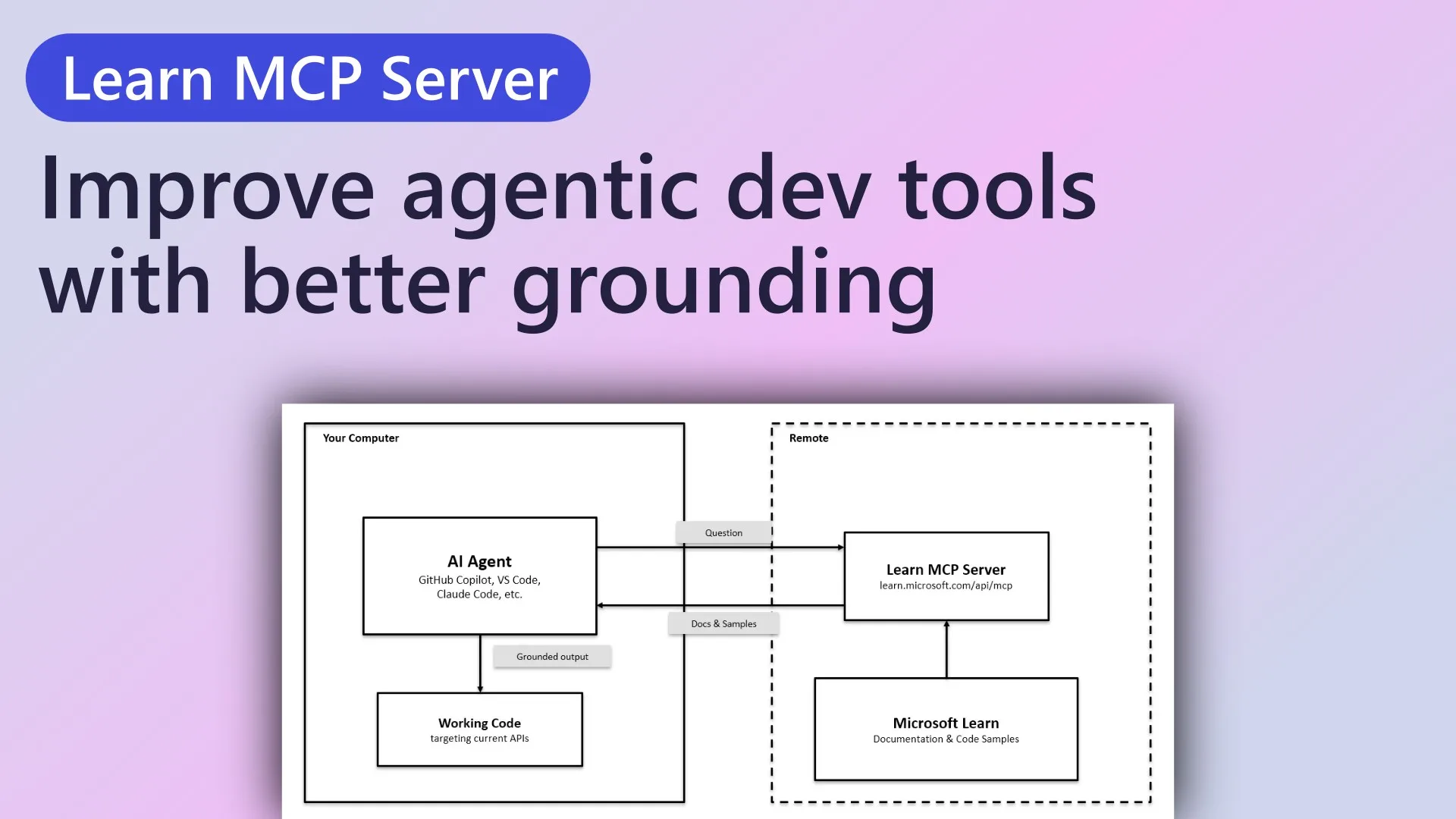
Improve your agentic developer tools by grounding in Microsoft Learn

Development workflows span terminals, IDEs, background agents, and custom assistants. What matters is whether they draw from the same current source. Learn MCP Server gives any MCP-compatible agent direct access to current Microsoft documentation - one endpoint, nothing to install, no authentication required. What does that look like in practice? You give your coding agent the prompt: "create a CLI script to deploy Azure AI Foundry." It reaches for , the Azure ML extension - the right answer a year ago. It hits a Python dependency crash, spends 15 tool calls debugging import paths, and produces a script target...
How AI coding agents actually use your technology

You ship an SDK, a CLI, an API, and developers use it. Now AI coding agents use it too, except they use it differently than humans do. Most of the time you have no idea what's actually happening between "developer types a prompt" and "agent generates code with your technology." Is the agent reading your docs? Is it calling your MCP server? Is it ignoring both and guessing from memory? In the previous article, we introduced the AX stack: model, harness, and agent extensions. We talked about what's fixed and what you can influence. This time, let's trace through what actually happens, step by step, when an agent...
The AX stack: what’s fixed, where you can win
AI coding agents promise to make you more productive. On the surface they do, but in practice they fall short: agents generate code that doesn't compile, use a deprecated SDK, or pick the wrong service entirely. Is it you using it wrong? Is it your tech stack? Or is it the tools you haven't configured yet? The stack between a developer's prompt and the generated code has layers. Some of those layers are fixed: you can't change them no matter what you do. But there's one layer where you have all the leverage. And if you don't know which is which, you'll waste time optimizing the wrong thing without seeing any r...
Agentic-Agile: Why Agent Development Needs Agile (Not Just Prompts)

"A bad system will beat a good person [or agent] every time" ~Dr. William Edwards Deming (with apologies) I started vibe coding by writing prompts (often dictated into my phone), refining them with an agent in M365 Copilot, and creating handoff files to use with GitHub Copilot CLI. The results were predictably non-deterministic. Prompt-driven development is a typical starting pattern: a developer opens a chat session, writes a prompt, reviews the output, adjusts, re-prompts. Maybe they get something useful. Maybe they spend an afternoon debugging emergent behavior that nobody specified and nobody tested. Then...
Azure Cosmos DB Conf 2026 Recap: Lessons from Production

A team was running at 100% RU utilization. Throttles were compounding into retries. P99 latency was degrading. The assumption was obvious: provision more throughput. They didn’t. Instead, they found a single logical partition absorbing more than 80% of traffic. After fixing the data model—without scaling the database—RU utilization dropped to 20–35%, throttling vanished, and latency normalized. That was the real-world case study Anurag Dutt shared in his Azure Cosmos DB Conf 2026 session, From Rising RU Costs to Stable Performance. One automated integration account was generating most writes. A partition...
LangChain.js for Beginners: A Free Course to Build Agentic AI Apps with JavaScript


Want to build AI agents with JavaScript that go beyond basic chat completions? Agents that reason, call tools, and pull from knowledge bases on their own? We put together a free, open source course to help you get there. LangChain.js for Beginners is 8 chapters and 70+ runnable TypeScript examples. Clone the repo, add your API key to a .env file, and start building. Why LangChain.js? If you already know Node.js, npm, TypeScript, and async/await, you don't need to switch to Python to build AI apps. LangChain.js gives you components for chat models, tools, agents, retrieval, and more so you're not wiring every...
Securing MCP: A Control Plane for Agent Tool Execution

The Model Context Protocol (MCP) is quickly becoming a common way for AI agents to discover and use tools. It provides a consistent interface to databases, APIs, file systems, and third-party services, which makes it easier to plug capabilities into agent workflows. However, MCP standardizes the execution surface without defining how that surface should be governed. Tool definitions are fed directly to the model, tool servers can be hosted by anyone, and there is no built-in point where policy is evaluated before a call is executed. To address that gap, we’ve been building a runtime governance layer for MCP...
Take your PostgreSQL-backed apps to the next level


PostgreSQL is a powerful and hugely popular database engine, and it really comes alive across Microsoft developer platforms. You can build with PostgreSQL across Azure offerings, develop productively in Visual Studio Code with strong extensions and tooling, and connect your data to agentic development workflows and AI services. There's amazing opportunity to bring those pieces together to modernize apps faster, migrate with confidence, and ship intelligent experiences on a proven database foundation. The challenge is that getting the most out of PostgreSQL across this full stack can be complex, especially when yo...
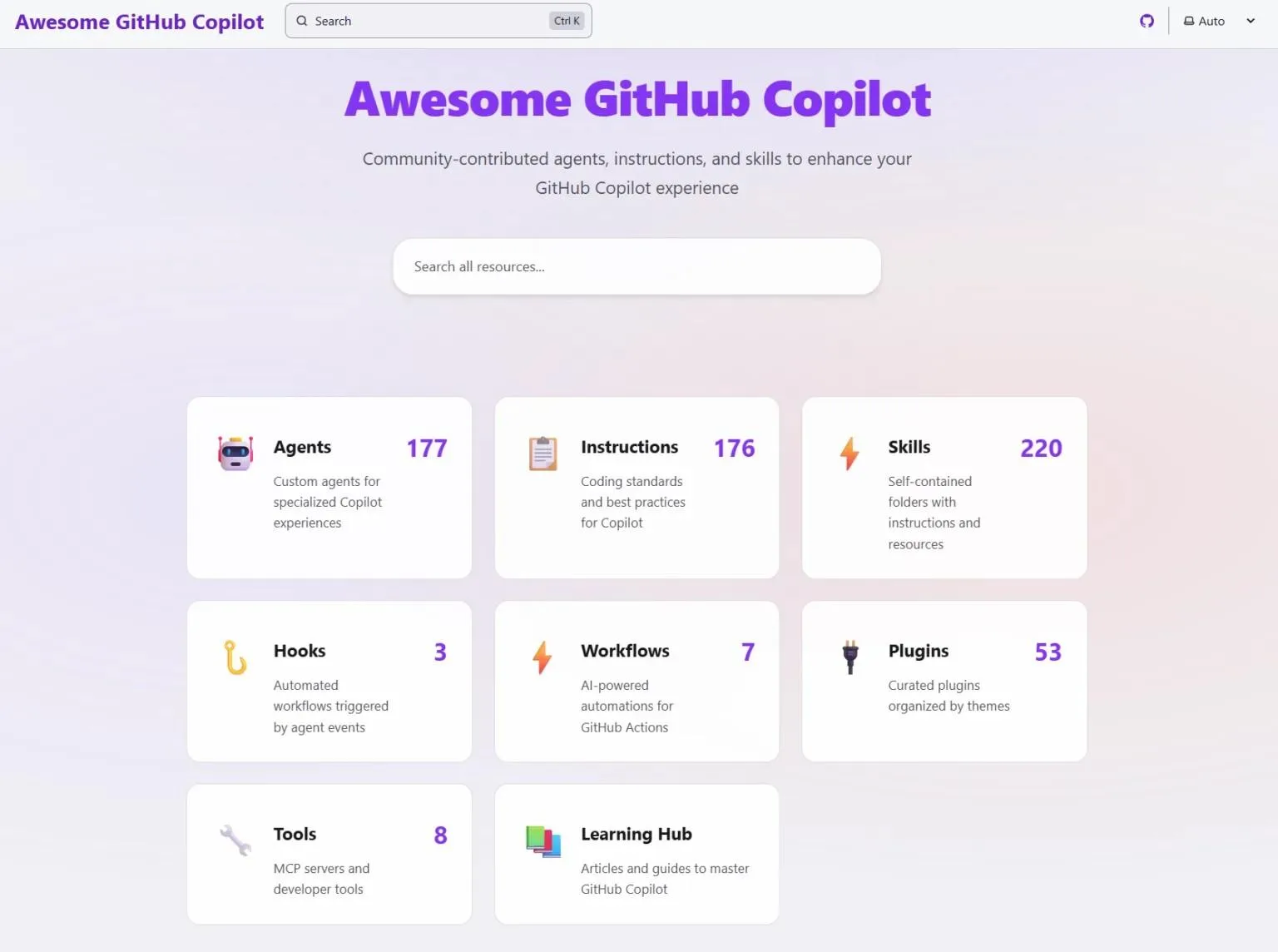
Awesome GitHub Copilot just got a website, and a learning hub, and plugins!

Back in July, we launched the Awesome GitHub Copilot Customizations repo with a simple goal: give the community a place to share custom instructions, prompts, and chat modes to customize the AI responses from GitHub Copilot. We were hoping for maybe one community contribution per week. That... did not happen. Instead, you all showed up. In a big way. The repo now has 175+ agents, 208+ skills, 176+ instructions, 48+ plugins, 7 agentic workflows, and 3 hooks - all contributed by the community. What started as a curated list has become something much bigger, and we needed to match that ...
