close
Showing posts with label Wikimedia Foundation. Show all posts

Monday, August 11, 2008

Now I can retire...

Taliesin West, Scottsdale, AZ, USA.My image of Taliesin West
(from Wikimedia Commons
)

Previously, I have written about how Encyclopedia Britannica introduced a free access scheme for bloggers. Nifty. But this flows both ways. EB is also moving to make use of resources available to it.

Point in case, the image at right.

As I am sure other people do, I periodically search for my own name using Google's search capabilities. Well, the other day, on the second page of the search (may not still return results) I found this link ... Turns out that EB chose to use my image to illustrate their article on Taliesin West! (Taliesin West was architect Frank Lloyd Wright's winter home and school in the desert in Scottsdale, Arizona, USA from 1937 until his death in 1959.)

So now I'm rich, right? Well no. That image, as you can see, is freely available on Commons, for anyone to use, as long as the license (in this case the GFDL 1.2) is honored. Which it is.

So am I upset? Nope! I'm delighted. This is how it's supposed to work. Free images are made free so that people can USE them. EB has properly atttributed the image and thus is free to use it as they see fit.

Maybe it's a bit ironic that EB is using a free image FROM a WMF site to illustrate an article which is supposedly better than the same article on Wikipedia. (which by the way, currently uses someone else's version of basically the same composition)... and, better or not, clearly is in competition.

But it's nifty! Got any other examples? I wonder who else has been honored this way?

By the way, here are both articles, you decide which is better:

  • Wikipedia's version is here.
  • Encyclopedia Britannica's version is here.
In all honesty, I have to say EB wins this one. What do you think?

Zemanta Pixie

Saturday, August 2, 2008

Signal to Noise, part II

Kismet (robot) can produce a range of Facial e...Robot Moderator?
Image via Wikimedia Commons
A while back, in my post Attacking the noise, I described ROBOT9000, automated moderating technology introduced at one of xkcd's IRC channels as an interesting experiment. Apparently the idea has legs.

While reading a very interesting New York Times piece on trolling, The Trolls Among Us (which, by the way, "outed" several trolls, giving their real life identities or information sufficient for a determined person to track them down.... perhaps more on that later... the topic has come up on various WMF wikis and discussion groups) I ran across the tidbit (on page 7 of the piece), that ROBOT9000 has come to 4chan.

Sure enough, there is now a moderated subforum at 4chan called ROBOT9000 (or /r9k/ ).

Dan must be proud!

I for one welcome our new robot masters, if they can improve signal to noise...

Do you?

Zemanta Pixie

Friday, August 1, 2008

Knol and Wikipedia

Wikipedia's Knol PageWikipedia's Knol page
Image by dannysullivan via Flickr
Fair use claimed for commentary
By now, everyone and their brother has blogged about Knol. If you don't know what it is, you've been under a rock, apparently (not that there's anything wrong with that)... follow the link. (which naturally leads to Wikipedia)

Probably half of those blogposts have to do with the relationship between Knol and Wikipedia. Again, go find them if you want to read them.

Some people are saying it's a new gold rush. I have an AdSense account so I decided to see what if anything in the way of gold there is to be had.

I've taken some content from Wikipedia and put it on Knol. The content I took is content I myself authored... I took my DYK articles, at the point of the last edit by me prior to the first edit by someone else, so all content was mine, and Knolised them. (why that edit? Because at that point the content is solely authored by me. That means I can relicense it as I see fit, granting GFDL does not take away the right to license under other terms as well)

The actual formatting leaves a lot to be desired, since they are paste jobs, if I see any signs of traffic I'll improve them. But for the most part at least so far, they are the only Knols on those topics. All their links lead straight to Wikipedia, at least for now.

I am not going to pimp them by linking... if you want to find them you can.

I'm curious as to how this all will play out... will these get any traffic? Will I get improvement suggestions? Will Knol itself complain? Most of these show high correlation to Wikipedia which is not unexpected.

What do you think? Have any of you done this? What will the long term effect be?

Zemanta Pixie

Monday, July 7, 2008

You got me...

Randall Munroe, creator of the webcomic xkcd, ...Randall Munroe
image via Wikimedia Commons
So, today's xkcd consists of a drawing of the Wood article in Wikipedia, but cut away to show only the lede, and the bottom, which is a large "in popular culture" section, with such gems as "In episode 7 of Firefly, "Jaynestown", Jayne is given a wooden rain stick by a villager", among others.

Wikipedia is big enough time that it now gets mocked in cartoons on a regular basis (in xkcd's case, lovingly... I think. :) )

Random questions:

Does anyone not think this is one of the funniest Firefly episodes? :) (it goes without saying that I expect most of my readership (all 3 of you) to have seen all the Firefly episodes)

Does Randall Munroe not actually like "in popular culture" sections? Or, is he annoyed that Wood doesn't have one? :) (It goes without saying that it doesn't have one, actually)

Was I the only xkcd reader to go check if Wood actually had an "In popular culture" section? (It goes without saying that I did go check)

Zemanta Pixie

Saturday, June 14, 2008

New privacy policy?

Erik Möller talking about wikipediaWikimedia projects (copyrighted
logos used under fair use)
Image via Flickr
The board of the Wikimedia Foundation is going to vote fairly soon on a new privacy policy. A draft of it has been placed on meta for comment.

The board often moves slowly on matters like this, but not this time, so if you are interested, you may want to comment.

Note that the foundational principle of allowing anonymous editing remains.

Zemanta Pixie

Wednesday, May 28, 2008

Happy Birthday Amnesty International

1986 Faroe postage stamp celebrating AI's 25th anniversary - Painting by Rannvá KunoyImage via WikipediaFreedom comes in many flavors. While the Wikimedia Foundation projects are primarily concerned with free content and free access to knowledge, that freedom goes hand in hand with other sorts. Freedom from oppression, freedom to speak and believe, freedom from injust political imprisonment are in some ways more important (although the entire basket of freedoms go hand in hand) and that's what Amnesty International is most concerned with.

Today is Amnesty International's birthday. Founded in 1961, it won the Nobel Peace Prize in 1977. Happy birthday!

Here's a Wikipedia link. Here's a Britannia link too.

I work hardest on wiki projects but the fight for freedom takes many forms. Let us not forget...


BERJAYA

Sunday, May 18, 2008

Her first GA, can FA be far behind?

Engraving of Ann Eliza Bleecker, a socialite and noted poet of New York, United States during the 18th centuryAnn Eliza Bleecker,
Image via
Wikimedia Commons

Forgive me for being a bit proud!

Background: While I tend to get involved in the meta aspects of Wikimedia Foundation projects (sometimes perhaps too much so) as well as write articles, my wife has instead concentrated on editing.

She has stated that she has no interest in becoming an administrator at any of the wikis she frequents. Can't say as I blame her, although she would be a good administrator, I am sure.

Except for occasionally voting in support or (rarely) opposition of various candidates, she stays out of the internal political discussions and controversies of Wikipedia (and other wikis), editing is all she does.

And when she edits, she's rather good. (I admit bias, mind you) I consider myself lucky to have a wife who enjoys many of the same hobbies I do (she's a skilled LEGO builder as well). She has built up a solid record of contributions.

She focuses on relatively obscure female historical figures, primarily Americans of the 18th and 19th centuries, who have been underserved by Wikipedia articles. It's not as glamorous as writing about major contemporary figures, and not nearly as easy, the sources can be hard to track down. But she writes good stuff! Her articles usually make "Did You Know" after they are created.

Case in point, her first Good Article (GA), which I used in my Britannica comparison, and then nominated for GA a few days ago. Yesterday it got reviewed, put on hold, and then, in a flurry of cooperative editing by her, Giggy (the reviewer), and myself, (all coordinated on IRC) had all the faults Giggy identified corrected in under 2 hours (maybe not a record, but quite rapid time for an article to come off hold) and was promoted. Here's an excerpt from the lede:

Saratoga campaign, Tomhannock is just north of Albany and south of Saratoga, New YorkSaratoga campaign,
Image via
Wikimedia Commons

Ann Eliza Bleecker (1752November 23, 1783) was an American poet and correspondent. Following a New York upbringing, Bleecker married John James Bleecker, a New Rochelle lawyer, in 1769. He encouraged her writings, and helped her publish a periodical containing her works.

The American Revolution saw John join the New York Militia, while Ann fled with their two daughters. She continued to write, and what remained of the family returned to Tomhannock following Burgoyne's surrender. She was saddened and affected by the deaths of numerous family members over the years, and died in 1783.

Bleecker's pastoral poetry is studied by historians to gain perspective of life on the front lines of the revolution, and her novel Maria Kittle, the first known Captivity narrative,[1] set the form for subsequent Indian Capture novels which saw great popularity after her death.

Bleecker was an important, if somewhat obscure figure in the American Revolution, and Wikipedia now has a good article about her, where previously it had none at all, thanks to the efforts of one editor. Wikisource also has a considerable portion of Bleecker's existing writings, mostly again thanks to my wife.

And she had fun doing the work. That's the idea. When Wikipedia fosters this sort of thing, it works, and works well. Reading about the issues and things that need fixing can leave you with the impression of a complete disaster, but that's not the case. Imperfect, yes? but darn good. Remember that, please. And go write something!

BERJAYA

Saturday, May 17, 2008

The Wikback, RIP?

A Quieter TimeThings are quieter at
Wikback these days
Image from Flickr
One of my earliest postings was about UninvitedCompany's Wikback which is a forum designed to be a place where folk with an interest in Wikipedia and WMF projects could discuss things. (and one that would be run somewhat differently than Wikipedia Review)

At the time, I opined that there might be some inhibitory effects from some of the actions taken and rules in place, and that sparked 11 comments from various folk. I think that may have been my all time high, or pretty close! (Hi to all 3 of you readers still with me!) Some predicted it would fail, while others defended the idea.

Well, two months have went by since then, and it would appear that the activity levels at the Wikback have died down to very low levels. Apparently, in the past 7 days, there have been just 4 active topics, if this list is to be believed.

Not every forum that is started ends up a success. Sometimes it's just random chance as to whether something clicks. But sometimes it's the rules, the people or whatever. Is that the case here?

Could Wikback still spring to lively life? Or is the current activity level likely to be where things stay indefinitely? Or is it over? What do you think?

Thursday, May 1, 2008

Fun with statistics

Paying people to hold signs is one of the oldest forms of advertising, as with this Human directional pictured aboveA form of advertising not likely
to be directly seen on WMF!
Image via Wikimedia Commons
Advertising as a funding source for Wikimedia Foundation projects is a fairly controversial topic, and there has been much discussion in the past. Opinions on the matter are held quite strongly by some folk.

Apparently Jimmy Wales ran a poll on advertising via a facility on Facebook that lets you poll things. Some analysis of this poll was carried out and posted on Meta (and, to my chagrin, although I'm active on Meta, I didn't find out about it that way).

The analysis is quite interesting, if only to show what sort of fun can be had with statistics.

FacebookFacebook: Image via Wikipedia
(fair use claimed)
According to Techcrunch, Facebook demographics are somewhat skewed. this is not surprising when you think about it, but I did not realise it was apparently 2/3 female in make up. Lonely male geeks, take note!

So clearly the demographic of these polls is not necessarily representative of the entire population. That's OK and not necessarily a drawback if one is just trying to get some preliminary sense of matters and doesn't plan to use the findings for actual decision making, absent more study.

Personally, I think the thing I found most amusing, and significant, was the large number of people that were not sure what the project's current structure actually is, and were not aware that the project does not currently have ads on it.

This is something to remember... it's true that the english wikipedia is the 7th most visited site on the internet, but it's also true that many people don't know much at all about its project structure or funding sources. Or care, presumably.

What do you think?

BERJAYA

Tuesday, April 29, 2008

governance uproar?

wikipedia pencilsI did not steal any pencils.
Image by kaurjmeb via Flickr
Ironically (or not) I'm writing this from the Wikimedia Foundation office... (although since I'm using Blogger's draft mode, I can queue it up for posting tomorrow morning, I hope they promote that from draft to production soon...) I happen to be in San Francisco on business and popped in to visit. There is a certain cachet to doing so, I guess

The announcement of the board's restructuring seems to have caused a bit of an uproar in some circles... Danny posted, and then referenced Durova's "community petition" part II post... maybe it's fashionable to express ... concern? dismay? outrage? what?

Myself, I think I'll just hang back and let others comment further, because I'm not sure I'm concerned... or dismayed, or outraged, or whatever... the structure doesn't seem completely unreasonable to me... some allocation to the chapters, which are growing in importance, some to the community, and some internal. If I had any concern it would be about the notion of experts being seated rather than being consulted but I'm fairly sure things will sort out on their own soon enough.

So call me unfashionable I guess. I'm more worried about the more immediate things like BLPs and the Checkuser policy churn that's been manifesting itself lately than I am about board structure.

BERJAYA

Sunday, April 27, 2008

Governance Reform for Wikipedia?

This image is a captured version of Wikimedia logo mosaic. In its history you may see other versions captured daily. Note that the original mosaic contains some animations, so this is not exactly how it looked/looks like.WMF logo as a mosaic of images
Image via Wikimedia Commons
Previously, I wrote about a Wikimedia Foundation (WMF) wide Wikicouncil. That idea continues to spark discussion (whether I think it's a good idea or not is another matter :) ) ... it has been the subject of discussion by the WMF board, but it appears that the idea is shelved, at least for now.

There is another initiative brewing, perhaps somewhat more grass roots, to foster "governance reform" on the English Wikipedia. The proposal and the talk page make interesting reading.

The argument put forth by proponents is that there has been a failure to get many proposals for reform enacted using the existing (consensus based) processes, and very few reform proposals imposed by fiat either, and that therefore a new process is needed.

Wikimedia Foundation wikis tend to operate using policy that is "descriptive", that is, policy lags behind practice and is written to describe how things are actually done, and as practice changes, policy changes to follow it, or lags practice. By contrast, "prescriptive" policy is written to describe how things ought to be done, and it is changed to force a change in actual practice, that is, policy leads practice.

If this proposal were adopted it would be a major change away from descriptive policy, and, some argue, away from the "wiki way".

Given the number of abortive attempts to change BLP policy that there have been lately, and the frustration I and others have expressed, this proposal has a certain attraction. Heck, it's a siren song... to think that if this were passed, 50 (or however many) reasonable people would now be able to change policy to be as I think it should be, regardless of "consensus" not being for the change. (we have seen things get 65% support and then be declared as dead, lacking consensus)

But there's the rub... who's to say that the 50 (or however many) people selected to be on this thing will be "reasonable", "thoughtful", "bold", etc? If the process used to select them is anything like the Request for Adminship process of late, it's just as likely that they will be popular, non controversial people who have never annoyed anyone or taken a stand on anything... and how do we know if they've never taken a stand what their stand will be on matters going forward? We won't know.

So I don't see this as a good idea, even if we wanted to change away from the wiki way of descriptive policy.

What do you think? Do you think the English Wikipedia has a problem with getting policy to change? If so, do you think the way to solve it is to change to prescriptive policy? And if so, do you think this governance reform is the way to achieve that?

I'd like to know! Tell me! Put your comments in on the talk page as well!


BERJAYA

Sunday, April 20, 2008

House Flags

Merritt-Chapman & Scott corporate ad, 1938The trigger: MC&S ad
Image via Wikipedia
(fair use to illustrate blog)
In one of those chains of odd connections, it turns out I want to write an article about "house flags"... these are the flags that civil shipping companies fly on their ships to show what line the ship belongs to. The same scheme is often used to decorate the smokestack(s) on more modern ships, which can be seen from farther away

Why do I want to write that article? Well you can thank Rettetast, I guess. He, or his bot, left me a message that a magazine ad image I uploaded (conforming to the then current Fair Use standards) long long ago (mid May 2006, and 2 years is a long time in wiki time) to illustrate the Merritt-Chapman & Scott article was no longer in compliance with current practice, and I needed to write a better justification. Perfectly legitimate and an important thing to fix, since the WMF has mandated all wikis be in compliance with fair use.

In reviewing the article I thought to myself it would be nice, since the MC&S house flag featured in the logo (and in the bottom of the ad) if I could find a house flag image to use that was better than the very grainy one in the ad. So I searched, only to find this page. It has a better house flag all right, drawn by Eugene Ipavec... but the irony of it alll! It's a recreation, based on the very Wikipedia article and image I myself uploaded!

This spurred me to search, and I found that the term "house flag" is used over 30 times in articles but has no article of its own. Doing the research is problematic though, as the term is very common and thus you get a lot of false returns. But I thing I may have found some few tidbits and if i can tear myself away from drama I will take a crack at changing the redirect I put in to become a real article. It may not end up very large but it would be better than the tidbit in the Maritime flags article (which itself is better than nothing)

What serendipitous connections, or even self referential ones, have you found that spurred you? And do you have any leads for good sources for a House flag article? (grin)

BERJAYA

Thursday, April 17, 2008

Money can't buy happiness?

Sometimes following tangents finds you interesting things. Danny's "White Fathers" blog post yesterday on what really would help folk in Africa, whether the WMF's mission of knowledge sharing was the most needful thing started the wheels turning for me.

Those wheels got a push from this thread on Wikipedia Review, and from Danny's "Congo" response to it here. I think maybe sometimes we lose track, in our situations, of how things really are and aren't, and what we can do about them. What I'm about to say should in no way be taken as diminishing how tough things are in places like the sub Sahara, the Congo, Sudan, Zimbabwe and the like. They're tough, make no mistake, way tougher than in the rich world...

So when I hear people saying "Money can't buy happiness?" I want to call BS. First, take a look at this classic essay by John Scalzi, "Being Poor" It's a rich world essay to be sure, but it drives home the point... being poor really really sucks.

Then take a look at this New York Times article... Maybe Money Does Buy Happiness After All ... Granted, its a study of the rich world, and of the well off people within it, but (quoting)

The fact remains that economic growth doesn’t just make countries richer in superficially materialistic ways.

Economic growth can also pay for investments in scientific research that lead to longer, healthier lives. It can allow trips to see relatives not seen in years or places never visited. When you’re richer, you can decide to work less — and spend more time with your friends.

That's rich world stuff... but the same thing is true in the less rich world. As Ben Yates cited in a "White Fathers" reply, cellphones can make a difference, and that says to me that aid isn't the solution. Changing society is the solution. Economic growth is the solution. Knowledge is the solution. Danny's right when he says an encyclopedia per se isn't the answer, that more thought is required, it has to deliver the things that are needed. But those who decry encyclopedias and economic and societal change in favour of direct aid? They miss the mark.

Money can't buy happiness? Tell it the the lady in Alabama with the 800 dollar car. Tell it to the mother in Gambia without the money to buy a sack of maize.

Money CAN buy happiness.... but the best kind of money is money you control because you earned it, because your society enabled it, not money that dropped in your lap.

BERJAYA

Wednesday, April 9, 2008

Blog till you drop?

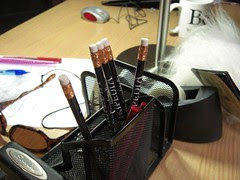
wikipedia pencilsI've got to get me some of these pencils!
Image by kaurjmeb via Flickr
I know that people make money from blogging. (not me, unless you count the 34 cents in AdSense revenue (or whatever it is, I try not to look) I've gotten so far) But I had no idea that there were "blogger sweatshops"...

The New York Times reports that people are burning out, and other outlets are also talking about how some blogges have actually died.

That seems messed up to me. While I've gotten some comments about my update frequency and about the quality of my posts... I'm doing this blogging thing for me, not for pay. As soon as it's not fun any more, I will stop. That's as it should be I would think.

Does this frenzy to work, to make money at blogging have anything to do with WMF projects or with free content in general? Well, I'm not sure. Money? not so much... people shouldn't be creating content for the money... but obsession? I've talked about obsession before and how it ties into doing what we like to do. I am sure I'm not the only Wikipedia editor who has looked at the time in shock, wondering how it got so late! It is easy to lose track during a good work session on an article, a policy page, or what have you, but it's important to keep a sense of perspective. As with anything else, some rotation is good as well... don't JUST hang out at Requests for Adminship, or the Articles for Deletion pages or Featured Article Candidates or whatever... take some breaks.

That's one of the reasons I'm glad I have multiple hats to wear within Wikimedia Foundation projects... when I tired of the hurly burly of the English Wikipedia, there are always pictures to categorise or upload (after all, I've got plenty of old pictures!) over at Commons, or things to do at Meta, or the like. But I also have my other obsessions too. Oh, and a real life and a job and a family and bills to pay. That sharpens the perspective I think.

How about you? How do you keep a sense of perspective?

BERJAYA

Sunday, April 6, 2008

More on Anonymity

John Seigenthaler Sr. has described Wikipedia as John Siegenthaler Sr. an early
victim of bad biographical data.
Image from Wikimedia Commons
Recall that I've spoken about anonymity before ... I've also talked about biographies and notability, twice before.

I made a rather loud statement of no longer being in favor of anonymity at the Biographies of Living Persons policy discussion page, as part of discussion on a proposal to limit editing on all such articles using semi protection. This was one of a number of ideas that have been advanced recently to try to deal with the perceived growing problem in this area.

Kim Bruning asked why I felt that a fundamental principle ("anyone can edit") should perhaps change to one in which only those willing to reveal their real name (verified as well as Amazon verifies real names, that is, not a perfect scheme, but not trivial to fake) would be allowed to edit at all. Clearly it goes against the early spirit. And I'm not happy about the idea, to be sure.

Simply put, the reason is that Wikipedia, and the Wikimedia Foundation have become too big. As the projects become more and more important, higher and higher ranked, more and more turned to, the stakes for accuracy are higher than ever before, with no end to this growth in significance in sight. The project participants, and the projects, have a greater responsibility than when this was a toy site.

Merely wishing to do no harm is insufficient. Merely saying that section 230 provides protection because the projects are "not publishers" is insufficient.

Sooner or later, someone with a biography that is seriously damaging (and make no mistake, with 250,000 odd biographies out there, there are sure to be some that are) will be mad enough and well off enough to sue. Don Murphy certainly threatens to. And moreover, with the recent success at securing large donations (a very good thing, make no mistake) the WMF is now a more attractive target.

So what's to be done? More than is being done, I say.

Just as with trademark law, where the holder must show reasonable care in defending against infringment, just as with trespass law, where the owner of a property hosting an "attractive nuisance" must show reasonable care in preventing entry, the projects must show reasonable care at preventing malicious editing of biographies. Tightening of the BLP policy, making OTRS more effective, hiring paid staff, whatever it takes.

But more importantly, the model of anonymous editing, or pseudonymous editing, means that the lawsuit cannot be laid off onto the individual editor that did the bad edit, despite statements that under GFDL the individual contributors are responsible. Server logs and IP addresses are insufficient ties of responsibility. Too easily evaded, too easily used for other things, so deliberately not retained indefinitely anyway.

So... it pains me to say it, but I think the only answer is real names. Real names allow the reasonable care defense, and allow transfer of liability. That has two positive effects, one that it protects the foundation, somewhat, but a bigger positive effect? It makes people actually take responsibility for what they write.

What do you think? Is the project too big for anonymity? Or is there another way out?

BERJAYA

Saturday, April 5, 2008

Planet Wikimedia

So I just put in a request to be added to Planet Wikimedia. This feed aggregation collects blogs from various wikimedians and is designed either for blogs that are primarily about Wikimedia Foundation related projects, or else that use filtered feeds to restrict the topics.

I had been holding off for a few reasons...

  1. I wasn't sure I would be able to stick with this for very long, but I've been hitting an average of one post a day for over a month now (with a little fudging, note I said an average!)
  2. I wasn't sure what I would be doing, I thought I'd be talking more LEGO and less WMF, but that hasn't been the case. (I have a few things I want to say about LEGO and I will )
  3. I wasn't sure how to do filtered feeds. But this help explains it. Hopefully I did it right, we'll see. I filtered on Wikipedia, Wikimedia Foundation, and Commons. I (ha!) left out Wikipedia Review as a filter tag.
    The Ouroboros, a dragon that bites its tail, is a symbol for self-reference.Ouroboros.
    Image from Commons

So what do you think dear (4, is it now?) readers? Worth reading and adding or just vanity on my part?

(By the way, this may be the most self referential post I've done yet!)

(Also by the way, see that "Zemified" logo? That's a nifty little addon for Firefox I found from Zemanta, it will suggest links and pictures for you. The Ouroboros image at right was suggested by it when I put 'self referential' into the text)
BERJAYA

Wednesday, March 12, 2008

Wikicouncil

Danny Wool's post about a Volunteer Council reminded me of the proposed Wikicouncil. I'm not sure whether these are the same thing or different ideas, but the idea of a Wikicouncil leaves me kind of confused as to what problem it is actually trying to solve. I'm not sure a new layer of governance without a clear mission is a good idea, we may have enough of those already.

That idea has been kicking around apparently since 2005 and still seems not quite fully formed.

What do you think?

(edit: Wikicouncil is indeed what is being referred to, see this mail from Effeiet Sanders, thanks to Danny for linking this up for me... my view hasn't changed, I am not sure this is a good idea, see this talk page to discuss pros and cons... )

Sunday, March 9, 2008

NotTheWikipediaWeekly...

So... in what has to be an interesting twist, PrivateMusings, fresh off a 90 day ArbCom sanction, has started a podcast. In his first two shows he managed to have some very interesting guests. He's after me to participate. dangling that I'd be a guest with Michael Snow, who you may know was recently appointed to the expanded Wikimedia Foundation board. I'm not sure I run with that crowd, or if I have anything to say, really.

So what do you think? Should I? And if so, what would you want to hear me talk about? Let me know.