close
The Wayback Machine - https://web.archive.org/web/20110727130602/http://fivethirtyeight.blogs.nytimes.com/

Politics


July 26, 2011, 7:57 pm

Romney and Perry: Dual Front-Runners?

At the betting market Intrade, Texas Gov. Rick Perry has overtaken Mitt Romney and is now considered the most likely person to win the Republican presidential contest. Mr. Perry is given a 35 percent chance of claiming the nomination as compared to Mr. Romney at 29 percent; Michelle Bachmann is a distant third place and assigned a 9 percent chance of winning.

Are the bettors being sensible or getting ahead of themselves? Although this is all fun and games as compared to the debt ceiling debate, a quick overview of the state of play is in order.

An average of the seven most recent polls of Republican voters (the six contained in the Real Clear Politics average plus the Economist / YouGov poll) finds Mr. Romney with the lead, with an average of 22 percent of the vote. After that, there’s essentially a four-way tie between Ms. Bachmann (13 percent), Sarah Palin (13 percent), Mr. Perry (12 percent) and Rudolph W. Giuliani (11 percent in the polls in which he is included). Herman Cain’s momentum appears to have faded, while Newt Gingrich and Tim Pawlenty are now often polling in the low rather than the high single digits.

BERJAYA

The results tighten up a bit, however, once we adjust for name recognition based on the latest Gallup numbers. (Dividing a candidate’s polling average by his name recognition can somewhat improve the predictive power of early-stage polls.) In particular, Mr. Perry is recognized by only slightly more than half of Republican voters. Of those who recognize his name, 21 percent list him as their first choice, just slightly behind Mr. Romney at 25 percent.

Ms. Bachmann also moves up slightly by this metric — but her name recognition has already grown to 78 percent, leaving her somewhat less upside than she once seemed to have.

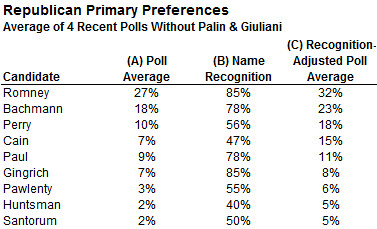
A more important contingency for Ms. Bachmann is whether Sarah Palin runs. Four of the polls ran versions without either Ms. Palin or Mr. Giuliani, and in those surveys, Ms. Bachmann’s support averaged 18 percent rather than 13 percent.
BERJAYA

However, this version of the numbers helps Mr. Romney as well — his support grows to 27 percent from 22 percent. Some of that is the runoff from moderate-leaning voters who might have preferred Mr. Giuliani, although Mr. Romney might also be picking up a few Sarah Palin supporters who haven’t thought much about the field and are defaulting to the most recognizable names.

Mr. Perry, interestingly, is not helped in this case — in fact, with Ms. Palin and Mr. Giulaini out of the race, his numbers decline a bit to 10 percent from 12 percent. The decline shouldn’t be taken too literally and is likely a sample size fluke at least in part. But it hints that Ms. Palin’s entry in the race would take more votes away from Ms. Bachmann than it would from Mr. Perry and could plausibly make his path easier despite the more crowded field.

Mr. Perry, however, has also yet to officially enter the race, and that’s the reason why it may be at least a little premature to anoint him as the frontrunner.

It’s not that Mr. Perry is literally likely to skip the presidential derby after making so much noise about it — most reporting suggests that he’ll officially become a candidate. But Mr. Perry will be getting off to something of a late start and will have to spend time fundraising or tweaking his campaign staff while Mr. Romney is in New Hampshire and Ms. Bachmann and Mr. Pawlenty are in Iowa. While not likely to be a fatal flaw, this could harm him in some intangible ways down the road.

More important is that Mr. Perry has yet to really endure the period of heightened scrutiny that almost all the other Republican faced when they announced their campaigns — and with decidedly mixed results. Mr. Romney survived his roll-out relatively well, although he got poor marks from conservative commentators for his health care speech. At the other end of the spectrum are Newt Gingrich, who was all but dead on arrival, and Jon Huntsman, whose campaign is moribund.

Apart from the general vetting that will take place — something that is relatively less likely to be a problem for Mr. Perry, the four-term governor of the nation’s second-largest state — there may be questions raised about his electability (is nominating a conservative Texas Republican the equivalent of a liberal Massachusetts Democrat?). Given his late start, comparisons may be made — perhaps unfairly — to Fred Thompson, whose 2008 campaign flailed.

And Mr. Perry will have to decide how to position himself between the establishment and the Tea Party. But that is a nice choice for a Republican candidate to have: Mr. Perry is probably the most capable of the candidates to maintain credibility with both groups. Given how conservative the Republican electorate has become, particularly in states like Iowa and South Carolina, Mr. Perry is probably closer than Mr. Romney to the median Republican primary voter.

So we have these two factors to weigh against one another: the fact that Mr. Romney’s campaign is at a far more advanced stage against the fact that Mr. Perry’s positioning is probably more in line with the mood of the G.O.P. electorate. You can make a credible case for either one; I tend to default toward Mr. Romney because he’s still a little bit ahead in the polls.

If Mr. Perry’s roll-out goes well, however, the Republican campaign could well develop into a heavyweight battle between the two rather than the Lord-of-the-Flies scenario that had seemed more likely before.

Ms. Bachmann or Mr. Pawlenty could also make themselves factors by winning Iowa, but they risk being relegated to the undercard if Mr. Perry gets off to a fast start. Look for them to throw a few banana peels his way to try to trip him up.


July 25, 2011, 11:37 pm

Washington Is Out of Touch. How About Wall Street?

The stock market, digesting Friday afternoon’s news of a breakdown in negotiations between President Obama and the House speaker, John A. Boehner, on plans to raise the federal debt limit, behaved relatively calmly today, with the Dow Jones shedding 0.7 percent to close at 12,593 points.

Should investors be more worried? Perhaps. Wall Street has trouble anticipating unprecedented events. The heuristic “Congress always comes through in the end” has pretty much always been right in the past. But one can point to a number of signs that this time is different.

In particular, there are several pieces of evidence that the Republican House of Representatives is extraordinarily conservative on fiscal issues. According to statistical systems like DW-Nominate, the median voter in the House — who is a very conservative Republican because the Republicans have a reasonably large majority and have very few moderates — may well be more conservative than at any point in the nation’s history, although comparisons become harder to make the further you go back into the past. Read more…


July 25, 2011, 9:53 am

Speaker Boehner’s Big Gamble

The Republican Speaker John A. Boehner, following the collapse of negotiations with President Obama, appears to be considering a path that would involve the House Republicans voting to raise the federal debt ceiling on their own terms, with little expectation of Democratic support.

It’s unclear what Mr. Boehner’s proposal, set to be unveiled on Monday, will entail. Some reports suggest that it might consist of a six-month increase in the debt limit, which would put the issue into play again in January or February just as the Iowa caucuses are taking place. But Mr. Boehner also hinted that his plans could include elements of the Republicans’ “cut, cap and balance” proposal, which was approved by the House last Tuesday but is stymied in the Senate.

If the House was able to approve any kind of increase to the debt limit, it would transfer focus to the White House and to the Senate. Mr. Obama has threatened to veto a short-term increase, but he would have little time left before the Treasury’s Aug. 2 deadline and perhaps little leverage. The Democratic-led Senate would probably be the bigger barrier: it could move to vote on its own proposal, leading to a potential standoff between the two chambers. Still, Mr. Boehner could put Democrats on the defensive, if not necessarily into checkmate.

Mr. Boehner, however, has a math problem. Republicans have 240 members in the House, and 217 votes are currently required to pass a bill. That means they could lose at most 23 votes, or about 10 percent of their caucus, assuming they picked up no Democratic support.

Mr. Boehner had previously indicated, however, that at least 59 Republicans would not vote to raise the debt limit under any circumstances, a number that appears to coincide with the 60 Republicans who are members of the Tea Party Caucus.

It is telling, perhaps, that the “cut, cap and balance” bill, although winning the support of all but 11 Republicans, did not raise the debt ceiling. Instead, it erected another barrier to it, requiring that a balanced budget amendment be approved by two-thirds majorities of both houses of Congress before additional borrowing authority was given to the Treasury.

In addition to Republicans who might defect for ideological reasons, some others might do so for electoral ones. Polling on the debt limit, which at earlier points had appeared to show a clear plurality of Americans against any increase, has now become highly ambiguous, with widely varying results depending on question wording. But both the debt limit increase and the spending cuts attached to it are likely to inspire mixed feelings in voters, and the roughly 75 Republicans serving in swing districts would need to consider the contours of the proposal carefully.

Thus, the sharp rhetoric in the Republican conference call Sunday, in which Mr. Boehner and other Republican leaders took a number of swipes at Mr. Obama while also urging their members to unite behind the proposal. Kevin McCarthy, the Republican House majority whip, reportedly told his colleagues that Mr. Obama was “throwing a fit because he’s worried about the election.” The idea seems to be that, if the most conservative Republicans aren’t swayed by pressure from Wall Street, or from the potential effects to the economy, perhaps the only thing that can move them is the potential to force Mr. Obama to concede defeat.

But if the vote on Mr. Boehner’s proposal fails, the risks to him are clear. It would presumably rattle markets, while making him look ineffectual. Most importantly, it would demonstrate that Republicans could not pass a bill, even through the House, without Democratic support, which would substantially reduce their leverage, as Mr. Boehner explicitly acknowledged in the conference call.

Then again, even if the Republican bill failed in the House, the counterproposal by Democratic leaders in the Senate would reportedly focus solely on spending cuts with no tax increases. Although some of the savings the Senate bill might claim to achieve would reflect an accounting treatment of the wars in Iraq and Afghanistan, that seems as much like a victory for Republicans as a defeat.

Meanwhile, although calling Mr. Obama’s bluff on his stated refusal to accept a short-term increase might qualify as a tactical victory for Republicans, its longer-term implications are ambiguous. Polls show that the public has a lukewarm view, at best, of how Mr. Obama has handled the negotiations. But the ratings for Republicans are much worse, calling into question whether they would benefit from another round of negotiations next winter under the heat lamp of the presidential primaries. There are increasing suggestions in the polling that the public could tell both Mr. Obama and the Republican Congress to find a new line of work.

Thus the real gamble that Mr. Boehner is taking: in seeking to trip up Mr. Obama, he may be putting his own majority at risk.


July 23, 2011, 5:00 am

Unfavorable Ratings for Both Major Parties Near Record Highs

A new CNN poll finds that 55 percent of voters have a negative view of the Republican Party, tied for their second-highest unfavorable score since CNN began asking this question in 1992. The Republicans also achieved a 55 percent unfavorable rating in a poll conducted in April 2009, although the party’s all-time high, 57 percent, was recorded as the House of Representatives was in the process of impeaching Bill Clinton in December, 1998.

The news for Democrats is not any better. Some 49 percent of voters now hold a negative view of the party, according to the poll. Although this figure is slightly better than for Republicans, it matches the Democrats’ record high unfavorable rating of September 2010 and is part of an upward trajectory that has persisted for the past three years.

The combined unfavorable score for both parties — 104 percent — is also a record, and represents the first time that the figure has been above 100.

BERJAYA

The G.O.P.’s unfavorable score has historically been more volatile than that of the Democrats. On previous occasions when the Republicans’ unfavorable rating spiked, however, like in 1998 and from 2006 through 2008, the Democratic Party’s declined slightly.

Since President Obama was inaugurated in 2009, however, the Democrats’ unfavorable rating have increased substantially without a corresponding drop for the Republicans. (A fine-toothed comb might find a very slight decline in the Republican unfavorable rating between 2009 and 2010, but it appears to be on the rise again now.) Thus, the combined dissatisfaction with the parties has grown steadily and is now about 20 percentage points higher than it was in the 2008 election cycle.

A credible independent bid for the presidency is always a long-shot, but might be more viable under these conditions. Or we may simply see a genuine anti-incumbent wave — a much-discussed phenomenon that has rarely occurred in practice — with significant numbers of elected officials in both parties losing office. It is not out of the question that Democrats could lose the White House but take back control of the House of Representatives.

But there are also downside cases for both the president and the Congress. Mr. Obama’s post-partisan branding, evident especially during the early phases of his 2008 campaign, has been submerged by parties that continue to become more partisan on the one hand and less popular on the other. Just 23 bills have been signed into law by the president this year, a staggeringly low number. The president has scored some tactical points during the debt limit negotiations. But both Democratic and independent voters, for somewhat differing reasons, may question whether his overall strategy has been effective.

For Republicans, meanwhile, there is the possibility that the party’s unfavorable rating, which is up 7 points since March, will continue to grow as it asserts an agenda whose popularity is questionable, especially on issues like changes to entitlement programs. Their favorable rating, 41 percent, is well below that of Democrats in 2007 or Republicans in 1995 after winning control of Congress in those years, leaving the G.O.P. without a clear mandate.


July 21, 2011, 2:59 pm

G.O.P. Governors Swing Right, Leaving Voters Behind

If the states are laboratories of democracy, then the Republican Party’s research pipeline has run dry. Moderate Republican governors, a thriving species before last year’s elections, are all but extinct.

***

I’ve used data from the Web site OnTheIssues.com to rate each current governor’s ideology on a scale that runs from zero for liberal to 100 for conservative. OnTheIssues evaluates candidates’ ideology in each of about two dozen major domestic policy areas based on their public statements and votes. My process is simply to average the ratings for each issue area together and then translate them to my zero-to-100 scale. (In some cases, OnTheIssues has not scored the candidate on a particular topic, in which case it is excluded from the average.)

For example, Christine Gregoire, the governor of Washington and a Democrat, winds up with a score of 10, meaning very liberal. Rick Scott, the newly elected governor of Florida, has a score of 91 (very conservative). Other candidates are more in the middle: Mike Beebe, the Democratic governor of Arkansas, has a score of 39 (quite moderate), while Mitch Daniels of Indiana, a Republican, scores at a 74 (about halfway between moderate and conservative).

We can compare these scores against the ideology of the voters in each state, as measured by 2008 exit polls. This is also simple: I assign zero points for every voter who describes themselves as liberal, 50 points for every moderate, and 100 points for every conservative, and then average the result.

Here, for example, is how the comparison looks for current Democratic governors. (I exclude a handful of cases where OnTheIssues has not rated the candidate on enough issues to provide for a reliable estimate.) You see a fair amount of ideological diversity among the Democrats, from moderates like Mr. Beebe and Kentucky’s Steven L. Beshear to liberals like Ms. Gregoire and Deval Patrick of Massachusetts. You also see that there is a correlation between the ideology of the governors and the ideology of the states: with one or two exceptions, Democratic governors in moderate or conservative states themselves tend to be moderate, while Democratic governors in liberal states are quite liberal.

BERJAYA

But if we perform the same exercise for Republican governors, the results look quite different:

BERJAYA

Unlike for the Democrats, there is almost no ideological diversity within the group: essentially all of the current Republican governors are quite conservative, taking moderate positions on at most one or two issues. Also unlike the Democrats, there is no correlation between the ideology of the governors and the ideology of the states. Whether you have a Republican governor in a fairly liberal state like Maine, a moderate state like Ohio, or a conservative one like Idaho, his agenda is likely to be highly conservative. (The closest thing to an exception — the outlier in the chart — is Gov. Gary R. Herbert of Utah, who shares some of the moderate tendencies of his predecessor, Jon M. Huntsman Jr.)

The contrast is especially striking when you put both Democrats and Republicans on the same chart. (The solitary green dot represents Lincoln Chafee, the independent governor of Rhode Island.)

BERJAYA

This is unusual behavior. Politics 101 would suggest that you need to be at least somewhat responsive to voters in your state. And American political parties in particular are traditionally broad-based coalitions that tolerate a fair amount of intellectual and ideological diversity, especially at the state level. Republicans, of course, are going to try to push policy toward the right and Democrats to the left. But you can go only so far before you get a ticket out of office, so electoral and policy goals remain in some degree of balance.

The new breed of Republican governors run counter to this principle in a way that wasn’t true as recently as a year ago.

In the next chart, I’m going to plot the ideological positions of the Republican governors who were in place a year ago, just before the 2010 elections (including some who continue to hold office now). This brings back into the fold at least a half-dozen moderate Republican governors who have since retired, like Arnold Schwarzenegger of California, M. Jodi Rell of Connecticut, Charlie Crist of Florida, Jim Douglas of Vermont, Donald Carcieri of Rhode Island and Linda Lingle of Hawaii. (Republicans lost the gubernatorial contest in five of the six aforementioned states despite their strong year overall.)

BERJAYA

So just a year ago, there were plenty of moderate Republican governors — most of them in liberal or moderate states, where they were often quite popular. Now there are almost none, save some borderline cases like Mr. Daniels and Mr. Herbert.

The unsurprising result is that Republicans now have a group of extremely unpopular governors — particularly Mr. Scott of Florida, Scott Walker of Wisconsin, John R. Kasich of Ohio and Paul R. LePage of Maine, all of whom have disapproval ratings exceeding 50 percent. Other Republican governors in crucial swing states like Michigan and Pennsylvania also have below-average ratings.

BERJAYA

Republicans do have a couple of bright spots — especially Susana Martinez of New Mexico and Bob McDonnell of Virginia — who remain quite popular and should have a long political future. But other Republican governors who are linked to national politics, like Rick Perry of Texas and Chris Christie of New Jersey, are not especially popular in their home states.

I don’t know that I buy the theory that these unpopular Republican governors are likely to harm the aspirations of the party’s presidential nominee though a “reverse coattail” effect, the evidence for which is quite spotty. But I do think it’s a significant problem for Republicans on its own terms. It suggests that the party has become uninterested in appealing to swing voters — and that the voters are starting to notice.

Retribution from the electorate is a strong possibility unless there is a change of course.


July 20, 2011, 10:37 am

Two Paths in Budget Debate and in 2012

Apart from being a critical moment for the United States’ fiscal policy, the budget debates are an inflection point in the 2012 campaign. Particularly if an especially large deal is struck, like the Senate’s “Gang of Six” plan, or if negotiations break down and Congress struggles to raise the debt ceiling, it could dictate the strategies of both presidential and Congressional candidates.

Incumbent presidents fundamentally have two strategies that they might want to pursue. The first path, the Referendum Path, is usually the preferred one if the president’s approval ratings are strong and if voters are in a positive mood about the direction of the country. The strategy is no more complicated than asserting that the president has done a good job and deserves another term, the paradigm case perhaps being Ronald Reagan’s 1984 “Morning in America” campaign.

If however the White House has doubts about whether it can win a referendum, it can instead pursue the Partisan Path. It’s also pretty simple: the message is that however well the president might be doing, the alternative is worse.

The Partisan Path has been less likely to succeed because it tends to be undertaken under more difficult circumstances. But it has worked occasionally, like in 1948, when Harry Truman persuaded voters that the “Do-Nothing” Republican Congress was to blame for the country’s economic problems. The Partisan Path was also adopted successfully in 2004 by George W. Bush, although Mr. Bush’s approval ratings and the country’s economic performance were probably just strong enough for him to have won re-election on the merits. Read more…


July 19, 2011, 1:50 pm

Is Obama Against Romney a Toss-Up?

Looking at head-to-head polls can be treacherous so far in advance of a presidential election. Instead, I’d suggest that you devote most of your attention to President Obama’s approval ratings and perhaps the favorability ratings of the Republican candidates, as well as to things like economic forecasts.

But that doesn’t mean the head-to-head polls should be entirely ignored. Every bit of information is potentially useful — and besides, things like approval ratings and economic forecasts are fairly crude tools at this stage too. Approached with sufficient caution, the head-to-head polls can probably provide some insight as to how different types of Republican candidates would fare against Mr. Obama, especially if you account for the name recognition disparities that some of them face.

Since March, pollsters have done surveys on a total of 20 distinct potential Republican opponents for Mr. Obama, as well as an unnamed or “generic” Republican candidate. Rarely has the Republican candidate led in these polls, although Mitt Romney and the generic Republican have been occasional exceptions and some candidates come much closer than others.

The table below provides an average of those polls, but with a couple of twists. First, when the same polling firm has surveyed a matchup multiple times, each of these polls are averaged together. Second and more importantly, I have applied a version of our adjustment for house effects, which are persistent partisan leans within the polls either for or against Mr. Obama. (Rasmussen Reports polls, for instance, tend to have somewhat Republican-leaning results, while polls from Ipsos have tended to show very favorable results for Mr. Obama.) This provides for a more apples-to-apples comparison, particularly for candidates who have been polled by some firms but not others. The polls also show consistent differences in the number of undecided voters, so a similar adjustment is applied for this. Read more…


July 15, 2011, 8:02 pm

A Bad Economy Could Harm House Republicans

If you are a Republican trying to keep your job in Congress, your feelings about President Obama notwithstanding, would you rather the economy be better or worse?

The answer is actually not so obvious. In five election cycles in the last 60 years, a poor economy combined with a divided government. This is how they proceeded:

1948 (Democrats control presidency, Republicans control Congress). This is one precedent favorable to Democrats, and unfavorable to Republicans in the House. The economy sputtered throughout the term that Harry Truman inherited from Franklin D. Roosevelt and was headed back into recession just as the election took place. However, not only did Truman, who ran a highly partisan campaign criticizing the “do-nothing Congress,” maintain the presidency, but Democrats also had a net gain of 75 seats in the House and 9 in the Senate, taking control of both chambers.

1960 (Republicans control presidency, Democrats control Congress). This election is not normally remembered as one driven by the economy, but the country was in recession at the time and had endured another recession early in Dwight D. Eisenhower’s second term. Eisenhower, however, remained personally popular, and his vice president, Richard M. Nixon, was the Republican nominee. Democrats won, but not in impressive fashion, with John F. Kennedy defeating Nixon by one-tenth of a percentage point in the popular vote (although his margin in the Electoral College was more robust). Democrats kept control of Congress, but lost 22 seats in the House and 1 in the Senate.

1976 (Republicans control presidency, Democrats control Congress). Jimmy Carter, considered the heavy favorite, defeated the embattled incumbent, Gerald Ford, by only two percentage points. Democrats gained just one seat each in the House and the Senate.

1992 (Republicans control presidency, Democrats control Congress). Bill Clinton defeated George H.W. Bush, although with only 43 percent of the popular vote, as Ross Perot took 19 percent. Most research suggests, however, that Mr. Perot did not cost Mr. Bush the election, and may have even taken votes away from Mr. Clinton. Mr. Clinton’s coattails were underwhelming, however: Democrats  lost nine seats in the House, while gaining one in the Senate.

2008 (Republicans control presidency, Democrats control Congress). This was truly a clean win, as Barack Obama claimed the presidency and Democrats expanded their numbers  in both chambers of Congress, gaining 21 House seats and 8 Senate seats.

If you’re looking at this history from President Obama’s perspective, the results do not seem so promising. In all five elections, one party swept both the presidency and Congress. And in four out of five cases, it was the party that controlled Congress — not the presidency — that did so. The situation is by no means completely hopeless: there is a reasonably clear precedent. In 1948, Truman succeeded in passing blame along to Congress, and Nixon in 1960 and Ford in 1976 might easily have won. But under normal circumstances, a president will take a hit for a poor economy, and a divided government will provide an insufficient buffer. (I would argue that a renewed economic crisis triggered by a debt default is not “normal circumstances,” but let’s leave that alone for now.)

On the other hand, the results also do not look so great if you’re a Republican representative interested in keeping your job. In these elections, the party in control of Congress did not do particularly well at retaining its seats, actually losing an average of 17 seats in the House and breaking even on average in the Senate. The party in control of Congress also saw its share of the House popular vote decline in four of the five years, to an average of 50 percent of the vote from 54 percent in the previous midterm.

(One other oddity: the party completing the sweep in all five cases was the Democratic Party. This is probably meaningless, although it is at least theoretically possible that Democrats have an inherent advantage over Republicans in difficult economic times when voters might have reason to blame either party.)

So there is something of a tradeoff here. Certainly, a poor economy is liable to hurt the president — and presidents normally have coattails, whether positive or negative. At the same time, Republicans  might also share in some of the blame if the economy is poor: voters could split their tickets and vote against both their Republican lawmakers and President Obama.

One experiment predicts the number of seats that the party in control of the House of Representatives will gain or lose based on two factors: the performance of the economy and the share of the popular vote that its candidate receives for president. For the economic variable, we’ll use per capita disposable income growth as defined by Douglas Hibbs, which I have calculated going back to 1924.

If you put each of these variables into a regression equation, you find — unsurprisingly — that the party in control of the House tends to do better when its presidential candidate performs well. But it also tends to do better when the economy is strong, other factors being equal. These effects appear to be statistically significant in cases in which the House and the presidency are controlled by different parties as well as those in which they are controlled by the same one, although the small sample sizes make it hard to know for sure.

Given my repeated admonitions against taking these sorts of models too literally, I’d digest the following with ample grains of salt, but here are the results from a somewhat fancier version of the equation that includes an interaction term between the two variables. The numbers reflect predictions about the number of seats that Republicans would gain or lose in the House based on various situations having to do with the performance of the economy and their presidential candidate. Values shaded in blue represent those cases in which the Republican Party would be projected to lose control of the House.

BERJAYA

This chart, which looks something like the one used to calculate the wind chill factor, might give you a headache. But there are four basic possibilities:

The economy is reasonably strong and Obama wins. In this case, which is reflected in the values in the bottom left-hand corner of the chart, the most likely outcome is that Congressional Republicans lose a few seats in the House. But their majority would not necessarily be threatened: voters could be in a magnanimous mood and might want to keep their divided government, and Mr. Obama might attempt to coast to victory on a “Morning in America” theme rather than adopting a more partisan tone. If you look at the presidents who were re-elected with a divided government and a good economy — Clinton in 1996, Reagan in 1984, Nixon in 1972 and Eisenhower in 1956 — they produced few coattails, with their parties gaining an average of nine seats in the House, failing to take control of the chamber in all four instances, and losing one seat on average in the Senate.

The economy is poor and Obama loses. This is the converse of the previous possibility. Republicans would be likely to retain control of the House, but it isn’t necessarily any kind of bonanza. The historical evidence suggests that the party in control of the House performs marginally when the economy is doing poorly, even if its president does well and wins. Under some circumstances — for instance, if the Republican presidential candidate won by an extremely slim margin, or won with a plurality of the vote because third-party candidates took some votes off the table — it’s entirely possible that the Republican Party would lose the House while winning back control of the presidency.

The economy is poor and Obama wins anyway. This is the worst possibility for Republicans because it implies that, as in 1948, the public will have rendered a judgment about who is responsible for the state of the economy, and that judgment will have been made against them. If voters are willing to re-elect President Obama despite a lagging economy, it will almost certainly mean they’ll also punish Republicans in Congress. The model argues that Republicans would be favored to lose the House in this eventuality, perhaps by a significant margin. Fortunately for Republicans, this possibility is relatively unlikely, although it could be triggered by some crisis –  like a debt default for which they shared in the blame, or by a poor Republican candidate who turned off independent voters and allowed Mr. Obama to manage a victory.

The economy is reasonably strong but Obama loses. This possibility is even less likely — it takes a lot to beat an incumbent president, and if the economy is reasonably healthy it can be next to impossible. The closest thing to a comparison is probably something like 1952: the economy was doing quite well that year, but the Korean War had become fairly unpopular, Democrats had been in power for a long time, and Republicans nominated an exceptional candidate in Eisenhower, leading Truman to decline a chance at another term and Adlai Stevenson to do poorly in his place. Winning under these circumstances would imply that Republicans had really won the argument on the merits, and their presidential candidate would probably have substantial coattails in Congress, as Eisenhower did in 1952: Republicans won 22 seats in the House that year and 2 in the Senate, gaining control of both chambers.

The moral is that the Republicans in Congress — as opposed to the Republican presidential candidate — will not necessarily benefit from a poor economy.

But the particulars get a little more complicated, since when the other party controls the White House, two effects cut against one another. On the one hand, presidents get blamed for a bad economy, and that is likely to have some effects down the ballot. About a third of voters who participate in presidential election years do not vote in midterm years and may have little interest in Congressional races, often voting a straight party ticket. On the other hand, the historical record provides some suggestion that voters are sophisticated enough to spread the blame around and vote all the rascals out of office. The majority party in the House has lost seats on average when the economy is poor, even when the president is from the other party.

Which of these effects will prevail in any given year is hard to know. But the view that under a divided government, a bad economy is bad for the president’s party, full stop, is probably too simplistic. A bad economy is almost certainly bad for the president himself. But it may be neutral or even favorable from the standpoint of his party’s candidates for Congress.

And there is one prominent case, 1948, in which a president succeeded in transferring blame to the Congress. This is why, particularly if the economy worsens but this is not perceived as being entirely Mr. Obama’s fault — for instance, in the event of a debt crisis — there is some downside risk for Republicans. Don’t be surprised if you catch David Plouffe, the senior White House political strategist, reading press accounts of Harry Truman’s campaign.


July 14, 2011, 6:13 pm

Nobody Wins the Debt Default Blame Game

The chances of a default on the United States debt are still fairly small. The prices for credit default swaps, financial instruments that pay investors in the event that a default happens, imply just a 0.05 percent chance, or 1-in-2,000, of a default occurring within the next year, according to The Wall Street Journal.

That seems like a considerable underestimate of the chances — I don’t have much confidence that Wall Street does a competent job of pricing in political risk. But Congress still has ample time to prevent one by raising the debt ceiling, and the Treasury Department may use any and all means to stave off a default for as long as possible even if Congress fails to act.

Even if an actual default is unlikely, the possibility of one may nevertheless influence both sides’ bargaining positions. In addition, far more likely than an actual default are situations where we stop short of one but nevertheless have significant consequences for the American economy because of downgrades to the United States’ credit rating, severe reductions in government spending and significant anxiety in the market. So although we’ve touched on this subject before, it’s worth revisiting: what happens to American politics if the debt ceiling isn’t raised by Aug. 2 and the economy suffers as a result?

Let’s keep in mind that there are three basic possibilities:

1) The situation plays out in such a way that is harmful to President Obama and helpful to the Republicans on balance.

2) The situation plays out in such a way that is harmful to Republicans and helpful to Mr. Obama on balance.

3) The situation plays out in such a way that is harmful to both Mr. Obama and the Republicans.

What do I mean by the third possibility? A literal interpretation would be that Mr. Obama loses the White House, either to a Republican or (less likely) to an independent candidate. But the Republican Party loses its majority in the House. Maybe quite a few Democratic incumbents in Congress also lose.

More broadly, it would mean that any victories achieved in 2012 would be superficial and Pyrrhic. The public would not trust either side to carry out its agenda. The next several election cycles would be extremely volatile. Prospects for independent candidates for president and for third parties, whether emerging from the center of American politics or from the wings, would improve significantly. And within the major parties, power would tend to transfer away from those who hold it.

Whether you’re Barack Obama or John A. Boehner, or a Republican senator in a swing state considering how to vote on the debt ceiling, two out of the three possibilities are bad for you. Those are terrible odds. This is why I’m deeply suspicious of claims that either party to the negotiations believes it could benefit from a default. This isn’t a zero-sum game, and although politicians are bad at many things, they are usually fairly perceptive about what will enable them to hold onto power.

But suppose that you have to pick between the first two possibilities: one side loses and the other side “wins.”

Arguing for the “Obama loses” side is the political scientist John Sides:

Assume there is no deal and then assume, as [Treasury Secretary Timothy F.] Geithner and others have warned, that there are serious consequences for the economy when the debt ceiling isn’t raised. This will hurt Obama. And it will hurt him more than it will hurt the Republican Party. Presidents suffer the consequences of a bad economy. Divided government does not change this. Beware pundits who see silver linings for Obama in this scenario.

And arguing against Mr. Sides are Jonathan Chait of the New Republic and Ezra Klein of The Washington Post. Here’s Mr. Chait:

It seems highly plausible to imagine that, if the Republicans block a debt ceiling increase, that the public will turn on them. The business elite will decide that the Republicans are dangerous and must be stopped. Obama will use his bully pulpit to explain to the public that the Republicans have forced withholding of entitlement payments and the closing of vital government services. Quite possibly, this effect could overwhelm any actual economic ramifications. I know the models say the economy will be all that counts. That could be right. But the models have never seen anything like this before.

I’m more inclined toward the argument advanced by Mr. Chait. I don’t think I’d say that Mr. Obama would be likely to benefit politically — but I do think it’s anybody’s guess, and the empirical models that Mr. Sides references tell us very little.

Part of the reason for my skepticism is that I think these empirical models are, in general, a little bit overrated by the political science community. Some models claim to explain as much as 90 percent of voting behavior based on economic fundamentals and a few other variables. But the models suffer from profound theoretical flaws owing to the infrequency of presidential elections, and their predictive power is nowhere near 90 percent when applied to new (“out-of-sample“) cases. A cynical view is that the models are really just anecdotal arguments in quantitative dress: if a model has trouble explaining a particular election, you invent a new variable to excuse it. A fairer view, perhaps, is that the models do a good job with the “normal” cases — clearly the economy matters quite a bit to a president’s re-election chances — but fumble on the more difficult ones.

Whatever else the 2012 election would be if the debt limit is not raised in a timely fashion, it would not be a normal case. There’s no especially appropriate precedent for the economy tanking by such an immediate and direct result of action (or inaction) in Washington. One reason the public tends to score strong economic performance in favor of the president, and poor economic performance against him, is because the United States economy is  incredibly complicated — it’s hard for the public to discern cause and effect. (It’s also hard for economists!) So the heuristic of blaming the president for poor performance and crediting him for strong performance is as reasonable as anything.

This would be different, however. The stock market could drop by thousands of points. Some major corporations, particularly in the financial services sector, might go under. Although the consequences might take some time to filter through the broader economy, there would nevertheless be a number of immediate and extremely visible effects. Many voters would feel as though they had perfectly reasonable grounds to connect the dots.

You’d have to weigh two things against each other: the additional damage to the economy, which is bad for the president all else being equal, and the additional ownership of the economy that Republicans would take for it, which is bad for them all else being equal. I don’t know which effect would win out, but it’s not a risk that either side should feel happy about taking.


July 13, 2011, 6:32 pm

G.O.P.’s No-Tax Stance Is Outside Political Mainstream

The back-and-forth of the debt limit negotiations can be perplexing. But the facts driving the debate are quite straightforward. Any deal, or any workaround to a deal, will need to be approved by a majority of the House of Representatives. The Republicans in the House of Representatives are extremely conservative on fiscal matters and are significantly out of step with the public as a whole. Given that Democrats continue to control the Senate and the White House, and that their votes may be necessary in the House as well, this makes compromise nearly impossible.

Consider, for example, the poll that Gallup released today, which asked Americans whether they prefer tax increases or spending cuts as part of a deal. Preferences were weighted toward spending cuts:

BERJAYA

Few Americans, however, take the view that spending cuts alone should be made in a deal, with no tax increases at all. In fact, only 26 percent of the Republican voters surveyed in Gallup’s poll took that position, along with 20 percent of voters overall.

We can also use the Gallup poll to tease out what mix of tax increases and spending cuts the public would like to see in a deal. Assume that the people who told Gallup that they wanted “mostly” cuts would prefer a 3-to-1 ratio of spending reductions to tax increases, and that those who said they wanted mostly tax increases would prefer a 3-to-1 ratio in the opposite direction. (The other choices that Gallup provided in the poll — an equal mix of tax increases and spending cuts or a deal that consisted entirely of one or the other — are straightforward to interpret.)

The average Republican voter, based on this data, wants a mix of 26 percent tax increases to 74 percent spending cuts. The average independent voter prefers a 34-to-66 mix, while the average Democratic voter wants a 46-to-54 mix:

BERJAYA

Now consider the positions of the respective parties to the negotiation. One framework that President Obama has offered, which would reduce the debt by a reported $2 trillion, contains a mix of about 17 percent tax increases to 83 percent spending cuts. Another framework, which would aim for twice the debt reduction, has been variously reported as offering a 20-to-80 or 25-to-75 mix.

With the important caveat that the accounting on both the spending and tax sides can get tricky, this seems like an awfully good deal for Republicans. Much to the chagrin of many Democrats, the mix of spending cuts and tax increases that Mr. Obama is offering is quite close to, or perhaps even a little to the right of, what the average Republican voter wants, let alone the average American.

However, all but 7 Republicans in the House of Representatives, or 97 percent of them, have signed the pledge of Grover Norquist’s Americans for Tax Reform stating that any net tax increases are unacceptable. One might have believed this to be simply a negotiating position. But the proposal that Senate Republican leader Mitch McConnell floated yesterday, which would give up on striking a deal and instead rely on some procedural gymnastics to burden Mr. Obama with having to raise the debt ceiling, suggests otherwise. Republicans in the House really may be of the view that a deal with a 3:1 or 4:1 or 5:1 ratio of spending cuts to tax increases is worse than none at all.

If we do take the Republicans’ no-new-taxes position literally, it isn’t surprising that the negotiations have broken down. Consider that, according to the Gallup poll, Republican voters want the deal to consist of 26 percent tax increases, and Democratic voters 46 percent — a gap of 20 percentage points. If Republicans in the House insist upon zero tax increases, there is a larger ideological gap between House Republicans and Republican voters than there is between Republican voters and Democratic ones.

BERJAYA

It would be foolish, in my view, to render any overly specific predictions about how the negotiations are likely to be resolved. But I would put greater weight on scenarios that would involve House Republicans not having to violate the pledge they signed to Mr. Norquist, including an end-around like Mr. McConnell’s — or even a failure to raise the debt ceiling at all, resulting in some combination of a debt default, a government shutdown, and a Constitutional crisis.

If a deal were to occur, it would probably have to be revenue-neutral. There is still some possibility of this because there are some tax reductions that many Democrats in Congress would support on their own merits — for example, cuts to the payroll tax, which could have a stimulative effect, in exchange for the closing of tax loopholes elsewhere.

But the House Republicans are very unlikely to capitulate on their no-tax pledge. And Democrats have little reason to capitulate either: they are on the right side of public opinion.


Featured Posts

  • Handicapping the Republican Field: Part II, the Wild Cards
  • Handicapping the Republican Field: Part I, the Top Tier
  • Let’s Talk About Redistricting
  • Qatar a Questionable World Cup Host
  • The 800-Pound Mama Grizzly Problem
  • The Hidden Costs of Extra Airport Security

About the Blog

FiveThirtyEight’s mission is to help New York Times readers cut through the clutter of this data-rich world. The blog is devoted to rigorous analysis of politics, polling, public affairs, sports, science and culture, largely through statistical means. In addition, FiveThirtyEight provides forecasts of upcoming presidential, Congressional, and gubernatorial elections through the use of its proprietary prediction models. Read more »

More News

Vote on Boehner Plan Delayed Amid Opposition

House Republican leaders said they planned to delay a scheduled vote on a plan to temporarily raise the debt ceiling, as passage seemed in growing doubt.

On All Levels of the Economy, Concern About the Impasse

If the United States’ credit rating drops because of a standoff over government spending, experts say borrowing costs, business confidence and job creation could all be affected.

After Aiding Republicans, Business Groups Press Them on Debt Ceiling

The U.S. Chamber of Commerce spent millions last year to help elect Republicans to the House, but now it finds they are not doing what it wishes regarding the debt ceiling.

Scorecard: Republican Supporters and Opponents of Boehner Plan

Republicans -- and outside groups that often support them -- have had to choose sides on the bill on the debt ceiling put forward by House Speaker John A. Boehner.

The Early Word: Pushback

Political news from today's Times and around the Web, plus a look at what's happening in Washington.

Hispanic Congressman Is Arrested in Deportation Protest

Representative Luis V. Gutierrez, a Democrat from Illinois, said he decided to participate in the protest after President Obama rejected his proposals to suspend deportations of some college students and make it easier for illegal immigrants married to American citizens to remain in the United States.

Archive