

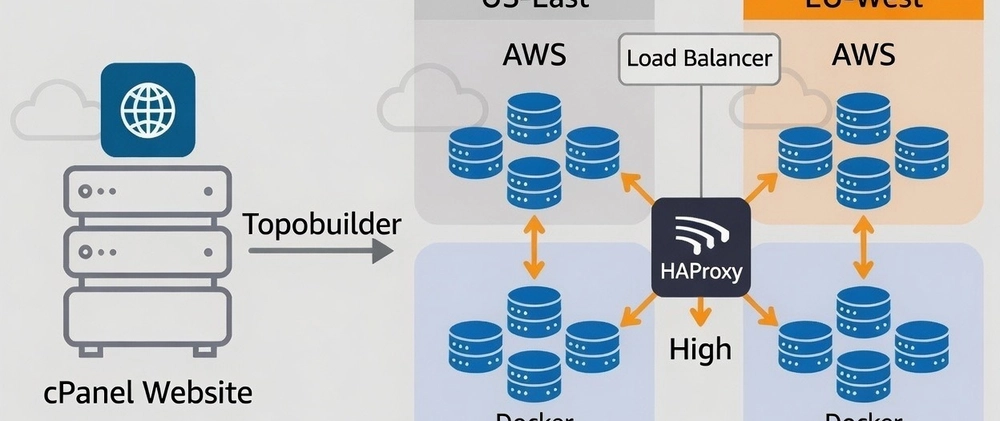

In 2024, I built a piece of software called topobuilder in Go. I've referenced it in interviews often enough that it deserves a public page to point at — so here's what it is and how I built it, told through fragments of a closed-source codebase.
What Is Topobuilder?
topobuilder is a go binary that runs off a single YAML configuration file that defines an existing PHP website hosted on a cPanel server. The defaults assume that any database connectivity is going to be performed over RDS or another remote connection. What you're doing is going from a single region into a multi-region load balanced containerized application. It takes about 12-36 minutes to deploy a 3-6-9 region cluster with an HAProxy load balancer. 3 regions is 12 minutes; 9 regions defaults to 36 minutes but can also be 12 minutes by adjusting the configuration — though this increases concurrency load and may result in rate limiting from the API utility.
The binary itself is portable — I've run it from DigitalOcean droplets and OVH boxes as easily as from a laptop. What it provisions is AWS. Where topobuilder runs and what topobuilder builds are two separate questions, and the first one is wide open.
Go Application Design
What I am going to do is explain this program, how it was built, and give you some insights into Go application design. To begin, we have the main.go file that is the primary entry point for the main() func.
package main

import (
    "context"
    "flag"
    "fmt"
    "gopkg.in/yaml.v3"
    "log"
    "os"
    "path/filepath"
    "strings"
    "topobuilder/cmd/models"
    "topobuilder/cmd/verbose"
)

const VERSION = "1.0.0"

var (
    runMode     string
    statePath   string
    configFile  string
    showVersion bool
)

func main() {
    flag.BoolVar(&showVersion, "v", false, "show version")
    flag.BoolVar(&showVersion, "version", showVersion, "show version")
    flag.StringVar(&configFile, "config", filepath.Join(".", "cfg.default.yaml"), "Path to cfg.slug-name.yaml")
    flag.StringVar(&verbose.LogDir, "logs", filepath.Join(".", "logs"), "Path to store verbose logs")
    flag.StringVar(&runMode, "mode", ModeDevelopment, "Runtime mode - choices are: "+strings.Join(RunModes(), ", "))
    flag.StringVar(&statePath, "state", "", "Path to state file")
    flag.Parse()

    if showVersion {
        fmt.Println(VERSION)
        os.Exit(0)
    }

    log.Printf("Topobuilder running with: %s %s", runMode, configFile)

    vLogErr := verbose.InitVerboseLogger()
    if vLogErr != nil {
        log.Fatal(vLogErr)
    }

    ctx := context.Background()
    app := models.NewApplication(ctx, runMode, statePath)
    if err := app.LoadConfigs(configFile); err != nil {
        log.Fatal(err)
    }

    app.Run()

    if cleanErr := app.Cleanup(); cleanErr != nil {
        _, _ = fmt.Fprintln(os.Stderr, cleanErr)
        os.Exit(1)
    }

    // exit
    os.Exit(0)
}
That's topobuilder! 😏🤫 Well, let's actually digest it. Given that I've built configurable that became figtree, why would I use the stdlib flag package for topobuilder? Because this application doesn't need to dynamically interact with the configuration runtime the way a web server needs to reload its SSL certificates across rotations without forcing the binary to be restarted. In topobuilder, we read our configs and then begin processing the application. Right tool, right job.
We'll break each of these down further, but I use the models package to return a new app that I can use. This is the primary entrypoint for topobuilder.
app := models.NewApplication(ctx, runMode, statePath)
Once we have an app, we need to load the massive YAML config file into the runtime. Instead of getting into what the configurations are for topobuilder, I am going to focus on how the .LoadConfigs(path string) operates in the (app *Application) itself.
if err := app.LoadConfigs(configFile); err != nil {
    log.Fatal(err)
}
Once the configurations are loaded, the bulk of the application's processing is actually conducted in this one line:
app.Run()
If the .Run() has a problem, it'll be captured in the .Cleanup() method in the (app *Application) definition.
if cleanErr := app.Cleanup(); cleanErr != nil {
    _, _ = fmt.Fprintln(os.Stderr, cleanErr)
    os.Exit(1)
}
Now, before we get into the configuration of topobuilder, we need to discuss the verbose package first.
The verbose package
Extracted into its own package, verbose provides a logger capable of scrubbing secrets before they touch STDOUT while preserving the written values to disk in your actual log file.
go get -u github.com/andreimerlescu/verbose
With the verbose package, you interact with it using .AddSecret(), .RemoveSecret(), .ImportSecrets(), and .AddKeyType() when handling sensitive data that you want to suppress from STDOUT, but not from the written log file.
// Existing SHA512 HEX strings + length can be registered below
verbose.ImportSecrets(map[string]int{
    "abc123...sha512hex...": 32,
})

// New header+trailer pattern to filter between values out of logs
verbose.AddKeyType(verbose.KeyType{
    Opening: "BEGIN_MY_SECRET",
    Closing: "END_MY_SECRET",
})

// Add a secret to `verbose` filtering
verbose.AddSecret(verbose.SecretBytes("my-api-token"), "[REDACTED]")

// Remove a secret from `verbose` filtering
verbose.RemoveSecret(verbose.SecretBytes("my-api-token"))

// render a stack trace to return with
verbose.TracefReturn("invalid -name provided: %v", *name)

// bypass sanitization — prints the raw value to the verbose log
verbose.Plain("The raw value is:", *secret)

// this will redact the secret automatically
verbose.Printf("Hello %s, your secret is safe: %s", *name, *secret)
With the verbose package, you're able to safely register new secrets at runtime and then rely on verbose.Printf(string, any) and verbose.Plain(any), plus many other fmt-style methods including verbose.TracefReturn(any), verbose.Sanitize(any), and verbose.Scrub(any). Throughout the application, topobuilder writes things that could contain secrets to STDOUT, but uses the verbose package to ensure that *** and [REDACTED] are what actually appear. This made running a demo in front of stakeholders not a zero-day incident waiting to happen. When I needed the actual values, I could open the text file written to disk and retrieve the raw value that way, or rely on the verbose.Plain(any) method.
flag.StringVar(&verbose.LogDir, "logs", filepath.Join(".", "logs"), "Path to store verbose logs")
In the main() func in the main.go file, you can see that we are directly assigning via the flag.StringVar method a value directly into the &verbose.LogDir string with a default of ./logs (OS safe). This means that -logs /var/log/myApp sets verbose.LogDir = /var/log/myApp and it's scoped package-wide regardless of where or what calls verbose.*.
The models package
This is where the magic happens and where we'll spend the most time digging in for your learning curiosity.
func (app *Application) LoadConfigs(configFile string) (err error) {
    // validate config file
    if len(configFile) == 0 {
        log.Fatal("invalid -config value provided")
    }
    configFileBytes, readErr := os.ReadFile(configFile)
    if readErr != nil {
        log.Fatal(readErr)
    }
    if err = yaml.Unmarshal(configFileBytes, app.config); err != nil {
        log.Fatal(err)
    }
    verbose.Asis("VERIFYING APPLICATION RUNTIME")
    startedAt := time.Now().Local()

    if err = app.config.Validate(app); err != nil {
        log.Fatal(err)
    }

    verbose.Asf("APPLICATION RUNTIME VERIFIED (took %d seconds)!", int64(time.Since(startedAt).Seconds()))
    return
}
This method is small despite doing so much. The -config path is read into topobuilder, pointing at a YAML file containing your runtime configurations. Every failure here is fatal by design — this is the gate, nothing has been provisioned yet, and a half-validated config should never reach Run(). Failing loudly at the door is cheaper than failing quietly in region seven.
You'll also see another method from the verbose package here — .Asis(any) does as it says, printing the value as it is, meaning no filtering takes place. Static strings like VERIFYING APPLICATION RUNTIME are informational notices that contain no secrets and therefore shouldn't use verbose.Printf — otherwise you're spending cycles filtering nothing.
The true magic is happening here:
app.config.Validate(app)
In order to understand what this line is doing — and why it can take up to 6 minutes to complete depending on topology size — let's look under the hood. Shall we?
Let's begin with what Application is, so we can see what app.config is talking about.
type Application struct {
    ctx       context.Context
    mode      ModeType
    config    *Config
    state     *TBState
    stateFile string
    user      *user.User
}
We have a *user.User stored as app.user that can be nil, and a state + stateFile used for a topobuilder state file. The mode was defined from main() above and the ctx is passed in from context.Background() in main() as well.
The Config struct is where the rules of engagement live for the YAML Configuration File that topobuilder accepts as the -config value.
type Config struct {

    // Required Properties

    Name            ProjNameKey   `json:"name" yaml:"Name"`
    Slug            ProjSlugKey   `json:"slug" yaml:"Slug"`
    Domain          ProjDomainKey `json:"domain" yaml:"Domain"`
    Mode            ModeType      `json:"mode" yaml:"Mode"`
    Email           string        `json:"email" yaml:"Email"`
    RollbackEnabled bool          `json:"rollback_enabled" yaml:"RollbackEnabled"`

    // Optional Properties

    Firewall     FirewallConfigs     `json:"firewall" yaml:"Firewall"`
    Directories  DirectoriesConfigs  `json:"directories,omitempty" yaml:"Directories,omitempty"`
    OnePassword  OPConfigs           `json:"one_password,omitempty" yaml:"OnePassword,omitempty"`
    AWS          AWSConfigs          `json:"aws,omitempty" yaml:"AWS,omitempty"`
    GitLab       GitLabConfigs       `json:"gitlab,omitempty" yaml:"GitLab,omitempty"`
    EBS          EBSConfigs          `json:"ebs,omitempty" yaml:"EBS,omitempty"`
    Ports        PortsConfigs        `json:"ports,omitempty" yaml:"Ports,omitempty"`
    LoadBalancer LoadBalancerConfigs `json:"load_balancer,omitempty" yaml:"LoadBalancer,omitempty"`
    SSL          SSLConfigs          `json:"ssl,omitempty" yaml:"SSL,omitempty"`
    Docker       DockerConfigs       `json:"docker,omitempty" yaml:"Docker,omitempty"`
    SSHConfigs   SSHConfigs          `json:"ssh,omitempty" yaml:"SSH,omitempty"`
    Wazuh        WazuhConfigs        `json:"wazuh,omitempty" yaml:"Wazuh,omitempty"`
    Secrets      SecretsConfigs      `json:"secrets,omitempty" yaml:"Secrets,omitempty"`
    Times        TimesConfig         `json:"times,omitempty" yaml:"Times,omitempty"`
    ShellKeys    ShellKeys
}
The Config struct is split into two groups of properties, arbitrarily separated by a comment only, for required and optional. The required properties are flattened types. The optional properties are additional struct {} definitions with their own rules. Ultimately, what this flattened Config struct {} offers is a YAML Configuration that natively looks something like this:
---
Name: My Landing Site
Slug: landing-1
Domain: mylandingsite.com
Mode: Development
Email: info@mylandingsite.com
RollbackEnabled: true

Firewall: # properties defined in the FirewallConfigs struct
Directories: # properties defined in the DirectoriesConfigs struct
OnePassword: # properties defined in the OPConfigs struct
AWS: # properties defined in the AWSConfigs struct
GitLab: # properties defined in the GitLabConfigs struct
EBS: # properties defined in the EBSConfigs struct
Ports: # properties defined in the PortsConfigs struct
LoadBalancer: # properties defined in the LoadBalancerConfigs struct
SSL: # properties defined in the SSLConfigs struct
Docker: # properties defined in the DockerConfigs struct
SSH: # properties defined in the SSHConfigs struct
Wazuh: # properties defined in the WazuhConfigs struct
Secrets: # properties defined in the SecretsConfigs struct
Times: # properties defined in the TimesConfigs struct
The pattern is that a <Property>: at the root level of the YAML Configuration File is defined as type <Property>Configs struct {} in the Go program — as you see above. So when adding Something: it would have a type SomethingConfigs struct {} attached to it, defined as YAML using camel-case and JSON using underline_connected_words.
Lines 48-219 of the config.go file are dedicated just to the implementation of app.config.Validate(app), expecting back an error or nil.
First the function handles — without revealing the whole thing — the required properties in series.
errs = data.AppendError(errs, cfg.Name.Validate(app))
data.AppendError is a helper from the data package (similar in spirit to verbose) that performs data manipulation tasks like appending an error type, unlike the bare append(slice, value) pattern.
cfg.Name points to the Name property in the Config struct. That is a type ProjNameKey which has defined:
func (n ProjNameKey) Validate(app *Application) error {}
In fact — this pattern is used on every property defined in the Config struct, both optional and required. What Validate(*Application) is doing behind the scenes is calling .Validate(*Application) on each element in the Config{} itself. That means WazuhConfigs.Validate(*Application) is defined and returns an error type, and so does everything else in there.
The next part of the configuration loading is done in a concurrent-where-possible manner that assumes and understands that some tasks take longer than others. This is why I use conditional mutexes as coordinators:
awsCoordinator := sync.NewCond(&sync.Mutex{})
dockerCoordinator := sync.NewCond(&sync.Mutex{})
deploymentCoordinator := sync.NewCond(&sync.Mutex{})
Lines 144-159 show us:
// Validate AWS Configs
// awsCoordinator issues Wait signal (blocks this goroutine)
// dockerCoordinator issues Broadcast signal
go func(wg *sync.WaitGroup, errCh chan<- error) {
    defer func() {
        dockerCoordinator.L.Lock()
        dockerCoordinator.Broadcast() // notify all waiting
        dockerCoordinator.L.Unlock()
        wg.Done()
    }()
    awsCoordinator.L.Lock()
    awsCoordinator.Wait()
    awsCoordinator.L.Unlock()
    errCh <- cfg.AWS.Validate(app)
}(&wg, errCh)
What these coordinators encode is a dependency graph, not just raw parallelism. Each validation goroutine waits on the coordinator that gates it, does its work, and broadcasts the next coordinator on the way out via defer. An earlier goroutine broadcasts awsCoordinator when its own prerequisites are satisfied, which releases this one; when AWS validation finishes, its defer broadcasts dockerCoordinator, releasing Docker validation, which eventually chains into deploymentCoordinator. The graph is what makes the ordering real — you can't validate a Docker registry against credentials you haven't resolved yet, and you can't resolve those credentials before 1Password has been reached.
Notice that I am passing a pointer to *Application into the Validate(*Application) method attached to the AWSConfigs struct. Also notice how I'm passing the response from that validation directly into errCh, which is a buffered channel of errors. Everything that can run wide runs wide; everything with a real prerequisite waits its turn.
For each of the optional configurations, the coordinators balance the order of validation operations needed to properly validate the runtime of topobuilder before it deploys anything into the wild.
The AWSConfigs struct looks like:
type AWSConfigs struct {
    AccessKey       string     `json:"access_key,omitempty" yaml:"ACCESS_KEY,omitempty"`
    AccessSecretKey string     `json:"access_secret_key,omitempty" yaml:"ACCESS_SECRET_KEY,omitempty"`
    Zones           []*AWSZone `json:"zones,omitempty" yaml:"Zones,omitempty"`
}
Your YAML Configuration will look like:
AWS:
   AccessKey: ""
   AccessSecretKey: ""
   Zones: # the AWSZone struct
The Zones property in the AWSConfigs struct also follows the .Validate(*Application) pattern in the AWSZone struct itself.
Lines 54-63 of the config_aws.go file contain:
if strings.HasPrefix(aws.AccessSecretKey, `op://`) {
    op, pErr := NewOPParse(app, app.config.AWS.AccessSecretKey)
    if pErr != nil {
        return pErr
    }
    value, err := op.GetValue()
    if err != nil {
        return err
    }
    app.config.AWS.AccessSecretKey = strings.Clone(value)
}
This magical little block allows the YAML to reference 1Password secrets via the op://<Vault>/<Item>/<Field> lookup syntax. If you've also defined the OnePassword: properties in the config file, you can use op:// values and topobuilder will look them up and automatically register the retrieved secrets with the verbose package — meaning a secret becomes redactable the instant it exists in memory, and your config file on disk never held it in the first place. Throughout many parts of the application we pass the *Application pointer directly into struct methods, including NewOPParse, which returns a 1Password structure with a bunch of methods attached including .GetValue().
Lines 69-93 in the same file look like:
// THE SETUP

errCh := make(chan error, len(aws.Zones))
doneCh := make(chan struct{})
wg := new(sync.WaitGroup)
errs := make([]error, 0)

// ZONES PROCESSED IN GOROUTINE -> EACH ZONE = GOROUTINE

go func() {
    for i, zone := range aws.Zones {
        i := i
        wg.Add(1)
        go func(wg *sync.WaitGroup, errCh chan<- error, zone *AWSZone, i int) {
            defer wg.Done()
            errCh <- zone.Validate(app, i)
        }(wg, errCh, zone, i)
    }
    wg.Wait()
    close(errCh)
}()

// COLLECT ERRORS

go func() {
    for err := range errCh {
        errs = data.AppendError(errs, err)
    }
    doneCh <- struct{}{}
    close(doneCh)
}()

// WAIT FOR EVERYTHING

<-doneCh
First we set up the concurrency channels, slices, and wait group; then we proceed to spawning two goroutines. The first is for the zones processing and the second is for the error collecting. Each zone defined is spawned into its own goroutine.
Without the <-doneCh at the end of the block, the zones would never validate. If the configuration calls for three zones, then there will be three spawned goroutines — one for each zone. If a zone yields an error, that value is passed into errCh and then picked up by the error collector via range errCh.
After each of these extensive checks is performed on each of the components used throughout topobuilder, app.config.Validate(app) finally completes!
verbose.Asis("SUCCESSFULLY VALIDATED APPLICATION RUNTIME ENVIRONMENT!")
That brings us back up to main() where we hand off to app.Run() next. Lines 131-194 in application.go, the Run() method is defined as:
// Run iterates over all AWS Zones and deploys the cluster topology to that endpoint
func (app *Application) Run() {
    fmt.Println("Deploying topology...")
    startedAt := time.Now().Local()
    var err error

    // Start a rollback
    rollback := app.NewRollback()

    // create the load balancer
    rollback, err = app.CreateLoadBalancer(rollback)
    if err != nil {
        // TODO #feature-rollback implement rollback here
        log.Fatal(err)
    }

    // build the image
    rollback, err = app.BuildImage(rollback)
    if err != nil {
        log.Fatalf("BuildDockerImage() failed with err: %v", err)
    }

    // create the topology
    var clusters []*Cluster
    rollback, clusters, err = app.BuildTopology(rollback)
    if err != nil {
        // TODO #feature-rollback implement rollback here
        log.Fatal(err)
    }

    // configure the network
    rollback, err = app.ConfigureNetwork(rollback, clusters)
    if err != nil {
        _, _ = fmt.Fprintf(os.Stderr, "NetworkClusters(app, rollback, clusters[%d]) resulted in networkingErr: %v\n",
            len(clusters), err)
    }
    fmt.Printf("Finished establishing multi-cluster network.")

    // configure HAProxy from the clusters
    rollback, err = app.ConfigureLoadBalancer(rollback, clusters)
    if err != nil {
        log.Fatal(err)
    }

    // update the domain's dns to point to the load balancer
    rollback, err = app.PublishLoadBalancer(rollback)
    if err != nil {
        log.Fatal(err)
    }

    state, stateErr := NewTBState(app, rollback, clusters)
    if stateErr != nil {
        log.Fatal(stateErr)
    }

    saveStateErr := state.SaveTo(app.stateFile)
    if saveStateErr != nil {
        log.Fatal(saveStateErr)
    }

    fmt.Printf("Wrote Topobuilder State to %s\n", app.stateFile)

    app.DeploymentSummary(startedAt, clusters)
}
This is where the actual meat and potatoes, so to speak, are contained for the binary. First, I establish a rollback plan. Currently unimplemented, the rollback plan is passed through each of the steps since in the event of a rollback being triggered, that would invoke the block of code in the comment. The scaffolding is threaded everywhere it needs to be — the execution is the next chapter.
When the load balancer is created, a set of .tf files are rendered by topobuilder in the DirectoriesConfigs.TerraformDir property. Then terraform apply is executed in that path until the HAProxy instance is up and running. topobuilder looks at the output of terraform, but it requires further capability verification before it continues — Terraform reporting success and the host being ready to do its job are two different claims, and I only trust the second one.
Next we see that app.BuildImage(rollback) is called. This connects to cPanel and compiles a Docker Image based on the PHP website. The topobuilder binary uses the DirectoriesConfigs struct to define where the Dockerfile is going to be written and the path where various docker commands will be executed. This method can take a long time depending on the size of the application and network conditions. The file produced is a .tar.gz inside the docker workspace directory. It's the image of the container that is going to be deployed on the various endpoints.
During the deployment of the application, Provisioner is a struct used throughout the BuildTopology(rollback) function. The pattern was <Utility>Provisioner for the interface. If the utility was DockerImage, then the provisioner was DockerImageProvisioner.
type DockerProvisioner interface {
    Installable
    Pingable
    Runnable
    Recoverable
    Prune() error
    Reset() error
}

type ProvisionerDocker struct {
    provisioner *Provisioner
}

// NewDockerProvisioner attaches DockerProvisioner to Provisioner
func NewDockerProvisioner(p *Provisioner) DockerProvisioner {
    return &ProvisionerDocker{provisioner: p}
}

// Status returns a DockerStatus populated with data
func (docker *ProvisionerDocker) Status() *DockerStatus {}

// Recover will attempt to get the docker process started on the Server
func (docker *ProvisionerDocker) Recover() error {}

// Start initiates the docker process on the Server
func (docker *ProvisionerDocker) Start() error {}

// Stop will terminate the docker process
func (docker *ProvisionerDocker) Stop() error {}

// Online checks ps aux for docker on each Instances' Server
func (docker *ProvisionerDocker) Online() bool {}

func (docker *ProvisionerDocker) Reset() error {}

// Uninstall removes docker from the Server
func (docker *ProvisionerDocker) Uninstall() error {}

// Installed checks ps aux for docker on each Instances' Server
func (docker *ProvisionerDocker) Installed() bool {}

// Install puts the docker engine on the Instances Server
func (docker *ProvisionerDocker) Install() error {}

// Prune runs docker prune on each Instances Server
func (docker *ProvisionerDocker) Prune() error {}
I define provisioner capabilities using the interfaces as:
type Installable interface {
    Install() error
    Uninstall() error
    Installed() bool
}

type Populatable interface {
    Populatable() PopulatableData
}

type Pingable interface {
    Online() bool
}

type Recoverable interface {
    Runnable
    Pingable
}

type Runnable interface {
    Start() error
    Stop() error
}

type Stateful interface {
    SetState(enabled bool) error
}
This means that I can have n-Provisioners with capabilities like being Stateful, Runnable, Recoverable, Pingable, Populatable, Installable — and have predictable behavior across packages like igo and counter, including docker and the Wazuh Agent, a DevSecOps monitoring capability supported by topobuilder. As each of these provisioners is consumed and used, the output is written via the verbose package where the raw values are written to the log file itself. This provides the operator access to see what each instance is doing as it's happening.
The <Utility>Provisioner interface is defined to consume the capabilities above like:
type DockerContainerProvisioner interface {
    Recoverable
    Installable
    Runnable
    Pingable
}
So you can see that the <Utility>Provisioner interfaces contain contracts for various capabilities like being Recoverable, Installable, Runnable and/or Pingable.
Then the various Provisioner implementation methods are defined against the following struct:
type ProvisionerDockerContainer struct {
    provisioner *Provisioner
}
This pattern is similar — it's Provisioner<Utility> in the struct name, and it has its own methods as the <Utility>Provisioner interface requires. Read one of these and you can predict all of them, which is the whole point of building it this way.
Next, we see app.BuildTopology(rollback) — which executes many of the AWS commands needed to create an EC2 instance and consumes the EBSConfigs struct out of the main config. The disk options on the cluster are cluster-wide and defined in one location.
As the topology is created, each zone runs concurrently (though 3 at a time is a configurable limit) as it creates the EC2 instances, uploads the .tar.gz image file, and installs the necessary provisioned software for the hosts. Once the load balancer can listen on the configured Ports: settings, the AWS networking is secured.
Then we see app.ConfigureNetwork(rollback, clusters). This is where the security groups are configured, the firewalld process, and the connectivity checks take place. This configures port access to and from the instance and the load balancer. This stage ultimately secures the network. A properly configured VPC is required before topobuilder can run.
Then, depending on whether Cloudflare is being used or if HAProxy is being used as the load balancer of choice, the app.ConfigureLoadBalancer(rollback, clusters) block is responsible for either running the necessary Cloudflare API calls, or compiling an haproxy.cfg file that gets loaded into a new EC2 instance created and designated as the load balancer entrypoint. topobuilder establishes secure connectivity between each endpoint and uses encrypted traffic for all data transmissions.
Once the HAProxy load balancer is healthy, then we can run app.PublishLoadBalancer(rollback), which issues a DNS record update to the Cloudflare API to set the Domain: <string> value from the YAML Configuration file defining the website you're deploying the cluster out to. This A record gets updated to the HAProxy instance.
Once the cluster has been created, the docker image deployed and launched, running and healthy, and the load balancer up and serving traffic on all endpoints in a health-check-verified manner, NewTBState(app, rollback, clusters) is invoked next. This writes a new .tbstate JSON structured text file that records the state of the output of the entire deployment step by step, including timestamps of when things were executed. This log of record is maintained during the runtime of topobuilder and is part of the rollback functionality. Once the state of the cluster is compiled, it's saved via state.SaveTo(app.stateFile) before app.DeploymentSummary(startedAt, clusters) is called to render a summary of the deployment to STDOUT.
Why I Built This
Front end landing pages like a basic PHP website that uses an RDS connected database are the perfect contender for topobuilder. It allows for spot instances to be selected in the configuration, and a campaign to be executed for a FRACTION OF THE COST. Ultimately — if you have a large cluster of instances serving thousands of clients, you can do it in the first class cabin for a premium. You might call that Kubernetes or Elastic Container Service (ECS). I built the budget Spirit Airlines alternative. Yes, topobuilder truly is like Spirit Airlines 🤫 — no seat recline, gets you there, costs a quarter as much.
That's also my honest answer when someone asks what do you know about Kubernetes. I know enough to understand the tax associated with its operations, and enough to explain to EVPs and CTOs what each option actually gives them and what it costs. topobuilder was built in a single month and delivered for a major launch. OPEX dropped dramatically because of it. When I interview with your company, I am interviewing you just as much as you are interviewing me — it goes both ways — and this is exactly the kind of tradeoff I want to be talking about in that room.
I'm talking about it now because it was super cool to build. The source stays closed — the use case is narrow enough that releasing it wouldn't serve anyone, and it was built two years ago and has not been updated since. It hasn't needed updating. ❤️🔥 For now 😏🤫. But how I built the configuration and the provisioners themselves are the meat and potatoes I'm offering for your reading time this Wednesday in July.
Alongside that, The Library still needs contributions despite being Locked In With AI, and Applicant Tracking Systems continue to do what they've done to the interviewing market. A single topobuilder config file can run a few hundred lines, and its syntax is legible directly from the structs above — which is also why AI-powered documentation systems digest this application so effectively.
Conclusion
I've been writing software for 17 years, since graduating college as a Computer Engineer and running the IEEE Student Branch I joined as a widdle freshman. At Cisco and Oracle, much of my career was closed source and off limits. After the pandemic, I wanted to give selflessly without expecting anything in return. That's why I wrote Project Apario into a three binary trinity called reader, writer and search.
When the problem statement was made by the client that requested topobuilder, I assured them that I have built complex software in Go from start to finish that is stable and shipped into production for months with minimal updates needed for maintenance — and then, with their trust, I built topobuilder over a single month. It combined many years of experience deploying multi-region architectures and all the manual work involved in getting any of those automated systems to actually work. I wanted to build something that could go from start to finish in a way I understood top to bottom. topobuilder was the result.
One number surprised me. When I ran text analysis against the repository, out of roughly 72,000 words of source there were only about 4,800 unique ones — an average of 15 repetitions each. That's not mystery, it's what a small pattern language looks like from the outside: Validate(*Application) on every config type, <Utility>Provisioner for every contract, Provisioner<Utility> for every implementation, the same capability verbs on every host. Once you've seen the pattern three times, you've seen all fifteen instances of it. 🤣
There's plenty I've left out here — how BuildImage turns a live cPanel site into a reproducible image, where the rollback design is headed, how nine regions collapse from 36 minutes to 12. Those are better conversations than paragraphs, and I'm always glad to have them.
The source stays closed. The ideas don't have to be — the config validation pattern and the provisioner capability interfaces are above in full, and they're yours to take. Twelve minutes, one YAML file, three regions, one binary I understand top to bottom.



Top comments (0)