

Technology
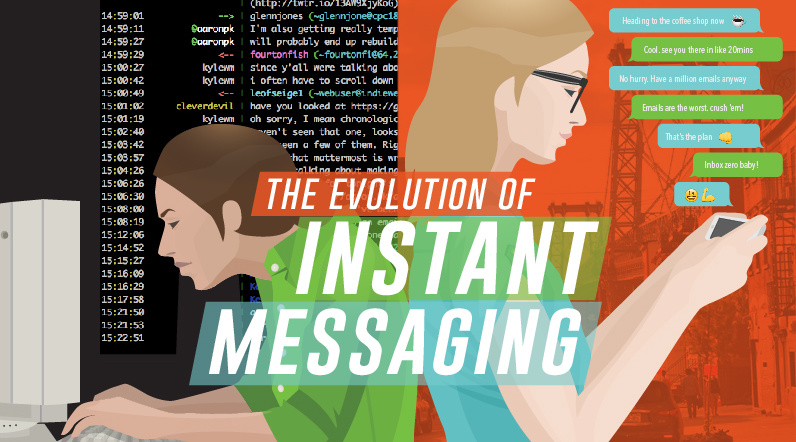
The Evolution of Instant Messaging

The concept of instant messaging crossed into the mainstream in the 1990s, allowing friends, acquaintances, colleagues, and like-minded thinkers from all over the world to connect in real-time.
Since then, instant messaging has revolutionized how we communicate, and today over 2.5 billion people are signed up for at least one messaging app. The present IM experience is seamless, and it intuitively integrates features like video, photos, voice, e-commerce, and gaming with plain-old messaging.
However, despite the impressive features of dominant apps like Snapchat, Facebook Messenger, and Whatsapp, today’s technology would simply not be possible without the earlier breakthroughs of their more rudimentary predecessors.
Instant Messaging: Past, Present, and Future
The following infographic from Hello Pal, a messaging app allowing for instant translation, shows the evolution of instant messaging. It pays homage to the advancements made in the early days by apps such as ICQ or AIM, while also looking at the trends in IM that will surface in the coming years.

While messaging is commonplace today, it was only two decades ago that chatting with friends and strangers online was a revolutionary concept.
The History of Instant Messaging
1961 – MIT’s Compatible Time-Sharing System (CTSS), along with other multi-user operating systems, helps to pioneer instant messaging by allowing up to 30 users to chat in real-time.
1988 – Internet Relay Chat (IRC) allows users to connect to networks with client software to chat with groups in real-time. IRC peaked in popularity in the 1990s, but still has hundreds of thousands of users today.
The late 1990s sees the first major competing IM platforms arrive: ICQ, AIM, MSN, and Yahoo all fight for market share in the new instant messaging market.
1992 – The first SMS message, “Merry Christmas”, is sent over the Vodafone GSM network in the U.K. in December.
1996 – Israeli company Mirabilis launches ICQ, which allowed users to chat one-on-one or in groups, exchange files, and search for other users. At its peak in 2001, ICQ had over 100 million accounts registered.
1997 – AOL launches AOL Instant Messenger (AIM), which pioneers the “Buddy List” concept. By the mid-2000s, AIM has the largest share of the instant messaging market in North America with 52%.
1998 – Yahoo! Messenger launches, allowing users with a Yahoo! ID to connect.
1999 – Microsoft releases MSN Messenger, a competitor to AIM and Yahoo. By 2005, roughly 2.5 billion messages are sent each day on the platform.
1999 – Across the Pacific Ocean, Tencent Holdings launches its first successful app. It’s called QQ, and it is initially a near-exact clone of ICQ.
To many, the 2000s is a Golden Age for instant messaging. Sharing photos, making video calls, and playing games are now common platform features
2001: By this time, only 30 million SMS text messages are sent per month in the United States.
2002: Apple launches iChat for its Mac OS X operating system, which is compatible with AIM.
2003: Skype allows Internet users to communicate with others through video, voice and instant messaging.
2005: Google Talk, available in a Gmail user’s window, is launched to allow easy communication between email contacts.
2006: MySpace launches the first instant messaging platform built within a social network: MySpaceIM.
2006: Market Snapshot (US Market)
- AIM: 53 million
- MSN: 27 million
- Yahoo: 22 million
- Google: 866,000
2006: By this time, 12.5 billion SMS text messages were sent each month in the United States
2008: Facebook Chat is released, allowing Facebook users to message friends or groups of friends on the social network. (Later on, Facebook would release a standalone mobile app version called Facebook Messenger in 2011.)
2009: An upstart WhatsApp allows users to text, send video, and audio for free.
Instant messaging undergoes a renaissance in the 2010s, as new apps like Snapchat, WhatsApp, and WeChat change how the game is played.
The popularity of new platforms change the concept of messaging entirely:
WeChat (2011)
Initially started by Tencent as a clone of WhatsApp, WeChat is now much more than a chat app. It’s a fully integrated mobile platform with shopping, payments, games, and much more.
WeChat processed $46 billion in payments in January 2016 – that’s about as twice as much as Paypal.
Snapchat (2011)
Snapchat, which is popular with millennials, allows users to send “snaps” which disappear after an allotted amount of time.
The app has evolved into a mix of private and public content, including brand networks and coverage of live events.
Slack (2013)
Slack’s workplace collaboration software allows teams to communicate easily and efficiently.
Slack was the fastest company to hit “unicorn” status ever, taking just 1.25 years to be worth over $1 billion.






Technology
Ranked: Which States Use AI the Most?
Some states are adopting AI at nearly double the rate of others. This map shows America’s emerging AI divide.


Ranked: Which States Use AI the Most?
See visuals like this from many other data creators on our Voronoi app. Download it for free on iOS or Android and discover incredible data-driven charts from a variety of trusted sources.
Key Takeaways
- Washington, D.C. leads the nation in AI adoption, with 40.3% of working-age residents using AI.
- Maryland, Utah, Texas, and Virginia round out the top five states for AI usage.
- Americans living in metro counties use AI at roughly twice the rate of those in rural counties.
Despite leading the world in AI investment and development, AI adoption remains uneven across the United States.
This map ranks every state by the share of working-age residents using AI in Q1 2026, based on Microsoft estimates of people who engage with AI for at least 90 minutes per month.
Washington, D.C. leads the nation, while several Sun Belt and Mid-Atlantic states rank among America’s fastest adopters.
AI Adoption by State in 2026
The following table shows the share of adults ages 15 to 64 using AI in every state.
| Rank | State or District | Share of Working-Age Population Using AI Q1 2026 |
|---|---|---|
| 1 | District of Columbia | 40.3% |
| 2 | Maryland | 36.3% |
| 3 | Utah | 35.7% |
| 4 | Texas | 35.3% |
| 5 | Virginia | 34.7% |
| 6 | New Jersey | 34.5% |
| 7 | Nevada | 34.2% |
| 8 | California | 34.0% |
| 9 | Connecticut | 34.0% |
| 10 | Georgia | 33.7% |
| 11 | Florida | 33.6% |
| 12 | Massachusetts | 33.4% |
| 13 | Illinois | 33.3% |
| 14 | New York | 32.7% |
| 15 | Rhode Island | 32.5% |
| 16 | Colorado | 32.3% |
| 17 | Washington | 32.2% |
| 18 | Arizona | 31.4% |
| 19 | Hawaii | 30.6% |
| 20 | Delaware | 30.6% |
| 21 | New Hampshire | 30.2% |
| 22 | North Carolina | 30.1% |
| 23 | South Carolina | 29.1% |
| 24 | Oklahoma | 28.9% |
| 25 | Idaho | 28.8% |
| 26 | Kansas | 28.6% |
| 27 | Tennessee | 28.5% |
| 28 | Oregon | 28.4% |
| 29 | Ohio | 28.3% |
| 30 | Wisconsin | 28.2% |
| 31 | North Dakota | 28.2% |
| 32 | Michigan | 27.4% |
| 33 | South Dakota | 27.4% |
| 34 | Alabama | 27.3% |
| 35 | Pennsylvania | 27.2% |
| 36 | Indiana | 26.8% |
| 37 | Missouri | 26.8% |
| 38 | Nebraska | 26.4% |
| 39 | Minnesota | 26.3% |
| 40 | Louisiana | 26.1% |
| 41 | Arkansas | 26.0% |
| 42 | Wyoming | 25.5% |
| 43 | Kentucky | 25.1% |
| 44 | Iowa | 24.4% |
| 45 | New Mexico | 23.9% |
| 46 | Alaska | 23.6% |
| 47 | Vermont | 23.3% |
| 48 | Mississippi | 22.9% |
| 49 | Montana | 22.7% |
| 50 | Maine | 21.4% |
| 51 | West Virginia | 20.8% |
| -- | 🇺🇸 U.S. Average | 31.3% |
State averages only tell part of the story.
At the county level, adoption rates can be dramatically higher. Williamsburg, Virginia, home to William & Mary, recorded the highest AI adoption rate in America at 73.2%, highlighting the outsized role that university and research communities play in spreading new technologies.
The Geography of AI Adoption
One of the clearest patterns in the data is the gap between metro and rural America.
According to Microsoft’s estimates, 32.9% of metro-county residents use AI, compared with 16.2% in rural counties. As a result, adoption is roughly twice as high in urban areas.
The gap largely reflects where knowledge-work jobs are concentrated. Metro areas have higher shares of workers in technology, finance, consulting, education, government, and professional services, where AI tools are increasingly used for writing, coding, research, analysis, and administrative work.
Rural areas, by contrast, generally have fewer digital-intensive jobs. That does not mean AI has less potential there, but adoption may progress more slowly if workers have fewer opportunities to encounter the technology in their day-to-day work.
In practical terms, Americans in large metro areas are more likely to be exposed to AI at work, trained on AI tools, and pushed to adopt them by employers.
Why D.C., Maryland, and Utah Rank So High
Washington, D.C. ranks first, with 40.3% of working-age residents using AI.
The result reflects the region’s concentration of government, legal, consulting, policy, and research jobs. These are fields where AI can be used to summarize documents, draft communications, analyze information, and speed up knowledge work.
Maryland ranks second at 36.3%, aided by its proximity to Washington, D.C. and its large base of contractors, cybersecurity firms, and research institutions.
Utah ranks third at 35.7%, offering one of the clearest examples of strong AI adoption outside the traditional coastal tech hubs. The state’s younger workforce and growing tech sector have helped make it one of America’s fastest-adopting AI markets.
Texas, Virginia, New Jersey, Nevada, and California also rank near the top, showing that AI use is spreading across a mix of tech hubs, business centers, and fast-growing states.
Why This Matters
As AI becomes a standard workplace tool, adoption rates may increasingly influence which regions attract investment, talent, and high-paying jobs.
Areas where workers are already using AI at scale could gain productivity advantages and become early beneficiaries of AI-driven growth. Meanwhile, regions with lower adoption rates may face pressure to catch up as businesses integrate AI into everyday operations.
In that sense, today’s AI adoption map may offer an early glimpse into tomorrow’s economic geography.
Learn More on the Voronoi App 
To learn more about this topic, check out this graphic on the jobs most exposed to AI.
Technology
How People Are Actually Using AI at Work in 2026
Employees now use AI more for decision-making and reasoning than routine admin tasks.


How People Are Actually Using AI at Work in 2026
See visuals like this from many other data creators on our Voronoi app. Download it for free on iOS or Android and discover incredible data-driven charts from a variety of trusted sources.
Key Takeaways
- Decision-making is now the #1 workplace AI use case at 28% of activity.
- Workers use AI more for reasoning and analysis than for routine admin tasks.
- Documentation and information gathering remain major everyday AI workflows.
The biggest use case for AI at work isn’t writing emails or generating images. It’s helping people make decisions.
According to the Microsoft Work Trend Index, decision-making accounts for 28% of workplace AI activity across more than 100,000 Microsoft 365 Copilot chats analyzed globally in February 2026.
The findings suggest workplace AI is evolving beyond simple productivity tasks. Instead of functioning mainly as an automation tool, AI is increasingly being used to analyze information, evaluate options, and support human judgment.
That shift challenges one of the biggest assumptions around AI adoption: that repetitive admin work would dominate office AI usage.
How AI is Actually Being Used at Work
Here’s a breakdown of the most common ways workers are using AI today.
| Activity | Share of Activities 2026 | Category |
|---|---|---|
| Decision-making | 27.5% | Analyzing, reasoning, and deciding |
| Data analysis | 5.5% | Analyzing, reasoning, and deciding |
| Creative thinking | 4.9% | Analyzing, reasoning, and deciding |
| Information processing | 3.1% | Analyzing, reasoning, and deciding |
| Quality assessment | 2.8% | Analyzing, reasoning, and deciding |
| Compliance review | 2.5% | Analyzing, reasoning, and deciding |
| Work planning | 1.0% | Analyzing, reasoning, and deciding |
| Strategy development | 1.0% | Analyzing, reasoning, and deciding |
| Scheduling | 0.4% | Analyzing, reasoning, and deciding |
| Knowledge updating | 0.3% | Analyzing, reasoning, and deciding |
| Team communication | 8.4% | Interacting with others |
| Information interpretation | 4.5% | Interacting with others |
| Admin work | 1.4% | Interacting with others |
| Ext communication | 1.3% | Interacting with others |
| Public engagement | 0.7% | Interacting with others |
| Advising others | 0.6% | Interacting with others |
| Conflict resolution | 0.5% | Interacting with others |
| Coaching others | 0.4% | Interacting with others |
| Relationship building | 0.3% | Interacting with others |
| Persuasion & influence | 0.3% | Interacting with others |
| Staffing | 0.3% | Interacting with others |
| Caregiving support | 0.3% | Interacting with others |
| Teaching & training | 0.1% | Interacting with others |
| Documentation | 11.7% | Producing work |
| Computer work | 4.7% | Producing work |
| Object handling | 0.3% | Producing work |
| Getting information | 13.0% | Information gathering |
| Estimation | 1.3% | Information gathering |
| Process monitoring | 0.5% | Information gathering |
| Identification | 0.2% | Information gathering |
| Equipment inspection | 0.2% | Information gathering |
AI Is Replacing Less Routine Work Than Expected
Decision-making alone represents a larger share of workplace AI activity than many traditional office tasks combined, including documentation, scheduling, and administrative work.
That runs counter to many early predictions about AI adoption. Initial concerns focused heavily on automating repetitive office tasks, but workers are increasingly using AI for higher-level thinking: analyzing information, weighing tradeoffs, and making decisions faster.
At the same time, communication-heavy work remains relatively limited by comparison. Tasks like advising others, conflict resolution, coaching, and public engagement collectively account for only a small share of overall AI usage.
The data suggests AI currently performs best in structured thinking tasks, while relationship-driven work remains far more human.
Why Documentation Still Matters
Even as AI expands into decision-making and analysis, traditional productivity tasks remain a major part of daily usage.
Documentation accounts for 12% of workplace AI activity, while finding information makes up another 13%.
That reflects how quickly AI tools are becoming embedded into everyday office workflows, from summarizing meetings and drafting reports to researching information and organizing internal knowledge.
For many workers, AI is no longer a specialized tool. It is increasingly becoming part of the default workday.
What This Says About the Future of Work
The first wave of workplace AI focused heavily on generating content such as emails, meeting summaries, and documents. Now, the technology is increasingly being used for something broader: helping people think through decisions.
If these trends continue, the workplace of the future may rely less on AI to fully automate jobs and more on AI to enhance how people think, analyze, and make decisions every day.
Learn More on the Voronoi App
To learn more about this topic, check out this graphic on the smartest AI models in 2026.
-
 Economy3 weeks ago
Ranked: The 30 Highest-Paying Jobs in America
-
Maps4 weeks ago
Mapped: America’s Most-Spoken Languages After English and Spanish
-
Politics3 weeks ago
Ranked: The World’s Most & Least Free Countries
-
Environment4 weeks ago
Ranked: Countries With the Highest Water Use Per Person
-
Energy2 weeks ago
Ranked: Who Controls the World’s Uranium Supply?
-
Economy3 weeks ago
Ranked: The World’s Biggest Economies by 2031
-
population4 weeks ago
The Fertility Rate of Every Country in the World
-
Misc2 weeks ago
Ranked: The Hardest Languages for English Speakers to Learn


