

Abstract and Introduction
Background and Aim: The current diagnostic methods for detecting Helicobacter pylori infection include rapid urease test (RUT), urea breath test (UBT), histology, culture, and serum antibody detection. The present study evaluated the efficacy of a novel highly specific test, an immunological RUT (IRUT), that uses a monoclonal antibody against H. pylori urease.
Methods: The clinical evaluation of the IRUT was performed in 100 subjects. Each gastric mucus sample obtained during endoscopic examination was incubated for 15 min with a solid tip coated with monoclonal antibody for H. pylori urease, and then the tip was introduced into a pH-monitoring cell containing urea solution. The change in pH of the solution after the enzymatic reaction (delta pH) was measured. The performance of the IRUT was compared with culture, histology, RUT, and UBT.
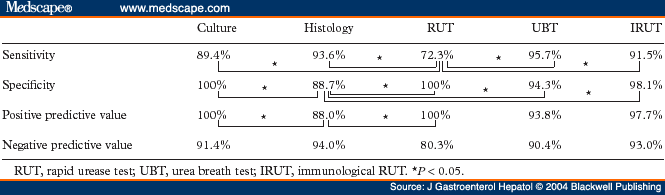
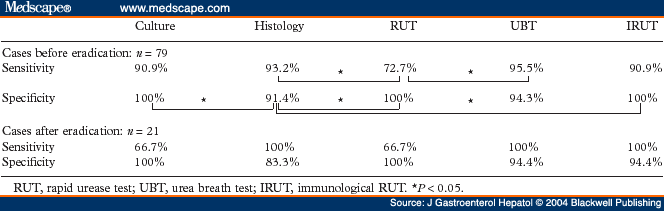
Results: Of the 47 H. pylori-positive subjects, 43 were IRUT positive (sensitivity, 91.5%), and of the 53 H. pylori-negative subjects, 52 were negative (specificity, 98.1%). Compared with the usual diagnostic methods, IRUT had high sensitivity and specificity for the detection of H. pylori and was no less efficient.
Conclusions: IRUT is a sensitive, specific and very rapid (within 20 min) method of detecting H. pylori infection.
Since the report of Marshall and Warren[1] there has been general agreement that Helicobacter pylori is closely associated with gastroduodenal disorders such as gastritis, peptic ulcer, and gastric cancer.[2] The current diagnostic methods for detecting H. pylori infection include rapid urease test (RUT), urea breath test (UBT), histology, culture, and serum and urinary antibody detection.[3,4] Some of those methods are based on the high urease activity of H. pylori,[5,6] but because they detect all enzyme activity of urease regardless of its origin, there is the possibility that urease derived from other bacterial species, such as Proteus mirabilis or Klebsiella pnuemoniae, will confound the result.
In the immunological RUT (IRUT), H. pylori-specific urease adsorbed onto a solid-phase tip coated with a monoclonal antibody against H. pylori urease is incubated with a urea solution in a urease analyzer comprising a flow-through cell for the solution, after immunological reaction with the patient's gastric mucus sample. The resulting change in pH of the solution (delta pH) is measured by ion-sensitive field-effect transistors within the cell.[7,8] We have previously used the IRUT for the detection of H. pylori infection[9] and the purpose of the present study was to analyze its efficacy in comparison with four conventional methods of detecting H. pylori; that is, RUT, UBT, histology and culture.
J Gastroenterol Hepatol. 2004;19(9) © 2004 Blackwell Publishing
Cite this: Immunological Rapid Urease Test Using Monoclonal Antibody for Helicobacter Pylori - Medscape - Sep 01, 2004.



Comments