Starting in 1996, Alexa Internet has been donating their crawl data to the Internet Archive. Flowing in every day, these data are added to the Wayback Machine after an embargo period.
Starting in 1996, Alexa Internet has been donating their crawl data to the Internet Archive. Flowing in every day, these data are added to the Wayback Machine after an embargo period.
TIMESTAMPS
The Wayback Machine - https://web.archive.org/web/20111126011444/http://coilhouse.net:80/
ATTENTION, NON-SHOPPERS. Whether you’re purposefully observing Buy Nothing Day or simply opting out of the ravenous corporation-fueled feeding frenzy of Black Friday because you find it all a bit… scary, you can still experience a gawping, consumer hoard horrorshow from the comfort and safety of your own home:
Fresh off the success of their nerdtastic exploration of the Night of the Living Dead cemetary, Cinemassacre decided to visit a certain humble indoor mall located in Monroeville, PA; the very same one featured heavily in George Romero’s original (1978) Dawn of the Dead film.
If you’re familiar with the movie, it’s adorkably entertaining. If you’re not, be sure to click on a corpse below; the photo links to a full YouTube Coilhouse Black Friday 2011 playlist comprised of choice cuts of the original Dawn of the Dead tidbits, and some other fun stuff.
Ya just can’t put a price tag on good, clean, satirical zombie fun!
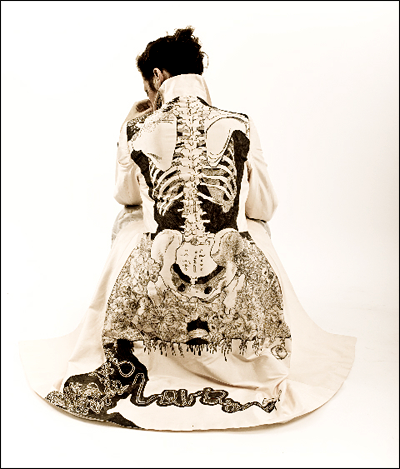
Beautiful hand-drawn coat by Jamie Avis. Jamie drew this using 10 felt-tipped pens. More images here. [via bloodmilk]
“Socks Anatomy” designed by Anton Repponen. Sadly, this is just a concept design, but you can find real anatomical socks (not a impressive, but still cute) in the Haute Macabre comment thread, where this was found.
I honestly have no idea what exactly is going on in this video for the Fleet Fox’s “The Shrine/An Argument. It seems to tell of the life and death of an ultra-violent deer who seems to have a tiny fish person living inside it. Or something. No doubt, there is dense symbolism and metaphor involved here but honestly, I’m not sure if decoding it is really a priority, especially when it’s so beautiful. Director Sean Pecknold, who also animated it along with Britta Johnson, films the characters, designed by Stacey Rozich (whose style reminds me a bit of Andy Kehoe), heavily vignetted which, combined with the paper doll quality to the animation, gives it strange, dreamlike quality. It also gives the impression of being far older than it actually is, like you’re watching something by Lotte Reiniger. The whole thing is simply mesmerizing.
Vinicius Quesada is a collage/street artist from São Paulo, Brazil. In 2010, he created a series of dystopian images titled Blood Piss Blues, “with real blood.”
Details abound in the works of Joe Fenton. Amidst the twisting, mouth-tipped flora are dozens of tiny figures. There heads are simply eyeballs or animal skulls or something almost like a brain crossed with a Piranha Plant. All nude, some are lithe and sensuous, others cherubic. Look closer still and you begin to see a second set of figures, tiny imps with horns or wings sprouting from their spherical forms. There’s an aura of mysticism throughout his work, as if the pieces illustrate some esoteric religion. Visually dense, his work manages to just avoid overwhelming the viewer and turning each piece into a tangle of lines. It’s worth visiting his site, so as too look at these at a much higher resolution than our pages allow. There’s a video, below, of Fenton working on his painting The Lullaby, giving a brief glimpse into the amount of work that goes into one of these.
Good morning! On this day in 1965, in Reykjavík, Iceland, a strange and delightful being called Björk Guðmundsdóttir was born. Or hatched out of a pod. Or was ejected from a volcano. Or something. Whatever.
Anyhoo… 46 years later, she’s still brimming with vim, vigor, and weirdness. Coilhouse has compiled a massive YouTube playlist of her music videos to honor the occasion of her whelping, and hopefully help you to wake your ass up on this glacially chilly November morn.
According to GLAAD, there has been an alarming global increase in brutal violence against LBTGQ people in recent years. More specifically, nearly two hundred transphobic murders were documented last year by the Transrespect vs Transphobia project. Statistics compiled by Trans Murder Monitoring assert that approximately every 72 hours, a trans person is murdered somewhere in the world. The countries with the most transphobic murders last year were Brazil, the United States, and Honduras.
These numbers only show us parts of a far bigger and more disturbing picture, as there are many countries where little, if any data, has been recorded. Nor do any of the statistics above include the gut-wrenching number of people who have been driven to take their own lives. Something to bear in mind: according to a National Gay and Lesbian Task Force / National Center for Transgender Equality survey posted at the National Network of Libraries of Medicine earlier this year, in the United States alone, “a ‘staggering’ 41 percent of the more than 6,400 respondents said they had attempted suicide, compared to a rate of 1.6 percent for the general population.”
From the “Fairy-God, Fashion Mother” series by Hormazd Narielwalla.
Born in India of Persian-Zoroastrian ancestry and now living London, artist Hormazd Narielwalla forages for patterns in historic tailoring archives to use in conjunction with his own photography, sketches and digital compositions, giving their forms new life as whimsical narrative works of art.
You can see some lovely examples of Homi’s unique work in our Issue Six feature devoted to Klaus Nomi. The puppet-like pattern collages are taken from Narielwalla (nickame Homi)’s series A little bit of Klaus…a little bit of Homi. Each Nomi figure contains elements extracted from the vintage bespoke pattern blocks of Savile Row tailors, made for customers now long-deceased. We could not have found a more deeply fitting serenade to the operatic, avant-garde style icon than Narielwalla’s work, with its deft mixture of affection, craft, and thoughtfulness. (Thank you again, Homi.)
In the following interview, Narielwalla tells Coilhouse a bit more about his work and his life. His current show, Fairy-God, Fashion-Mother, which features a series of paper collages inspired by cult curator Diane Pernet, will be viewable at The Modern Pantry in London until January 7th.
From Hormazd Narielwalla’s “A Little Bit of Klaus, a Little Bit of Homi” series.
How did you get started making art, and what eventually drew you to this very specific and personal form of creative expression?
I was pursuing a Masters degree at the University of Westminster, aiming to become a menswear designer specializing in alternate ways of communicating fashion. During one of many research meeting with William Skinner (the Managing Director of Savile Row tailors Dege & Skinner), I acquired a single set of bespoke patterns belonging to a customer, now-deceased.
From the “Dead Man’s Patterns” series by Hormazd Narielwalla.
The tailors no longer needed the patterns, as they were made for a shape that no longer exists. With the support of my mentors British designers Shelley Fox and Zowie Broach (from Boudicca), I followed my instinct to divorce the patterns from their original context, viewing them as abstract shapes of the human body instead. That is when and where my first publication, Dead Man’s Patterns, was conceived.