The Internet Archive discovers and captures web pages through many different web crawls.
At any given time several distinct crawls are running, some for months, and some every day or longer.
View the web archive through the Wayback Machine.
From the start, people have likened the American Recovery and Reinvestment Act of 2009, also known as “the stimulus”, to the New Deal’s famous public works program, the Works Progress Administration (WPA) started in 1935.123 Over its eight years, the WPA hired eight million people to work on 1.4 million projects, many of which built roads, bridges, sewers, airports, parks, reservoirs and electric transmission — infrastructure that has lasted decades, some to this day. While the Recovery Act did not hire workers directly, its funding, loans and loan guarantees saved or created jobs for three million people.4 Many of those people worked and are still working on the 45,000 projects that the Recovery Act classifies as infrastructure, transportation or energy/environment.5
Ivanpah Mojave Desert Solar Plant Unit 1 tower
(BrightSource Energy, Inc.)
One of the bigger of those projects, the Ivanpah Mojave Desert solar plant, will stand among the world’s largest, putting out 400 megawatts of electricity. Another big power project, the Caithness Shepherds Flat Wind Farm in Oregon, will stand as the world’s largest wind farm, putting out 845 megawatts. Some of the bigger transportation building projects are the Moynihan Station Amtrak train hall in New York City, the Innerbelt Bridge in Cleveland and the Caldecott Tunnel in Oakland. And one of the biggest of the Recovery Act’s electric vehicle battery projects, the new Johnson Controls advanced battery plant in Holland, Michigan, makes complete lithium-ion battery systems for hybrid and electric vehicles.
WPA Plaque on bridge in Springfield, Ohio
(Ohio Federal Writers’ Project)
Since its start in February 2009, the Recovery Act has completed about 21,000 of the 45,000 infrastructure-type projects, while the rest will continue to course through the domestic economy for another few years. While the Recovery Acts’s running time won’t last as long, the public good from the infrastructure it builds may well last as long as that of the WPA.
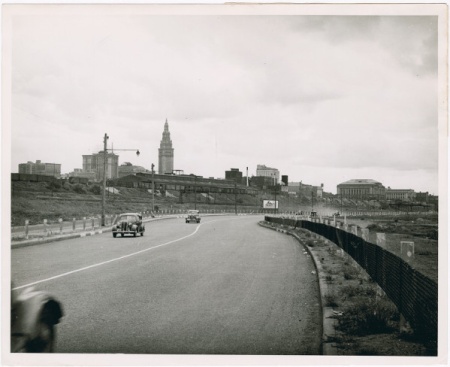
Cleveland Shoreway in 1939 – built by the WPA (Ohio Federal Writers’ Project)
Cleveland Innerbelt Bridge – to be built with Recovery Act funding
(Old bridge to be replaced is ghosted-out in foreground.) (ODOT)
Teachers called to stand and be fired. Providence Journal / Connie Grosh
Political winds seem to be blowing against U.S. teachers. Republican state governments accuse teachers of having lavish benefits, and pass laws to tear-up their contracts and destroy their unions.1 A public school district superintendent refuses to bargain, fires the entire teaching staff, and the Obama Administration applauds.234 These same policy-makers take standardized testing of students, now used, with questionable reliability, to rate schools, and push it to rate — and fire — teachers.5678 All of these actions seem to come from a notion that there are a great many bad teachers that should be fired and lazy teachers that could be threatened into working harder. But who has seen many of these bad and lazy teachers? Among my 50 or so public school teachers from kindergarten through twelfth grade, all but one did a passable job or better. The one who didn’t was just old and too unaware to rein in her wild ninth-graders, and soon retired. Nevertheless, let’s count her as failing, giving us one-in-fifty, 2% of teachers that could not do the job. That hardly makes a great many. Now think back on all of your teachers, K through 12. Leaving aside whether you liked a teacher, what percent really did not do a passable job?
Almost cut my grass.
It happened just the other day.
It’s getting kind of long.
I could’ve said it was in my way.
But I didn’t, and I wonder why …
Well, I did eventually cut my grass, but not till latter May. And it’s no wonder why — I’m slow to mow to start with, and the very rainy spring in the land south of Lake Erie this year often left the yard too soggy to mow.1 But the lack of mowing had a benefit — a nice showing of wildflowers, with honeybees working them. And it saved some time and gasoline. So, I imagine I’ll let that yard grow again next year — especially since I found some advice on meadow care that suits me: “Mow once a year in early spring before new growth begins.”2 That’s it. So that’s the plan.
Here are some pictures of the yard in bloom, 14 May 2011:
On the last day of March, Ohio governor John Kasich signed the Republicans’ anti-democratic law, Senate Bill 5 (SB5). Soon after, a citizens alliance began using the state’s democratic public referendum law to repeal it.19With 40-some clauses that weaken workers and their unions, SB5 practically cancels the public worker’s right to collective bargaining, which is a form of workplace democracy. 627 SB5 has two clauses that seriously weaken workers’ bargaining leverage.8 One clause, SB5’s first, totally bans strikes. The other bans arbitration in case of no agreement, and lets the public employer choose its own last offer. SB5 also has clauses that weaken the contract. Two ban bargaining for the major benefits of health insurance and retirement. Another allows a public employer to break the employment contract, if the state auditor declares a fiscal watch. Other SB5 clauses weaken the union. For instance, one bans fair share payment by non-union workers to the union for costs of bargaining and upholding their contract. Another classifies more workers as “supervisors”, ineligible for union membership. Yet another bans any bargaining to limit privatization, or compensate the worker for it. But Ohio’s public referendum law empowers citizens to repeal a new law — though it isn’t easy.3 First, a citizens committee gets its ballot language approved by the secretary of state, after which the new law goes on hold until the referendum process plays out. Then the committee has 90 days from the time the newly-passed law was filed to gather the valid signatures of 6% of the electorate that voted in the last governor’s race, with at least 3% in each of half of the state’s counties. For the referendum on SB5, that meant 231,149 valid signatures, and about 450,000 signatures total to ensure enough valid ones.4 But the committee got thousands of volunteers to circulate petitions, and ended up with 1,298,301 signatures — nearly three times the goal — from all 88 counties.5 Last Wednesday, one day before the deadline, a parade of 6,000 people and a semi-truck marched through Columbus to deliver the petitions in 1,502 boxes to the secretary of state. Next, the petitions will go to the county boards of elections for validation. And in November Ohio will, with hardly a doubt, hold a public referendum on SB5.
Some countries in the Western Hemisphere have given constitutional rights to non-human entities — with opposite effects on their democracies. While Ecuador and Bolivia stand to strengthen their democracies by declaring human-like rights for Pacha Mama, that is, Nature, the United States, has weakened its democracy by giving human rights to the business Corporation. Ecuador and Bolivia take from their indigenous Andean people a tradition of reverence for Nature as a living being, which encompasses human and all other life.1 In 2008, Ecuador held a national referendum and resoundingly approved a new constitution, in which “Nature, or Pacha Mama, where life is reproduced and occurs, has the right to integral respect for its existence and for the maintenance and regeneration of its life cycles, structure, functions and evolutionary processes.”2 And last year Bolivia, following adoption of a new constitution, wrote similar rights for Nature into its laws. Now persons and communities in those countries, where oil and gas drilling, and mineral mining have ruined much land, and farming has cleared much rainforest, can petition the government on behalf of Nature to stop such damage.3In contrast, the United States takes from its founders a tradition of respect for the “unalienable Rights” of the individual.4 Its 223-year-old constitution has stood to protect those rights, and makes no mention of the Corporation.5 But in 1886, the Supreme Court reporter led his summary of a run-of-the-mill Supreme Court case with a claim that the court had never ruled on — “The defendant Corporations are persons within the intent of the clause in section 1 of the Fourteenth Amendment to the Constitution of the United States, which forbids a State to deny to any person within its jurisdiction the equal protection of the laws.”6 Later court rulings mistakenly used that claim as precedent, and wrongly gave the Corporation equal protection rights.7 Since then, the courts have stretched that errant precedent to give other human rights, such as free speech and privacy, to the Corporation, which has used them to overturn health, safety and environmental laws made by elected legislatures.89 But last year’s Supreme Court ruling using the right of free speech to allow the Corporation to pump unlimited money into elections has fueled a movement to amend the U.S. Constitution to state what the average child could tell you: that the Corporation is not a real person, and does not have human rights.10131112When backed by a constitution that bans human rights for the Corporation and recognizes human-like rights for Nature, a nation’s elected governments — local, regional and national — may better uphold the people’s will for health, safety and a natural environment.
Exclusive: President Barack Obama’s health care law is heading to the rightist-dominated U.S. Supreme Court which may render a decision during the heat of Campaign 2012. Republican jurists are sure to claim that the law violates the “originalist” thinking of the Founders, but Robert Parry offers a differing view. By Robert Parry Today’s American Right is fon […]
Brad Pitt’s new movie, Moneyball, may be about baseball but it also raises larger questions about the importance of applying facts and rationality to achieve a successful outcome, a lesson that the American people might apply to their political judgments, writes Lisa Pease. By Lisa Pease Even if you don’t care for baseball, you’re going to love the new film […]
Pulitzer-winning author Alice Walker sees a reflection of the injustice done to African-Americans in today’s treatment of the Palestinians, leading her to object when the artwork of Palestinian children is barred from U.S. museums and to join a flotilla that challenged Israel’s blockade of Gaza, as Dennis Bernstein reports. By Dennis Bernstein Alice Walker i […]
Special Report: The National Archives has approved an appeal by journalist Robert Parry seeking release of a 30-year-old secret, the address where George H.W. Bush supposedly went on an October weekend in 1980 — when several witnesses put Bush in Paris meeting with Iranians. But it turns out the “alibi witness” is now dead. By Robert Parry A three-decade-old […]
Obama administration officials have been talking tough about Pakistan and its alleged support to militants who have crossed into Afghanistan to attack U.S. forces. But the reality is that Washington has little leverage left after a decade of failed wars, as Gareth Porter reports for the Inter Press Service. By Gareth Porter The U.S. threat last week that “al […]



 Print this article.

 Loading ...


