close
The Wayback Machine - https://web.archive.org/web/20111005022842/http://publicreason.net/

UCSD has just posted a position in Global Justice — at the Associate or tenure-track Assistant level. The position is housed in Political Science and formally designated a “political theory” job, though we are open to other subfields as appropriate.  The position is affiliated with our new Center on Global Justice.  We launched the Center last Spring, at a conference with Amartya Sen, Elinor Ostrom and 25 scholars across disciplines.  www.globaljustice.ucsd.edu  The university has committed to building the Center over the next years, and it will be an exciting opportunity for whomever takes this job.  The Center is committed to “social science research in action” — and refocusing “global justice” from transcendental thinking toward concrete problem  solving, and the identification and amelioration of manifest injustices on the ground.  Applications from philosophers are welcome.

The ad will be posted on APSA shortly, but for now can be found here:  http://polisci.ucsd.edu/faculty/employment.html

If you know any individuals or networks who should know of this opportunity please pass it along.  Thanks.

Gerry Mackie and Fonna Forman-Barzilai, Co-Directors
UCSD Center on Global Justice

“Democracy and Its Critics: Ancient and Modern”, 22 October 2011 at St. Hugh’s College, Oxford University. Organized by the Political Thought Specialist Group of the Political Studies Association of the U.K. The keynote address will be given by Professor Richard Bellamy (UCL / Chair, Britain and Ireland Association for Political Thought). Another keynote speaker will be Dr. Ricardo Blaug (University of Westminster).

As a number of people wrote to me yesterday and today to ask if they can still register for the above conference, I have decided to extend the call for registration for ten more days. So people who did not have the time to register are now given the opportunity to do so until 10 October 2011.

Please send a cheque for £37.00 made payable to “Zenon Stavrinides” to Dr. Zenon Stavrinides, Research Fellow, School of Law, The Liberty Building, University of Leeds, Leeds LS2 9JT, U.K. People from abroad who would prefer to make a bank transfer, please contact Dr. Stavrinides directly (e-mail: z.stavrinides@leeds.ac.uk). The participatory fee will cover mid-morning tea/coffee and biscuits, a sandwich lunch and mid-afternoon tea/coffee and cake.

For queries concerning accommodation please contact me (evangelia.sembou@hotmail.com).Best Wishes,

Evangelia Sembou

Dr. Evangelia Sembou
Convenor, Political Thought Specialist Group of the Political Studies Association of the United  Kingdom
http://www.psa.ac.uk/spgrp/39/polthought.aspx

Readers of Public Reason might be interested in the New Books in Philosophy interview I conducted with Jason Brennan about his new book, The Ethics of Voting (Princeton UP, 2011).  Follow this link.

Cheers,  –Robert Talisse

The Katherine A. Pearson Chair in Civil Society and Public Policy

Applications are currently invited for The Katharine A. Pearson Chair in Civil Society and Public Policy tenable jointly in the Faculty of Arts (www.mcgill.ca/arts) and in the Faculty of Law (www.mcgill.ca/law), McGill University. The appointment is expected to be at the rank of Full Professor. The Katharine A. Pearson Chair in Civil Society and Public Policy was created through a generous gift from the McConnell Foundation.

The Faculties of Arts and of Law seek applications from scholars of international renown with impeccable academic credentials in Arts and in Law, and demonstrated interdisciplinary expertise. The purpose of the Chair is to contribute to the teaching and supervision of undergraduate and graduate students in the two faculties. The holder of the Chair will also be expected to assume leadership within a new Civil Society Program at McGill University, develop new research directions in civil society and foster research grant applications to sustain the Program.

The Civil Society Program will rest on a broad meaning of civil society as an analytic term for the social sciences and humanities. Moving beyond the now-standard opposition of civil society to the State, the Program will explore both formal non-governmental structures and organizations (the “community sector”), and informal associations, practices, beliefs and values that mediate between the self and the State. The Program will study the role of individuals and non-governmental institutional forms, groups, communities and organizations in the development of legal and public policy. It will explore innovative, pluralistic and adaptive approaches to governance in meeting local and global challenges posed by health, environment, personal and economic well-being, social diversity and equity in a context of declining public resources.

The Civil Society Program will draw on McGill University’s identity as a socially important institution in public life in Canada and a respected voice internationally. McGill’s embrace of the advantages of study in Montreal – bilingualism, bicultural and bijural institutions, a cosmopolitan urban setting – are understood as central to the success of this venture. It will focus on Canada as a laboratory for study and public action, and recognize that Canada represents, at its best, a model setting for teaching, research and public outreach on matters relating to civil society in the international community.

Applicants shall provide a letter of intent, a summary of research interests (including proposed research program), complete curriculum vitae, copies of three representative publications, and the names of at least three references to the Staff Appointments Committee by October 15, 2011. However, applications will be accepted until an incumbent for the Chair is found. Email applications are preferred (linda.coughin@mcgill.ca) but hard copy applications can also be mailed to:

Staff Appointments Committee
c/o Dean’s Office
Faculty of Law
McGill University
3644 Peel Street
Montreal, Quebec, Canada, H3A 1W9

All qualified applicants are encouraged to apply; however, Canadians and permanent residents will be given priority. McGill University is committed to diversity and equity in employment. It welcomes applications from indigenous peoples, visible minorities, ethnic minorities, persons with disabilities, women, persons of minority sexual orientations and gender identities and others who may contribute to further diversification.

The conference of the Political Thought Specialist Group of the Political Studies Association of the United Kingdom on the theme of “Democracy and Its Critics: Ancient and Modern” is approaching.

The venue and conference programme is as follows:

DEMOCRACY AND ITS CRITICS: ANCIENT AND MODERN

22 October 2011

at
St. Hugh’s College, Oxford University

09:30-10:00: Arrival / Registration

10:00 -10:10: Welcoming talk by Dr. Evangelia Sembou (Convenor, Political Thought Specialist Group of the Political Studies Association of the United Kingdom)

10:10 -10:50: Keynote Address by Prof. Richard Bellamy (University College London,U.K. / Chair, Britain and Ireland Association for Political Thought) Title to be confirmed

10:50-11:30: Mr. Matthew Landauer (Harvard University, USA),Wagging the Demos? Demagoguery and Popular Decision-Making in Democratic Athens

11:30-12:10: Dr. Jaroslav Danes (University of Hradec Kralove, Czech Republic), Origins of Classical Political Theory as a Criticism of the Ideals, Values and Operation of the Athenian Democracy

12:10-12.50: Dr. Andros Loizou (University of Central Lancashire, UK), Democracy, Polity and Aristotle’s Middle Constitution

13:00-14:00: LUNCH

14:00-14:40: Mr. Barry Macleod-Cullinane (Councillor, London Borough of Harrow), The Agora,the Ballot Box & the Politician: Bertrand de Jouvenel on Democracy& The Enterprise of Politics

14:40-15:20: Dr. Ricardo Blaug (University of Westminster, UK), Information Processing in Public: The Assembly and Its Council

15:20-16:00: Ms. Ana Rita Ferreira (Portuguese Catholic University/University of Minho, Portugal), Social-democratic Ideology: Liberal Democracy’s Best Friend?

16:00-16:20: COFFEE / TEA BREAK

16:20-17:00: Professor Joseph Femia (University of Liverpool, UK), The Classical Elitist Critique of Democracy: a Re-evaluation

17:00 - 17: 40: Ms. Anthoula Malkopoulou (University of Jyvaskyla, Finland), Against Elections: The Political Thought of Abstention

17:40-18:20: Dr. Yossi Nehushtan (The College of Management, Law School, Israel), Is Democracy Possible?

18:20-19:00: Dr. Marta Nunes da Costa (CEHUM, Portugal), Democracy and Democracies - Between Theory and Facts

There is a participatory fee of £37.00, which will cover mid-morning tea/coffee and biscuits, a sandwich lunch and mid-afternoon tea/coffee and cake.

Those interested in attending are kindly requested to send a cheque made payable to “Zenon Stavrinides” to Dr. Zenon Stavrinides, Research Fellow, School of Law, The Liberty Building, University of Leeds, Leeds LS2 9JT, U.K. by 30th September 2011. Please note that for logistical reasons we are now asking interested participants to make cheques payable to “Zenon Stavrinides”. People from abroad who would prefer to make a bank transfer, please contact Dr. Stavrinides directly (e-mail: z.stavrinides@leeds.ac.uk).

Please do not hesitate to contact me (evangelia.sembou@hotmail.com), should you have any queries (including questions about accommodation in Oxford).

Dr. Evangelia Sembou
Convenor, Political Thought Specialist Group of the Political Studies Association of the United Kingdom
http://www.psa.ac.uk/spgrp/39/polthought.aspx

This year, we’re looking for a tenure-track Assistant Professor in Moral and Political Philosophy with interdisciplinary research and teaching interests. It’s a 2/2 load, including a graduate seminar. Applications should be received by 14 November and applicants MUST complete the online application (per university policy) in addition to sending the department a complete dossier. Here’s the ad that will appear in the JFP:

Virginia Tech, Blacksburg, VA. The Department of Philosophy and the interdisciplinary program, the Alliance for Social, Political, Ethical, and Cultural Thought (ASPECT), invite applications for a tenure track position in the Philosophy Department, to begin August 10, 2012.

Rank: Assistant Professor
AOS: Moral or Political Philosophy
AOC: Moral and Political Philosophy

The department is a major component of the ASPECT interdisciplinary PhD program. Since this position is part of an ASPECT cluster hire, the successful candidate will have a special interest in and a commitment to interdisciplinary teaching and research connected with the ASPECT program.

Teaching load is four courses per year, including one graduate seminar. Evidence of excellence in research and teaching required. Salary: competitive. Ph.D. completed by August, 2012

The department offers a strong MA in Philosophy, and is also involved in an interdisciplinary PhD program in Science and Technology Studies. Virginia Tech is an EO/AA employer and particularly encourages applications from women, veterans, persons with disabilities, and minorities.

Interested candidates are REQUIRED to complete a brief on-line application at www.jobs.vt.edu (posting # 0110928) and send dossier (cover letter with statement of interest, CV, 3 letters of recommendation, graduate transcripts, a writing sample, and evidence of teaching excellence) to ASPECT Search Committee, Department of Philosophy—0126, Virginia Tech, Blacksburg, VA 24061. We will begin reviewing applications as soon as they are received, until the position is filled. Applications should be received by November 14, 2011, for full consideration.

Here are podcasts from a lecture series on the state, which took place recently at the University of Oxford. The lectures are by Stefan Bird-Pollan (University of Kentucky), Nadia Urbinati (Columbia University), Thomas Pogge (Yale University), Erika de Wet (University of Pretoria), Paul Guyer (University of Pennsylvania), and Quentin Skinner (Queen Mary, University of London). Please follow this link: http://beta.podcasts.ox.ac.uk/series/state-state

Cheers, Reidar Maliks

“DEMOCRACY AND ITS CRITICS: ANCIENT AND MODERN”, 22 OCTOBER 2011, ST. HUGH’S COLLEGE, OXFORD UNIVERSITY

This is a reminder that the Political Thought Specialist Group of the Political Studies Association of the United Kingdom
will hold an one-day conference on the theme of “Democracy and Its Critics: Ancient and Modern” at St. Hugh’s College, Oxford on Saturday,
22nd October 2011. For the conference programme please go to http://www.psa.ac.uk/spgrp/39/PolThought11.pdf.

There is a participatory fee of £37.00, which will cover mid-morning tea/coffee and biscuits, a sandwich lunch and mid-afternoon tea/coffee and cake.

Those who would like to attend are kindly requested to send a cheque made payable to “Political Thought Specialist Group of the
PSA” to Dr. Zenon Stavrinides, Research Fellow, School of Law, The Liberty Building, University of Leeds, Leeds LS2 9JT, U.K. by 30 September 2011. People from abroad who would prefer to make a bank transfer should contact Dr. Stavrinides (z.stavrinides@leeds.ac.uk).

There will be a small number of rooms in university accommodation for those traveling from afar. Please contact me (evangelia.sembou@hotmail.com) for more information (including guest houses and hotels in Oxford).

Moreover, please do not hesitate to contact me or Dr. Zenon Stavrinides (z.stavrinides@leeds.ac.uk), should you have any more queries.

Dr. Evangelia Sembou
Convenor, Political Thought Specialist Group of the Political Studies Association of the United Kingdom
http://www.psa.ac.uk/spgrp/39/polthought.aspx

Jason Brennan (Georgetown) and I (Bowling Green) have put together a conversation on public reason/political liberalism and its treatment of religious contributions to public life (which would not have been possible without the help of the great folks over at Phil TV, especially David Killoren). In the video, I argue that there are relatively unexplored versions of public reason that are considerably friendlier to religious contributions to public life than public reason’s proponents and detractors believe. Jason presents me with a number of sharp challenges and observations.

Watch us here.

Public Reasoners,

I am pleased to announce the premier of the Twin Cities Review of Political Philosophy. TC Review is a journal that combines scholarship from professionals and academics written toward an undergraduate audience as well as research work from undergraduates. Our undergraduate staff worked hard to get this issue assembled, but it also could not have happened without the wonderful student papers submitted to the Review as well as the cooperation and support of senior faculty from around the country, many of whom are fellow public reasoners. If I may be permitted one last thank you in this space, the posting of our Call for Papers on Public Reason was met with numerous responses, so we all wish to express our gratitude for everyone who goes into making this online community what it is. We have PDF files for those interested that are accessible from the link at the beginning of the paragraph, but I thought I would also take the liberty of adding a link to a site where you can read the review from your web browser. Thanks again to all.

Public Reasoners might be interested in checking out the interview I conducted with Elizabeth Anderson about her recent book, The Imperative of Integration, for New Books in Philosophy. 

Follow this link.

Cheers,

–Bob Talisse

Tulane University Center for Ethics and Public Affairs | Deadline: 15 November 2011

This is a great fellowship opportunity in a great place:

The Murphy Institute’s Center for Ethics and Public Affairs at Tulane University invites applications for up to three Faculty Fellowship positions for the 2012-2013 academic year. These fellowships are available to support outstanding faculty whose teaching and research focus on ethics, political philosophy, political theory, or questions of moral choice in areas such as, but not restricted to, business, government, law, economics, and medicine. While fellows will participate in conferences and seminars organized by the Center, they will be expected to devote most of their time to conducting their own research. Faculty Fellows receive a stipend of 60,000 USD and are eligible for Tulane faculty benefits, including health insurance. Applicants should hold a doctorate in philosophy, political science, political theory, or political economy (or a related discipline), or a professional, terminal degree in a field such business, law, or medicine, at the time of application. Tulane University is an affirmative action/equal opportunity employer. Women and minorities are encouraged to apply. Required application materials include the completed fellowship application form, curriculum vitae, project description with bibliography, scholarly paper, and 2 reference letters. Applicants must submit their materials via Academic Jobs Online website. For more information and the application form click here or contact Margaret Keenan at mkeenan [at] tulane.edu or 504-862-3236.

I’d like to thank all of you who sent me comments on the RNR (”Foundations of a Nonideal Theory of Justice”) I posted here the other week. Almost all of you homed in on a problem with the Side-Constraint Principle that had been worrying me: its unexplained (and unjustified) reference to ideal primary goods.  I’ve now fixed the issue and would like to post the paper here one final time (old revisions are in red; new ones in blue) before I send the paper back to the journal later this week.  Any last-minute comments/suggestions/worries would be immensely appreciated.  Again, I really can’t thank you all enough.  Your feedback has been invaluable!

Foundations of a Nonideal Theory of Justice 

Cornell University, 27-28 April 2012 | CFP Deadline: 1 Nov 2011

Via Pinar Kemerli at Cornell:

“From Meydan Tahrir to Wisconsin: Rethinking Revolution, Democracy and Citizenship”

An interdisciplinary graduate student conference, hosted by the political theory graduate students in the Department of Government at Cornell University, April 27 – 28, 2012.

From revolutionary awakenings in the Arab world to protests against austerity measures in Europe and assaults on labor rights in Wisconsin, a “specter is haunting the world” – the specter of democracy and equality. This conference aims to bring together a diverse group of graduate students to discuss the significance of these revolutionary mobilizations and moments of solidarity for political thought. How do unfolding events challenge us to reconsider political concepts such as democracy, revolution, and citizenship? In light of these historical developments, papers might address political possibilities and anxieties unleashed by the current revolutionary enthusiasm: To what extent are these demands for economic equality, labor rights, and democracy compatible with contemporary hegemony of (neo)liberalism? Does the Tea Party as a conservative social movement challenge our ideas regarding the content of democratic politics? Is it the attempt to weaken union rights in Wisconsin that represents an undermining of democratic citizenship, or the recall efforts that have followed them? When are “rebels/protesters” justified in claiming popular authority and taking up “constituent power”? How should we interpret the nationalist discourse and imagery evoked in revolutions? What is at stake in the tendency to present the Egyptian revolution as a radical break from the past, as a distinctively “secular moment”? What do transnational connections between the protesters in Tahrir Square and the public workers of Wisconsin tell us about revolutionary enthusiasm from afar, about democracy’s ‘witness’, or about projection of democratic imagery and metaphor?

We seek papers that will engage a wide range of disciplines, including politics, sociology, developmental sociology, history, anthropology, and near eastern studies. In order to be considered, applicants should email their proposals to cornelltheoryconference [at] gmail.com by November 1, 2011. Proposals should include a two-page c.v. and a prospectus of 500-1000 words.

Decisions will be announced by January 15, 2012.

Hi everyone, I’ve been working on this paper for a number of years, and it is finally under revise-and-resubmit.  Given that I work in a very small department and am not great at networking, I could really use some help vetting my revisions.  I would be very grateful if anyone here is willing to read it and send thoughts about it my way (revisions are in red).  Here is a brief abstract:

This paper systematically extends John Rawls’ original position to nonideal theory, showing how the parties to a “nonideal original position” ought to prioritize four types of nonideal primary goods over Rawls’ principles and priority relations, and then agree to five lexically ordered principles for distributing those goods under nonideal conditions.  All five principles (and their orderings) are also shown to fare very well in reflective equilibrium, cohering with a number of pretheoretic moral intuitions.

Here is the paper: Foundations of a Nonideal Theory of Justice.

Within the last fifty years, interpretation has become one of the most important intellectual paradigms of humanities and social sciences scholarship. Theories about law and literature, philosophy and political thought, history and theology all rely on textual interpretation. Issues such as the role of intentions in the interpretation of texts, the question of whether texts determine, or constrain, interpretations of them, and how much, if any, contextual information is required for their understanding, concern all those disciplines, and call for cross-disciplinary collaboration and exchange. Finally, the simultaneous proliferation of certain interpretive approaches such as ‘hermeneutics’, ‘deconstruction’, and ‘feminist (re)readings’ of texts across disciplinary divides has shown the permeability of these boundaries, and has thus made this call for collaboration even more pertinent.

This conference will provide a setting in which distinguished proponents and critics of some of the prevalent interpretive approaches currently used in humanities and social sciences research are able to engage, for the first time, in a rigorous debate about the advantages and costs of each approach, and to discuss the political assumptions that inform them, as well as aims that drive them.

One of the primary goals will be to evaluate the validity of each interpretive method in reference to the readings it produces when applied to texts. Some of the key questions in this respect include: What is it that each method can or cannot claim to be able to show? To what extent do these methods succeed both in theory and in practice? Do they prevent or improve our understanding of texts? A second focus of the conference is to shed light upon the political dimension of interpretive enterprises and to decode their ideological presuppositions. There has virtually been no interdisciplinary exchange about the question of whether these approaches are ideologically sustained, and if so, whether ideologically charged approaches in turn induce interpreters to systematically ignore some aspects of texts, whilst emphasizing others. Here, consequences will be drawn for the interpretation of politics, widely construed.

Read the rest of this entry »

I’ve been encouraged by a fellow reader of this blog to post an announcement about my two books that have come out in the last year.

Cover of Rawls, Dewey, and ConstructivismThe first is called Rawls, Dewey, and Constructivism (2010), and was reviewed positively on Notre Dame Philosophical Reviews here. You can find the book on Amazon here: USUKCA.

From the publisher:  In Rawls, Dewey, and Constructivism, Eric Weber examines and critiques John Rawls’ epistemology and the unresolved tension - inherited from Kant - between Representationalism and Constructivism in Rawls’ work. Weber argues that, despite Rawls’ claims to be a constructivist, his unexplored Kantian influences cause several problems. In particular, Weber criticises Rawls’ failure to explain the origins of conceptions of justice, his understanding of “persons” and his revival of Social Contract Theory. Drawing on the work of John Dewey to resolve these problems, the book argues for a rigorously constructivist approach to the concept of justice and explores the practical implications of such an approach for Education.

From Notre Dame Philosophical Reviews:  ”Weber’s excellent book raises a constructivist challenge against Rawls’s constructivism… In Rawls’s writings, the reference to Kantian constructivism is so vague as to be essentially meaningless. That is one of the implications of this very useful book.”

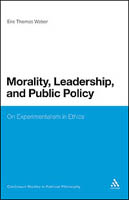
Cover of Morality, Leadership, and Public PolicyThe second book is called Morality, Leadership, and Public Policy: On Experimentalism in Ethics and was released in July of 2011. It is available on Amazon here: USUKCA.

From the publisher:  Informed by the pragmatism of John Dewey, this book argues the practical benefits for public policy of a rigorous experimentalist approach to applying moral theory.

Initial reviews from the back of the book can be read on the US Amazon page for the book or on the publisher’s Web site here.

If you’re interested in reviewing one of these books, you can contact me by email at etweber@olemiss.edu.  Also, you can visit my Web site at http://ericthomasweber.org, where I post info on my academic work as well as materials from public engagement efforts.

Call for Papers

Fall 2014 Symposium:  The Epistemology, Ethics, and Politics of Emergencies

The Editors of Reason Papers are soliciting submissions of manuscripts for a special symposium on emergencies (due by March 1, 2014). Send submissions to reasonpapers@gmail.com. Inquiries welcome.

Submissions may grapple with any of a wide variety of issues related to emergencies (not an exhaustive list): How is “emergency” to be defined?  How do we know when we enter/exit an emergency?  How should moral and legal norms be formulated so as to take stock of emergencies-if they should? Are moral norms defeasible in the face of emergencies, or specially contextualized so as to preserve their indefeasibility? Who has special authority for decision-making in an emergency? How best to guard against abuses of power or corruptions of norms in emergency situations?

We’re looking for submissions across the broadest spectrum of relevant disciplines-philosophy, political science, legal studies, history, sociology, anthropology, medicine, criminology/police studies, strategic/military studies, etc.

International Journal of Theory of Politics - Teoria politica

Obedience and consent in contemporary political systems
Why do we obey one another? How many forms, reasons and/or irrational motives are there behind obedience and disobedience? In Western democracies, passive acquiescence or slothful obedience is widespread: Similar phenomena have been described as «voluntary servitude» (La Boétie), acceptance of «mild despotism» (Tocqueville), effect of «massdemobilization» (Wolin). Today, civil liability is interrupted by episodes of protests and transgressions yet such reactions seem to run out of steam with short notice, without having had any significant effect on the general political arrangements. How are such reactions related to people’s profound mistrust in current institutions (Rosanvallon)? Is apathy here best understood as anti-politics and a font of populist degeneration? More generally, what relationships are there between democracy and consent? What kind of consent? By whom? For whom or for what, on whom or on what? How can we measure the distance between critical and uncritical consent, free and manipulated consent or consent extorted by threats and flattery, or shaped by dreams and nightmares forged by the media, or consent that is simply bought? Which forms of consent grounds «audience democracy» (Manin)? Are these phenomena specific toestablished democracies? Is it different elsewhere? Does the so-called Arab spring offer a «fourth wave» of democratization?

Teoria politica particularly welcomes papers on the following topics:
•    The multiple dimensions of obedience and consent in contemporary political systems
•    Passions that strengthen or weaken obedience and consent
•    Formation and use of obedience and consent in political contexts
•    Rules preventing deterioration of consent and obedience
•    New forms of disobedience and dissent

Deadline: November 15, 2011

For editorial criteria, please send an email to teoriapoliticatorino@gmail.com

Application deadline: August 1
Stipend: $25,000 for one-semester or yearlong visitorship
Eligibility and how to apply
Call for applications

CALL FOR ABSTRACTS

The Bowling Green Workshop in Applied
Ethics and Public Policy

Manipulation

March 16-17, 2012

The Bowling Green Workshop in Applied Ethics and Public Policy will take place in Bowling Green, Ohio on March 16-17, 2012. The keynote speaker will be Marcia Baron (Indiana University).

Those interested in presenting a paper are invited to submit a 2-3 page abstract (double-spaced) by September 30, 2011. We welcome submissions in all areas in applied ethics and philosophical issues relevant to public policy. Special consideration will be given to papers relevant to this year’s conference theme: manipulation. The theme is to be construed broadly, however, and we encourage contributions from any area of moral and political philosophy where manipulation is of interest or concern.

Only one submission per person is permitted. Abstracts will be evaluated by a program committee and decisions made in October 2011. Please direct all abstracts and queries to:
pibarra@bgsu.edu

Further information about the Workshop will be available on the workshop website:

http://www.bgsu.edu/departments/phil/conferences/manipulation

The Political Thought Specialist Group of the Political Studies Association of the United Kingdom will be holding a
conference on the theme of “Democracy and Its Critics: Ancient and Modern” at St. Hugh’s College, Oxford University on 22nd October 2011. The conference programme is as follows:

DEMOCRACY AND ITS CRITICS: ANCIENT AND MODERN

22 October 2011
at St. Hugh’s College, Oxford

09:30 -10:00: Arrival / Registration

10:00 - 10:10: Welcoming talk by Dr. Evangelia Sembou (Chair, Political Thought
Specialist Group of the Political Studies Association)

10:10 - 10:50: Keynote Address by Prof. Richard Bellamy (University
College London, U.K. / Chair, Britain and Ireland Association for Political Thought)
Title to be confirmed

10:50 -11:30: Mr. Matthew Landauer (Harvard University, USA)
Wagging the Demos? Demagoguery and Popular Decision-Making in Democratic Athens

11:30 -12:10: Dr. Jaroslav Danes (University of Hradec Kralove, Czech Republic)
Origins of Classical Political Theory as a Criticism of the Ideals, Values and Operation
of the Athenian Democracy

12:10 -12.50: Dr. Andros Loizou (University of Central Lancashire, UK)
Democracy, Polity and Aristotle’s Middle Constitution

13:00 -14:00: LUNCH

14:00 -14:40: Mr. Barry Macleod-Cullinane (Councillor, London Borough of Harrow)
The Agora, the Ballot Box & the Politician: Bertrand de Jouvenel on Democracy& The
Enterprise of Politics

14:40 -15:20: Dr. Ricardo Blaug (University of Westminster, UK)
Information Processing in Public: The Assembly and Its Council

15:20 - 16:00: Ms. Ana Rita Ferreira (Portuguese Catholic University/University of
Minho, Portugal)
Social-democratic Ideology: Liberal Democracy’s Best Friend?

16:00 -16:20: COFFEE / TEA BREAK

16:20 -17:00: Professor Joseph Femia (University of Liverpool, UK)
The Classical Elitist Critique of Democracy: a Re-evaluation

17:00 - 17:40: Ms. Anthoula Malkopoulou (University of Jyvaskyla, Finland)
Against Elections: The Political Thought of Abstention

17:40 -18:20: Dr. Yossi Nehushtan (The College of Management, Law School, Israel)
Is Democracy Possible?

18:20 -19:00: Dr. Marta Nunes da Costa (CEHUM, Portugal)
Democracy and Democracies - Between Theory and Facts

There is a participatory fee of £37.00, which will cover mid-morning tea/coffee and biscuits, a sandwich lunch and mid-afternoon tea/coffee and cake.

It would greatly facilitate our planning and logistics if interested persons would send a cheque made payable to “Political Thought Specialist Group of the PSA” to Dr. Zenon Stavrinides, Research Fellow, School of Law, The Liberty Building, University of Leeds, Leeds LS2 9JT, U.K. by 30th September 2011.

Please do not hesitate to contact the conference organizers, Dr. Evangelia Sembou (evangelia.sembou@hotmail.com)
and Dr. Zenon Stavrinides (z.stavrinides@leeds.ac.uk), should you have any queries (including queries of accommodation).

Dr. Evangelia Sembou
Convenor, Political Thought Specialist Group of the Political Studies Association of the United Kingdom
http://www.psa.ac.uk/spgrp/39/polthought.aspx

We are pleased to inform you that the international conference “Axel Hägerström and Modern Social Thought”, on occasion of the centennial of his 1911 lecture ”On the Truth of Moral Ideas”, will take place on September 23-24 in Uppsala, Sweden.
For information please see the conference website: www.hagerstromcentennial.se

Public Reasoners:

The holiday caused a slight delay in posting my New Books in Philosophy interview with Jerry Gaus about The Order of Public Reason. It has now been posted here.  Please check it out.

Thanks,

–Bob Talisse

Postgraduate Essay Prize, 2011Res Publica: A Journal of Moral, Legal and Social Philosophy

For the seventh year running, Res Publica will be awarding a prize for the best paper submitted by a current postgraduate student in 2011.  This may be in any area of moral, legal, social or political philosophy. Entries should conform to the normal requirements for submissions - please see the website address below for details. 

All entries must be received by 15 October 2011, with the winner to be announced early in 2012  The winner will receive £100 and a year’s subscription to the journal.  The winning essay will be published in Volume 18 (2012).

Previous winners:
Alexandra Couto, ‘Privacy and Justification’ 12.3 (2006)
Alasdair Cochrane, ‘Animal Rights and Animal Experiments: An Interest-Based Approach’ 13.3 (2007)
Göran Duus-Otterström, ‘Betting Against Hard Determinism’ (14.3, 2008)
Seth Lazar, ‘The Nature and Disvalue of Injury’ (15.3, 2009)
Guy Sela, ‘Moral Luck and Liability Lotteries’ (16.3, 2010)
Christopher Nathan, ‘Need there be a Defence of Equality’ (forthcoming: 17.3, 2011)
The prize will be judged by a panel of referees, along with the journal editors.

Entries should be submitted via the journal’s submission website - www.editorialmanager.com/resp/ - and labelled PG Essay Prize.

There is more information on Res Publica on the Springer website at: www.springer.com/11158

Or contact, the co-editors:
Sune Laegaard     laegaard@ruc.dk
Jonathan Seglow  j.seglow@rhul.ac.uk

Hello Public Reasoners!

I write to announce a new podcast, New Books in Philosophy. Carrie Figdor (U of Iowa) and I co-host the podcast, and each episode features an in-depth interview with an author of a newly-published philosophy book. Interviews will be posted on the 1st and 15th of each month. The inaugural interview, posted today, is with Eric Schwitzgebel (UC Riverside), author of Perplexities of Consciousness (MIT Press). An interview with Jerry Gaus (Arizona), author of The Order of Public Reason (Cambridge University Press), will be posted on July 1st. Upcoming podcasts include interviews with Robert Pasnau, Sandy Goldberg, Carolyn Korsmeyer, Fabienne Peter, Jason Brennan, Allen Buchanan, Elizabeth Anderson, and others. Please click over to the NBiP site, and check out what we’re doing.

Here’s a link to the interview with Eric Schwitzgebel.

Cheers,
–Robert Talisse

This summer, the Association for Political Theory will host its first virtual reading group (VRG). The purpose of the virtual reading group is to create a space for a profession-wide discussion on topics of shared interest to political theorists and philosophers, a discussion that will culminate in a round-table discussion during the meeting itself.  All members of APT are invited to participate, including those who will not be able to participate in the conference this year.  Part of the purpose of the virtual reading group is to expand the reach of the high quality conversations among APT members beyond the physical space of the conference.

The 2011 APT Program Committee has selected Martha Nussbaum’s Not for Profit: Why Democracy Needs the Humanities as the subject of discussion.  We believe that the themes of the book connect to the professional, pedagogical, and political concerns that are of interest to many members of the organization, and we hope that Not for Profit will serve as a launching pad for a broader discussion in the profession.

APT members can participate in the VRG at http://aptvrg2011.blogspot.com/ , by submitting comments to the blog (please note that comments cannot be anonymous). Each week, from June 6-August 5, 2011, participants will discuss a new chapter of the book.  All members of APT are invited to participate in virtual discussion.  The VRG will culminate in a round-table session at the annual conference in October featuring Fred Dallmayr (University of Notre Dame) and Arlene Saxonhouse (University of Michigan).  Both the virtual reading group and the round-table session will be co-chaired by Lisa Ellis and Peyton Wofford of Texas A&M University.

Our conversations will get started each week by a guest commentator who will post some reflections and provocations about the chapter.  Then, APT members are invited to participate in the reading group by reading the relevant chapters and posting on the blog.

[APT membership is free; to join, please click this link.]

The schedule is below the fold:

Read the rest of this entry »

MANCEPT Workshops in Political Theory, 8th Annual Conference

Manchester, 31 August - 2 September 2011

Call for papers: Deliberative Democracy, Interests and Partisanship

In the last few years the mainstream theory of deliberative democracy has been criticized because it underestimates the value and role of self-interest and partisanship in the political arena. For this reason, deliberative democracy has been accused of (i) lacking any capacity for guidance in real politics (practical critique), (ii) misrepresenting the very nature of politics (ontological critique) and (iii) excluding the least advantaged and their perspectives from the political realm (normative critique). Should these critiques lead to a revision of the deliberative ideal? And if so, along which lines?

This workshop aims to explore the role that interests and partisanship should play in deliberative democracy. Papers discussing these issues in the light of specific case studies (e.g., international, political, and industrial negotiations) are especially welcome.

The following is a representative (and non-exhaustive) list of topics of discussion:

  • Deliberative constraints: if self-interest is to be included within the scope of democratic deliberation, should we talk of ‘deliberative bargains’? Which values and criteria should constrain these forms of deliberation?
  • Object and site of deliberation: can interests and partisanship play a role in deliberation over any possible topic? Or any possible level (constitutional, legislative, etc.)? Or should they be limited to specific sites and topics?
  • Agents of deliberation: Who are the proper agents in a deliberative bargaining? Which forms of partisanship and political mobilization are compatible with, or should be encouraged by, the ideal of deliberative democracy?

Those who are interested in participating in the workshop are invited to send a short abstract (300-500 words) to Enrico Biale (enrico.biale@unipmn.it) or Valeria Ottonelli (vottonel@nous.unige.it). The extended deadline is the 24th of June 2011.

Further information on the Mancept Workshops can be found at http://manceptworkshops.wordpress.com/.

iPad 2

A lazy question to mark the beginning of summer:

Suppose an academic were to (a) succumb to Apple’s marketing prowess and (b) invest a great deal of time and energy researching/discovering the best ways to make use of his/her new iPad 2, what would be the most valuable information s/he would learn, particularly regarding which apps to get?

I’m primarily interested in using the iPad to read and take notes on books and journal articles, and take it that iAnnotate is (one of) the best apps for that. But I’m also interested in suggestions about the iPad’s capabilities that are not so obvious, i.e., things someone who doesn’t have much time for (b) wouldn’t even think to look for.

Here’s this year’s lineup of political theory panels at the Annual Meeting of the Canadian Political Science Association next week, as organized by Loren King and Colin Farrelly. Of special interest: Carole Pateman’s plenary address, and the workshop on “Global justice and global governance.”

De l’usage du terme « libertin ». Invectives et controverses aux XVIe et XVIIe siècles

Colloque international et Séminaire doctoral transdisciplinaire sur la Renaissance

Université Libre de Bruxelles

Grande Salle du CIERL (17, avenue F.D. Roosevelt)

Mardi 31 mai et Mercredi 1 juin

Organisé par l’Institut interuniversitaire Renaissance et Humanisme (ULB/VUB), le Centre Interdisciplinaire d’Etude des Religions et de la Laïcité (ULB), le PHI - Centre de recherche en Philosophie (ULB, http://phi.ulb.ac.be/) et le Service de philosophie (UMONS)

Avec le soutien du FNRS et de l’Académie Wallonie-Bruxelles.

L’objectif de ce colloque est d’explorer les sens et les éventuelles lignes de cohérence du libertinisme en partant exclusivement des usages attestés du terme “libertin(s)” dans le cadre de controverses morales, théologiques, scientifiques, politiques ou philosophiques au XVIe et XVIIe siècles.

Mardi 31 mai

10 h: Allocution d’ouverture par Manuel Couvreur (Doyen de la faculté de Philosophie et Lettres ULB)

10 h 15 - 11h30

Thomas Berns (ULB) : Introduction : le machiavélien, l’averroïste et le libertin

Jean-Pierre Cavaillé (EHESS) : Les usages polémiques des termes « libertine », « libertinism » en Angleterre, XVIe-XVIIe siècle

Read the rest of this entry »

BERJAYA

The Experimental Month Initiative hosts 17 different experimental philosophy studies designed by 29 philosophers, each working on illuminating a different philosophical question.

Please take a moment to help these philosophers out, either by stopping by the Experiment Month website to fill out a brief questionnaire or by spreading the word about these new studies.


We reach the end of the book. It has been a long-haul and I am grateful to everyone who has been involved. I’m going to use this post to achieve two aims: (a) to summarize the main themes of the book in light of Jerry’s emphases in the conclusion and (b) to discuss the novelties explored in Appendix A.

Discussion and Review

The very first sentence of the Conclusion is illustrative: “The philosopher’s stone that transforms individual goal pursuit into social restraints on goal pursuit is, like other alchemical projects, enticing but misguided” (547). Let’s reflect for a moment on why Gaus begins the conclusion of this 550-page book in this way. Wasn’t this point merely one of many made along the way? Isn’t this just part of the point of the book?

I. Hayek and the Social Contract Tradition

I suggest that if we take Jerry at his word, we can shed light on the deepest themes in the book. First, note that this claim in effect rejects the entire basis of the social contract tradition, a tradition one might easily think that Jerry is defending and extending rather than rejecting. In some sense, Jerry rejects the contract metaphor. The idea that our interest in social morality can ground our reasons to follow social-moral rules (the idea that arguably lies at the heart of the contractarian tradition) must be rejected; and Jerry has tried to show why at great length. Instead, we must adopt an entirely distinct philosophical anthropology, one that is at root deeply Hayekian, for as Jerry says, “Our reason did not produce social order - we did not reason ourselves into being followers of social rules. Rather, the requirements of social order shaped our reason.” This just is Hayek, who wrote:

Man is as much a rule-following animal as a purpose-seeking one. And he is successful not because he knows why he ought to observe the rules which he does observe, or is even capable of stating all these rules in words, but because his thinking and acting are governed by rules which have by a process of selection been evolved in a society in which he lives, and which are thus the product of the experience of generations (LLL, 11).

Many of you know Hayek the classical liberal, but Jerry is following Hayek the social theorist, who attempted to integrate the rationality of rule-following into his philosophical anthropology at the deepest level. Jerry has argued throughout the book that the conception of the person employed within public reason liberalism and liberalism broadly speaking must move in this Hayekian direction. If public reason liberals follow Jerry’s lead, the fundamental structure of public reason and even the nature of the social contract theorists’ project must substantially change. In short, political justification must not begin with deriving the rationality of rule-following from a teleological conception of practical reason. Instead, it must begin with an understanding of the nature of human beings who are already rule-followers and the nature of the moral emotions and cooperative activities that accompany such rule-following. It is in this way that Jerry moves most forcefully away from Hobbesian conceptions of public reason. He goes further by arguing that even the Kantian conception of the person he endorses cannot be constructed out of practical reason alone. Instead, human nature contains Kantian elements for thoroughly Humean-Hayekian-evolution reasons. Our rule-following nature is contingent on our social development (though no less contingent than our goal-seeking nature).

Read the rest of this entry »

This section is very interesting, though it might be less exciting than the others in this chapter. It focuses on the question of state provision of public goods and addressing negative externalities. The last section takes up forms of “practical paretianism”, some very influential today. One of the things distinctive about Jerry’s liberalism is his attitude to a state function that is widely accepted, namely, provision of public goods.

In 25.1 Jerry comments on the quotation from Green that opens the chapter. At the end of the rich passage, Green says “That, however, is the beginning, not the end, of the state. When once it has come into being, new rights arise in it and further purposes are served by it.” Green was not as adverse about the further purposes as we might be. Jerry wishes to examine what further purposes states may serve after it has assumed the role “as interpreter and protector of social morality”. Might there be a function of states as “providers of services and goods that are not morally required”? In our time, ever since the rise in the influence of economics or what used to be called political economy, the first task that comes to mind is the provision of public goods or, more colloquially, the remedying of “market failures” (i.e., externalities). With what are known technically as public goods, the benefits accrue to people independently of their contribution to their production. They thus create what is called a “collective action problem”, which often approximates an n-person PD. The two defining features of a public good are indivisibility (once produced it is available at no additional cost to anyone) and nonexcludability (it is not feasible or efficient to exclude people from enjoying the good). The thought is that states may or should step in and facilitate the production of the good, taxing people for the costs. If all goes well, the result will be mutually beneficial for all or, more colorfully, progress towards the Pareto frontier.

Jerry rightly points out that there are alternative institutions and communities capable of addressing many public goods problems. Given how dangerous state action can be — and I would add, clumsy — Jerry argues that we should seek assistance first in non-statist approaches. But he concedes that there are “times when the state and its coercive power appear to be the only viable way to cope with some problems. In these cases, the provision of public goods is, at least in principle, capable of publicly justifying state coercion” (533). He rightly points out that the costs of providing the good in question must considered when raising the question.

25.2 considers a problem with this abstract case for the state provision of public goods, namely, “that few goods are purely public”. If some Members of the Public prefer no good to particular packages of goods and costs, then no proposal for producing the good will pass. The result is constraining, “a severe restriction on the range of justifiable public policy.”

Read the rest of this entry »

I apologize for my tardiness. I have fallen behind in my readings, but I was also ill this week and am only today rising (from bed). I expect there will be a number of corrections to be made in what I say. [Lesser points and asides are often bracketed.]

Sects 24 and 25 are likely to be as controversial as the others in this chapter. In 24, “Private Property and the Redistributive State”, Jerry defends a three basic propositions:

- Private property rights are justified in Jerry’s theory at a relatively early stage, and this constrains what is to follow.

- Socialism will not figure in the eligible set.

- A variety of redistributive frameworks will also be rejected.

I’ll start with the first (subsect. 24.1). Jerry starts by reminding us that in 18.3 he established private property when considering public justification in conditions of evaluative diversity. There, following a suggestion of an early John Gray, Jerry argues that a jurisdictional conception of private property rights are what “deeply pluralistic social order[s]” need to handle their disagreements. A jurisdictional conception of private property rights understands property as “a sphere in which one’s evaluative standards have great authority for others” (374). [Small point: The name of this account, used by Eric Mack in his interesting account of rights, can mislead if one comes to think that the authority of the property owner rivals the state’s jurisdictional rights. If one wanders onto the land of the US federal government, that is, the land it owns, then one is subject to its authority (in the sense above). But even on one’s own land in the US one is subject to the jurisdictional authority of American government (at different levels), or so the latter claim. US law is supposed to determine what counts as ownership, etc. The state’s authority is jurisdictional in a more elementary sense, I think, than the Mack-Gaus one.]

Jerry grants that property rights depend more on the state than other rights. “… the right to private property must be interpreted and developed, but to a far greater extent than other abstract rights, is definition depends on the state” (509). This is largely true, though Jerry could have used a less misleading word than ‘definition’. And it is always worth remembering that there was a great deal of property prior to the rise of modern states. [The political conditions of medieval life typically defy being categorized as either “states” or “states of nature”.] Again, on the next page: “Thus, far more than other basic rights, the political order determines our rights of property.”

Read the rest of this entry »

MANCEPT Workshops in Political Theory, 8th Annual Conference

Manchester, 31 August - 2 September 2011

Call for papers: Liberalism and the Family

The particular difficulty that liberals have in dealing with the internal affairs of families is now well established and remains a contentious and vibrant area of debate. This broad-based workshop is designed to bring together those who are working on any question related to how liberalism ought to view, and deal with, relationships within the family. We invite any papers, or suggestions for roundtable discussions, related to liberalism and the family.  Here are some suggested questions, although we will consider any proposals and papers related to the broader theme.

With respect to children:

  • To what extent should liberals allow children to be enrolled into comprehensive doctrines?
  • Must liberals ensure children be brought up to be autonomous?
  • Should parents provide public reasons for their treatment of their children?
  • What is the legitimate extent of parental partiality?
  • For what reasons should the state intervene in a child’s upbringing?
  • Is there a specifically liberal approach to thinking about reproductive ethics?

With respect to gender roles:

  • Should liberals abolish the family? Should liberals endorse marriage?
  • What is a just division of labour within the family?
  • How far should liberals be concerned with justice between partners?

With respect to the family within liberal theories of justice:

  • Is the family part of the ‘basic structure of society’? If so, in what way?
  • Can Rawls’s ‘Justice as Fairness’ deal with justice in the family?
  • How can liberal theories of justice adequately represent children in their procedures of construction?
  • Should we be perfectionist in bringing up children?

Please send proposals, abstracts, and any further inquiries to dean.redfearn@manchester.ac.uk by 31 May 2011.

This workshop is part of the annual Political Theory Workshops organised by the Manchester Centre for Political Theory (MANCEPT) in Politics at the University of Manchester. Further details about the conference are available on the website at: http://manceptworkshops.wordpress.com/

Debating Toleration: Attitudes, Practices and Institutions

3 - 5 November, 2011

Faculty of Political Science, University of Pavia (Italy)

Instances of xenophobia, marginalisation and discrimination directed against vulnerable groups are often framed in terms of (in)tolerance on the part of the majority against a minority. Recent cases highlighted in the media include the Swiss referendum which resulted in the banning of new minarets and the expulsion of Roma in France. Yet, while appeals to toleration are often made in order to devise appropriate political responses to such questions, it is far from clear and uncontroversial what such appeals actually mean and require. Are such issues correctly understood and addressed in terms of toleration, or should they instead be interpreted with the aid of other cognate ideals, such as respect or recognition?

The conference invites discussions both of theoretical interpretations of toleration, respect and recognition, and of more applied contributions on the role of these ideals in informing social policies in contemporary democracies.

Participants are invited to address the following questions:
• What does the ideal of toleration require of contemporary societies?
• What particular problems of societal conflict can be usefully analysed in terms of the concepts of tolerance and intolerance?
• Are issues raised by minority claims correctly understood in terms of toleration?
• Are respect and recognition interpretations of toleration, or do they represent different, and sometimes conflicting notions?
• Are group-oriented policies a threat to social cohesion? What alternative policy solutions can be offered to promote a tolerant society?

Keynote speakers

Colin Bird (University of Virginia)
Anna Elisabetta Galeotti (Università del Piemonte Orientale, Vercelli)
Peter Jones (University of Newcastle)

Papers are welcomed from the fields of ethics, political philosophy/theory, law and social policy.

Deadline for paper proposals (500 words): 26 June 2011

Conference registration is free of charge. Accommodation fees and details will be arranged individually.
Anyone who wishes to attend the conference without presenting a paper can write to check availability.
Details about meal arrangements and conference programme to follow.

For further information, or to submit a proposal, please contact: respect[at]iusspavia.it

The conference is kindly supported by the Society for Applied Philosophy (UK) and is a part of the activities carried out within the framework of the RESPECT research project (GA no: 244549), funded under the European Commission’s 7th Framework Programme.

The views expressed during the execution of the RESPECT project in whatever form and or by whatever medium are the sole responsibility of the authors. The European Union is not liable for any use that may be made of the information contained therein.

We are pleased to announce the fourth issue of Dissensus, focused on “Efficacité : normes et savoirs”, directed by T. Berns and D. Pieret, with contributions of G. Jeanmart, T. Le Texier, D. Pieret, G. Brausch, L. Bouquiaux, A. Rouvroy, T. Berns, M. Cervera-Marzal, A. Janvier and V. Bonnet.

Dissensus is the University of Liege (Belgium) peer-reviewed electronic journal in political philosophy. Papers are welcome, in English or French and are to be sent to secretariat.dissensus[at]ulg.ac.be

Dissensus is available on http://popups.ulg.ac.be/dissensus/ and http://www.philopol.ulg.ac.be/dissensus.html.

I’m very happy to say that a symposium on Corey Brettschneider’s Democratic Rights has now been published in Representation. The symposium is based on the contributions to the reading group on the book that took place here in late 2008. (This follows an earlier symposium in the same journal that originated from our earlier reading group on David Estlund’s Democratic Authority.) Representation very generously gave us a lot of space to explore the issues that Corey’s book raises, so people working in democratic theory might like to take a look.

The symposium comprises my introduction and the following papers:

front coverWe are pleased to announce the online publication of Public Reason Vol. 2, No 2. Public Reason is an open access peer-reviewed journal of political and moral philosophy, but it is also available in print.

ARTICLES

Anti-paternalism and Invalidation of Reasons
Kalle Grill (Uppsala University)

Modus Vivendi, Consensus, and (Realist) Liberal Legitimacy
Enzo Rossi (Social Ethics Research Group, University of Wales, Newport)

“Scales of Justice” and the Challenges of Global Governmentality
Ina Kerner (Humboldt University of Berlin)

Rawlsian Compromises in Peacebuilding? Response to Agafonow
Endre Begby (Centre for the Study of Mind in Nature, University of Oslo)

The Basis of Universal Liberal Principles in Nussbaum’s Political Philosophy
Matthias Katzer (University of Siegen)

Religious Toleration and Public Funding for Abortions: a Problem with
Christopher Eberle’s Standard of “Conscientious Engagement”
Michael Harbour (Harvard Law School)

Dussel’s Critique of Discourse Ethics as Critique of Ideology
Asger Sørensen (University of Aarhus, School of Education)

BOOK REVIEWS

Amartya Sen, The Idea of Justice
Reviewed by Stefan Bird-Pollan

Axel Gosseries and Lukas Meyer (edited by), Intergenerational Justice
Reviewed by Cédric Rio

Public Reason publishes articles, book reviews, as well as discussion notes
from all the fields of political philosophy and ethics, including political
theory, applied ethics, and legal philosophy. The Journal encourages the
debate around rationality in politics and ethics in the larger context of
the discussion concerning rationality as a philosophical problem.
Public Reason is committed to a pluralistic approach, promoting
interdisciplinary and original perspectives as long as the ideal of critical
arguing and clarity is respected. The journal is intended for the
international philosophical community, as well as for a broader public
interested in political and moral philosophy. It aims to promote
philosophical exchanges with a special emphasis on issues in, and
discussions on the Eastern European space. Starting from 2010 Public Reason
publishes two issues per year, in June and December.

Best regards,
Mircea Tobosaru
Assistant Editor (Public Reason)

« Older entries