
Last update: Monday, October 10, 2011 at 3:06 PM Eastern.
 About the author
 Dave Winer, 56, is a visiting scholar at NYU's Arthur L. Carter Journalism Institute. He pioneered the development of weblogs, syndication (RSS), podcasting, outlining, and web content management software; former contributing editor at Wired Magazine, research fellow at Harvard Law School, entrepreneur, and investor in web media companies. A native New Yorker, he received a Master's in Computer Science from the University of Wisconsin, a Bachelor's in Mathematics from Tulane University and currently lives in New York City.
Contact meMy sitesRecent storiesRecent linksMy bike
CalendarWarning!

 occupyweb.org programming note
I think the photos page on occupyweb.org is the more compelling of the two pages (the other is the news page).
But the news page came first, so it was on the home page. As a result, when people write about it, they look at the home page, and in a couple of cases missed the photos page altogether.
So I swapped them. The home page now has the photos. Both are linked to from the menu bar.
Hopefully this will help things sort out better. 
Angry Birds on TV On the season finale of Breaking Bad last night there was a commercial for Angry Birds on Chrome, if you can believe it.
In case you don't already know:
1. Angry Birds runs in the browser in Chrome.
2. It's integrated with Google-Plus for teamwork features.
I'm pretty sure this is the only place on the web you can run this wonderfully addictive game without downloading or installing anything.
If you're playing Angry Birds on Chrome, let's be friends so we can access more levels!
One more thing: Breaking Bad was also great. Nothing like last year's finale (why was I expecting it to be). Outstanding special effects. And (mild spoiler ahead) all we'll be talking about till next summer is what about Mike.
PS: I came across a cheat sheet for extra Chrome levels in Angry Birds.
More format tweaks on scripting.com I'm doing some more tinkering with the blog.
1. On the home page, let's make it so that all the top level items are expanded by default. I don't see any benefit in having the previous days' posts collapsed. It doesn't matter which day they were posted on. This way you can just use the scrollbar to scroll through the recent pieces. You don't have to stop scrolling, and expand something, then resume scrolling. I'm sure no one was actually doing that.
 2. Right now I have the right sidebar implemented as a float:right, which is perfect -- except for one thing. When you reach the end of it, the left part, the story text, wraps underneath it. Now the lines of the story text are too long. So somehow I have to make a column out of the left side. I did a lot of fussing with a lot of different approaches, and sorry folks, the one I like the best is a two-column table. I think the people who say tables shouldn't be used for layout are wrong. If you look at how you ahve to stand on your head to get a reasonable two-column layout any other way, well, I wish they would have just changed the names of table elements and let us have such a simple approach to layout. Or I could just use a table. Which is what I am going to do, now. Because I care more about pleasing readers than anyone else. (Though I don't like to admit it.)
On the other hand, what if I put a div around the group of stories, and just say it's a fixed width. How about that? Maybe that would work. Would be even simpler than going to a two-column table. (Actually there already is a div around them, it's called scriptingHomePageBody.)
Bing! That worked. So hopefully that solves the text-width problem. I'm sure some people hate the new font. I'm still playing with that. Have a look at Google Web Fonts to see if you can come up with a nicer serif font. Right now I'm using Cardo.
3. A small change for people using the Scripting2 software. When we upload a picture, in the generated HTML, include a class="storyImage" on the img element. This allows us to style it from the stylesheet. If you don't have the style defined, it does no harm to have it there. (Actually I spoke too soon, I can't add the feature, you have to add it to your own template, at this location: scripting2Data.editor.prefs.watchedFolder.clipboardTemplate. I will change it for new users though.)
Format tweaks on scripting.com A few small changes to the home page on scripting.com.
1. Bigger font.
2. The page gets narrower, fewer characters on a line.
3. Change from Ubuntu to Cabin Cardo.
4. Hot-up the whole title, not just the blue arrow. (I think some people don't know about the story pages.)
5. Crumb trail is bigger. Also Cabin font.
I love Atom too If I am the father of RSS, then Atom is my niece or nephew. It's got a lot of the same genes. It has hair and a nose and a chin and feet and hands, but they're arranged somewhat differently.
Anyway, for the occupyweb.org photos page, I have to use Atom, because Flickr has features in their Atom feeds that they don't provide in their RSS feeds. Such is life in the lands of Really Simple. Sometimes it's Not So Simple. But we party on, with our boots on the ground, for a greater cause. Photos!
This time I wanted to get the category elements from the feed. So I added a bit of code to a core routine in Frontier, xml.rss.getFeedItems. It takes the URL of a feed, and returns a table structure with all the information it contains. It flattens out the differences between Atom and RSS. The upper-level code just has to deal with RSS.

Update: It works! The tags are now displayed on the photos page.
BTW, that's an interesting picture, isn't it. It'll scroll off very quickly so I wanted to preserve a link to it. And the real point of this work is to gain visibility for the pictures people are taking. Some very talented photographers at work here, and the subject matter is historic. It's been a couple of generations since so many people in the US have taken to the streets.
Boots on the ground! Here's a pic with a lot of meaning.

It's Adam Curry at OccupyLA yesterday, standing for The Cause.
BOTG4RSS!

Zuccotti Park I made my first trip down to Zuccotti Park today.
Took lots of pictures and was quite overwhelmed by the scene.

Huge numbers of people. Very loud. Very New York. Hard to parse.
One thought I kept coming back to -- how will this end?
Maybe I was just overwhelmed.
R E S P E C T Find out what it means to me.
I cut off comments on a piece about respect, because as often happens, people were using the comment space to write blog posts instead of responding to the piece they were responding to.
If you're going to write a blog post, why not write a blog post? They offer free hosting at a variety of places. The only possible reason that I can think of is that more people might read their comment here. So that's spam. Great. We know what to do with that.
Comments offer you an opportunity to communicate with the author, or provide an alternate point of view to something he or she said. If you talk over that person's head, and rebut someone who's not even present, well -- that's just plain disrespectful.
One person said in all seriousness (apparently) that someone else's opinion was invalid because they were probably autistic. Can you imagine, a medical diagnosis in a comment? Oy. Even if the person is qualified, how is that appropriate?
Stallman & Steve People I respect dis Richard Stallman, and I gotta say I don't like it when they do. So I stood up for him, saying his epitaph of Steve Jobs was both appropriate and respectful. As a result I got a smattering of negativism and disbelief from people who read my bit. Of course I expected it.
Since Twitter is 140-character-limited, which is sometimes a good thing, one has to puzzle it out. What does he mean? He must not understand those words, some people say. But I have a very strong appreciation for both words. If you read my web writing going back to the beginning, you'll see the concept of Respect in a lot of the pieces. I really worked this one through.
Respect means you respond to who the person really is, or what the object really is, not what you imagine it is.
Respect can come out in many ways, because there are many facets to the things that can be appreciated. If I look at the elephant's trunk and respect it, I'll be saying something different than if I look at the elephant's tail. Yet both can be responsive to the truth of elephants.
So when Stallman says that Jobs made computers that put users in a tightly controlled box ("jail made cool"), he is being respectful. It's very true! I was around for all of Jobs's career, and one thing's for sure about his computers, he tweaked the extent of user and developer control as far to the extreme that he thought he could get away with. Sometimes he went too far, and it didn't work.
Stallman and Jobs in this regard are at two extremes. So when Stallman views Jobs, this is what he sees. (And he also sees a man who died, and responded to that too. It helps you feel the humanity of Stallman, he has this much in common with Jobs, he too will die.) Stallman is telling you about Stallman through Steve's life. Perfect. Totally appropriate (the other word) because that's exactly what we all do, whether we admit it or not.
I think Stallman and Jobs are of similar stature, in a historic sense.
History is a funny thing. You may find that Jobs's fetes fade out, people may not believe that an iPod was innovative in its day, a breakthrough even. Five years ago I gave a lecture to a Harvard class about creativity and started talking about Jack Benny. Highly educated kids, very earnest -- also very puzzled. They didn't know who Jack Benny was.
A friend's son asks his mom how old she was when she got her first cell phone. And the funny thing is, there probably are moms out there right now who grew up with cell phones. Even the jokes about the speed of time go out of date!
See how history sometimes paves these things over.
Right now, we're all contemporaries of Steve Jobs. But soon that will not be true.
Where Jobs was smooth and accepted, and adored by millions, Stallman is a true irritant, and I don't know why. He doesn't irritate me. I enjoy his chutzpah, and see the honor, integrity and consistency of his philosophy. And also its effectiveness. That's the thing about Stallman. You can villify or ridicule him, but you can't ignore him. He has changed things. Think about it.
There's a lot of balance to this moment in time.
UI unification A very simple thought, not of broad interest.
 I use the Bootstrap Toolkit for my apps now. For example, it's in the occupyweb.org project. Anyway, now that I use Bootstrap, I breeze through the UI of Twitter. I assume it's also using Bootstrap. If not, it's using something very much like it.
This is a D'oh moment. It was the thing that was wonderful about the Mac too, back in the mid-80s. A normal person could use five or ten apps, where on the IBM PC, the other burgeoning platform of the day, people were sticking with one. Having a unified UI meant people could do more with computers.
We will see the same effect, I believe, on the web, when the user interfaces start unifying. Bootstrap is an important step in that process. It may actually become the unification.
Photos on occupyweb.org I wanted to get a feel for what the various Occupy communities look like, and poking around, as usual, wasn't doing it for me.
So I wrote a little aggregator that pulls pictures from Flickr with the tag #occupywallst and flows them through a reverse-chronologic river.
http://occupyweb.org/photos.html
Having something visual to go with the words makes a world of difference.
What does Occupy mean to tech? I've already written a couple of pieces about how the Occupy theme applies to the tech industry. Not finished there, because the financial part of the tech industry is fairly analogous to and integrated with Wall Street. They've created their own kinds of bundled securities. Instead of mortgages they bundle bloggers. And they've discovered that if you simplify and streamline blogging, you can create more of them. And if you put together enough bloggers under one roof, the theory is that you should be able to sell something to them, or more likely sell them to someone. The idea is as dehumanizing as having one's home considered by others to be an instrument for speculation.
 A columnist from Russia asks why there was no one marching in the streets in 2008 when the crisis came to a head. Because we, collectively, were in shock. And didn't understand what had happened. Now, three years later, it's settled in. We get it. The bubbles are just going to get thinner and thinner. And each time they pop and then rebuild, the number of people who can participate shrinks, and their stake goes up. It's like a massive game of musical chairs. Most of us were out of the game a long time ago. And the ones who are still in are so dazed and confused, all they can do is lash out at anyone who wants to break the spell, hoping that enough people don't hear them, and they can keep going round for a few more turns.
It's the world doing what Steve said we should all do -- drop acid -- but we're all doing it 24 by 7.
What's happening now is that we're getting it. It's understood. Now how are we going to move on from here?
The President said yesterday that it's time for bankers to go back to being bankers. Lend money to people and companies for a fair return. The service they provide is valuing risk. That's what they compete on, superior insight into understanding risk. He's absolutely right about that. And anyone who suggests that the game can keep going on, is just trying to line their pockets a bit more, before the last real crash comes. What they plan on doing then to keep from waking up is a mystery. But it's their problem, and they're making it ours.
In the same way VCs must get back to financing products that people pay for. The multiples will be nowhere near as high. That's because it won't be a speculative bubble. But it is the kind of business you can base a world economy on. The one we have now is ridiculous.
Also to the VCs, we need to start investing in basic formats and protocols, and ways of keeping data safe in a distributed way. You guys have made huge fortunes by centralizing. And there's been a huge cost. I've been warning about this for decades. Sooner or later the chickens are going to come home to roost here too.
And to academia, let's stop turning our brightest students over to the VCs to become mini-Zucks. Most of them will fail. It's a bad deal for the kids, and it's mortgaging the future of academia, the same way the bankers are mortgaging everything else. Let's instead learn from the experience of the building of the open Internet, and teach the kids the joy of collaborating. Let's show them how what they're using now is the result of many generous people who didn't get their names in the history books, or on the cover of Time, or make billions of dollars. In other words, let's teach.
And let's keep our minds open and discuss and learn.
The message of Occupy  It's really simple. The United States has been run for the benefit of a very small group of people. That was never the idea of this country. This must change.
Occupy Wall Street is not part of any party. It's not left or right, although many of the people that are part of it look left. But if you look at the groups that are forming around the country, you'll see that it looks more like America than it does any single political discipline. If it works, it should be equally comfortable for a Republican who yearns for real representative government in the United States as it is for a labor union member, student or retiree. It should be the thing that we all agree on. The principle that Lincoln spoke of in the Gettysburg Address. A government of the people, by the people and for the people. Whether it perishes from the earth is the question. Imho.
The 99 percent message is brilliant, but it's problematic. What if I were a member of the 1 percent (I might be). Would my participation be welcome?
Is it measured by net worth or income? What are the actual numbers?
Here's a test. Would Warren Buffett be welcome if he wanted to march? I don't think there's any doubt the Buffett is already part of the movement. But he's also part of the one percent.
Is this movement against success? If so, we have a problem. Because the self-reliance of Emerson is a core American value. And the ideal of opportunity for all. But the playing field must be level, and we must extend help to each generation as it was extended to previous generations. If you study the history of this country you'll see those are also core values.
I've heard some borderline ageist things. Not surprising. When I was young and we were marching in the streets, some people said Don't trust anyone over 30. I wasn't one of them, and I didn't believe it. But it was said. Ageism is the one "ism" that seems to be tolerated. I personally am not tolerant of it, and I call it out when I see it. On Twitter today, after I changed my icon to a tribute to the young Steve Jobs, a correspondent excused himself as being old (I'm guessing he thought I was younger than I am). I asked how old. He said he was born in 1958. I said he was the same age as my kid brother. I especially don't like ageism when it's accepted by people who are victimized by it. It reeks of segregation. It's unacceptable. It breeds fear. It's anti-inclusive.
Another idea that people have picked up from the 60s is The Whole World is Watching. That one is good. Let's make sure that remains true. In the 60s that was about TV. Things have gotten better, the media is more distributed now. You definitely can't trust TV. But hopefully we can trust each other.
Again, the only movement worth supporting is one whose sole principle is inclusion. Of representative government. Of a society built for the benefit of everyone, not just a few.
So far the Occupy movement has been very disciplined. And that's good. I'm watching and listening carefully before deciding whether to support it. I imagine others are as well.
I would suggest clarifying the 99 percent position. Since that is one of the few platforms that has emerged, they should say exactly what that means.
Now, I think it's totally okay to call out the people who accepted a bailout from the American taxpayers and feel no obligation to listen to the people who bailed them out. They should never have been bailed out in the first place, but once it happened, we are entitled to make sure it doesn't happen again. Once we bailed them out we owned their ass. That's how bankruptcy works, financially, morally and legally. It's the ultimate of chutzpah to act superior to your rescuers. That too is unacceptable.
And that value is one that is shared by the Tea Party people. I know to some they're not welcome, but they should be. I think they started with similar idealism but were usurped by people with an ugly agenda. At the core, if you take them at face value, and why shouldn't we -- their ideas are very similar. Let's give them the benefit of the doubt. Again, inclusion is the right way to go. Building walls is what we're opposed to. Yes?
In tribute to Steve Jobs For the next 24 hours my Twitter icon will be an iconic picture of Steve.
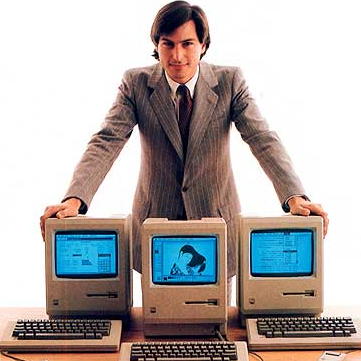
This picture appeared on the cover of MacWorld in the issue that came out on January 24, 1984. The day the Mac came out of the bag and said Hello World.
Steve Jobs as Frank Lloyd Wright In 1983, my little software company was lucky to be invited to work on Apple's new computer in development, the Macintosh. Back then Apple wasn't as secretive as it is today. Everyone knew something was coming. We knew what it was called, but no one was saying what it was.
 I gladly signed the agreement, and to this day I remember my first glimpse of the Mac. I arrived at a building on Bandley Drive in Cupertino some time in August 1983, and was met by Mike Boich and Guy Kawasaki from the Mac team. As we walked to the conference room, I saw, out of the corner of my eye, a beige plastic box that was small and upright. And personal. How it said that to me, in just a glimpse, I have no idea. Is that a computer? Another thought popped into my head: It said "I'm new." And that was something because back in those days everything was new. And it was personal, for me. All this from a fraction of a second look.
Before that I had been an Apple II developer for a number of years, and was a devotee of Apple's products, though I also loved IBM's PC. There was a sense that we were all creating a new world, we all loved our work -- and Jobs and the people he nurtured at Apple, were leaders. I was on stage during the rollout of the Mac at Flint Center on January 24, 1984. We shipped our product later that year and went on to have one of the first hits for the Mac.
But I want to tell a different story. Not a personal one, because I did not have a personal relationship with Steve Jobs. However, I built products that made it to market through his platforms. And in doing so, my vision was shaped by his. And later, with podcasting and RSS, I got to influence the direction of his products.
I wish Jobs had been a blogger, had written about his design process, so I could quote something. But he was the opposite of a blogger. Jobs was a mass communicator. No one in my generation has mastered the art as Jobs did. Today, with the outpouring of feeling on the net, are people mourning the man, or the phenomena he could unleash, just by saying "One more thing."
And he was a designer, even though people seem to be overlooking that in their remembrances, calling him more of a visionary. He got down in there and made small but very important design decisions about his products. Ones that had wide impact, for better, or worse. And often they weren't things his products did, rather things his products didn't do that defined them.
The Mac was full of them. No cursor keys, so you had to use the mouse to navigate. I doubt if money was the reason, though leaving out the cursor keys probably saved a bit, and allowed the other keys to be bigger. It also meant Apple had to design its own keyboard, because they all had cursor keys.
No hard drive. No expansion slots. No fan.
A standardized user interface. This was very controversial with software developers such as myself. We felt what we did was user interface design. What would we do if the UI was already designed. New ideas sometimes don't get accepted right away by everyone.
And there were the almost-great ideas, like having networking built into every Mac starting with the Mac Plus. At the time networking wasn't even an option on IBM PCs. The networking, while a bold and great idea, didn't have the impact it should have had because the programming APIs were impossibly difficult. Had they been easy the Mac would have been the web, and we could have saved 20 years of incremental upgrades to turn the web into what the Mac was in 1984.
And at times Steve forgot where his ideas came from, or seemed to. He tormented Bill Gates, probably in jest, that he was stealing his ideas from Apple, when they both stole from Xerox.
I had some personal interactions with Jobs, but they weren't very special. I doubt if he knew who I was. He called me once, out of the blue -- to rant about the stupidity of people at Apple. This was in 1997 just after coming back. Even today, after all these years, I have a hard time saying I agreed with him, and I didn't say so in the conversation, I just stayed silent. He doesn't suffer fools quietly, that's for sure. Ooops, he didn't. Hard to think of him in the past tense. Why did he call me then? I have no clue.
 One more thing.
In the first rush of memorials, people are comparing Jobs to Henry Ford (industrialist), Thomas Edison (inventor) or Walt Disney (media). But there's also a lot of Frank Lloyd Wright in there. All these men had imperfections, and greatness. But Wright's were, imho, more Jobsian than the others.
"He's so wonderfully prickly and famous for bursting into any house he built un-announced - just come in with a troop of people and show them the house, rearrange the furniture. He would even sneak into the houses to rearrange the furniture when the owners were away," T.C. Boyle wrote of FLW, but it also describes how early Mac developers felt after demoing their products for Steve.
To both Jobs and Wright the people who used their products were not as important as the computer or the building. More than the thing itself, what mattered to Wright, and I think what mattered to Jobs is the integrity of his vision. In a way it was a shame that the vision had to be instantiated.
Of course that's what made their ideas so great and influential. Among the many Jobs quotes worth remembering, and quoting -- Artists ship. I agree. And when you ship, along with the vision, comes reality. And then you learn and ship again.
There might still be Jobs shipments to come. We don't know what's in Apple's pipeline. But his thinking and vision, his person, will influence others and drive them to greatness, for generations to come.
Thanks Steve Back to the normal ride Windy! Whoooo.
Strong headwind uptown, beautiful cruising tail wind coming home.
75 degrees and bright sunny day.
Map: 1 hour 4 minutes. 11.59 miles.
Occupying Facebook Yesterday I was given a list of Occupy sites on Daily Kos, about 200 of them. Most were Facebook sites, there were a handful of blogs with feeds.
Of course without feeds they can't be part of occupyweb.org. But that's okay, because occupying Facebook is every bit as good as occupying Wall Street. Seriously. And because of what's happening on Facebook, the show is going to move out to the web.
Read this article about where Facebook thinks they're heading. And then try to imagine the conversations they're having with advertisers. How long before there's an Occupy for individual brands. And do they really want to compete with the occupiers on Facebook. Who are they kidding. People are going to find what the brands have to say very easy to ridicule. Basically I can't imagine they will do anything but cede the space to protestors.
 There you have the coming faceoff. And it's going to be a good one. Whatever plays out won't be in Cairo or Tunisia, it'll be in New York and Silicon Valley. It'll look a lot like the faceoff on the Brooklyn Bridge. But visible to everyone in the world. This is what American democracy looks like. It's always been class warfare, but now the formerly disarmed class has a way of organizing.
But everybody, be sure you have a good backup plan. Where will you congregate on the web if you lose your Facebook presence? Really, seriously be thinking about that.
At the DNC in Chicago in 1968, the protesters chanted "The whole world's watching." This time in a whole new way.
A river for the Occupy movement When a new phenomenon shows up, like Wikileaks or OccupyWallSt, or the web itself, my immediate impulse is to try to get my arms around it. To get enough input flowing into my brain so I get a feel for the story.
Following a hashtag on Twitter is useful, but it isn't what I'm seeking. CNN or MSNBC is a substitute for it, but they aren't really covering this stuff, and aside from that, I know that they are giving me a superficial story. I want something less processed, with less MSM judgment. Something more raw.
What I'm looking for, of course, is a river. So yesterday I took a look around to see how many of the Occupy sites had feeds.
My algorithm was simple. I got a list of the top cities in the United States from Wikipedia. And I typed into Google, one after another: Occupy <CityName>. And about half of them came up hits. An overwhelming majority are planning events. But it seems most of them are using Facebook to plan the events. Since Facebook doesn't reliably produce feeds for its groups (if they do I don't know how to find them) I can only use blogs. And I don't really want to go into Facebook, since I feel strongly that it's as much a part of the problem as the culture of Wall Street. I want to produce a "green" river.
Anyway -- it's here! Flowing slowly, but there are stories there. I hope that by spreading the news it will attract more readers, and thereby more new feeds, and more news in the feeds we already have.
And of course the OPML reading list for this river is publicly available.
Why your Occupy event should have a feed Lots of organizations that are doing Occupy events have blogs and therefore have feeds. But some are relying exclusively on Facebook, and those events can't be part of a RSS-based information flow.
It's really easy to get a feed. One comes for free with every blog. So if you have a Tumblr or Wordpress blog, or any other popular blog flavor, that's all you need. Even if you're using Facebook to communicate, it's helpful if you can broadcast the big news to the non-Facebook world by adding it to a blog that lives outside of Facebook.
Facebook is the equivalent of Wall Street in the tech world. So it's important that you communicate not just with people inside Facebook, but those outside as well.
If you have questions, feel free to post them here.
In the 60s they burned draft cards They burned draft cards and bras.
So I wondered what will be today's equivalent, and then it hit me.
Will we burn our Facebook pages? I believe I will do it.
I wonder who else.
We're looking for "Occupy" sites! Hi! I'm Dave Winer, and I'm really in awe of what's going on around the country in the communities and also on the web. Lots of really smart people who want to be part of a great country, and actually doing something about it.
My contribution is a news site where you can follow all the updates from people who are blogging about the events, with first-hand accounts, pictures and movies.
We're also finding links to mainstream articles and adding them to the flow as well. Not just good ones, all kinds. Let's find out what people are saying.
Anyway, here's a list of the sources we have so far:
If there's a site in your community, you might want to get involved.
And if you know of a local site that we don't have in the list, please post a comment here.
Thanks!
Occupy Silicon Valley?  It's great that occupations are springing up all over the United States. But I wonder when will there be an occupation of Silicon Valley? It feels kind of weird for me to raise the question because I lived and worked in Silicon Valley for many years. I know some of the people who run the place. Lived in Woodside, Menlo Park, Palo Alto and Los Gatos. My neighbors were the power brokers of the valley. And some of them are people who I did business with, who I like as human beings, and who I think are basically just as good as any of us. However, in pursuit of more wealth, they represent every bit as much what's wrong with our economic system as any Wall Street banker.
Instead of bundling parcels of mortgages and turning them into derivatives, they bundle up parcels of people and turn them into masses of users, who generate content. Then they sell access to those users for a price, to other businesses. The problem is that as growth levels off, and it's sure to do that (how many more groups of 800 million can Facebook find, and where will they have to go to find them, and who will they have to sell out to to get there) -- they're going to have to take more from those users. Zuck calls it "sharing." The rest of us call it "privacy."
Ahh so you think there is no such thing as privacy. Think again. Do you want to see every piece of porn everyone you know is looking at? That's a lot of porn, and some of it might be fairly tasteless. Live and let live we all say, until you put your life in my face. Do you want your friends (and everyone else) to know everything you buy at the grocery store? Every phone call you make? Your exact whereabouts at any moment? What power this would give to stalkers. And what fear this would cause in those who are stalked.
So while Silicon Valley is enabling an ever-more-intrusive role for networks, how about occupying a bit of Silicon Valley, as a reminder that users are people, just like they are. And that turnabout is fair play.
Relying on Facebook, Twitter and Google The NY Times has a report in today's paper about the Occupy Wall Street campaign and its spread to other cities around the country.
The second paragraph begins: "With little organization and a reliance on Facebook, Twitter and Google groups to share methods, the Occupy Wall Street campaign, as the prototype in New York is called..."
They put their finger on exactly what is troubling, from my perspective, about using corporate online media to organize political efforts to upset a supposedlly different corporate world. The assumption is that there are no connections between Wall Street and the ownership of the tech companies. This of course is not true. They are very interlocked. When Wall Street is threatened the response could easily come from one of the online networks.
Better to develop completely independent communication channels in case the Google, Facebook or Twitter ones are interrupted. Or as independent as you can possibly make it. Depending on university-hosted communication systems, for example, while certainly not foolproof, is a better bet than using the corporate systems.
Having multiple redundant channels is the best way of all. (In other words, based on the design of the Internet itself.)
Right now I don't want to be more specific because I don't want to jinx the great energy behind this movement. If I see specific signs that they are over-relying on corporate online media, I'll say more.
PS: I couldn't disagree more with this piece in the Atlantic. Just the act of occupying space in the middle of NYC is causing people to talk about things in a way they weren't before. It's the change they're creating in the rest of us that matters right now, not the ignorance of Wall St. They will be the last to hear it.
Stolen from the best One of my mottos is Only Steal from the Best.
It was with that in mind that I stole the design of my new story template from Readability. I figured they had invested so much in figuring out what readable meant in web writing, why not just lift the design and use it on my site?
I sent a pointer to Rich Ziade, the CEO of Arc90, the company that makes Readability, with my compliments. He said in response, "It doesn't need Readability. A good sign!" Now that's a software developer I admire. A man on a mission -- to make the web more readable.
And we're doing our small part here at Scripting News.


