close
The Wayback Machine - https://web.archive.org/web/20111008021511/http://rpayne.blogspot.com/

Search This Blog

Loading...
BERJAYA

Thursday, October 06, 2011

Academic update

I finished the paper for the LSE/Millennium conference to be delivered October 22. This link should work: "Cooperative Security: Grand Strategy Meets Critical Theory?"

Additionally, I spent some time this past week adding a bunch of my papers and publications to my Academia.edu page. If you have journal access from a university, virtually all the open/download links will work. Some of the links should work for anyone.

If you really need one of my papers, shoot me an email.


Visit this blog's homepage.

Follow me on twitter.

Wednesday, October 05, 2011

Obama and Wall Street

Is Occupy Wall Street fueling a populist political movement on the left that can pave the way to new economic stimulus, dramatic economic reforms in the tax code, or whatever else they might seek? I'm not trying for cheap snark -- but they have been somewhat unclear about their goals.

Could the protest movement even help energize voters on the political left, in the same way the tea party did on the right in 2010, and thus help Barack Obama and other Democrats find victory in November 2012?

Or, as my Duck of Minerva colleague Megan MacKenzie argued today, should the White House be ashamed for ignoring (and thereby "insulting") the anti-Wall Street populism for the past 10 days?

BERJAYA

I have to disagree with Megan on this one.

Sunday, Obama blasted Bank of America for its $5 fee on debit card users. "You don’t have some inherent right just to, you know, get a certain amount of profit, if your customers are being mistreated,” he said. Later, he added, “this is exactly the sort of stuff that folks are frustrated by.” Was that a nod to the protesters? It sure sounds like they are on the same side.

The National Journal today criticized the President for his overt "tax the rich" populism -- an approach some of his advisors apparently think will fail in key swing states. Steve Benen dismissed that take, however.
A month ago, independents sided with the GOP by a five-point margin on creating jobs, but now we independents siding with Obama by 13 points. That’s a pretty dramatic swing in a fairly short period of time, suggesting that those arguing that the president is driving independent voters away with his new economic message have this precisely backwards.
Google the White House website for "Wall Street" and you learn that the President or his chief spokespersons have been demonizing Wall Street in some way almost every day -- and pointing out that their reform law was aimed at tightening regulation. Here's a sample from September 30:
frankly, we had seen the rules tilted against ordinary folks in favor of those who were well connected in Washington or powerful on Wall Street.

And we argued in 2008 -- and we captured I think the imaginations of a lot of people -- that we could bring about some fundamental change if we got past some of the partisan rancor and the constant politicking that had come to characterize Washington.
Treasury Secretary Tim Geithner today emphasized "shock" that Wall Street itself has turned against President Obama -- and he expressed (somewhat incoherent) sympathy for the concerns of those who Occupy Wall Street. For the new populist Obama, it is desirable for Wall Street to hate you. "The enemy of my enemy is my friend," right?

And finally, Politico reported this additional evidence today:
“He [Obama] gets genuinely pissed off at the banks; it’s not an act,” said Jared Bernstein, a former adviser to Vice President Joe Biden, who participated in Obama’s daily economic briefing in the Oval Office for the first year of the administration.... “The angriest I ever saw the president was when we found out about those bonuses,” he said. [The banking industry] is like a Doberman he found by the side of the road, nursed back to health, only to have them jump up and bite him.
Our newly populist president has seen his poll numbers drop month-after-month. I do not know if his new economic message will reverse those trends, but it does appear as if he's rolled up his sleeves for a fight with Wall Street. And in doing that, he's with the Occupy Wall Street crowd.


Visit this blog's homepage.

Follow me on twitter.

Saturday, September 24, 2011

A's Moneyball followup

As an addendum to Friday's post, I found an exchange on SABR-L, from December 9, 1998. I don't know that I can quote the person I was debating, but my words should be fair game for quotation here. I had contended that "Small-market teams have won recently, and have a chance to win in the future." More specifically, I suggested that the A's would be competing for a World Series appearance by 2001.**

A skeptic in turn pointed out that the A's of 1998 had a terrible third baseman and bullpen, plus no starting pitching or right-handed power-hitting.

My response:
First, I said they'd be competitive for a playoff spot, not a sure Series winner. Second, the A's have one of baseball's top prospects at 3B in Eric Chavez. My prediction was based, in part, on the A's willingness to reward OBA in their minor leagues (this *will* pay off as it did for the Yankees in the past half-decade). RH power hitters are easy to come by for 1b/dh/lf. How much would Billy Ashley cost right now? How much was Bubba Trammell worth last year at this time? Hinch, Tejada, Grieve et al provide a great young nucleus. Pitching? You don't like Witasick (3/1 k/bb ratio in PCL with a sub 4 ERA in 1998)? I agree they need to develop some talent--but who predicted Glavine/Smoltz in 1990? Saberhagen/Gubicza/Jackson in 1983? A 2001 World Series rotation might include someone currently in college--or even high school. What if the A's offered Stairs and Rogers for Clemens? Bullpen holes are among the easiest to fill since there are plenty of hard throwers out there that find their control or develop new off-speed pitches every season.
The 2001 A's won 102 games and made the playoffs as the Wild Card (Seattle won 116 games!). Eric Chavez was the starting 3B and he hit and fielded like an MVP candidate. The rotation was led by Tim Hudson (2nd year pitcher from Auburn; a member of '97 draft class), Mark Mulder (2nd year pitcher obtained in trade, but drafted in '98 from Michigan State), and Barry Zito (2nd year pitcher drafted from UCSB in '99). Right-handed Jermaine Dye slugged almost .550 for Oakland after coming over in a mid-year trade for trinkets and beads (KC got Neifi Perez, but it was a three-way deal with the Colorado Rockies). RH Olmaedo Sáenz also had 30+ extra base hits in a limited role as a corner infielder. The A's bullpen featured a lot of no-name relievers in their late 20s and early 30s who limited walks, got strikeouts and performed perfectly well. Their closer was Jason Isringhausen who did a fine job and had been obtained by the A's in a trade for an older reliever -- Billy Taylor.

I'm not claiming any sort of clairvoyance here -- I think this set of predictions were all made conceivable by the work of Bill James and those who followed him.


** In fairness, I also mistakenly predicted a Pirates resurgence.

Visit this blog's homepage.

Follow me on twitter.

Friday, September 23, 2011

Me and Brad Pitt: ? degrees of separation


Today, the "Moneyball" film is being released nationally, starring Brad Pitt (longtime blog favorite Angelina Jolie's spouse) as Oakland A's GM Billy Beane. I read and enjoyed Michael Lewis's book of the same name many years ago.

A lot of people in baseball directly or indirectly contributed to this moment. When Michael Lewis wrote this book, he consulted then-ESPN baseball columnist Rob Neyer, who used to work for Bill James. I don't know if Lewis was reading the usenet rec.sport.baseball.analysis group (or some similar discussion forums), but there was some great stuff being posted there by people who created and operated Baseball Prospectus. Many SABR members were also involved in these discussions. Here's my contribution to a KC Royals discussion, September 11, 1996. Readers might note that the on-line baseball community was giving a lot of attention to on-base percentage and runs scored in 1996. That's because we all read Bill James in the 1980s.

Anyway, in April 2000, inspired by what I was reading in those on-line forums and in some related books, I gave a talk for the Louisville SABR group called "Can Small Market Teams Compete?" I've archived a scan of my presentation on Google Docs, complete with my pre-powerpoint handouts about the size of American cities (census data), the Forbes magazine 1999 list of team values, team payrolls from USA Today, etc.

I thought it was a good talk, though some members of the audience were fairly skeptical about my conclusions. For those who don't want to look at the scans, here's an October 5, 2000, post I contributed to STATLG-L, a baseball discussion list that I used to frequent:
Subject: small market teams
From: Rodger A. Payne
Reply-To: Baseball (and Lesser Sports) Discussion List
Date: Thu, 5 Oct 2000 12:41:08 -0400

At a SABR Regional meeting in Louisville earlier this year (April, iirc),
I presented "Can Small Market Teams Compete?"

I'm a KC fan and have a personal interest in this question for obvious
reasons. However, the team I used as my case study was Oakland.

Much of my presentation was about team finances and population. Teams like
Philly and the Chisox are in big media centers, but media often seem to
consider them to be "small" (and some smaller city teams are considered
"big"). It's interesting stuff, but I'm leaving it out of this post.

Instead, I'm posting about the last portion of my presentation, which was
devoted to strategies that small market teams could use to build discount
winners in today's context. Then, I pointed out that the A's employ
virtually all of them. Here are the 3 most important:

1. Build on youth.

First, teams can set very low salaries until players are arbitration-
eligible, and even then pay below free agent prices for players. This
means, in practice, that most players work on-the-cheap for 3 years and at
well below market for the next 4 years (if they decline arbitration in the
last year, they are on the road to free agency).

Further, data on performance indicates that players tend to reach a high
level of play in this discount period (some research shows that most
players are fully developed around ages 24-25, though the data is better
for hitters), often peak around 27, and decline from age 30 onward--when
free agent market conditions are often determining salaries.

The Indians developed an innovation now sometimes copied by other teams:
offering certain players multiple year contracts to "buy out" years of
arbitration (or even a year or 2 of free agency). With strong choices,
this can really save money and buy good will with a player who might
otherwise get a very low salary in years 2-3 of his major league career.

The A's, as was noted yesterday, take much advantage of this with Chavez,
Tejada, Hudson, etc. Next season, look for Jose Ortiz (a middle
infielder), Eric Byrnes (OF), and Adam Piatt (corner infielder) to play
important roles on the A's--replacing perhaps higher-priced Velarde,
Stairs and Jaha (the A's probably screwed up in resigning Velarde and Jaha
last season).

2. Use "Ken Phelps All Stars" to plug holes.

The minor leagues are filled with veteran baseball players that could be
obtained easily (as minor league free agents or in "minor" trades) and
quite cheaply. Triple A rosters, in particular, are now littered with
these guys (often "failed" prospects). Just look around the AAA rosters
the past few seasons. These players are generally not arbitration eligible
and can be paid peanuts for several years, which is usually during their
peak/pre-decline age 28-30 seasons.

Moreover, many of these veterans are quite capable of playing important
roles on major league teams. The key issue is whether teams will give them
a chance. It might be difficult to find an All Star hitter, or a very
talented SS, CF, or C, but talented LF, 1B, DH, pitchers and probably some
2Bs are readily available. Think Brian Daubach--not a star, by any means,
but quite capable of putting up an .800 OPS and contributing to a winning
team (if not asked to carry too much of the load). Daubach actually had
putrid numbers against LHPers this year (657 OPS in 110 PAs), but fits the
bill versus righties: 794. He was better in 1999 (943 vs. RHPers, when he
got only 50 PAs vs. LHPers). Dave McCarty would be another example.

The A's have been quite good at acquiring and using these players:
Geronimo Berroa, Matt Stairs, Olmedo Saenz, Sal Fasano, Gil Heredia
(arguably) and perhaps Jeff Tam fall into this category. Jeremy Giambi
may as well.

3. Value walks.

I think a good argument can be made that major league teams dramatically
undervalue on-base skills. Players who walk a lot don't seem to reach the
majors in proportion to their real value. I'm not confident that there's
systematic study of this (yet), but it seems apparent to me. The cliche
repeated about players from the Dominican Republic is that "you don't walk
off the island." Similarly, players seldom "walk" their way through the
minors to the majors.

Yet, walking is a vital part of OPS. Players who walk more than other
players contribute a great deal to scoring runs. That's a huge positive
and some teams obviously don't get it. Sadly, KC is one of those teams.

The A's, however, are well known for appreciating the base-on-balls. The
major league team has been near the top for a couple of years now, GM
Billy Beane has said in interviews that the organization looks for players
that walk, and their minor league affiliates from top to bottom are at or
near the top of their leagues in walking/OBA. I used numbers from 1998-99
in my presentation to demonstrate this point. These walking teams are also
very good at scoring runs.

-----------------

Teams should, of course, combine these strategies. Since KPAS are mostly
1B/LF/DH-types, it makes sense to focus scouting and other resources on
developing SS/C/CF/3B. KC, of course, has mostly failed at this, while
Oakland has Tejada, Hernandez, T. Long and Chavez. NYY has Jeter, Posada,
Williams and soon Soriano/Jimenez.

This would also mean getting KPAS who know the strike zone. Detroit should
be rewarded for finally giving Billy McMillon a chance. The IL walk
leaders this season included Ozzie Timmons (TB), McMillon, and Morgan
Burkhart (Bos). Three of the top 8 in the PCL were A's players (Mark
Bellhorn, Bo Porter and Steve Decker), but the list also included Mike
Neill and Brian Lesher--potential KPAS hitters. It's interesting to me to
see former KC non-walking prospect Phil Hiatt just barely in the top 20.

Well, this is pretty long so I should stop. Comments would be appreciated.
I'm also interested in how few walks a team surrenders to its opposition
(I think pitchers with great control are often undervalued) and potential
gains from developing talent with an inflated value and trading it for
players of *real* value. Swap that stolen base king or proven closer for
someone who can really help a team win.
One point that I didn't discuss, and neither did Michael Lewis, is the use of steroids. Those Oakland teams a decade ago featured Jason Giambi and Miguel Tejada. That's two MVPs linked to steroids -- and that's not even counting prototypical moneyball players like late-career David Justice and Jeremy Giambi.


Visit this blog's homepage.

Follow me on twitter.

Wednesday, September 21, 2011

Upcoming: Paper for Millennium conference at LSE

LSE
Photo credit = leelver

Next month, I'll be heading to London to present a paper at the Millennium: Journal of International Studies annual conference featuring this theme: "Out Of The Ivory Tower: Weaving the Theories and Practice of International Relations."

Here's the abstract I submitted for my paper, “Cooperative Security: Grand Strategy meets Critical Theory?”
Major powers are frequently urged to embrace grand strategies tied to particular international relations theories. In the case of United States foreign policy, scholars usually analyze a well-known set of strategic choices -- primacy, selective engagement, off-shore balancing, collective security, and cooperative security. These grand strategy choices have typically been favored by relatively mainstream realist, neorealist, liberal and neoliberal thinkers in IR. This paper explores the evolution of cooperative security from its clear ties to liberal and neoliberal international relations theory to its current understanding in world politics, which is surprisingly consistent with critical IR theory. Cooperative security no longer merely implies multilateralism, negotiation, and arms control. Rather, security is now more frequently described as indivisible and genuine cooperation requires shared decision-making and consensual practices. Even nongovernmental organizations are increasingly granted a voice in security discussions. While weapons and warfare remain very important security concerns, the cooperative security agenda today includes ideas associated with human security. This has meaning for the unit of analysis (both the actor providing security and the actor being secured) and for the breadth of the security agenda, which currently seems to include poverty, environmental calamity, global inequality, and hunger. In all, the evolving notion of cooperative security offers a potential promising pathway towards achieving the emancipatory ideals associated with critical IR theory.
The conference is the weekend of 22-23 October, but I'm going to be in the area Monday through Friday, 17-21 October, as well and am still looking for academic opportunities.

I'll be searching for pints of well-hopped bitters too.


Visit this blog's homepage.

Follow me on twitter.

Saturday, September 17, 2011

Is LEED misleading?

Center for Predictive Medicine dedicated

Photo credit = University of Louisville.
Pictured: Center for Predictive Medicine, LEED building


The September/October 2011 Mother Jones has a short article challenging the notion that LEED-certified buildings use less energy. University of Louisville, along with many other institutions, have embraced Leadership in Energy and Environmental Design certification from the US Green Building Council as a key means by which to achieve sustainability in their operation practices. If LEED is a fraud, then that's a huge story.

You can get electronic access to the MJ piece by providing your email address, but here's a key excerpt for those who want to be saved the trouble:

According to 2008 study commissioned by USGBC, LEED buildings are 25 to 30% more energy-efficient than conventional ones. But when Gifford looked at the study, he found that it had compared the meaning of one group of buildings to the median of another-what seemed to him a classic apples-to-oranges mistake. He got some of the data and calculated that LEED buildings actually used 29% more energy. “Going to so much trouble and expense to end up with buildings that use more energy than comparable buildings is not only a tragedy, it is also a fraud,” he wrote in a trade magazine. The USGBC stood by its numbers.
Henry Gifford is identified in the piece as a NY energy efficiency consultant.

An Oberlin College physicist, John Scofield, is also quoted in the article -- and he does not think much of LEED certification either: "This is like requiring people to wear copper bracelets for arthritis!" Another blogger, Erich Vieth, has poked around at Scofield's website and helpfully provides a link to the academic work by Scofield backing this claim.

When I return to the Sustainability Council after my sabbatical, I'll be asking about this.


Visit this blog's homepage.

Follow me on twitter.

Thursday, September 15, 2011

Election 2012: Early Analysis

BERJAYA

Photo source = whitehouse.gov

Today, I've been participating in a discussion at Outside the Beltway about Barack Obama's reelection prospects in 2012. It is still very early in the election cycle and much can change before next November.

One basic fact stands out, however, regardless of polling showing the incumbent President's vulnerability in specific states he won in 2008. Obama can win reelection in 2012 merely with the Kerry states plus Florida. That means (a) the incumbent can lose Colorado, Indiana, Iowa, New Mexico, Nevada, North Carolina, Ohio, and Omaha; and (b) Republicans could be in big trouble regardless of the economy if they select a candidate who tells Florida’s retirees that their Social Security benefit is built on an unconstitutional ponzi scheme.

If the Republican’s spend most of the next year talking about the deficit (and more tax cuts), then it’s pretty easy to imagine that Social Security would seem vulnerable under their leadership -- regardless of candidate. Everyone recalls the first major policy initiative Bush pursued after his 2004 victory, right?

Despite the concessions I make above, there are long-term demographic issues working against Republicans in Colorado, Nevada and New Mexico.

Finally, it must be noted that campaign Obama proved a lot more effective at his job than governing Obama has. Think of the jobs bill (and related tax cuts/increases) as part of the campaign instead of as a meaningful policy initiative that is likely to gain traction in the current Congress. That perspective reveals it to be an essentially populist proposal aimed at attracting swing voters — especially when pitched directly against specific Republican counter-proposals in a two-way race, namely, additional corporate tax cuts and deregulation.


Visit this blog's homepage.

Follow me on twitter.

Friday, September 09, 2011

Unanswered Questions about Saudi links to 9/11

alfaisal
Photo credit = secret1me's

So, here we are a decade after the 9/11 attacks and many long-time mysteries of the early Bush "war on terror" years have been solved -- Osama bin Laden was located in Pakistan and killed; Scooter Libby of Vice President Dick Cheney's office leaked covert CIA agent Valerie Plame's name to Robert Novak to bolster the dubious case for war on Iraq; and the anthrax terrorist was identified by the FBI after he committed suicide. Bruce Ivins was a Army-employed microbiologist.

Not every loose end has been tied together, of course. For example, we still don't know very much about alleged Saudi connections to the 9/11 hijacking plot.

As long-time readers may recall, neither congressional investigators nor the 9/11 Commission were completely forthcoming about this topic. From Salon, two days ago:
What's in the famously redacted 28 pages?

A joint inquiry of the House and Senate intelligence committees produced an 800-plus page report on activity of the intelligence community in connection with the 9/11 attacks, completed in December 2002. But 28 pages were redacted in the public version, all in the section titled "Finding, Discussion and Narrative Regarding Certain Sensitive National Security Matters." It has been widely reported that those pages -- which neither the Bush nor Obama administration have declassified -- deal with links between 9/11 hijackers and Saudi government officials. Newsweek, for example, reported that the section "draws apparent connections between high-level Saudi princes and associates of the hijackers."

As long as those pages remain classified, though, it's impossible to assess the nature of those connections.
I'm no "Truther," but as this story from McClatchy on September 7 reports, there are still puzzling mysteries concerning the alleged Saudi connection to the hijackers:
Just two weeks before the 9/11 hijackers slammed into the Pentagon and World Trade Center, members of a Saudi family abruptly vacated their luxury home near Sarasota, Fla., leaving a brand new car in the driveway, a refrigerator full of food, fruit on the counter — and an open safe in a master bedroom.

In the weeks to follow, law enforcement agents not only discovered the home was visited by vehicles used by the hijackers, but also phone calls were linked between the home and those who carried out the death flights — including leader Mohamed Atta — in discoveries never before revealed to the public.
Local counterterrorism officials describe a scene that sounds like it came from a movie you've already watched:
"The beds were made ... fruit on the counter ... the refrigerator full of food. ... It was like they went grocery shopping. Like they went out to a movie. ... (But) the safe was open in the master bedroom, with nothing in it, not a paper clip. ... A computer was still there. A computer plug in another room, and the line still there. Looked like they'd taken (another) computer and left the cord."
The story quotes former Florida Senator (and former Select Intelligence committee member) Bob Graham saying that this news "opens the door to a new chapter of investigation as to the depth of the Saudi role in 9/11. ... No information relative to the named people in Sarasota was disclosed."

Graham has raised similar concerns for years. Until more is revealed about what the US knows of the Saudi role in the 9/11 attacks, people are going to keep asking these sorts of questions. Some will be formulating troubling conspiracy theories.


Visit this blog's homepage.
Follow me on twitter.

Sunday, September 04, 2011

Palin in Iowa

September 18 2008 1180
Photo credit: Dave Davidson (2008 campaign)

Who writes Sarah Palin's speeches? Saturday, in Iowa, she spoke out against crony capitalism:
Sarah Palin did not say whether she would seek the Republican presidential nomination, but...in a 40-minute speech before a Tea Party rally here, which was one of her most expansive addresses since she accepted the Republican vice presidential nomination three years ago, she railed against “crony capitalism” in both parties.

“I want all of our GOP candidates to take the opportunity to kill corporate capitalism that is leading to this cronyism that is killing our economy,” Ms. Palin said.
Does she understand the meaning of "crony capitalism"? From Investopedia:
What Does Crony Capitalism Mean?

A description of capitalist society as being based on the close relationships between businessmen and the state. Instead of success being determined by a free market and the rule of law, the success of a business is dependent on the favoritism that is shown to it by the ruling government in the form of tax breaks, government grants and other incentives.
In Iowa Saturday:
[Palin] outlined economic proposals for creating jobs, including the elimination of all federal corporate income taxes. She said the cozy relationship between political contributions and government favors needed to be exposed and eliminated.
And as a reminder, consider Sarah Palin's multi-million dollar job working for Rupert Murdoch at Fox News. From The Nation's Eric Alterman in the September 5 edition:
One key factor must always be kept in mind when discussing Rupert Murdoch: he has a lot of money ($7.6 billion, according to Forbes) and makes even more for other people. Between 1977 and 2001, News Corporation outearned every other blue-chip company save Berkshire Hathaway and Walmart. And while money might not buy you love in America, it does buy a great deal of special favors and improper indulgences from powerful people.

Being a billionaire media mogul is even more fun when it comes to politics. Not only do politicians need your cash; they need your newspapers, magazines and TV networks too. It is this unholy nexus that Murdoch has mastered...

Murdoch regularly uses book deals, television contracts and columnist gigs as bribes to the powerful, just as he uses these same properties to punish those who refuse to go along. Don’t forget that until recently, Murdoch had four potential Republican presidential candidates on the Fox payroll. One of them—Sarah Palin—even got a state-of-the-art studio built in her home, gratis. And each of these powerful people has a pretty strong incentive to look the other way every time one of Murdoch’s properties or employees feels it necessary to break a law here or there in the service of the great man’s power, profits and influence.
Either Sarah Palin is a brilliant ironist, or she represents the dénouement of a horrifying Orwellian nightmare.


Visit this blog's homepage.
Follow me on twitter.

Sunday, August 28, 2011

I saw mascots

From mid-June to early August, I was on the road for 28 days, visiting Boston for a wedding, the Delaware Shore, Tulsa (twice), and Traverse City, Michigan. I'm posting a couple of interesting cell phone photos from the period. Both, coincidentally, depict local mascots of sports teams.

This first shot is the Delmarva Shorebird. After many years of visiting the Delaware shore, I finally made it to a minor league baseball game. The nice little park is in Salisbury, Maryland, and this creature sat right behind my spouse for an inning:

BERJAYA

The second shot is a Bulldog in downtown Big Rapids, Michigan. This dog is the mascot for the local Ferris State University and downtown Big Rapids has a number of these little statues in different guises. My spouse and I had just dined at the terrific Blue Cow Cafe, which emphasizes local and organic food. The ale I drank was very good, though a bit floral tasting. The pork chop was simply outstanding, perhaps the best I've ever had and I frequently eat chops at good restaurants all over the US:

BERJAYA


Visit this blog's homepage.

Follow me on twitter.

Saturday, August 27, 2011

Saturday Sheep Blogging

Friday night, the family made the annual trip to the Kentucky State Fair -- always held in Louisville in mid-August. I took this photo with my cell phone.

BERJAYA

And no, the creature is not in the Klan or some other evil society. It was recently shorn.


Visit this blog's homepage.

Follow me on twitter.

Friday, August 26, 2011

Jasmine Revolt: Cascade Effects?

IMG_9195a
Photo credit: Flickr page on HINDRAF Rally in Kuala Lumpur by Shamshahrin Shamsudin

Thanks to my sabbatical, I had time this week to attend an interesting panel of a relatively small workshop sponsored locally by the Center for Asian Democracy: "The Jasmine Revolution and the 'Bamboo' Firewall: The impact of the Internet and new social media on political change in East Asia." My colleague Jason Abbott (CAD Director) explains a bit more about it on his blog -- and promises a more complete recap next week.

The panel I attended featured three interesting papers on "The New Media in Southeast Asia: Spotlight on Malaysia."
Asha Rathina Pandi (University of Hawaii, Manoa)
“‘Makkal Sakthi’ (People’s Power): Blogs, civil society and the 2007 Hindraf protest rally in Malaysia”

Meredith Weiss (SUNY – Albany)
“Parsing the Power of ‘New Media’ in Malaysia”

Thomas Pepinsky (Cornell University)
“Tak Nak Mereform: Contemporary Malaysian Politics in Historical Perspective”

Chair/Discussant -- Jason Abbott (University of Louisville)
As a student of international relations, it was somewhat unusual for me to attend a panel clearly constituted by comparativists talking almost exclusively about domestic economic, political and social variables. Indeed, during the Q&A;, a fellow workshop participant asked the question that was most on my mind -- how did the Malaysian events the speakers described during their talks tie into the Jasmine Revolt?

One respondent pointed out the different ethnic mix in Malaysia and agreed with an audience member that only Bahrain is somewhat similar in the Middle East context.

I would have liked a lot more followup, to explore potential international and/or transnational dimensions. Did local activists learn from protesters in North Africa and the Middle East? Were new communications media employed globally, or were they primarily used on a local level, as emphasized in the talks? Were there any contagion effects of the other rebellions? Are states of East Asia (this panel focused on Malaysia) feeling any international pressure from bigger powers, international institutions, or transnational NGOs to embrace democratic norms?

Unfortunately, this particular panel did not really address those sorts of questions and I did not have time to attend the Roundtable scheduled to follow this session.

In short, the presentations were good, but not sufficiently IR for my tastes.


Visit this blog's homepage.

Follow me on twitter.

Tuesday, August 23, 2011

NPR's Top 100 Sci-Fi & Fantasy Books

NPR recently published a list of the top 100 science fiction and fantasy books, compiled from a survey of 60,000 listener-readers. The full list is here.

I don't really read work in this genre very often, but I did read some sci-fi in my teens and have occasionally grabbed something unread if it is already on my shelf.

These are the ones I've read from the list. You'll note that I've read half of the top 20, but apparently none of the bottom 35.

1. The Lord Of The Rings Trilogy, by J.R.R. Tolkien
3. Ender's Game, by Orson Scott Card
4. The Dune Chronicles, by Frank Herbert
6. 1984, by George Orwell
9. Brave New World, by Aldous Huxley
13. Animal Farm, by George Orwell
14. Neuromancer, by William Gibson
17. Stranger In A Strange Land, by Robert Heinlein
19. Slaughterhouse-Five, by Kurt Vonnegut
20. Frankenstein, by Mary Shelley
21. Do Androids Dream Of Electric Sheep?, by Philip K. Dick
25. The Stand, by Stephen King
28. Cat's Cradle, by Kurt Vonnegut
35. A Canticle For Leibowitz, by Walter M. Miller
45. The Left Hand Of Darkness, by Ursula K. LeGuin
63. The Road, by Cormac McCarthy

And this is the much longer list of books I have not read -- including a few that are important in popular nerd culture. Some are marked (maybe) because I read some Asimov, Bradbury, Clarke, Heinlein and Wells when I was a teenager (decades ago, ugh), but cannot recall the specific titles. My friends then were also reading and discussing these books, so the titles are kind of one big blur. I probably read at least 3 or 4 of the works marked (maybe), meaning I've read about 20% of the NPR list.

My memory is especially hazy when I know that I've seen a film based on the book (noted by ** below). My household includes copies of the books in bold, so it is plausible that I'll read them eventually:

2. The Hitchhiker's Guide To The Galaxy, by Douglas Adams **
5. A Song Of Ice And Fire Series, by George R. R. Martin
7. Fahrenheit 451, by Ray Bradbury (maybe) **
8. The Foundation Trilogy, by Isaac Asimov (maybe)
10. American Gods, by Neil Gaiman
11. The Princess Bride, by William Goldman **
12. The Wheel Of Time Series, by Robert Jordan
15. Watchmen, by Alan Moore **
16. I, Robot, by Isaac Asimov **
18. The Kingkiller Chronicles, by Patrick Rothfuss
22. The Handmaid's Tale, by Margaret Atwood
23. The Dark Tower Series, by Stephen King
24. 2001: A Space Odyssey, by Arthur C. Clarke **
26. Snow Crash, by Neal Stephenson
27. The Martian Chronicles, by Ray Bradbury (maybe)
29. The Sandman Series, by Neil Gaiman
30. A Clockwork Orange, by Anthony Burgess **
31. Starship Troopers, by Robert Heinlein (maybe) **
32. Watership Down, by Richard Adams
33. Dragonflight, by Anne McCaffrey
34. The Moon Is A Harsh Mistress, by Robert Heinlein (maybe)
36. The Time Machine, by H.G. Wells (maybe) **
37. 20,000 Leagues Under The Sea, by Jules Verne **
38. Flowers For Algernon, by Daniel Keys
39. The War Of The Worlds, by H.G. Wells (maybe) **
40. The Chronicles Of Amber, by Roger Zelazny
41. The Belgariad, by David Eddings
42. The Mists Of Avalon, by Marion Zimmer Bradley
43. The Mistborn Series, by Brandon Sanderson
44. Ringworld, by Larry Niven
46. The Silmarillion, by J.R.R. Tolkien
47. The Once And Future King, by T.H. White
48. Neverwhere, by Neil Gaiman
49. Childhood's End, by Arthur C. Clarke
50. Contact, by Carl Sagan **
51. The Hyperion Cantos, by Dan Simmons
52. Stardust, by Neil Gaiman **
53. Cryptonomicon, by Neal Stephenson
54. World War Z, by Max Brooks
55. The Last Unicorn, by Peter S. Beagle
56. The Forever War, by Joe Haldeman
57. Small Gods, by Terry Pratchett
58. The Chronicles Of Thomas Covenant, The Unbeliever, by Stephen R. Donaldson
59. The Vorkosigan Saga, by Lois McMaster Bujold
60. Going Postal, by Terry Pratchett
61. The Mote In God's Eye, by Larry Niven & Jerry Pournelle
62. The Sword Of Truth, by Terry Goodkind
64. Jonathan Strange & Mr Norrell, by Susanna Clarke
65. I Am Legend, by Richard Matheson **
66. The Riftwar Saga, by Raymond E. Feist
67. The Shannara Trilogy, by Terry Brooks
68. The Conan The Barbarian Series, by R.E. Howard
69. The Farseer Trilogy, by Robin Hobb
70. The Time Traveler's Wife, by Audrey Niffenegger
71. The Way Of Kings, by Brandon Sanderson
72. A Journey To The Center Of The Earth, by Jules Verne **
73. The Legend Of Drizzt Series, by R.A. Salvatore
74. Old Man's War, by John Scalzi
75. The Diamond Age, by Neil Stephenson
76. Rendezvous With Rama, by Arthur C. Clarke (maybe)
77. The Kushiel's Legacy Series, by Jacqueline Carey
78. The Dispossessed, by Ursula K. LeGuin
79. Something Wicked This Way Comes, by Ray Bradbury (maybe)
80. Wicked, by Gregory Maguire
81. The Malazan Book Of The Fallen Series, by Steven Erikson
82. The Eyre Affair, by Jasper Fforde
83. The Culture Series, by Iain M. Banks
84. The Crystal Cave, by Mary Stewart
85. Anathem, by Neal Stephenson
86. The Codex Alera Series, by Jim Butcher
87. The Book Of The New Sun, by Gene Wolfe
88. The Thrawn Trilogy, by Timothy Zahn
89. The Outlander Series, by Diana Gabaldan
90. The Elric Saga, by Michael Moorcock
91. The Illustrated Man, by Ray Bradbury (maybe)
92. Sunshine, by Robin McKinley
93. A Fire Upon The Deep, by Vernor Vinge
94. The Caves Of Steel, by Isaac Asimov (maybe)
95. The Mars Trilogy, by Kim Stanley Robinson
96. Lucifer's Hammer, by Larry Niven & Jerry Pournelle
97. Doomsday Book, by Connie Willis
98. Perdido Street Station, by China Mieville
99. The Xanth Series, by Piers Anthony
100. The Space Trilogy, by C.S. Lewis

Visit this blog's homepage.

Follow me on twitter.

Thursday, August 18, 2011

Popular will

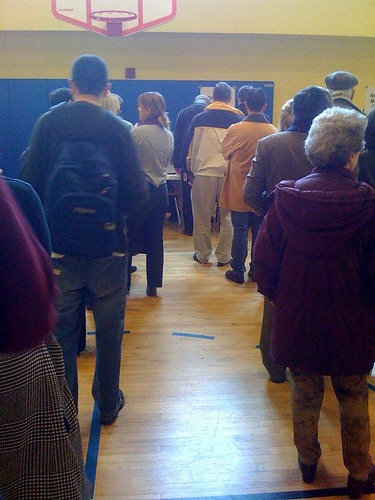
The voting lines 10:30a NW DC

Photo credit, christopher j. dorobek

Andrew Hacker has an interesting piece in the August 18 New York Review of Books, explaining why Barack Obama's chances for reelection are much better than recent poll results would suggest:

The 2012 electorate will differ from 2010’s in a crucial respect: it will contain nearly 50 million additional voters. Some will be new, but most of them will be people who supported Obama in 2008. Compared with the 2010 House electorate, they will be younger, more ethnically diverse, with fewer identifying themselves as conservatives, and a higher proportion will be women. Most of them would not have voted for the Republicans who now make up John Boehner’s House.
Hacker, by the way, discusses a number of recent political books in the article, including one on the 2010 election edited by Larry Sabato. That volume includes a chapter on Kentucky's junior Senator, Rand Paul, written by my colleague Laurie Rhodebeck.

Hacker credits Sabato with pointing out that election outcomes are "determined by the people who show up" to vote. In midterm elections, about 40% of voters turn out to vote, while presidential elections draw substantially more voters -- about 55 to 60% of the electorate in the past quarter century.

This column in yesterday's Guardian succinctly summarizes the importance of this difference:
...the sweeping Republican gains in Congress in the midterm elections of 2010 were on the usual 40% turnout; Obama was elected in 2008 on a 61% turnout. Yet it is the Republicans who think they have a mandate from the American people.
Perhaps, in hindsight, Democrats should have tried harder to convince non-voters that the 2010 midterms were a referendum on Obama that required their attention. Republicans certainly made that case to the likely voters -- who are older, more affluent, less diverse, and more likely to vote in midterm elections. Instead, Democrats often ran away from their successes (health care reform, the stimulus) and distanced themselves from the President.

In any event, despite the poor economic numbers, it would appear that President Obama stands a pretty good chance of reelection -- so long as his 2008 voters actually show up to the polls.


Visit this blog's homepage.

Follow me on twitter.

Saturday, August 13, 2011

From Hollywood: The antigenocide paparazzi

George Clooney in southern SudanPhoto credit: Australian Department of Defence.

Thanks to a busy summer travel schedule, I neglected to mention in mid-July new photographic data about ongoing violence in Sudan, acquired and released by partners affiliated with actor George Clooney's Satellite Sentinel Project.
The Harvard Humanitarian Initiative collects and analyzes images from commercial satellites, feeding them through a web platform designed by Google and the open-source software firm Trellon and comparing them with on-the-ground reports from The Enough Project, a human rights group. The group's work is especially vital in places like South Kordofan, where neither the U.N., outside aid groups nor journalists are allowed....

Yesterday, the group published a report on its latest images. As evidence of mass graves, the Satellite Sentinel Project points to the three freshly excavated areas pictured in the lead image above and to the white objects below, which it suspects are white plastic tarp body bags. A witness tells the organization that he saw 100 bodies or more put into one of the pits.

Based on these images and eyewitness reports, the organization concludes that the Sudanese military and pro-Khartoum militias "have apparently engaged in a campaign of systematic mass killing of civilians in Kadugli."
Obviously, this is potentially vital human rights work conducted by a celebrity-backed non-governmental organization.

SSP16 Fig3: Central Kadugli TownPhoto credit: ENOUGH Project.

Earlier this year, in news reports about the project, the Hollywood icon emphasized the potential deterrent effect of transparency:

"We are the antigenocide paparazzi," Clooney tells TIME. "We want them to enjoy the level of celebrity attention that I usually get. If you know your actions are going to be covered, you tend to behave much differently than when you operate in a vacuum."
If the group's July report is accurate, then Sudanese leaders have obviously not yet been deterred by the eyes in the skies.

However, anyone who has seen "Hotel Rwanda" understands the implicit threat Clooney is directing at human rights abusers. In a scene roughly two-thirds of the way into the film, the Paul Rusesabagina character played by Don Cheadle (involved with Clooney in the Satellite Sentinel Project) attempts to influence corrupt Rwandan General Bizimungu:
GENERAL BIZIMUNGU

Your white friends have abandoned you,
Paul.

PAUL
The United Nations are still here.

GENERAL BIZIMUNGU
(laughs) The United Nations. Madmen are
on the streets, Paul. But I will take
care of you. (chugs his drink) Your
cellar is well-stocked, right?

PAUL
Yes, General. I am glad you came by. I
overheard something that I think you
should know about.

GENERAL BIZIMUNGU
What did you overhear?

PAUL
A discussion between an American Embassy
official and a UN Colonel.

GENERAL BIZIMUNGU
What did they say?

PAUL
The American assured the colonel that
they would watch everything.

GENERAL BIZIMUNGU
Watch everything? How? They are gone.

Paul points surreptitiously to the sky. The General looks up.

PAUL
Satellites.

GENERAL BIZIMUNGU
Satellites?

PAUL
Yes, they can photograph the epaulets on
your shoulder.

GENERAL BIZIMUNGU
And what will they do with these
satellites?

PAUL
The American said intervention is too
costly, better to get photographic
evidence and snatch up the high command.

GENERAL BIZIMUNGU
The high command? Our high command?

PAUL
'Snatch them up and put on a war crimes
trial. Lock them all away forever. No
political risk, and big publicity.'
That's what he said. (a beat) I thought
I'd better tell you.

The General looks again to the sky then.
Given what Duck of Minerva co-blogger Alana Tiemessen has recently noted about the international reaction to events in Syria (likely tied to ongoing intervention in Libya), Clooney's data might not yield any tangible action.

Note: My film class typically views "Hotel Rwanda" near the end of the term.


Visit this blog's homepage.

Follow me on twitter.

Friday, August 12, 2011

Film: "Made in U.S.A."

Made in U.S.A (Jean-Luc Godard)

“We were in a political movie ... Walt Disney with blood.”

I generally do not discuss films unless I enjoy them and intend to recommend them without hesitation. Jean-Luc Godard's "Made in U.S.A." is an exception, worth mentioning in part because it has so rarely been viewed in the US. Godard made the film in 1966, during an incredibly prolific period of his career. Ostensibly, the film pays homage to "The Big Sleep," a Humphrey Bogart-Lauren Bacall detective story based on a book by Raymond Chandler. That earlier film classic is well-known for the sizzling chemistry between Bogart and Bacall, as well as the convoluted plot and ambiguous resolution of the murder mystery.

For his source material, Godard used a book (The Jugger) by Donald Westlake. It is one of Westlake's Parker novels, penned pseudonymously as Richard Stark. Since Westlake did not authorize the use of his book and was not paid for his ideas, he sued successfully to prevent the film from being distributed commercially in the United States. The film premiered briefly at the New York Film Festival n 1967, but was not then shown again stateside until 2009 -- very soon after Westlake died. TCM recently broadcast the movie and I recorded it.

Artistically, the film is interesting, colorful, and quite odd. Westlake's Parker, a ruthless killer and efficient criminal in the book series, is renamed Paula Nelson and played by the beautiful Anna Karina (Godard's soon-to-be ex-wife). As the film's colors and ideas are clearly embedded in the 1960s, this bit of gender-bending is obviously just one element of the broader social and cultural commentary addressed in the film. At one point, Paula says advertizing is fascism. On another occasion, she explains her cartoon-like experiences as if she is in a "film by Walt Disney, but played by Humphrey Bogart--therefore a political film." A dirty cop twice talks in the voice of Tweety Bird and many of the colorful pop images in the film certainly add a cartoonish quality to the film.

As the New York Times explained in April 2009:

...while this film is far from a lost masterpiece, it is nonetheless a bright and jagged piece of the jigsaw puzzle of Mr. Godard’s career.

...There is, for one thing, a pouting and lovely Marianne Faithfull singing an a capella version of “As Tears Go By.” There are skinny young men smoking and arguing. There are the bright Pop colors of modernity juxtaposed with the weathered, handsome ordinariness of Old France, all of it beautifully photographed by Raoul Coutard. There are political speeches delivered via squawk box.

And of course there is a maddening, liberating indifference to conventions of narrative coherence, psychological verisimilitude or emotional accessibility.

As assaultive as “Made in U.S.A” can be, it also seems to have been made in a spirit of insouciance, improvisation and fun.
The Times does not devote much attention to the film's explicit and implicit political agenda. The plot, such as it is, revolves around the disappearance and presumed murder of a young communist writer -- the former lover of the film's protagonist. Various characters in the film compare murder to war and the cold war to hot war. One ticks off a list of past battles, culminating in Hanoi, and suggests that all these wars have been essentially the same. Overtly leftist themes and slogans are woven into the dialogue and some characters seem to see a "vast right-wing conspiracy" almost everywhere.

Some critics interpret a strange bar scene as an example of Hegelian dialectic and the communist slogans emanating from the squawk box might suggest a Marxist dialectic at work. Whatever the preferred method, the title "Made in U.S.A." almost certainly has a double meaning and arguably suggests the need for a double reading.

First, Godard's homage to "The Big Sleep" says that American artists deserve credit and praise for the genre of film noir. And hard-boiled detective fiction as well -- one character, a writer, is named David Goodis. These dark stories cover important themes often ignored in the mainstream. Of course, the mainstream is represented by Disney cartoons and advertizing and Godard speaks fairly explicitly and critically about these elements of pop culture. Even in "The Big Sleep," the murderer's identity is made ambiguous (and other important plot points are changed) because Chandler's original story would not have been compliant with Hollywood morality codes of the time.

The second meaning of the title suggests that then-contemporary cold war conspiracies, whether overt like Vietnam or covert like a real mystery referenced in the film, were literally "made in America." Again, the criticism is not especially subtle. Young thuggish characters named Robert McNamara and Richard Nixon briefly appear towards the conclusion of the main story. One proclaims that he enjoys killing and the other clearly assents.

Keep in mind that McNamara was Secretary of Defense at the time of this film serving under one of the most progressive Democratic administrations of the last century. LBJ's "Great Society" produced important civil rights legislation, Medicare, Medicaid, new environmental laws, anti-poverty efforts, etc. But, of course, Johnson and McNamara also prosecuted and escalated the war in Vietnam.

Nixon was technically just a former Vice President (under Dwight Eisenhower), private citizen and corporate lawyer at the time this film was made. However, Nixon was an active party leader in 1966, meeting with foreign leaders while traveling abroad and campaigning for Republicans in midterm elections. Nixon had been a notable cold war hawk for some time and was a key figure on the House Committee on Un-American Activities. In his first campaign, he defeated a female incumbent by implying she was a "pink lady" harboring "communist sympathies."

In the ending shot, Paula tellingly opines that "The Right and the Left are the same. We have years of struggle ahead, mostly within ourselves.”

This film remains important because the struggle against pervasive commercialism is far from over and the cold war's end failed to kill the national security state.


Visit this blog's homepage.

Thursday, August 11, 2011

Syria, R2P, & the Obama Doctrine

Syrian protesters in front of the Syrian embassy in Cairo
Photo credit: Maggie Osama at the Syrian embassy in Cairo.

Given the brutal crackdown against anti-regime demonstrators in Syria, many analysts concerned about human rights are calling for external intervention. If the world had the responsibility to protect innocents in Libya, they argue, then the same logic applies for Syria. Thousands have already died as people stand up to their government.

However, as many other analysts have noted, nation-states view R2P (as it is known) as an ideal that must be considered on a case-by-case basis -- in the context of the just war doctrine and in conjunction with the views of relevant regional organizations.

Yes, such selectivity potentially weakens the norm's deterrent power, but it is more pragmatic and reflective of international politics as it is actually practiced. One major problem limiting new application of R2P is a lingering suspicion that this framing is used by western powers to justify broader intervention -- for regime change in Libya, for example.

As I have argued previously, US policy (doctrine?) during Barack Obama's presidency arguably reflects something like pragmatic cosmopolitanism. The US will apply its resources to avoid catastrophe when the benefits outweigh costs and the action has multilateral support.

Even if the UN Security Council, which can obviously act only with at least tacit support of the US, could cobble together the material resources to move more forcefully against the Syrian regime, it is not clear that such action would meet these standards for intervention. The US would want to see support from Russia, Turkey, India and perhaps China. And all these nations would need to be convinced that more coercive action would be narrowly targeted and likely to succeed.


Visit this blog's homepage.

Saturday, July 30, 2011

Nuclear savings

As the August 2 debt ceiling deadline approaches, members of Congress have floated all sorts of ideas to cut future spending because (tea party-backed) House Republicans say they won't vote for an increase without the cuts. Thanks to Grover Norquist, new tax revenues are deemed unacceptable because nearly every Republican in Congress has pledged not to increase taxes. They even oppose ending the Bush tax cuts on the wealthy even though Norquist himself apparently said that expiration of the Bush tax cuts (responsible for a significant share of the recent deficit growth) would not amount to a tax increase.

Republicans demand "entitlement reform," which is often their code phrase for long-sought policy changes they favor for ideological reasons -- including privatization and thus a huge reduction in guaranteed benefits paid by government. Democrats do not want that sort of "reform" and are not eager to slash the social safety net any further.

In the past few days, Democrats in the Senate have been working on a package of spending cuts that is actually larger than the $900 Billion in discretionary spending cuts offered in the latest plan pushed by the Speaker of the House, John Boehner. This is because Senator Harry Reid's plan pockets $1.3 Trillion in anticipated security-sector savings from the troop reductions in Afghanistan and Iraq. That is over a decade and includes future debt service related to the spending.

Earlier this week, I read a book review by Joseph Cirincione that outlined a potential additional source of $300 billion in savings. A nuclear freeze, which would only be a baby step toward President Obama's call for "global zero," would create these big savings:
Pentagon programs...will spend $300 billion over the next decade on the very [nuclear] weapons Obama says he wants to make less relevant.
I've often blogged about the need to include defense cuts in any deficit-reduction package. In addition to the concrete savings from de-escalation in Iraq and Afghanistan, why not pocket some money by stopping the development of new nuclear weapons?


Visit this blog's homepage.