

 Formed in 2009, the Archive Team (not to be confused with the archive.org Archive-It Team) is a rogue archivist collective dedicated to saving copies of rapidly dying or deleted websites for the sake of history and digital heritage. The group is 100% composed of volunteers and interested parties, and has expanded into a large amount of related projects for saving online and digital history.

The first two would be much better served striking the head of whatever ingrate spilled solution all over the scope and then DIDN'T WIPE IT UP.

Showing posts with label sometimes being an electrophysiologist sucks. Show all posts
Showing posts with label sometimes being an electrophysiologist sucks. Show all posts
Thursday, March 3, 2011

Thursday, March 26, 2009
Electrophysiology isn't a technique you add to your CV; it's a state of being!
Neuropharma's comment on my last post contained something that stuck in the craw of this old electrophysiologist. Some grad student she knew thought he could waltz over and learn some electrophysiology right quick, and include it in his thesis.
Then reality struck this student, rapidly disabusing them of this conceit:
"He was shocked to discover that it would take him such a long time to learn the technique (he's starting from level 0) and said that it seemed so easy when reading it from some published paper!"
Every newb thinks that a technique they haven't mastered is easy, until they actually try it. And in fact, the bare bones mechanics of patching are pretty straightforward. I've taught a lot of novices how to patch, and by and large they can get to the point of gigaohm seals in a week or two (ok, we're talking transfected HEK cells here). Hell, I'm thinking any primate above lemurs could learn to get seals. (Not a bad idea actually; screw those automated patch systems, gimme an army of squirrel monkeys and an old warehouse, and I'll screen your chemical library right quick! It'd be like the nut shelling squirrels in Willy Wonka. And they'd literally be DrugMonkeys! LOLZ.)
Then reality struck this student, rapidly disabusing them of this conceit:
"He was shocked to discover that it would take him such a long time to learn the technique (he's starting from level 0) and said that it seemed so easy when reading it from some published paper!"
Every newb thinks that a technique they haven't mastered is easy, until they actually try it. And in fact, the bare bones mechanics of patching are pretty straightforward. I've taught a lot of novices how to patch, and by and large they can get to the point of gigaohm seals in a week or two (ok, we're talking transfected HEK cells here). Hell, I'm thinking any primate above lemurs could learn to get seals. (Not a bad idea actually; screw those automated patch systems, gimme an army of squirrel monkeys and an old warehouse, and I'll screen your chemical library right quick! It'd be like the nut shelling squirrels in Willy Wonka. And they'd literally be DrugMonkeys! LOLZ.)
But there's a huge distinction between the currents you're recording at that point, and 'good' currents. These first currents are crap, e.g. the leak is terrible, the series resistance is awful, the throughput stinks, the solution applications kill cells or generate huge noise, you've got visible 60 Hz pickup. At best they're barely interpretable. But Electophysiologicus will dole out a decent cell here, a nice recording there. That'll be just enough to keep you coming back for more, and to keep the image of good recordings in your mind's eye.
The transition between the crappy recordings of the apprentice and the regular good recordings of the master takes a long, long time, on the order of a year I'd say.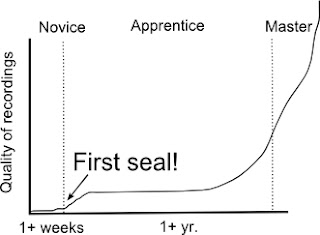
These are the dark times, where the progress is non-existent, perhaps to a greater extent than an analogous part of the curve for other technical subspecialties. Most electrophysiologists I've talked with had this time in their training, typically falling into the 2nd year of graduate school.
And yet, there's very little useful advice the masters can give their apprentices during this time, other than "keep at it". Sure, there are suggestions to try this, or don't do that. In the end though, everyone just has to put in their time, slowly perfecting each requisite skill, and evolving their own personal technique. It sucks, for sure, but it does end.
It's just not gonna end before your rotation or your last few months before you finish your thesis.
The transition between the crappy recordings of the apprentice and the regular good recordings of the master takes a long, long time, on the order of a year I'd say.

These are the dark times, where the progress is non-existent, perhaps to a greater extent than an analogous part of the curve for other technical subspecialties. Most electrophysiologists I've talked with had this time in their training, typically falling into the 2nd year of graduate school.
And yet, there's very little useful advice the masters can give their apprentices during this time, other than "keep at it". Sure, there are suggestions to try this, or don't do that. In the end though, everyone just has to put in their time, slowly perfecting each requisite skill, and evolving their own personal technique. It sucks, for sure, but it does end.
It's just not gonna end before your rotation or your last few months before you finish your thesis.
Tuesday, March 10, 2009
Hubris - and that ain't a circumscision in Whoville
Alas, I fear I have angered the Gods of Electophysiology with my last post.
(I'm digging the bass in this one!)
For now in their puckish ways, they have sentenced me to several hours fidding with the puller, in a vain sisyphusian search for something resembling a stable program. Or really anything that might give a useable pipette.
I've been burned bad. So what does one do when burned like Icarus in the tale of old?
WHY, IT'S TIME FOR MAIDEN!
(I'm digging the bass in this one!)
And it's back to the puller...
Friday, July 11, 2008
Dreaming of heaven...of the electrophysiologist's type
I've often said that in electrophysiologist's heaven, there's no series resistance, and you have an infinite number of solutions in a special magic fridge/shelf, containing every possible permutation of divalents, weird anions, or whatever.
Cause dealing with the lack of those two things is a series pain in the ass.
*sigh*
Cause dealing with the lack of those two things is a series pain in the ass.
*sigh*
Subscribe to:
Posts (Atom)
