website statistics
close
The Wayback Machine - https://web.archive.org/web/20100625231015/http://www.blogpi.net/category/blog-consultants

Archive for the 'Blog Consultants' Category

Use it Or I Lose Interest

Is Sen. Richard Shelby following you on Twitter? He is — or should I say, his staff — started following me about a week ago. They’re following 700+ other accounts, and 500+ are following back.

But here’s why I even bring it up:

richardshelby-twitter

Any plans to tweet, Senator?

I don’t know about you, but I try keeping my follow list limited to those who are saying something interesting, and I prefer not to follow accounts that are saying nothing at all.

Shelby’s name recognition is good enough so far to induce most Twitter users to follow him back, but if he doesn’t pick it up soon, I bet you’ll see people start drifting away.

Just another reminder for the e-campaign folks — if you can’t make proper use of a platform, don’t hop the bandwagon until you can do something with it.

Update 1: As of early evening on April 15, @RichardShelby has come alive, at least a bit.

Update 2: For what it’s worth, as of Friday morning before her much-anticipated Twitter show, Oprah Winfrey has 62,484 followers and growing briskly but has not updated yet either. I find this annoying too, but it sounds like she’ll be getting right on it — and you know, she’s a little more famous than Sen. Shelby.

Update 3: A week later, the three tweets from April 15-16 are still the only ones posted. Fail, cont.

C-SPAN 2.0 (Ft. New Media Strategies)

C-SPAN 2.0 Featuring New Media Strategies
I don’t write about clients often. When I do it’s really something, and this is really something: New Media Strategies will be working through the conventions with C-SPAN, perhaps my favorite Beltway news organization, to run their Convention Hub. The website was designed by NMS partner JESS3, will be maintained by the multi-partisan Public Affairs practice, with editorial oversight and video from the Cable-Satellite Public Affairs Network. I wish I could show it to you. I can’t just yet, but as I said, it’s going to be really something.

What I can offer are details about the Convention Hub microsites. There will be two, one for each convention, with video and blog coverage around the clock:

  • C-SPAN will provide exclusive video from the conventions, and for the first time, this C-SPAN video is searchable, clippable and embeddable. As someone who has tried (unsuccessfully) to jerry-rig an embeddable C-SPAN video in the past, this is a huge leap forward.

  • NMS will feed the latest convention reporting and blogging to the Convention Hub pretty much non-stop. Or as our official language puts it, “extensive real-time blogosphere coverage using NMS’s proprietary combination of software and trained human analysts.”

  • C-SPAN Campaign 2008 LogoMore about that software another time; all I can say is that it answers the questions I’ve asked about such analysis tools.

  • The Hub will also include Twitter feeds of users using the hashtags #RNC08 and #DNC08 (and surely other tags, as their usage rises).

  • The site goes live at c-span.org/politics later this month. The Democratic Hub will be at c-span.org/politics/DNC08 and the Republican Hub will be at c-span.org/politics/RNC08.

  • NMS will have a presence at each convention to help to facilitate coverage and promote the Convention Hub. It certainly doesn’t hurt that we have bloggers credentialed to both (see you in St. Paul).

  • There is more, but I’m not exactly sure what I didn’t see in the press release that’s public, so I’d better hold off for now. At the moment, this is the only public hint on c-span.org:

C-SPAN Convention Hub banner teaser

Meanwhile, the C-SPAN Convention Hub is already drawing praise from one of C-SPAN’s (few) notable critics. The Sunlight Foundation has differed with C-SPAN before over distribution of copyrighted C-SPAN video, so they are enthusiastic about the open nature of the Convention Hubs:

The convention announcement marks a new moment for C-SPAN as a modern Internet information provider. Once a small cable channel with a dream; now with embeddable web video, Twitter hashtags, and aggregated blog posts.

As a longtime C-SPAN junkie, I couldn’t be more proud to play a small part in this project. How dependent am I on the C-SPAN network?

  • I wake up to Washington Journal every weekday morning (my Twitter account will bear this out).

  • Before I found podcasts, I’d listen to streaming Realplayer segments from the program (I still listen to the podcast of Brian Lamb’s Sunday night Q&A).

  • Back in college I would sometimes wake up early (4 a.m.) to catch particular episodes live, such as the first of the Hitchens-Sullivan conversations with Lamb, shortly after 9/11.

  • If it’s the weekend and my television is not on baseball or football, it’s on BookTV.

  • The tagline of my personal blog, The Washington Canard, is: “Where C-SPAN is the local TV news.”

The good news is that it’s a supportable addiction.

And by way of conclusion, a confession: I want this searchable video for my own reasons. On Election night 2004, The Hotline worked all through the night covering the coverage, as the election tipped from Kerry winning the exit polls to Bush winning the popular vote. If you’ve seen my Facebook photo, this is where that crazy image comes from.

As usual, C-SPAN cameras were in the office for Chuck Todd and Vaughn Ververs to offer recaps, also deep into the morning hours. Sometime around 3 o’clock in the morning, I informed friends watching the coverage from back on the West Coast to look carefully: As the cameras rolled, I picked up a plastic trash bin and… well, I danced through the background.

The waltz, I think.

I entered left with vulcanized dance partner, twirling across one shoulder, behind the talking head, past the other shoulder, exiting right. To this date, it’s still my best television appearance. And I look forward to the day, much sooner now, that I can embed this on Blog P.I.

Cerf’s Up: When Bipartisanship Really Isn’t

At last week’s Personal Democracy Forum, one of the events I missed was the launch of a coalition called InternetforEveryone.org. I’m skeptical of the organization, and while I admit I’m not really sure what it’s all about, therein lies part of my skepticism. It’s very easy to agree that Internet access should be as widely available as possible. However, the policy details are not so easily agreed upon. But as a market-oriented thinker, I’m inclined to agree with Erick Erickson that this is in fact a bad idea.

Supporters at the press conference included Stanford professor Larry Lessig, former FCC commissioner Jonathan Adelstein, environmental activist Van Jones, a venture capitalist from the firm which first funded Twitter, Google’s chief evangelist Vint Cerf and Josh Silver from Free Press. That’s the same Josh Silver I criticized back in May for claiming the only real news was his kind of news.

Also on the panel: Republican consultant David All, whom I count as a friend and whose work on Slatecard I admire but with whom I disagree on some matters of policy and partisanship. I’m not the first to note the incongruity of this panel; if you happened to check out the comments at All’s TechRepublican starting this weekend, Mike Turk initiated a very interesting debate with All on the merits of the group continuing through today.

David has called Internet for Everyone a “bipartisan” organization, which Turk has also called into question. All’s claim seems very hard to justify, based on the names above. For one thing, the only other reference to Internet for Everyone as “bi-partisan” comes from Brian Reich at Fast Company — who is, coincidentally, a former Gore campaign aide. Meanwhile Tim Karr of Free Press didn’t bother to include the word “bipartisan” in his announcement at Huffington Post.

But I was reminded of a tweet from @DavidAll the evening the conference ended:

David All tweet about Vint Cerf as a Republican

And in a post on Saturday, All did concede that the bipartisanship of the group was tenuous:

As one of the only Republicans in the coalition (Vint Cerf of Google is a registered Republican), I believe it’s crucial for Republicans to embrace a national broadband strategy.

Curious about Vint Cerf’s Republican bona fides, I decided to punch his name into OpenSecrets.org. For the sake of column width, I’ve removed his employers (principally MCI, MCI Worldcom, Worldcom and Google). Here’s what I found:

Vint Cerf’s political donations, via OpenSecrets.org

Finally! Proof that Vint Cerf is a Republican. Well, maybe he was once a Republican. And so, David’s claim that the Internet was Republican from the beginning has a fighting chance. But Cerf is clearly not a Republican now, in fact he has been quite an active Democrat since approximately the Reagan administration.

There are certainly times when cross-ideological partnerships are a good idea, such as when Redstate’s Mike Krempasky, Adam Bonin and Markos Moulitsas of Daily Kos came together to fend off campaign finance restrictions on bloggers. But it concerns me that David All — one of the C&E-recognized rising stars of GOP Washington — is giving ideological cover to an organization which is not just non-conservative and not just un-conservative, but whose basic idea treats limited government and market-based solutions as beneath discussion.

P.S. I hope this doesn’t dissuade him from watching the rest of The Wire.

Let’s Just Admit Slatecard is the Republican ActBlue

BERJAYAIn the past week or so, two online GOP operatives (neither of whom is David All) have separately suggested to me that the competition among the three Republican Internet fundraising websites is effectively over. Even I doubted the separation would happen this quickly, but as of now even a late push by one of the two laggards would have a hard time catching on.

Evidence that Slatecard, bootstrapped project of Republican consultant David All (and web developer Sendhil Panchadsaram), is “the Republican ActBlue” can be found throughout mainstream political coverage over the past six months. Here are just a few:

Campaigns and Elections:

Then why the development of small donor online vehicles, including the Democratic ActBlue and Republican Slatecard, that aim to raise small donations on the congressional level? Both tools are growing substantially, and several candidates for Congress are highlighted on those sites.

USA Today:

“Your average online donor is an impulse buyer,” said David All, a Washington, D.C.-based consultant who last year founded Slatecard.com, which he hopes to be a Republican answer to ActBlue. So far, the site’s donors have raised more than $5,000 for GOP presidential candidates.

Wall Street Journal [$]:

Mr. All, the Republican consultant, started a rival site last October called SlateCard.com. It has raised just $300,000. “What I’m finding is a lot of Republican campaigns are just hiring college kids or using their son who has a Facebook account,” said the 28-year-old Mr. All. “They don’t understand what this is all about.”

Human Events:

Slatecard aims to raise money for Republican candidates in the same way that ActBlue has for Democrats. Slatecard lets users create profiles (“slatecards”) for candidates they support and then raise money by donating to that candidate and passing it on to friends, family members, co workers — anyone — through blogs, emails, and social networking groups.

Wired:

“If you read the statute, the result is not surprising,” said Don McGahn, an attorney who advises Slatecard, the Republicans’ answer to ActBlue. “However, when they passed the statute, there wasn’t even the internet … what it really shows is that the way to fix this is to pass legislation to update the Matching Payment Act .”

While Slatecard is more elegant, interactive and transparent than its counterparts, it seems that All’s sometimes controversial self-promotion has made the lion’s share of difference, especially as he has succeeded in persuading local congressional campaigns to use his site, sometimes making it their exclusive online fundraising platform.

RedState, former backer of Big Red Tent, now supports SlatecardBut if you need further evidence that Slatecard is the take-all (no pun intended) winner of the online GOP fundraising tool primary, consider the image at right, taken from the sidebar of leading Republican activist site RedState. It’s a Slatecard widget encouraging contributions to the McCain camapign.

It’s noteworthy not just for being there but for what it replaces: Nearly a year ago, RedState announced it was backing one of the future also-rans, Big Red Tent:

Patrick Ruffini has said more than once that the right needs to stop building what the left already has and instead build the next big thing. As part of heading in that direction, please let me introduce you to the Big Red Tent. We didn’t build it, but we’re actively supporting it.

There is more irony here: Ruffini is chiefly responsible for the other runner-up, Rightroots, and RedState’s Erick Erickson was party to a minor internecine fight with All during the Republican primary season. To back All’s Slatecard over Big Red Tent may have been a difficult choice, but considering how the other two have languished, it may have been no choice at all.

Update: David writes to say that 48 candidates now have used Slatecard exclusively for online fundraising, though some have already lost their primary or special elections. That’s impressive, especially for a site not yet nine months old.

Four Blogs, Two Candidates and One Year Later

Balloon Juice, The Daily Dish, MyDD and Taylor Marsh

Three’s a trend, and this is Blog P.I.’s third post in a row leaning on juxtapositions; this time, the subject of two posts from late 2006 and early 2007 have converged in a way I certainly couldn’t have imagined at the time. Both were about bloggers’ attitudes toward the presidential campaign then still taking shape, and if one can make any definitive predictions in politics, it’s that you can never make definitive predictions about the future. And this is all the more true on the morning after the primaries in North Carolina and Indiana.

  • In October ‘06 it was The Agony and the Apostasy, about the leftward drift of two well-known (onetime) conservative bloggers, Andrew Sullivan and John Cole. Sullivan claims to believe everything today that he believed in the early 2000s, but the day-to-day effect of his blogging is pretty much the opposite. Cole has gone from a Republican supporter of the Iraq war to a sarcastic critic of all things Republican.
  • Then in January 2007, Hillary in Blogistan: On Blogads, the Netroots and Peter Daou, a lengthy reported piece about the Internet advertising campaign directed by Daou, coinciding with the official launch of Clinton’s presidential bid. That post also explored Nevada blogger Taylor Marsh’s incensed reaction to being excluded from the original ad buy. This post also referred to MyDD as “one of the leading anti-Hillary sites on the left.”

So how much does a year change? Quite a bit. The 2006 post wondered about which way the two apostates would break in the 2008 race:

It seems plausible that Sullivan and Cole could support a Republican for president alongside their erstwhile compatriots, but probably not until after the primary is decided.

My answer, hedging as it was, does not seem to have stood the test of time.

  • In the year and a half since, Sullivan has moved his blog from Time to The Atlantic and, in concert with his recent criticism of the Republican Party and conservative movement overall, he has become one of the most prominent supporters of Barack Obama. So much so that The Atlantic published a December cover essay by Sullivan presumptuously titled “Goodbye to All That: Why Obama Matters.” On the Republican side, Sullivan had preferred McCain over the runners-up, in large part based on McCain’s opposition to the Bush administration’s torture/interrogation policies. Of course, Obama holds the same opinion. Sullivan was no doubt pleased with last night’s results in North Carolina and Indiana, but one cannot escape the sense that he’ll miss the Clintons.
  • Cole, meanwhile, has become an even more constant, if not more ardent, supporter of Obama’s candidacy. Like Sullivan a former 1990s conservative, he acquired no later appreciation for Hillary Clinton. And like Sullivan, he now sees her worse attributes similar to what he doesn’t like about the modern Republican party. He remains a member of the Pajamas Media advertising network which is run and largely populated by right-of-center blogs such as Instapundit and Protein Wisdom. But now he’s also been using the Democrat-oriented ActBlue website to raise money for Obama (and Obama alone) which probably makes him the only blog simultaneously affiliated with both Pajamas Media and ActBlue. As for the primary results, Cole was exultant, apparently staying up most of the night blogging the results.

Clearly, neither are rejoining the Republican camp anytime soon. More interesting, though, is what’s happened with Taylor Marsh and MyDD.

  • At the time, Marsh was leaning strongly toward Edwards and was unimpressed by Clinton. But regardless of her displeasure with the Clinton campaign’s ad buy, barely two months later she had changed her mind and made the case for Clinton. Even before then, her site had started to turn anti-Obama, especially after he dissed her home state by skipping an AFSCME-sponsored presidential forum in Carson City. Since then, she has been one of the most ardent pro-Clinton bloggers and one of the most committed Democratic opponents of Obama. And only just this morning, with the primary results clear, is Marsh shifting again: recognizing that Clinton cannot win, she will oppose John McCain without making the case for Obama.
  • Meantime, MyDD has undergone even bigger changes than the other three. In this case it wasn’t a change of mind, but a change of bloggers: in July of last year, the two principal authors, Chris Bowers and Matt Stoller, decamped for an entirely new website: Open Left. Their new blog has now become a new leading anti-Hillary site, as MyDD once was. Meanwhile, MyDD has shifted back to reflecting the opinion of the site’s original founder, Jerome Armstrong. Armstrong stepped up his own blogging and brought in a new contributor, pro-Hillary Todd Beeton. Armstrong had previously been a consultant to Mark Warner, former governor of (and all-but-guaranteed future senator from) Virginia, but since he exited the presidential race more than a year ago, Armstrong has become an unflinching proponent of Hillary Clinton. So much so, in fact, that it has been the source of conflict between Armstrong and his former co-author Markos Moulitsas, to say nothing of the wider leftosphere. Today, Armstrong is sounding a little more apathetic than Marsh, merely affirming that the Clinton campaign has the right to continue on.

Taken as a whole, the four websites defy categorization, dissimilar in cause and effect, except in that their content has changed dramatically over time. And I am sure that whether McCain or Obama takes the oath of office next January, I don’t want to make any predictions about which candidates each site will be supporting in 2012.

There are Two Things Wrong With this Picture

F7 with Huckabee and Romney and Obama

If the question doesn’t make sense, then read this:

At Rightroots, we have built a way for Republicans to rally behind their new nominee right out of the gate. We’re asking all Republicans to donate online to the new nominee next Thursday, February 7th. …

On February 7th, we’ll set up a page on Rightroots for you to give to the nominee and show you our community’s results in real time. …

If the nominee is McCain, we still have to do this. His campaign especially is running on fumes financially, but they’ve shown they can be effective with an even a small amount of money.

You can’t read the fine print on the screen shot above (well, you could if you squinted) but here’s what’s relevant:

The Super Tuesday primaries are over and February 7th is here. On Tuesday, Senator John McCain established himself as the frontrunner for the Republican nomination, with Governor Mitt Romney and Governor Mike Huckabee winning primaries and caucuses throughout the nation.

Please give generously to the major Republican candidates who remain active contenders for the nomination…

It’s fair to point out that Romney did not officially suspend his campaign until a few hours after the page went live, but it’s also fair to point out that by February 6, McCain was the only realistic nominee. Also fair, Romney was still there as of the last revision of this post. My own initial coverage of the February 7 effort was quite favorable, so I would be derelict if I failed to follow up and say that anyone who bought into the initial pitch — let alone gave money — should feel misled.

The February 7th Sign or: Stop This Train, I Want to Get On

Patrick Ruffini has announced a new Rightroots-branded initiative called February7.org. The premise is simple: Republicans are likely to have a presumptive nominee by the morning after the morning after Super Tuesday (Tsunami Tuesday for you First Read fanboys and girls). This primary has not been as ugly as the Democrats’, but it has been ideologically dispiriting, mostly featuring candidates who fell short of conservative ideals. An early fundraising push could help rally the GOP while the Democrats are still fighting amongst themselves.

That nominee is most likely to be John McCain, while Ruffini has switched his support from “Rudy to Romney,” as he put it Tuesday night. Therefore, the most likely scenario is he will have to grudgingly switch again in about a week. If the move is a painful one for many, better then to get it over with. But there’s more to it, as he explains in the announcement on his own site:

You can probably tell that I have strong views about this nomination contest. Win or lose, I’m equally convinced of the importance of getting behind the eventual winner. A nation at war cannot afford Hillary or Obama in the White House. …

Beyond just showing support for our nominee, we’re doing this to help solve a concrete strategic problem for our Party during the month of February.

The simple fact is that when it comes to contributions from others, our candidates are broke. They’ve spent it all on Florida. No one is up on TV in any February 5th state, while Hillary and Obama have money to burn (I saw Clinton ads in California last weekend). Based on the fact that they have money to play with and have held a fundraising advantage throughout the cycle, there is a chance they could start pummeling our candidate with negative ads right away.

If we fundraise the same old traditional way — with fundraising events and direct mail early and banking on Internet enthusiasm late — we will lose. There is no way we’ll be able to get the money when and where we need it. On the Internet in particular, contributions come in late, often too late for the money to be spent effectively. We’re hoping to help frontload some of this money so that the candidate can use it against Hillary/Obama right away. When it comes to giving, early is the new late.

Well said. But for my money, the best part of the website is that one can toggle between “Stop Hillary” and “Stop Obama,” not unlike a blog that lets you change the background color:

Stop Hillary at February7.org             Stop Obama at February7.org

Please notice that no “Stop Edwards” version was created.

P.S. I first heard about this through a Twitter account Ruffini set up last week: Twitter.com/February7. I followed the account back, but of 111 users Ruffini followed, only 13 followed it back. That 11.7% rate would be terrific if it was direct mail, but it isn’t that. Twitter marketing has been the focus of much discussion over the past year, but here is some evidence that the medium strongly favors established personalities — Ruffini is one, but @February7 is not. And setting up new Twitter accounts is fun, but not all that effective.

To Boldly GOP Where No… The Blog on the Edge of… Sorry, I Got Nothing

Via Buzz Brockway on Twitter and Peach Pundit, artwork from a new article in Campaigns and Elections:

Campaigns & Elections artwork featuring Erick Erickson, David All, Patrick Ruffini and Rob Bluey in Star Trek uniforms

A hearty congrats to all featured, and I think my colleague the Virginia delegate to QandO may be quoted in the piece. Yet the pay wall leaves me wondering. As a resister of all things Star Trek (and sympathizer with K-Lo at The Corner on this) I’m not sure if I should be envious; Matt Lewis’s Town Hall commenters are pretty harsh, and not just the Ronulans.

But the article isn’t public, so I can’t judge for myself, nor can bloggers or their commentariats. C&E publishes much of its content on the website, but right now there is a little C&E dollar icon symbol next to the one article that’s actually about bloggers. Who are the ad wizards at C&E who came up with this one?

I also wonder if the falling out between David and Erick (and others) from a few months back gets any inches. My guess is not, and even if I’m wrong, it makes me think it’s too bad Wonkette doesn’t report on its city’s industry in the same depth as Valleywag (retooled in early 2007) or even Gawker (retooling, but not pulled).

Certainly the Beltway and the District is as much a company town as the Silicon Valley/Palo Alto, so where’s the 100-word-version? Someone, please, quote the key grafs in a blog post. Make it so.

And to tell the truth, I probably watched ST:TNG on afternoon television for at least thee years in middle school.

Update: I have now read the article, and I am pleasantly surprised that the kerfuffle noted above is indeed covered, and that author Walter Alarkon even used the word “kerfuffle.” Aside from the annoying Star Trek motif and an embarrassingly lame pull quote, the article does a reasonably good job of explaining the current challenges Republican web strategists face. If the piece brings a wider awareness to these issues, it’ll have done all it needs to.

You can read the article here in the original layout; thanks to Theodora in the comments for bringing it to my attention. Still, the snazzy NXTbook software (which doesn’t even live on the C&E page) features no plain text, so it’s next to invisible to search engines. Likewise, it doesn’t let you copy and paste, so it’s next to useless for blogging.

Updated again: In the comments, it has been pointed out that there is an XML page running in the background, so it’s not a total SEO disaster. Meanwhile, Rob Bluey is weighing in…

I wasn’t going to post it, but I feel the need to set the record straight. For starters, I hate Star Trek.

Why Buy the Book When You Can Get the Blog for Free?

The number of books about the political blogosphere climbs ever upward, and today I see that yet another is on the way, from Democratic Virginia blogger-consultants Lowell Feld and Nate Wilcox. The book won’t be out until the middle of 2008, but Feld announced it in a post on Raising Kaine last night. It’s called “Netroots Rising: How a Citizen Army of Bloggers and Online Activists Is Changing American Politics,” and it’s already listed on Amazon:

Netroots Rising by Lowell Feld and Nate Wilcox, as seen on Amazon

Wait. I think I need to do an exaggerated double-take, for comic effect:

Netroots Rising by Lowell Feld and Nate Wilcox, as seen on Amazon

Forty bucks? What is this, a college-level textbook? A coffee table book? Merely oversized? Is it 800 pages? I buy enough books that my Amazon Prime account pays for itself, and I can’t remember the last time I shelled out this much for a book that wasn’t out-of-print.

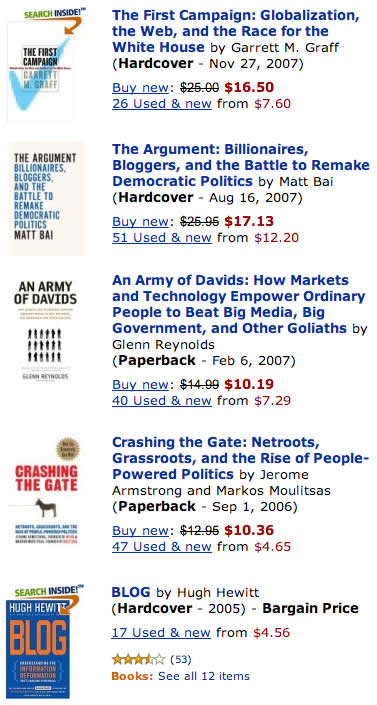
For comparison, here are the Amazon listings for other recent (though indeed they are all recent) books about politics and the Internet:

Political blog books by Garrett Graff, Matt Bai, Glenn Reynolds, Markos Moulitsas, Jerome Armstrong and Hugh Hewitt

These aren’t all new, and they’re not all hardcover. But you’ll see that the two released this fall — the tomes by Graff and Bai — are indeed hardback, and with Amazon discounts they cost less than half of “Netroots Rising.”

It is certainly the kind of book I would be inclined to buy. I bought most of the books listed above, mostly from Amazon, and mostly when they were brand new. But at forty bucks, I may just have to apply for a library card.

Rightroots, Big Red Tent and Slatecard: An Assessment

Logos for Slatecard, Rightroots and Big Red Tent

Online fundraising startups are a longstanding interest of Blog P.I. In our year and a half, we’ve devoted more than a few posts to the subject, including the progressive, Democrat-supporting ActBlue, the conservative, Republican-aligned newcomer ABC PAC/Rightroots, attendant security issues and flawed coverage often (but not exclusively) in the Washington Post. The last time I wrote about it, Rightroots had relaunched, and two similar Republican fundraising startups — Big Red Tent and Slatecard — were announced and on the way shortly.

Now, all three have been up for more than a month, which I think is enough time to make an early comparative assessment.

For those playing at home: Rightroots is a reboot of the ABC PAC/Rightroots slate that saw a trial run fairly late in the 2006 cycle, controlled by McCain adviser Becki Donatelli, former Giuliani Patrick Ruffini and Mike Turk, an outside adviser to the Thompson campaign. Big Red Tent is an outside-the-beltway venture by a pair of Austin, Texas web consultants Ryan Gravatt and Brad Jackson. Slatecard is the brainchild primarily of ubiquitous DC Internet guy David All and web developer Sendhil Panchadsaram (who strangely has no website that I can find).

Last weekend, I signed up for each one and made some nominal contributions. Since then, I’ve continued poking and prodding. I thought about putting together an elaborate chart comparing their features side-by-side. Perhaps in a future post I will, but for now, but I don’t think that gives as clear a picture of what I thought about them. Instead, this post collects my observations, with screen captures. It’s a long one, so I’ve tucked the rest of this post below the fold. Follow me…

Continue reading ‘Rightroots, Big Red Tent and Slatecard: An Assessment’