

 From the industry newsletter Nucleonics
Week (subscription required):
From the industry newsletter Nucleonics
Week (subscription required):
Eight German municipal utilities have filed a complaint with the European Commission against lifetime extension for the country's nuclear reactors, charging that it is anti-competitive and makes their investment in renewable energy unprofitable.
On October 28 the lower house of Germnay's parliament, the Bundestag, approved a bill with amendments to the nuclear law that allow the country's 17 operating nuclear reactors to continue operating after 2022. All of the units were scheduled to be shut by that date.
The amendments allow reactors that went online before 1980 to operate for eight more years and those that went into operation after 1980 to run for 14 more years.
In a statement on November 11, Albert Filbert, chief executive of the HSE power company [and spokesman for the 8 utilities], said the utilities believe they are "victims" of that decision and that they will lose about Eur4.5 billion (USS6.1 billion) if the reactors continue to operate. Nuclear power will make electricity from renewable energy too expensive to be competitive, he said.
First, how in hell is keeping perfectly OK nuclear power plants in operation "anti-competitive?" This petition by German renewable energy companies reminded me of French economist Frederic Bastiat's famous Candlemakers' Petition in which producers of artificial light urged the French government to outlaw the sun because of its ruinous competition. I think you'll see the similarity:
We ask you to be so good as to pass a law requiring the closing of all windows, dormers, skylights, inside and outside shutters, curtains, casements, bull's-eyes, deadlights, and blinds — in short, all openings, holes, chinks, and fissures through which the light of the sun is wont to enter houses, to the detriment of the fair industries with which, we are proud to say, we have endowed the country, a country that cannot, without betraying ingratitude, abandon us today to so unequal a combat.
And as Bastiat's petitioners argued, shutting down cheaper energy, "Produces more jobs."
First, if you shut off as much as possible all access to natural light, and thereby create a need for artificial light, what industry in France will not ultimately be encouraged?
If France consumes more tallow, there will have to be more cattle and sheep, and, consequently, we shall see an increase in cleared fields, meat, wool, leather, and especially manure, the basis of all agricultural wealth.
If France consumes more oil, we shall see an expansion in the cultivation of the poppy, the olive, and rapeseed. These rich yet soil-exhausting plants will come at just the right time to enable us to put to profitable use the increased fertility that the breeding of cattle will impart to the land.
Our moors will be covered with resinous trees. Numerous swarms of bees will gather from our mountains the perfumed treasures that today waste their fragrance, like the flowers from which they emanate. Thus, there is not one branch of agriculture that would not undergo a great expansion.
The same holds true of shipping. Thousands of vessels will engage in whaling, and in a short time we shall have a fleet capable of upholding the honour of France and of gratifying the patriotic aspirations of the undersigned petitioners, chandlers, etc.
Or is the petition of the German renewable energy industry more of an example of a broken windows fallacy energy policy?
Hat tip to Steve Frantz.
This month nannies banned beverages that mix booze with caffeine and one top official even hinted that the feds may disable cell phones in cars.
But this time top dishonors go to the heartland mayor who sacked the Lingerie Football League.
Presenting Reason.tv's Nanny of the Month for November 2010: Oklahoma City Mayor Mick Cornett!
Approximately 1.17 minutes.
"Nanny of the Month" is written and produced by Ted Balaker. Associate Producer: Alex Manning. Opening animation: Meredith Bragg.
To watch previous Nanny of the Month episodes, go here.
Scroll down for downloadable versions of our videos, and subscribe to Reason.tv's YouTube page to receive automatic notification when new content is posted.
Politico reports that Rep. Paul Ryan, the top Republican on the House Budget Committee and a member of the president’s fiscal commission, is skeptical of some key parts of the fiscal commission’s proposal:
Reps Paul Ryan (R-Ohio), and Jeb Hensarling, (R-Tex.), said that the plans called for too much in tax increases, and they claimed that the Bowles Simpson approach to health care would have the effect of furthering the Obama health care reform, which Republicans have vowed to repeal. Ryan and Hensarling said they would push Ryan’s “Roadmap” plan to budget reform.
And via RealClearPolitics, here’s Rep. Ryan explaining why you can’t solve the deficit problem without addressing Medicare:
If you’re in the Washington area tomorrow morning, you can see Ryan debate New York Times columnist David Brooks at the American Enterprise Institute. The topic of debate will be a question near and dear to the hearts of Reason readers: How much government is too much?
I’ll be in attendance, and I'll also be staying afterwards to tape a post-debate discussion panel with Ezra Klein and Jennifer Rubin of The Washington Post.
You can read my feature on Ryan and his deficit plan from the June 2010 issue here.
National Review’s Andrew McCarthy wrote a column yesterday about the WikiLeaks’ brouhaha where he deployed the unfortunate sentence “the First Amendment has never been understood to mean what it says,” thus opening himself up to the dread charge of endorsing a “living Constitution.” Blogging today at NR’s The Corner, McCarthy hastens to add that he only meant that the language of the First Amendment is “more sweeping than the freedom it was understood to convey.” As evidence, he cites conservative legal hero Robert Bork’s famously cramped reading of the First Amendment, including this passage from Bork’s bestselling 1997 book Slouching Towards Gomorrah:
[t]here are certain well-defined and narrowly limited classes of speech, the prevention and punishment of which have never been thought to raise any Constitutional problem. These include the lewd and obscene, the profane, the libelous, and the insulting or “fighting” words — those which by their very utterance inflict injury or tend to incite an immediate breach of the peace. It has been well observed that such utterances are no essential part of any exposition of ideas, and are of such slight social value as a step to truth that any benefit that may be derived from them is clearly outweighed by the social interest in order and morality.
It’s nice to learn that McCarthy thinks the First Amendment means some of what it says, though his deference to Robert Bork raises a few additional concerns. Bork is no individualist and he is certainly no civil libertarian. His legal philosophy centers on letting the majority have its way. As Bork wrote in his 1990 book The Tempting of America, the “first principle” of the American system is majority rule, not individual rights. “In wide areas of life,” he wrote, “majorities are entitled to rule, if they wish, simply because they are majorities.” So Bork believes that speech with “slight social value” doesn’t really deserve to be free. But who gets to measure that value? Bork would basically allow legislative majorities free rein to ban suspect speech in the name of “order and morality” and then angrily denounce any court that struck down the ban. The First Amendment deserves more respect than that.
 The U.N. Cancun climate change conference
convened on Monday, and on Wednesday the Republican leadership
decided to get rid of the Select Committee on Energy Independence
and Global Warming created by soon-to-be-former Speaker of the
House Nancy Pelosi (D-Calif.) in 2007. Politico reports:
The U.N. Cancun climate change conference
convened on Monday, and on Wednesday the Republican leadership
decided to get rid of the Select Committee on Energy Independence
and Global Warming created by soon-to-be-former Speaker of the
House Nancy Pelosi (D-Calif.) in 2007. Politico reports:
Rep. Jim Sensenbrenner (R-Wis.) made official what many had already expected – the GOP majority will axe the Select Committee on Energy Independence and Global Warming, which Pelosi created in 2007.
“This hearing will be the last of the select committee,” Sensenbrenner announced.
Republicans intend to investigate climate change issues at the Energy and Commerce Committee where chairmanship is hotly contested among Rep. Joe Barton (Tex.), Rep. Fred Upton (Mich.), Rep. John Shimkus (Ill.) and Rep. Cliff Stearns (Fla.).
Note: I will be covering the Cancun climate change conference beginning next week.
Dear visitors: If you are seeing bizarre formatting, vertical lines through text, or other problems with our new site look, please clear your cache or do a hard refresh (Ctrl-F5, or click refresh while holding shift on a Mac).
Thanks,
The Squirrels
I mentioned Jack Shafer's eloquent defense of Wikileaks in today's Morning Links roundup. Here's an excerpt:
International scandals—such as the one precipitated by this week's WikiLeaks cable dump—serve us by illustrating how our governments work. Better than any civics textbook, revisionist history, political speech, bumper sticker, or five-part investigative series, an international scandal unmasks presidents and kings, military commanders and buck privates, cabinet secretaries and diplomats, corporate leaders and bankers, and arms-makers and arms-merchants as the bunglers, liars, and double-dealers they are...
The recent WikiLeaks release, for example, shows the low regard U.S. secretaries of state hold for international treaties that bar spying at the United Nations. Both Secretary of State Hillary Clinton and her predecessor, Condoleezza Rice, systematically and serially violated those treaties to gain an incremental upper hand. And they did it in writing! That Clinton now decries Julian Assange's truth-telling an "attack" on America but excuses her cavalier approach to treaty violation tells you all you need to know about U.S. diplomacy...
The idea of WikiLeaks is scarier than anything the organization has leaked or anything Assange has done because it restores our distrust in the institutions that control our lives. It reminds people that at any given time, a criminal dossier worth exposing is squirreled away in a database someplace in the Pentagon or at Foggy Bottom.
Over at the Economist, Will Wilkinson also defends Julian Assange.
If secrecy is necessary for national security and effective diplomacy, it is also inevitable that the prerogative of secrecy will be used to hide the misdeeds of the permanent state and its privileged agents. I suspect that there is no scheme of government oversight that will not eventually come under the indirect control of the generals, spies, and foreign-service officers it is meant to oversee. Organisations such as WikiLeaks, which are philosophically opposed to state secrecy and which operate as much as is possible outside the global nation-state system, may be the best we can hope for in the way of promoting the climate of transparency and accountability necessary for authentically liberal democracy. Some folks ask, "Who elected Julian Assange?" The answer is nobody did, which is, ironically, why WikiLeaks is able to improve the quality of our democracy.
Finally, here's Glenn Greenwald on the backlash, in particular the sad reaction from our watchdog media.
The WikiLeaks disclosure has revealed not only numerous government secrets, but also the driving mentality of major factions in our political and media class. Simply put, there are few countries in the world with citizenries and especially media outlets more devoted to serving, protecting and venerating government authorities than the U.S. Indeed, I don't quite recall any entity producing as much bipartisan contempt across the American political spectrum as WikiLeaks has: as usual, for authoritarian minds, those who expose secrets are far more hated than those in power who commit heinous acts using secrecy as their principal weapon...
It's one thing for the Government to shield its conduct from public disclosure, but it's another thing entirely for the U.S. media to be active participants in that concealment effort. As The Guardian's Simon Jenkins put it in a superb column that I can't recommend highly enough: "The job of the media is not to protect power from embarrassment. . . . Clearly, it is for governments, not journalists, to protect public secrets." But that's just it: the media does exactly what Jenkins says is not their job, which -- along with envy over WikiLeaks' superior access to confidential information -- is what accounts for so much media hostility toward that group. As the headline of John Kampfner's column in The Independent put it: "Wikileaks shows up our media for their docility at the feet of authority."
Most political journalists rely on their relationships with government officials and come to like them and both identify and empathize with them. By contrast, WikiLeaks is truly adversarial to those powerful factions in exactly the way that these media figures are not: hence, the widespread media hatred and contempt for what WikiLeaks does.
 Rhonda Kallman, a Boston Beer
Company co-founder who went on to start her own business, New
Century Brewing, complains
that her brain-child, a caffeinated light lager known as Moonshot,
was included on the FDA's recently published list
of "adulterated" alcoholic beverages, along with Four Loko and two
of its close competitors, Joose and Core. According to The New
York Times, Kallman "said her beer, which has an alcohol
content of 5 percent, is being unfairly lumped in with
high-alcohol, high-caffeine malt energy drinks that bear no
resemblance to Moonshot or other beer."
Rhonda Kallman, a Boston Beer
Company co-founder who went on to start her own business, New
Century Brewing, complains
that her brain-child, a caffeinated light lager known as Moonshot,
was included on the FDA's recently published list
of "adulterated" alcoholic beverages, along with Four Loko and two
of its close competitors, Joose and Core. According to The New
York Times, Kallman "said her beer, which has an alcohol
content of 5 percent, is being unfairly lumped in with
high-alcohol, high-caffeine malt energy drinks that bear no
resemblance to Moonshot or other beer."
Well, Moonshot bears a little resemblance to Four Loko, since it is a malt beverage containing caffeine. It has about as much caffeine per ounce as Four Loko (more than soda, less than Red Bull or coffee), although its alcohol content is substantially lower (5 percent vs. 12 percent). The Times reports that the FDA says it picked these four companies "because caffeine was put directly in the beverages as a food additive and was not naturally occurring, as it would be in a beer brewed with coffee" (or with yerba maté). That does not explain why the FDA sent no warning letters to producers of caffeinated distilled spirits such as PINK vodka, which was on the agency's list of possibly adulterated beverages a year ago. Perhaps the FDA reasons that such products are not aimed at the "young adults" it fears cannot handle the combination of alcohol and caffeine. In its warning letter to New Century Brewing, the FDA complains that "the marketing of the caffeinated versions of this class of alcoholic beverage appears to be specifically directed to young adults."
Is Moonshot? Explaining how she came up with the idea for the beer, Kallman says, "I was looking at what consumers were drinking, and clearly it was caffeinated—look at Red Bull and Starbucks and even Mountain Dew." The market for at least two of those brands skews pretty young. Then again, Moonshot is not sweet, fruity, artificially colored, or packed in tall, neon-hued cans. Its taste and retro look don't seem to be aimed at college-age binge drinkers, which presumably is the demographic the FDA has in mind when it refers to "vulnerable...young adults." Nor does Moonshot appeal to beer connoisseurs, judging from the reviews at Beer Advocate's website. As beer writer J.R. Brooks, a critic of the FDA's ban, explains to the Times, "Her Moonshot product has taken a lot of shots not just this time, but from some craft beer lovers who don't like Moonshot for the same reason, because the caffeine is added. They sort of see it as a stunt beer or novelty beer."
So who exactly is drinking Moonshot? Are they so young that the FDA deems them vulnerable? And what are we to make of the beer's name, not to mention the animation that used to appear on New Century Brewing's website, showing a rocket blasting off? Are they winks at the '60s or an allusion to the product's psychoactive effects? The former explanation seems more plausible, but who knows? Such are the puzzles posed by a policy of declaring a product "adulterated" based on its marketing—i.e., based on what its manufacturer says—as opposed to its contents.
I discussed the moral panic behind the Four Loko ban in a column last week.
 Reason Senior
Editor Tim Cavanaugh will be on the Larry Elder Show this morning
at 10am PST (1pm EST).
Reason Senior
Editor Tim Cavanaugh will be on the Larry Elder Show this morning
at 10am PST (1pm EST).
Cavanaugh and the Sage from South Central will be discussing California's woes -- which range from government employee pensions to government solar energy swindles to excessive jaywalking penalties -- and will focus on the recent claim from Wall Street Journal columnist Brett Arends that the Golden State's problems are all a political propaganda hit.
Listeners in Southern California can tune in to KABC, 790 AM.
Others can listen live at the KABC site or hear an archived version at LarryElder.com.
According to a federal judge in Virginia, ObamaCare’s individual mandate to purchase health insurance is constitutional under the Commerce Clause because, under precedents set by previous cases, “Congress has broad power to regulate purely local matters that have substantial economic effects, even where the regulated individuals claim not to participate in interstate commerce.” The ruling, which was released yesterday, dismissed an argument by Liberty University, a Christian school based in the state, that the law should be invalidated because, among other reasons, it unconstitutionally requires individuals to purchase health insurance.
The section of the decision dealing with the mandate leans heavily on the Supreme Court’s ruling in Gonzales v. Raich, a case in which the Court decided that, under the Commerce Clause, Congress could criminalize growing marijuana at home for personal use because failure to do so would upend a legitimate regulatory activity. Yesterday’s ruling by Judge Norman K. Moon quotes Raich to argue that Congress may regulate “purely intrastate activity that is not itself ‘commercial’...if it concludes that failure to regulate that class of activity would undercut the regulation of the interstate market in that commodity.”
What about the argument that refusing to purchase insurance is not activity, but inactivity, and therefore not within Congressional authority to regulate? Judge Moon didn’t buy that either. Cases in which the Supreme Court has ruled that Commerce Clause does not grant authority to regulate—like the 1990 case in which the Court invalidated a law criminalizing possession of a gun near a school—have dealt with attempts to regulate activities that were not highly commercial in nature or effect. The gun ban was not “an essential part of a larger regulation of economic activity,” and therefore not constitutionally justified.
But the ripple effects of a declining health insurance mean that, for the purposes of determining regulatory authority, it is a commercial activity with economic effects, and therefore Congress can regulate it. The focus here is on the “economic” part of the phrase “economic activity.”
All in all, it’s a tidy recipe for rapid regulatory expansion: If one sort of economic regulation is acceptable, then so are additional regulations required to make the initial regulation work.
More on the Commerce Clause and the individual mandate here and here.
Link via Tony Pierce. Reason columnist Greg Beato on the makers of the video here.
 It is one thing to be abused by democracy, argues
David Harsanyi, and quite another to be abused by a bunch of
rejected, disgruntled, and disconnected politicians. Does it make
any sense to allow departing senators—such as Robert Bennett,
Blanche Lincoln, and Arlen Specter—to help kill earmark reform in
the Senate, seeing as none of them will experience the consequences
of voting to preserve a corrupted process? The answer, Harsanyi
writes, is to abolish the lame-duck sessions of Congress once and
for all.
It is one thing to be abused by democracy, argues
David Harsanyi, and quite another to be abused by a bunch of
rejected, disgruntled, and disconnected politicians. Does it make
any sense to allow departing senators—such as Robert Bennett,
Blanche Lincoln, and Arlen Specter—to help kill earmark reform in
the Senate, seeing as none of them will experience the consequences
of voting to preserve a corrupted process? The answer, Harsanyi
writes, is to abolish the lame-duck sessions of Congress once and
for all.
 In a recent
column, George Will notes the parallels between current
concerns about violent video games and the controversy over comic
books in the 1950s (he also mentions moral panics provoked by
"ragtime music, 'penny dreadful' novels, jazz, 'penny theatres,'
radio and movies," as well as rock 'n' roll, rap, TV, and the
Internet). Will emphasizes that Fredric Wertham, the psychiatrist
who wrote the anti-comic diatribe Seduction of the
Innocent and testified on the subject before Congress, was a
man of the left, reflecting the "Puritan streak in progressivism."
He quotes a lawyer for the trade groups challenging California's
law against selling "offensively violent" games to minors, who told
the Supreme Court that "today's crusaders come less from the pulpit
than from university social science departments, but their goals
and tactics remain the same." They also frequently adopt the
language of public
health, even when discussing such seemingly nonmedical issues
as gambling and violent entertainment.
In a recent
column, George Will notes the parallels between current
concerns about violent video games and the controversy over comic
books in the 1950s (he also mentions moral panics provoked by
"ragtime music, 'penny dreadful' novels, jazz, 'penny theatres,'
radio and movies," as well as rock 'n' roll, rap, TV, and the
Internet). Will emphasizes that Fredric Wertham, the psychiatrist
who wrote the anti-comic diatribe Seduction of the
Innocent and testified on the subject before Congress, was a
man of the left, reflecting the "Puritan streak in progressivism."
He quotes a lawyer for the trade groups challenging California's
law against selling "offensively violent" games to minors, who told
the Supreme Court that "today's crusaders come less from the pulpit
than from university social science departments, but their goals
and tactics remain the same." They also frequently adopt the
language of public
health, even when discussing such seemingly nonmedical issues
as gambling and violent entertainment.
Critics of violent video games, of course, insist they are nothing like those fuddy-duddies who worried about comic books, crime novels, and Elvis Presley's hips. They say this medium, unlike all those others, really is so radically and alarmingly new that different legal standards should apply to it (an argument that provoked a skeptical response from Justice Antonin Scalia). Yet the state of California, in defending (PDF) its law, approvingly cites such embarrassing precedents as a 1956 Rhode Island law that included this finding:
It is hereby declared that the publication, sale and distribution to minors of comic books devoted to crime, sex, horror, terror, brutality and violence, and of pocket books, photographs, pamphlets, magazines and pornographic films devoted to the presentation and exploitation of illicit sex, lust, passion, depravity, violence, brutality, nudity and immorality are a contributing factor to juvenile crime, a basic factor in impairing the ethical and moral development of our youth and a clear and present danger to the people of the state.
For his part, Will seems concerned about "the coarsening of the culture," although he evidently believes this particular effort to stop it, which would require creating a new First Amendment exception for a heretofore protected category of speech, goes too far. Good for him. But it is often hard to tell the difference between the social conservatives of the left and the social conservatives of the right. Is it really just a matter of violence vs. sex?
I discussed the video game case in a column last month. Jesse Walker analyzed "the intolerant alliance" between censors of the left and censors of the right in a 2001 Reason essay. More on the comic-book crackdown here and here.
One throwaway line dripping with ignorant contempt (remember, this is written in the supposed voice of a Chinese diplomat in Washington):
[T]he Americans are oblivious. They travel abroad so rarely that they don't see how far they are falling behind.
So rarely? According to the Centers for Disease Control [pdf], some 60 million Americans, or one-fifth the population, travel abroad each year. China? According to the China Tourism Academy, in 2009 mainland Chinese made a total of 47 million trips abroad. Even if you wrongly assume that each of those 47 million trips were made by different people, that's still 13 million fewer, and only about 3.5% of the population.
Reason on Friedman's China syndrome here.
UPDATE: Another New York media monster with a China fetish plays the insular-hick card, too:
Mayor Mike Bloomberg, leader of the Bloomberg faction of the Bloomberg party, was interviewed en route to China, where he was seeking to open diplomatic ties between Cathay and the colorful principality he governs. A quote: "If you look at the U.S., you look at who we're electing to Congress, to the Senate — they can't read. I'll bet you a bunch of these people don't have passports."
Janet Napolitano said last month that we should expect to soon see tighter restrictions at bus, train, and marine transportation centers, too. Here's a report about TSA, Border Patrol, and local police setting up a checkpoint at a Greyhound station in Tampa. Note how quickly preventing a possible terrorist attack expands to include catching illegal immigrants, and preventing drug and what sounds like "cash smuggling." (It's hard to tell from the audio.) Note also the complete and utter reverence the local news report bestows on these government agencies, who after all are merely "teaming up to keep your family safe."
A liberal blogger wrote to me in an email this week that libertarians who call the TSA pat-downs a violation of their civil liberties do a disservice to actual violations of civil liberties. It's not difficult to envision the day where anyone wishing to take mass transportation in this country will have to first submit to a government checkpoint, show ID, and answer questions about any excess cash, prescription medication, or any other items in his possession the government deems suspicious. If and when that happens, freedom of movement will essentially be dead. But it won't happen overnight. It'll happen incrementally. And each increment will, when taken in isolation, appear to some to be perfectly reasonable.
Reason's Nick Gillespie will be on WBAL's Ron Smith show this morning at 10.30 a.m. ET, talking about his recent piece, "Did The Midterms Matter?"
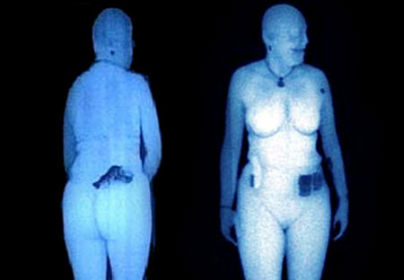 According to the Transportation Security
Administration, Americans have no problem with the new airport
screening procedures, so they should stop complaining. Senior
Editor Jacob Sullum says that self-contradictory reassurance,
which would be unnecessary if it were true, seemed slightly more
plausible after chaos failed to ensue from protests by Thanksgiving
travelers who refused to walk through the TSA's full-body scanners
last week. But Sullum offers several reasons to question the TSA's
portrait of placid passengers happily baring all for the sake of
homeland security.
According to the Transportation Security
Administration, Americans have no problem with the new airport
screening procedures, so they should stop complaining. Senior
Editor Jacob Sullum says that self-contradictory reassurance,
which would be unnecessary if it were true, seemed slightly more
plausible after chaos failed to ensue from protests by Thanksgiving
travelers who refused to walk through the TSA's full-body scanners
last week. But Sullum offers several reasons to question the TSA's
portrait of placid passengers happily baring all for the sake of
homeland security.
Today's challenge:
Make your guess. Then click here and here to see how you did. Winners get a valuable prize.*
 Organizing for America, the QUANGO behind the
Obama election campaign of 2008, wants its followers to thump the
tub for President Obama's proposed federal pay freeze.
Organizing for America, the QUANGO behind the
Obama election campaign of 2008, wants its followers to thump the
tub for President Obama's proposed federal pay freeze.
From a message the organization sent out to members today:
The economy is growing again, yet all across America families and businesses have been tightening their belts. The President knows their government must do the same.
Yesterday, he announced a proposal to freeze pay for non-military federal employees for two years — a plan that will lead to $60 billion in savings over 10 years. It’s one of many tough choices the President has made to cut costs in the upcoming budget to begin to put our nation’s fiscal house in order. And it follows directly from this administration’s dedication to stretching federal dollars and reining in the long-term deficit.
Now, if you listen to some talk radio hosts or a few of the talking heads on cable news, you’ll hear a very different assessment of our fiscal policies.
Obama is actually asking for fans to take on right-wing commentators, but his followers on the left are appalled at the idea of organizing against overpaid, un-fire-able employees. "Here’s what OFA is reduced to," FireDogLake's David Dayen says. "We’ve officially gone around the bend." He concludes, "I can’t wait to see the open rate on this one. And the unsubscribe rate."
Nobel laureate Paul Krugman uses his New York Times blog to compare Obama to a fictional totalitarian.
The federal pay freeze doesn't go nearly far enough, but it's a step in the right direction by a president who has, well, not always been the most scrupulous spender. The disparagement of Obama for making the suggestion doesn’t inspire a lot of confidence in the left’s ability to rejoin the reality-based community. Krugman is so lost in his own sick fantasy world that he really seems to believe the U.S. government does not need to rein in spending. But are other liberals that extreme? Some things are true even though Obama and the Republicans believe them.
On this week's episode of PJTV's new show, The Bottom Line, Reason Associate Editor Peter Suderman and host James Poulos discuss how ObamaCare is reshaping American health care. You can watch the complete episode at PJTV. Approximately 20 minutes.
Today the Supreme Court heard arguments in Schwarzenegger v. Plata, California's challenge to a federal court order requiring it to reduce its prison population. The order, in response to complaints that the medical care offered by California's prisons is so abysmal that it violates the Eighth Amendment's ban on cruel and unusual punishment, demands that the state reduce overcrowding from more than 200 percent of designed capacity to 137.5 percent within two years. Such a cut would require the release of 38,000 to 46,000 prisoners. Margaret Dooley-Sammuli of the Drug Policy Alliance notes that California could meet a large fraction of that goal simply by releasing the 10,000 people who are serving time for drug possession.
The Supreme Court has to decide whether the court order violates the Prison Litigation Reform Act, which says remedies for unconstitutional conditions must be closely tied to the specific facts of the case. The three-judge panel that issued the order concluded that medical care in California's prisons cannot be improved enough to satisfy the Eighth Amendment as long as overcrowding persists. Not surprisingly, that argument was treated skeptically by the more conservative members of the court, who suggested that ordering the release of prisoners unjustifiably infringed on state authority and endangered the public:
"If I were a citizen of California, I would be concerned about the release of 40,000 prisoners," Justice Samuel Alito stated.
Alito further pressed attorney Donald Specter, of the Berkeley-based Prison Law Office, to acknowledge that the overall recidivism rate for California prisoners currently released on parole is 70 percent.
"Seven, zero," Justice Antonin Scalia reiterated, driving the point home.
But if much of the recidivism involves drug possession, as opposed to robbery, rape, or murder, the public safety threat is less dramatic than Alito and Scalia imply. The first step toward alleviating overcrowding in prisons is to free people who don't belong there—and stop locking them up.
Fact of the day: We're at war, but Americans aren't voting on foreign policy.
Midterm election exit polls found only 8 percent of voters saying that a foreign policy issue was a voting consideration for them, and more generally, national polls show just 11 percent citing a foreign policy issue as the most important problem facing the nation. This is the lowest registration of international concerns since immediately before the 9/11 attacks.
Related: A plurality of Americans think the main reason there hasn't been a successful terrorist attack on U.S. soil since 9/11 is dumb luck:
A 43 percent-plurality says that the reason there has not been another terrorist attack in America since 2001 is mostly the result of luck. More than a third (37 percent) credit the government doing a good job, while 13 percent say America is a difficult target for terrorists. The public has been divided on this question since it was first asked in 2005.
 Social science research published last week in
the Proceedings of the Royal Society uses economic games
to probe the notion that God (and His adherents) hates free riders.
The researchers find that people who donate to religious
organizations will engage in costly punishment of unfair behavior.
Reason Science Correspondent Ronald Bailey reports on
research suggesting that belief in moralizing supernatural agents
may have a large role in explaining the evolutionary puzzle of
human cooperation.
Social science research published last week in
the Proceedings of the Royal Society uses economic games
to probe the notion that God (and His adherents) hates free riders.
The researchers find that people who donate to religious
organizations will engage in costly punishment of unfair behavior.
Reason Science Correspondent Ronald Bailey reports on
research suggesting that belief in moralizing supernatural agents
may have a large role in explaining the evolutionary puzzle of
human cooperation.
Senior Editor Katherine Mangu-Ward appeared on a very special Thanksgiving episode of Freedom Watch with Judge Napolitano, talking charitable giving and social security:
And last night she showed up again, talking/hollering about bailouts and paritisan control:


 Swear to God
 Reason on Facebook
 Reason on Twitter
 Reason on YouTube
 Reason RSS