close
The Wayback Machine - https://web.archive.org/web/20101202032407/http://chiefio.wordpress.com:80/
Feeds:
Posts
Comments

OK, there is a climate conference going on in Cancun Mexico. It’s all about “Global Warming”. So is it really warmer than normal in Mexico now? (If you click on the image you can get a more readable version).

Mexico Temperature and Departure From Normal December 2010

Mexico Temperature and Departure From Normal December 2010

So I make that about 70 F in Cancun. Not bad at all, but not exactly “warm”. Now look at that anomaly chart. Hey, Mexico is ‘below normal’… Couldn’t happen to a nicer group of folks…

Original Source

Meanwhile we have a bit of cold in Norway. Yeah, it’s in Norwegian, but it basically says there’s a record cold not seen in 222 years…

http://www.aftenposten.no/vaer/article3927193.ece

Has an interesting video in it. About 1/2 way though they start talking to a guy in French… threw me for just a minute. Mostly just talking about the snow impacts.

Kaldeste november på 222 år
November har vært rekordkald i Trondheim. I de 222 årene som er gått siden målingene startet opp, har det aldri vært registrert lavere temperaturer enn i år.

Which I think says “Coldest November in 222 years. November has seen record cold in Trondheim. In the 222 years since recorded temperatures began, there has not been a colder year recorded than this year.”

(I have free translated this. The Google translate seemed a bit off to me.)

Further down it says:

Det har vært drevet minst åtte meteorologiske målestasjoner ulike steder i Trondheim. Ingen av de har noen gang målt en så ekstremt kald november.
I løpet av gårsdagen ble den gjeldende 1919-rekorden på – 3,5 grader, på den tidligere målestasjonen til Meteorologisk institutt i Trondheim sentrum, passert.

“There have been at least eight meteorological stations in different parts of Trondheim. None of those has ever measured so extremely cold a November.
In the course of yesterday, the current record of 1919, – 3.5 degrees at the former station of the Meteorological Institute in Trondheim, was passed.”

So we can add Norway to the cold record set in Tahoe, California. And the snow making a mess of the UK.

But hey, it’s only a 222 year record…

From the BBC no less:

http://www.bbc.co.uk/news/uk-11855579

BBC’s Rona Dougall in Dunblane: “Here in Stirlingshire we’re in white-out conditions”

Related stories

Your pictures: Snowy scenes
Temperature drops to -17C in Wales
Travel disruption in Scotland

Temperatures plummeted to the coldest on record for November in parts of the UK overnight.

Northern Ireland hit a new low of -9.5C (15F) at Lough Fea, Co Tyrone, and in Wales, a record minimum of -18C (0F) was reached at Llysdinam, in Powys.

Snow is still falling in Scotland, Northern Ireland and north-east England, and Edinburgh, Glasgow and Derry airports have been closed.

Forecasters say the cold spell will continue well into next week.

Met Office severe weather warnings for heavy snow and widespread ice remain in place for eastern and central Scotland, and eastern England from the Borders down to the East Midlands.

Standard News format:

A bit more homey, but I like the music:

h/t Carsten Arnholm on the Norway news.

This is from 2009, but I like the music and the photos give a feel for a cold northern winter…

COLD Europe. Cold North America. Cold Pacific Ocean.

“Where’s The Heat!?”

UPDATE 1 Dec 2010

h/t Luis for the pointer to this nice Meteo France image of Europe:

Europe via Meteo France

Europe via Meteo France

It looks to me like the top line is marked with 27/9/10 which as I understand Euro dating would be 27 September 2010. But the companion images look to be very similar and of more contemporary date stamp (and I’m not sure that IS a date stamp). At any rate, it either shows what lead up to the cold, or what happened during the cold snap.

Here’s the IR version that is reverenced in comments below for 1 Dec 2010:

Europe IR Map 1 Dec 2010

Europe IR Map 1 Dec 2010

Now that’s a load of Bull Shit if ever there was one…

Amish Manure Spreader

Amish Manure Spreader

The original of this looks like it’s from Google as far as I can tell. It is unclear to me what, if any, permission is needed to use this for purposes of political satire / lampooning. I believe it falls under non-commercial fair use.

Original Image from: http://commondatastorage.googleapis.com/static.panoramio.com/photos/original/20755663.jpg

OK, the “Food Safety Bill” has passed the Senate. I wonder if anyone has read it?

Frankly, I’m finding the word “safety” is rapidly coming to mean “tyranny” and it’s become a Red Flag when I see it. So in this case, I may well be over reacting to some other folks over reacting. On the other hand, if you told me a few years ago that government agents would be feeling me up at the airport and looking at nude pictures of me I’d have not believed that possible either….

So what have we got?

The financial news is just calling it “Food Safety” as is the MSM news. Not much mention of any potential “issues” in it. It’s the “alternate news” that got it’s panties in a bunch. Is there really cause for the degree of worry about the bill? Who knows. Certainly not the Senators (who, per all evidence, never bother to actually read anything they sign.)

FWIW, the “justification” is that there have been some salmonella outbreaks on some widely distributed foods along with a couple of other bacterial contamination issues. The problem as I see it is that there is no way any amount of “food safety inspection” can ever solve those problems. Just about every surface you would like to name anywhere in the food handling process is going to have some salmonella on it. It’s not like this is the Plague we’re talking about. It’s one of the most common bacteria around. If something lives in the water, it has salmonella exposure. Any bird product is going to have salmonella exposure. The answer is clean kitchen techniques and proper cooking, not Food Nazis.

Per the “E. Coli” outbreak from beef: That would be much better handled by simply sending out folks with butt wipes and finding the few cows that have the mutant form that causes the disease and eradicating that source. The idea of letting the (fairly few) sources continue while then trying to ‘fix it’ via assuring Zero E. Coli in the process is just insane. Every single gut of every single animal has E. Coli in it. ALL manure will have E. Coli in it. One presumes this means they will attempt to ban the use of manure as fertilizer even though it is the natural cycle. Like defining Pi as “3″, they do not see the simple truth of the nitrogen cycle.

There is a mutant form of E. Coli that causes the disease. For most of us, the E. Coli that lives in us is a helpful bacteria. The mutant is found in only a few cows and is known by the letters that describe it’s unique genetic makeup. The wiki article:

http://en.wikipedia.org/wiki/Escherichia_coli_O157:H7

points out that our present systems are finding ways to fix this problem already:

In January 2007 Canadian bio-pharmaceutical company Bioniche announced it had developed a bovine vaccine capable of reducing O157:H7 in cattle by over 99%.[21]

On March 4, 2009, the United States Department of Agriculture (USDA) granted Epitopix a conditional license for the first E. coli O157 vaccine for cattle in the US.[22]

AND without a whole new $Billon Dollar set of Federal Fruit Fondlers and / or “TSA Proctologists” bovine or otherwise…

But here are some of the concerns expresses by others (from a random sample)

http://www.naturalnews.com/030418_Food_Safety_Modernization_Act_seeds.html

(NaturalNews) Senate Bill 510, the Food Safety Modernization Act, has been called “the most dangerous bill in the history of the United States of America.” It would grant the U.S. government new authority over the public’s right to grow, trade and transport any foods. This would give Big brother the power to regulate the tomato plants in your backyard. It would grant them the power to arrest and imprison people selling cucumbers at farmer’s markets. It would criminalize the transporting of organic produce if you don’t comply with the authoritarian rules of the federal government.

“It will become the most offensive authority against the cultivation, trade and consumption of food and agricultural products of one’s choice. It will be unconstitutional and contrary to natural law or, if you like, the will of God.” – Dr. Shiv Chopra, Canada Health whistleblower ( http://shivchopra.com/?page_id=2 )

So they make this sound like a “Grow A Tomato, Go To Prison” act.

While I hope not “hope is not a strategy”… or perhaps “This was not the ‘hope’ and ‘change’ I was looking for…”

IFF this is in fact in the bill, I’m willing to sign on to a Freedom Of Religion lawsuit as I have Amish ancestors and the free exchange of food and open pollinated seed is part of the Amish belief in a “simple” life with no technology used that is not found documented in the Bible.

This tyrannical law puts all food production (yes, even food produced in your own garden) under the authority of the Department of Homeland Security. Yep — the very same people running the TSA and its naked body scanner / passenger groping programs.

This law would also give the U.S. government the power to arrest any backyard food producer as a felon (a “smuggler”) for merely growing lettuce and selling it at a local farmer’s market.

These folks assert it makes “seed saving” a criminal act:

http://foodfreedom.wordpress.com/2009/06/13/seeds-how-to-criminalize-them/

The basic thesis is that though seed is not mentioned by name, all the processes around it are mentioned and the details are left open for bureaucratic definition.

Seeds – How to criminalize them
Posted on June 13, 2009 by geobear7
Nov. 30, 2010 UPDATE: US Senate passes the Patriot Act for Food, S510, by a vote of 73 to 25.

March 19, 2009
By Linn Cohen-Cole

Wisdom says stop a bill that is broad as everything yet more vague even than it is broad.

Wisdom says stop a bill that comes with massive penalties but allows no judicial review.

Wisdom says stop a bill with everything unspecified and actually waits til next year for an unspecified “Administrator” to decide what’s what.

Where we come from, that’s called a blank check. Who writes laws like that? ”Here, do what you want about whatever you want and here’s some deadly punishments to make it stick.”

[...]

Here’s the bill. Let’s use our imaginations and extrapolate from the little bit it reveals and from the reality we know.

SEC. 206. FOOD PRODUCTION FACILITIES.

(a) Authorities- In carrying out the duties of the Administrator and the purposes of this Act, the Administrator shall have the authority, with respect to food production facilities, to–

(1) visit and inspect food production facilities in the United States and in foreign countries to determine if they are operating in compliance with the requirements of the food safety law;

(2) review food safety records as required to be kept by the Administrator under section 210 and for other food safety purposes;

(3) set good practice standards to protect the public and animal health and promote food safety;

(4) conduct monitoring and surveillance of animals, plants, products, or the environment, as appropriate;

(5) collect and maintain information relevant to public health and farm practices.

(b) Inspection of Records- A food production facility shall permit the Administrator upon presentation of appropriate credentials and at reasonable times and in a reasonable manner, to have access to and ability to copy all records maintained by or on behalf of such food production establishment in any format (including paper or electronic) and at any location, that are necessary to assist the Administrator–

Privacy? What privacy… Anything and everything looks like it’s fair game to me.


(1) to determine whether the food is contaminated, adulterated, or otherwise not in compliance with the food safety law; or

(2) to track the food in commerce.

(c) Regulations- Not later than 1 year after the date of the enactment of this Act, the Administrator, in consultation with the Secretary of Agriculture and representatives of State departments of agriculture, shall promulgate regulations to establish science-based minimum standards for the safe production of food by food production facilities. Such regulations shall–

(1) consider all relevant hazards, including those occurring naturally,and those that may be unintentionally or intentionally introduced;

(2) require each food production facility to have a written food safety plan that describes the likely hazards and preventive controls implemented to address those hazards;

(3) include with respect to growing, harvesting, sorting, and storage operations, minimum standards related to fertilizer use, nutrients, hygiene, packaging, temperature controls, animal encroachment… and water….

Ah, such a little paragraph, and so much evil packed in it. Notice they mention harvesting, sorting and storage operations? Notice they never mention seeds, but they are precisely what those words cover.

Now, watch how they will be able to easily criminalize seed banking and all holding of seeds. First, to follow how this will be done, you must understand that:

1. There is a small list inside the FDA called “sources of seed contamination” and
2. The FDA has now defined “seed” as food,
3. So seeds can now be controlled through “food safety.”

Those seeds (so far) include:

*seeds eaten raw such as flax, poppy sesame, etc.;
*sprouting seeds such as wheat, beans, alfalfa, most greens, etc.;
*seeds pressed into oils such as corn, sunflower, canola, etc.;
*seeds used as animal feed such as soy ….

That includes most seeds. It may even be all seed, given how they are skilled at ‘new’ definitions.

And what are the “sources of seed contamination” per the FDA? They include only six little items:

*agricultural water;
*manure (but not chemical pesticides or fertilizers);
*harvesting;
*transporting equipment;
*seed cleaning (sorting) equipment; and
*seed storage (storing) facilities.

Did you know that seed cleaning equipment is THE single most critical piece of equipment for sustainable agriculture? It is how we collect organic seed. It is the machinery used after the season, when plants “go to seed,” to separate out (sort) the seeds from the plant material so the farmer can collect (harvest) and then save (put in storage) seed for the next year at little cost. With his own seed, the farmer also stays free of patented, genetically engineered, corporately privatized seeds.

This year, 2009, one item on the “sources of seed contamination” list is suddenly illegal in some parts of this country – seed cleaning equipment.

To get the drift, perhaps you need to know that the people who clean seed are being wiped out, as well.

How can they make such vital equipment illegal? Quietly, first of all, so as not to alert organic farmers who have a lot of political ties. And by saying it contaminates food. And by applying their innocent and reasonable sounding “minimum standards.”

“Contaminate” is their favorite word since the public fears the deadly contamination that industry itself – not farmers – has caused. That fear is valuable. Scare the public and it is easy to get “food safety standards” set without anyone reading them. 39 progressive co-sponsors leap on, thinking this is about “food safety.” But it is only about the use of “food safety,” not the reality of it

For to eliminate seed cleaning equipment, the FDA simply sets minimum “food safety” standards for seed cleaning (the simple separation of seed from plant) such that a farmer would need a million to a million and a half dollar building and/or equipment to meet the new requirements … per line of seed.

On the ground, where reality lives, a farmer in the Midwest who has been seed cleaning flax for 40 years with his hand made seed cleaner now can’t sell his flax on the market anymore. Never mind there are NO instances of anyone ever having gotten sick from seed cleaning equipment. And a farmer in another part of the Midwest who has been cleaning wheat, corn and soy for years with one single perfectly fine piece of equipment would now need three to four and half million dollars for three separate pieces of equipment, in order to satisfy the “food safety” standards.

So… looks like a “Big Win” for Agribusiness and a “Big Lose” for everyone else.

There is an interesting reference to Iraq and Monsanto that ought to be “checkable”:

Set the standard for “food safety” and certification high enough that no one can afford it and punish anyone who tries to save seed in ways that have worked fine for thousands of years, with a million dollar a day fine and/or ten years in prison, and presto, you have just criminalized seed banking.

The penalties are tremendous, the better to protect us from nothing dangerous whatsoever, but to make monopoly over seed absolutely absolute. One is left with control over farmers, an end to seed exchanges, an end to organic seed companies, an end to university programs developing nice normal hybrids, and an end to democracy – reducing us to abject dependence on corporations for food and gratitude even for genetically engineered food and at any price.

When you know that Monsanto with the help of the US government plundered ancient and rare seed banks in Iraq that held seeds with a genetic heritage (a biohistory belonging to all of us) going back thousands of years and then made it a crime for farmers there to collect or use their own normal and non-patented seeds off their own land, you see how extreme the intent to control is.

Now, perhaps it is possible to see how the identical thing is being done here, only it comes in a heavily disguised way – through “food safety” that isn’t “food safety” at all – and quietly sits in only one tiny little paragraph within a very large bill (and with no reference to seeds at all).

The Iraqis are now utterly at the mercy of Monsanto and the US for survival itself and will have to pay whatever prices are set for food. They can no longer just grow their own and be free people. So, no matter what form of government they may ever have, as long as this is true, they are now enslaved because the control over them is that extreme. Kissinger was right – control food and you control people.

These folks have the same kind of ideas in about the same language:

http://www.infowars.com/senate-bill-s-510-food-safety-modernization-act-vote-imminent-would-outlaw-gardening-and-saving-seeds/

While these folks have a nice video about it:

http://naturalnews.tv/v.asp?v=9209B7B02D4A5A8EA8B71038D6C18D26

My Take On It

If this passes the House and gets turned into law, don’t expect much compliance. There is a very long tradition of farmers being, well, independent. Were I a commercial farmer, I’d be real tempted to just mention at the local Farmers Grange that this looked like a good year to let the land lay fallow for a year. ALL of it…

I also know that there are a LOT of home gardeners who will be Royally P.O.ed if the TSA starts showing up to “Pat their Tomatoes”…

Clathrate To Production

Methane Clathrate deposits per USGS

Methane Clathrate deposits per USGS

Original Image

Japan has very little natural source of energy. As a consequence, they have been at the forefront of such things as getting Uranium from sea water (which they have now made practical to do, though it’s still a tiny bit more expensive than land based resources so we don’t actually do it yet).

Their latest seems to be some improved methods for methane clathrate production. Methane clathrate is an ‘ice’ made by combining water ice with methane. It has some ‘interesting’ properties, not the least of which is that if forms at great depth in the oceans where the cold / pressure curve crosses the ice point. So under the ocean there are truly gigantic quantities of methane clathrate. At present, we do not treat these as a ‘resource’ at all. As far as energy reserves is concerned, they simply do not exist. Yet they are there. (Nothing nefarious in that. It’s just how economic reserves is defined. If it’s not economical to use, it does not exist for practical economic purposes.)

How Much?

For a LLNL news posting we have:

Researchers discover ice that resists melting

While performing studies of methane clatrate, a material viewed as a potential energy source, scientists produced a mysterious phenomenon-ice that does not liquefy when heated well beyond its usual melting temperature. The energy stored in methane clathrate deposits on Earth has been estimated at twice that in all conventional hydrocarbon deposits of oil, gas, and coal.

The discovery occurred while researchers-Bill Durham of Lawrence Livermore and Laura Stern and Stephen Kirby of the U.S. Geological Survey-were experimenting with a new method for synthesizing methane clathrate, a solid compound of water and methane occurring on Earth and possibly on the icy moons of the outer solar system. Clathrate refers to the compound’s porous lattice-work structure.

In a project funded by NASA, the team mixed fine, granular ice and cold, pressurized methane gas in a constant-volume reaction vessel that was slowly heated under strictly regulated conditions. Curiously, the scientists found that the ice did not liquefy as predicted when the melting temperature was reached and surpassed. Clathrate was formed only after many hours, with the temperatures inside the reaction vessel reaching above 50&degree;F before the last of the ice was consumed (the researchers never did see melting) as part of the process.

The three scientists concluded that a kind of “chemical armoring effect” accompanying clathrate formation suppresses the melting of the ice. They are hopeful that their new method of producing methane clathrates will pave the way for further experimentation and a better understanding of this phenomenon. Their findings were published in the September 27 issue of Science magazine.
Contact: Bill Durham (510) 422-7046 (durham1@llnl.gov).

Original Source

OK, got that? MORE than all the other fossil fuels combined. That’s a lot…

But we’ve not been able to ‘produce’ it in any reasonable way. Why? Well, remember the BP oil spill in the gulf? How the “dome” tended to ‘ice up’ and clog? That was methane clathrate ice. And the blowout itself may have been partly due to clathrates. The drilling may destabilize them and result in a giant sudden gasification. A “blow out”. So one of the issues is how to get this stuff out without blowing out.

From this link: http://marine.usgs.gov/fact-sheets/gas-hydrates/title.html

I found this interesting chart:

Gas Hydrates compared to other Carbon Stores

Gas Hydrates compared to other Carbon Stores

There are two very interesting points in it. First, that hydrates so dominates the non-rock carbon sources. Second, that ‘footnote’ that says they left the rocks out as they are 1000 times more carbon. (Yet we are supposed to panic about the small amount of carbon we burn even while the planet recycles vastly more carbonate via volcanoes and subduction zones. Carbon is dominated by the geology, and by gas hydrates, and certainly not people. If you’ve not worked out the geology and the gas hydrate recycling, you’ve got no clue what caused past changes in CO2 or in C12 / C13 ratios. Then, after that, you can approach the question of what’s happening in the soils and ditritus of the world… )

Enter Japan and Canada

In this story:

http://thegwpf.org/energy-news/1909-methane-hydrates-the-next-energy-revolution-.html

we have:

Arctic’s ‘fiery ice’ is potential new energy source

The Gazette, 15 November 2010

For the Japanese, drilling down through Arctic permafrost to get at “fiery ice” was much less daunting than boring into the deep sea.

They came up with $48 million — with $3 million from Canada — for an epic experiment in the Northwest Territories that has generated tantalizing evidence, to be detailed in Tokyo this week, that frozen gas hydrates may live up to their billing as a plentiful new energy source.

The Canadian and Japanese team will describe how they got the hydrates to release gas, like bubbles out of champagne. In a world first, the team got a production well to generate a steady flow of gas for six days, fuelling a flame in the Arctic darkness.

“The message is quite clear, you can produce gas hydrates using conventional techniques,” says Scott Dallimore, a senior scientist at Natural Resources Canada, who co-led the project in the Mackenzie Delta.
Over two winters the researchers drilled down more than a kilometre into a 150-metre-thick layer on the edge of the Beaufort Sea at Mallik — the most concentrated known deposit of the frozen fuel in the world.

“It’s a landmark, no doubt about it,” says Ray Boswell, technical manager of the U.S. government’s gas hydrate program. Boswell will be taking close notes Tuesday as Dallimore and his Japanese colleagues describe how the well and hydrates responded as the gas was freed.

Previous experiments have produced gas from hydrates for a few hours. Mallik’s steady, sustained flow for six days “is very good news,” says Boswell, who is optimistic gas hydrates may one day heat homes and fuel vehicles.

So there is a load of it, and they produced gas for several days in their first big test. I’ve bolded some bits:

Wednesday, 24 November 2010 10:41 Takeo Kumagai, Platts

Global estimates “range from merely jaw-dropping to the truly staggering,” according to the U.S. Department of Energy. Canada is believed to have enough hydrates along its coasts to meet the country’s energy needs for a couple of hundred years.

Japan looks to offshore methane hydrates to cut reliance on energy imports – Japan, which imports more than 95% of its carbon-based fuel needs in the form of oil, gas or coal, has for decades looked for the means to reduce its reliance on foreign suppliers and increase its energy security. It’s one of the reasons Japan, the world’s largest importer of LNG, has been so adamant in staking its claim to the possible gas reserves underneath the waters surrounding the various disputed isles of the East China Sea.

Now, fortune and technology may be smiling on the energy-poor country, with the discovery of an unconventional energy source that could possibly provide it with enough gas to meet its demand for 14 years. Japan, at least, has been working with that hope ever since it confirmed 40 trillion cubic feat of methane hydrates in the southern Sea of Kumano in 2007.

So Japan has a load of it, and they are looking to produce it.

Next month Japan takes another step toward that goal, with the start of a four-month-long site survey for a four-well drilling project that runs from October 2011 to March 2012. If all goes well, a year later the survey and the wells will result in what Japan says will be the world’s first offshore production test of methane hydrates, with commercial output to start by 2018.

However, unlike technologies used in the faster-than-expected development of shale gas in the US, the technology for extracting usable fuel from Japan’s methane hydrates is still in the developmental stage.

In March 2008, for six consecutive days, Japan was able to extract gas from hydrates using a decreasing pressure system to produce 2,000 cubic meters of gas a day, at the Mallik site in Canada’s Beaufort Sea. That represents only a small fraction of the amount of gas Japan consumes daily.

Under current plans, Japan aims to reach a gas output level of around 10,000 cubic meters/day during next year’s production test, but its priority would be given to collect data rather than reaching a certain level of production, according to government officials.

Once Japan completes the first offshore production test in fiscal 2012-2013, the government will scrutinize the collected data in the following fiscal year, with an eye to launch the second offshore output test in fiscal 2014-2015.

After that, the next challenge would be lowering production costs of methane hydrates to make it competitive against the nearly 70 million metric tons of LNG that Japan imports yearly.

If Japan can lower the methane hydrates output costs to the point of offshore production platforms, it could be made competitive against LNG by bringing it ashore via pipelines to its nearest coasts.

Notice that even though there is more of it than anything else in the fossil fuels arena, it all comes down to lowest cost to produce. IFF Japan can get the costs low enough, then all that energy is held to exist as a ‘reserve’, if they can’t, it doesn’t “exist”. The flip side of this is that as OTHER energy sources rise in price (due, perhaps, to depletion) at some point the cost curves do cross and suddenly we have more than double world energy reserves.

Somehow this definitional aspect of energy “supply” is lost on the folks who like to panic about “running out”. We never “run out” of energy, we just change the energy source…

http://chiefio.wordpress.com/2009/03/20/there-is-no-energy-shortage/

In Conclusion

This implies that even as the current glut of natural gas tails off, there is a gigantic supply just waiting in the wings. I’d not bet on natural gas rising to high prices and staying there any time soon. There can be small seasonal spikes and, due to the costs and monopoly character of pipelines and LNG facilities, there can be local and geographic spikes. But long term there is just a gigantic supply overhang.

Energy shortage? No way…

Aging Mice Rejuvinated

Mice - Not related to the story, I just like the picture...

Mice - Not related to the story, I just like the picture...

Original image

From the “WOW” department.

Telomeres are the controls on gene lifetime. As cells divide, the telomers on the end of genes get shorter. Eventually they cause the cell to no longer divide, the cell is aged, and with it all the rest of the organism.

These folks gave a drug to some mice with artificially shortened telomeres and reversed several symptoms of aging.

Yeah, a thousand and one reasons why it might not work out as well in people, but… The potential of this is astounding…

From:

http://online.wsj.com/article/SB10001424052748703785704575642964209242180.html

The study was published online Sunday in the peer-reviewed journal Nature.

“These mice were equivalent to 80-year-old humans and were about to pass away,” says Ronald DePinho, co-author of the paper and a scientist at Dana-Farber Cancer Institute in Boston. After the experiment, “they were the physiological equivalent of young adults.”

The institute is a teaching affiliate of Harvard Medical School. The first author of the study is Mariela Jaskelioff at Dr. DePinho’s lab.

I have no idea if the original Nature article is available or behind a paywall. Somehow I think this is going to be a big big deal…

The researchers had devised an estrogen-based drug that would switch on the animals’ dormant telomerase gene, known as TERT. The drug, in the form of a time-release pellet, was inserted under the skin of some mice. A similar pellet without the active drug was given to a separate group of control mice.

A month later, the treated mice showed surprising signs of rejuvenation. Overall, their telomeres had lengthened and the levels of telomerase had increased. This woke up the dormant brain stem cells, producing new neurons. The spleen, testes and brain grew in size.

In addition, key organs started to function better. The treated mice regained their sense of smell. The male animals’ once-depleted testes produced new sperm cells, and their mates gave birth to larger litters. The treated animals went on to have a typical lifespan, though they didn’t live longer than normal mice.

The reversals of age-related decline seen in the animals “justify exploration of telomere rejuvenation strategies for age-associated diseases,” the paper concludes.

The biggest question here is raised by that line about “didn’t live longer than normal mice”. Does this drug reverse normal aging? Or does it only fix the artificially induced aging in these mice?

One worry is cancer. Tumors somehow turn on the telomerase gene, allowing cancer cells to divide continuously. Up to 90% of human cancers require certain levels of telomerase to do so. Indeed, many researchers are trying to deactivate telomerase as a cancer-fighting strategy.

Still, turning on telomerase for controlled periods of time might be useful. The strategy might one day have a role in treating rare genetic disorders that are linked to telomeres and cause premature aging, such as Werner’s syndrome, according to Dr. DePinho.

The telomerase technique may also be relevant for people who age normally—provided it is clear that prolonged telomerase reactivation doesn’t trigger tumors in later life.

Pardon me, but if I’m 75 and miserable with maybe 3 years lifespan ahead of me and I can take a drug that makes me, oh, like 40 again (but I die of a rapid cancer in 5 years) I’m more than willing to make that deal.

Statistically, people with longer telomeres in their blood cells have an increased number of healthy years beyond the age of 60, Dr. DePinho said. And those over 60 with the shortest telomeres have higher rates of diabetes, cardiovascular disease and Alzheimer’s.

Dr. DePinho said the next step was to try the technique on normally aged mice to see whether it can slow, halt or reverse signs of aging in them.

Write to Gautam Naik at gautam.naik@wsj.com

I found this article in “Nature News” but I’m not sure if that is “Nature” or not…

http://www.nature.com/news/2010/101128/full/news.2010.635.html

It has a link to a ‘full article’ which requires payment here:

http://www.nature.com/nature/journal/vaop/ncurrent/full/nature09603.html

so I presume the “Nature News” is the freebee teaser publication…

It has the following abstract:

Telomerase reactivation reverses tissue degeneration in aged telomerase-deficient mice

Mariela Jaskelioff1, Florian L. Muller1, Ji-Hye Paik1, Emily Thomas1, Shan Jiang1, Andrew C. Adams2, Ergun Sahin1, Maria Kost-Alimova1, Alexei Protopopov1, Juan Cadiñanos1, James W. Horner1, Eleftheria Maratos-Flier2 & Ronald A. DePinho1

Belfer Institute for Applied Cancer Science and Departments of Medical Oncology, Medicine and Genetics, Dana-Farber Cancer Institute, Harvard Medical School, Boston, Massachusetts 02115, USA
Division of Endocrinology, Diabetes & Metabolism, Beth Israel Deaconess Medical Center, Harvard Medical School, Boston, Massachusetts 02215, USA

Correspondence to: Ronald A. DePinho1 Email: ron_depinho@dfci.harvard.edu

An ageing world population has fuelled interest in regenerative remedies that may stem declining organ function and maintain fitness. Unanswered is whether elimination of intrinsic instigators driving age-associated degeneration can reverse, as opposed to simply arrest, various afflictions of the aged. Such instigators include progressively damaged genomes. Telomerase-deficient mice have served as a model system to study the adverse cellular and organismal consequences of wide-spread endogenous DNA damage signalling activation in vivo1. Telomere loss and uncapping provokes progressive tissue atrophy, stem cell depletion, organ system failure and impaired tissue injury responses1. Here, we sought to determine whether entrenched multi-system degeneration in adult mice with severe telomere dysfunction can be halted or possibly reversed by reactivation of endogenous telomerase activity. To this end, we engineered a knock-in allele encoding a 4-hydroxytamoxifen (4-OHT)-inducible telomerase reverse transcriptase-oestrogen receptor (TERT-ER) under transcriptional control of the endogenous TERT promoter. Homozygous TERT-ER mice have short dysfunctional telomeres and sustain increased DNA damage signalling and classical degenerative phenotypes upon successive generational matings and advancing age. Telomerase reactivation in such late generation TERT-ER mice extends telomeres, reduces DNA damage signalling and associated cellular checkpoint responses, allows resumption of proliferation in quiescent cultures, and eliminates degenerative phenotypes across multiple organs including testes, spleens and intestines. Notably, somatic telomerase reactivation reversed neurodegeneration with restoration of proliferating Sox2+ neural progenitors, Dcx+ newborn neurons, and Olig2+ oligodendrocyte populations. Consistent with the integral role of subventricular zone neural progenitors in generation and maintenance of olfactory bulb interneurons2, this wave of telomerase-dependent neurogenesis resulted in alleviation of hyposmia and recovery of innate olfactory avoidance responses. Accumulating evidence implicating telomere damage as a driver of age-associated organ decline and disease risk1, 3 and the marked reversal of systemic degenerative phenotypes in adult mice observed here support the development of regenerative strategies designed to restore telomere integrity.

Quake – 6.6 Near Japan

Off the coast of the southern island of Japan, we have a 6.6 quake. Some news shows are reporting this as a 6.9 but I’ll go with USGS.

Asia Quakes

Asia Quakes

Original Image with clickable areas

The strange thing from my point of view is that it’s in the middle of nowhere. Zooming in:

South of Japan

South of Japan

Original Image

Magnitude 6.6 – BONIN ISLANDS, JAPAN REGION
2010 November 30 03:24:41 UTC
This event has been reviewed by a seismologist.Magnitude 6.6
Date-Time Tuesday, November 30, 2010 at 03:24:41 UTC
Tuesday, November 30, 2010 at 01:24:41 PM at epicenter
Time of Earthquake in other Time Zones
Location 28.415°N, 139.139°E
Depth 478.3 km (297.2 miles)
Region BONIN ISLANDS, JAPAN REGION
Distances 335 km (210 miles) WNW of Chichi-shima, Bonin Islands, Japan
455 km (285 miles) NNW of Iwo Jima, Volcano Islands, Japan
525 km (325 miles) S of Hachijo-jima, Izu Islands, Japan
810 km (500 miles) S of TOKYO, Japan
Location Uncertainty horizontal +/- 13.2 km (8.2 miles); depth +/- 0.5 km (0.3 miles)
Parameters NST=506, Nph=514, Dmin=334 km, Rmss=0.65 sec, Gp= 25°,
M-type=”moment” magnitude from initial P wave (tsuboi method) (Mi/Mwp), Version=B
Source USGS NEIC (WDCS-D)
Event ID usc0000h7t

Don’t really know what to make of it, though. Far enough away from anything of interest to not cause much damage. Big enough to be interesting.

The Rest of the World Earthquakes

There was another 6.x in Indonesia a while back that I’d not bothered to post about, but probably worth a mention here as it’s “nearby”.

Magnitude 6.1 – NEW BRITAIN REGION, PAPUA NEW GUINEA
2010 November 23 09:01:06 UTC

This event has been reviewed by a seismologist.Magnitude 6.1
Date-Time Tuesday, November 23, 2010 at 09:01:06 UTC
Tuesday, November 23, 2010 at 07:01:06 PM at epicenter
Time of Earthquake in other Time Zones
Location 6.021°S, 148.957°E
Depth 66.2 km (41.1 miles) set by location program
Region NEW BRITAIN REGION, PAPUA NEW GUINEA
Distances 68 km (42 miles) WNW (290°) from Kandrian, New Britain, PNG
231 km (144 miles) ENE (70°) from Lae, New Guinea, PNG
313 km (195 miles) NNE (14°) from Popondetta, New Guinea, PNG
429 km (267 miles) NNE (27°) from PORT MORESBY, Papua New Guinea
Location Uncertainty horizontal +/- 12.1 km (7.5 miles); depth fixed by location program
Parameters NST=330, Nph=362, Dmin=409.7 km, Rmss=1.26 sec, Gp= 14°,
M-type=centroid moment magnitude (Mw), Version=9
Source USGS NEIC (WDCS-D)
Event ID usc0000f0y

Australia and Indonesia

Australia Region Quake Map

Australia Region Quake Map

Original Image, with captions and description. The original is interactive with clickable regions for ‘close ups’.

Here is a Pacific centric view:

With quite a bit of action North of New Zealand.

Pacific Centric Quake Map

Pacific Centric Quake Map

Original Image with Clickable Details

Both Hemispheres

Where no one place stands out, but there is just what looks like a lot of smaller to medium stuff all over the place.

A view of Earthquakes from the South Pole

A view of Earthquakes from the South Pole

Original Image with Clickable Details

North Polar Earthquake Map

North Polar Earthquake Map

Original Image with Clickable Details

If you click the links to the originals you can not only ‘click through’ to any given area or quake, but by clicking on the little blue diamonds you can rotate the globe to different points of view. It’s kind of fun…

The Whole World View

Current quake map

Current quake map

Original Image, with captions and description. The original is interactive with clickable regions for ‘close ups’.

North America

A bit of interesting action continuing on the mid-Atlantic spreading zone and some mild stuff down in Mexico.

North America and Mid Atlantic Ridge Quake Map

North America and Mid Atlantic Ridge Quake Map

Original with clickable details

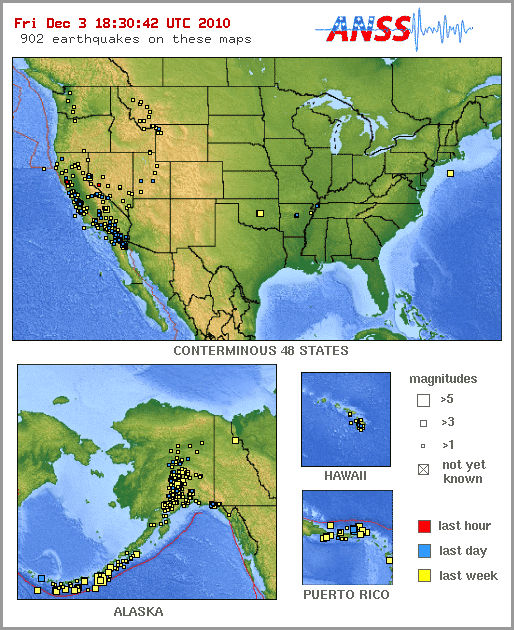
Live USA Quake Map

Zooming in just a bit on the USA.

BERJAYA

Live USA Quake Map

California Map

Action Closer to Me

As I live in California, it makes it easier for me if I keep them in the list where I can see what’s shaking near me.

Current quake map in California

Current quake map in California

Original Image, with captions and description. The original is interactive with clickable regions for ‘close ups’.

Mammoth Lakes / Long Valley Volcano

Because I want to know if it starts to blow it’s top…

BERJAYA

Mammoth Mountain - Long Valley Super Volcano

UPDATE: 30 Nov 2010

In comments, boballab posted a link to a picture of the undersea topology with volcanoes marked.

Google Earth volcano and quake map

Google Earth volcano and quake map

So it looks a bit less like “nothing there” and a bit more like “on a fault in the approach to the volcano rise line”. Those lateral cracks we see near spreading zones.

On the “tips” thread at WUWT, R. de Haan posted this:

Wikileaks behind CRU ClimateGate release?

I did find it a rather interesting discussion, though to me it sounded more like a discussion of how to handle the leak after it was public rather than how to handle it via making it…

Then again, it has a kind of “inside baseball” nature to the discussion so folks who have a better context can probably interpret it better than I can.

Gut It Out

Well, that was interesting…

On Fox there is an odd show called “Red Eye”. It’s odd as it’s a sort of a conservative show but has a ‘kinky’ bent to it that is somewhere between metrosexual and veiled Gay with attempts at cool. Not all that explicit, but just on the edge. Yet they discuss current issues that matter in a clear and direct way.

OK, for those who’ve never seen it, here’s a sample:

Then after that kind of humor bit, they will do some story that has real news value, but with a humor twist on it.

So why this post?

The host is Greg Gutfeld. He does a daily monolog on a news item called the “Gregalogue”. The one tonight was on Global Warming and the way that warmers have recently deciding that over hyping the horrors isn’t working. It was delivered a bit more seriously than usual. Here are some text quotes (maybe it will eventually show up on U-tube…) and there is more at the other end of the link

From: http://www.dailygut.com/ the current topic:

MONDAY’S GREGALOGUE: THE CONSEQUENCES OF DOOM
So climate change experts having finally got the message. And the message is: their message sucks. In fact, their “Scare the hell out of us” screed was so awful, researchers claim, that it actually undermined their mission.

Which, I always thought, was to scare the hell out of us.

Yep, according to Cal-Berkeley shrinks, dire predictions about global warming can “backfire if presented too negatively.” Of course that raises one question: how do you present dire predictions, positively?

“Hey, were all gunna die. LOL.”

Which leads me to a theory: these Berkeley researchers are dopes.

You may have noticed they don’t pull a lot of punches on this show… That’s part of why I like it.

Look the fact is, people like me questioned global warming evidence because we’d seen this hysteria before – with emotional warnings about the coming ice age, the dangers of nuclear power, artificial sweeteners and DDT.

And this caused us to grow cold to such crap, and overlook real threats like terrorism, the resurgence of malaria, and of course, the rise of Ed Hardy t-shirts.

Worse, with global warming, we saw that anyone who dare to question the hysteria would be labeled a “skeptic,” and treated like a “leper.”

And never get “laid.”

But the climategate scandal proved that inevitably, these cocky GW experts would overstep the science, get humbled, retreat into therapy. (Have you seen Gore lately?)

So at this point, I’m starting to giggle uncontrollably while wanting to grab a Scotch / Rocks at the same time. If you can find the live version, the delivery alone is worth it for the added effort. The discussion afterward was fun too.

So now, finally, shrinks are saying these experts should rethink their messaging.

Of course, this is still not tackling the real problem. Note that the shrinks aren’t telling experts to stop exaggerating consequences – instead, they say, “present solutions to global warming.”

Meaning: just assume your lies were right all along and push the curly light bulbs.

That ain’t gunna work either.

And if you disagree with me you’re a racist homophobic globalphobe.

There is no way I can improve on that. Best I can do is suggest reading it twice. Maybe three times. And pouring another beverage and reading it again. And then telling a friend or two…

Somehow I think “Global Warming” has definitely reached the “Jump The Shark” stage…

Now That’s Low in Tahoe

Yesterday and the day before were “a bit cold” in Truckee Tahoe California. I’ve heard on the news that it was a record. What does Wunderground say?

http://www.wunderground.com/cgi-bin/findweather/getForecast?query=truckee%20california&wuSelect=WEATHER

Note that “low” of -13 F / -25 C

Truckee Tahoe California 25 November 2010

Truckee Tahoe California 25 November 2010

Notice how the temperature is way below the ‘averages’ for that date…

Here is yesterday:

Truckee Tahoe California 26 November 2010

Truckee Tahoe California 26 November 2010

Notice the dropping barometric pressure? There is a winter advisory and more on the way…

from:

http://tahoeweatherdiscussion.com/

Truckee broke their record lows of -1 & 1 Tuesday & Wednesday night set back in 1966. The lows this year were -9 & -13. South Lake also broke their record both nights set back in 1978 of 5 & 2 with lows Tues & Wed night of -8 & -7. Reno came within 1 degree of it’s record low of 9 set back in 1952. Pretty amazing. No changes to the Saturday storm from the forecast yesterday. BA

Still looking for an official confirmation of the new record lows…

Older Posts »