close
The Wayback Machine - https://web.archive.org/web/20110403174128/http://connectedtalk.wordpress.com/
Feeds:
Posts
Comments

Cranes for Japan

DoSomething.org has teamed up with Students Rebuild – Paper Cranes for Japan, to raise money for the crisis in Japan. I am writing about this today because we talk of collective action during the year, bringing people together, students in particular to work for the greater good of something. This project, is wonderful because students do not need a car, solicit donations, or depend on an adult to be involved and understand they can make a difference in the world.

According to legend, anyone who folds a thousand paper cranes, which are sacred creatures in Japanese culture, will be granted a wish by a crane. With a goal to collect 100,000 origami cranes from young people to represent wishes of support and healing, the challenge hopes to raise $200,000 for the reconstruction of a youth facility by the Japanese team from Architecture for Humanity.

Students will be able to follow the efforts of Architecture for Humanity on their web site to see how their donations are being used in the rebuilding effort. And after 100,000 cranes are submitted, they will be turned into a woven art installation – a symbolic gift from students around the world to their Japanese counterparts.

On the student rebuild page there are links to a video tutorial on how to make the cranes, and also instructions how to request mailing labels for the cranes and where to send them.
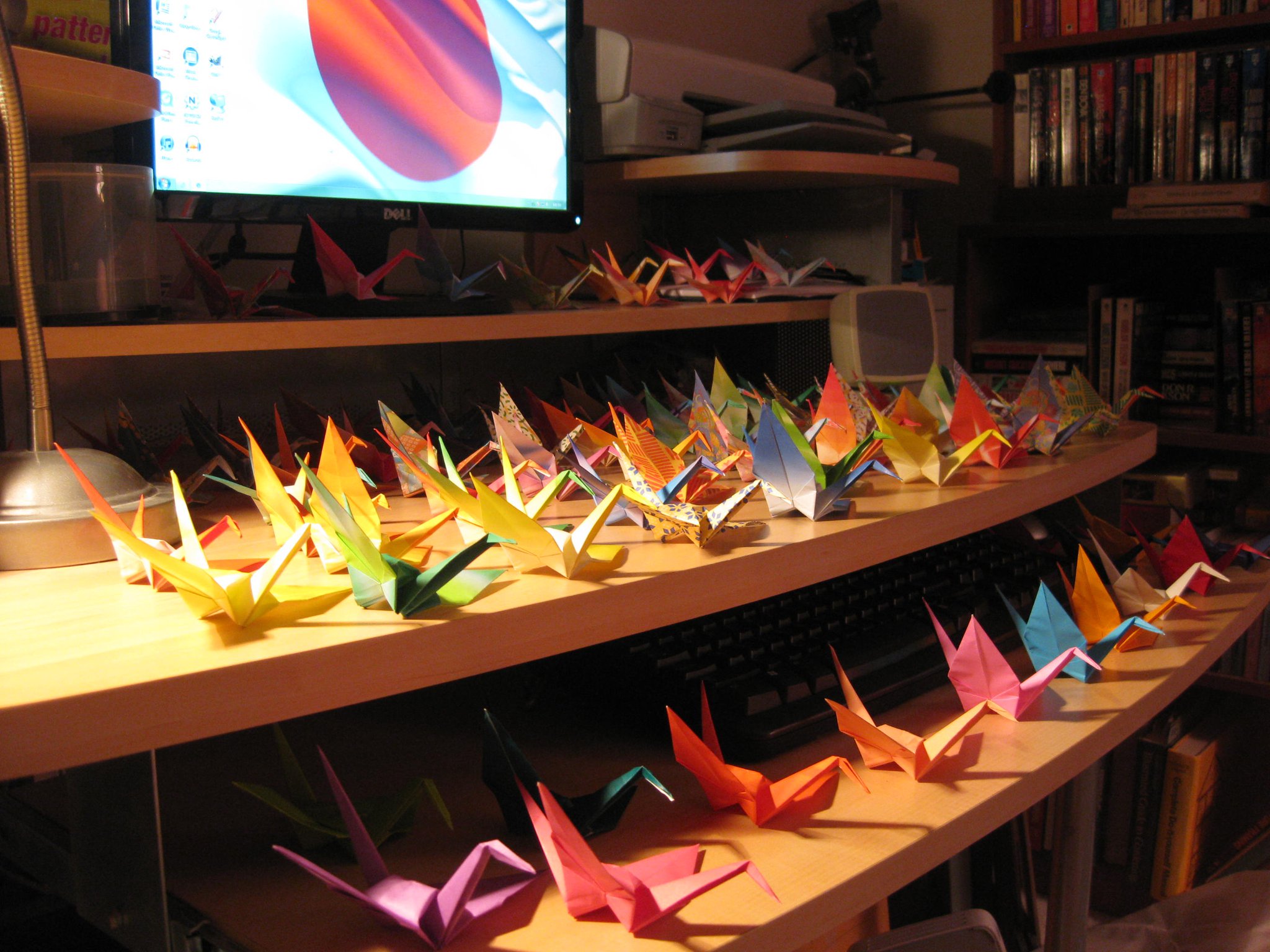
BERJAYAImage Source Ellis Aquarius Powell

Birthday Celebration

Yesterday we celebrated our granddaughter’s third birthday, time certainly does go by quickly, at least for me! Here are some fun facts my daughter wrote about her on the family blog. A little peak into our precious little girl.

  • She is a chatterbox, basically talking all day long. She also likes to make sure that you are hanging on her every word, by repeating herself until you acknowledge EVERYTHING that she’s said.
  • She is a constant ball of energy.
  • Her favorite color is pink.
  • She loves to sing and dance.
  • When she dances or plays any kind of musical instrument she closes her eyes and sways from side to side, so we affectionately call her “Ray”.
  • Her favorite restaurant is Moe’s.
  • She loves Dora and Mickey Mouse Clubhouse.
  • She has a memory like an elephant…I am constantly amazed at the little details she remembers.
  • She LOVES her Daddy and tells everyone that she’s Daddy’s girl.
  • She has strong opinions and isn’t afraid to tell you what she wants.
  • She loves her little brother and always wants to know where he is and what he’s doing.
  • Although she had a traumatic start, she is a daily reminder of God’s goodness.
  • We love her to pieces!

Thoughts on Mindset

I recently read Carol Dweck’s book Mindset and want to share some key points and also get your views.
For those of you who are not familiar, Carol Dweck has a Ph.D. from Yale University, is a professor at Stanford University and a social psychologist. Her book and her work centers around theories of intelligence.  Fixed mindset and growth mindset, nature vs nurture.

In the first few pages of the book she discusses her own beliefs as she started her career in psychology. Prior to her research she believed human qualities were innate, carved in stone. Children are born “gifted”, have “natural talents”, one was smart or they were not, and failure meant you were not smart, it was that simple. This is the description of a “fixed” mindset: a belief in nature, the way you are born is the way you will always be.  Believing your qualities are set in stone, creates an urgency to prove yourself, over and over. When we praise children as being smart or brilliant, we boost their their sense of self and they like it, we all do, and don’t want to loose it.  In so doing, we don’t offer reasons why we believe they are smart, just that they are. Those with fixed mindsets begin to evaluate situations based upon whether they will look smart, whether they will be deemed a winner or a looser, and this may instill a sense of insecurity.  They feel they have to continue to prove they are smart. If they come across something that doesn’t come naturally to them, what happens? Avoidance of the situation, being uncomfortable knowing they may not appear smart.

Growth mindset emphasizes nurture, emphasis is placed on effort and hard work, not simply praised for being smart but why someone thinks they are smart. They are praised for time spent learning something of interest to them, praised for the questions they asked as they were digging deepre, the process they used in tracking down information or constructing something physical.  Those with growth mindset know how to create the outcome they are striving for, challenges are viewed as a good thing, because they feel confident through their perseverance and hard work, they have the ability to succeed, and they believe this about themselves. They enjoy learning, figuring out the answers, asking more questions, because they are not viewing situations as win or lose.

Is it important for adults to understand their own mindset and how it may influence our interactions with others, whether this is at home, in the work place? Whichever mindset you have, isn’t this the lens through which you view all others, all situations?  Can we change our mindsets, would you want to?

I really enjoyed this book, it has given me a lot to think about.

Gaping VoidAmazing

Older Posts »