close
The Wayback Machine - https://web.archive.org/web/20101102051636/http://freelance-zone.com/blog/

Recent Articles:

Fashion For The Writer…What’s Your Take?

November 1, 2010 editorial, lifestyle 3 Comments

I decided I’m tired of wearing sweats all the time.

Anybody out there get me?

Catherine L. TullyAs a writer, you don’t have to dress up for work. It’s easy to start your day in pajamas and find yourself still in them at noon. Nice clothes hang in the closet, longing for a chance to see daylight. A baseball cap is the solution to fixing your hair. Let’s face it–it’s tough to justify getting dressed up to go to the post office.

That said, there’s something to be said for treating your job–like a job. I’m not saying you need to wear a three piece suit or skirt and blouse to your desk, but it sure doesn’t hurt to shower first thing and change into something that makes you feel a bit more professional. After all, just because you can do an interview in your skivvies, doesn’t mean you should, right?

I’m tossing this out there to FZ readers–what do you wear to write? Do you agree with my new resolution to dress a bit nicer and take that morning shower first thing? Or do you think that part of the “free” in freelancer means the right to work in whatever you please?

I’d love to know.

Reddit Digg Facebook Technorati Google StumbleUpon Netscape Yahoo Ask Fark ThisNext

How to use personality tests

Can knowing your "type" help freelancers gain and retain more clients?

Can knowing your "type" help freelancers gain and retain more clients?

By Jake Poinier

If you’ve spent any time in the corporate world, you’ve probably taken DiSC or Myers-Briggs Type Indicator personality tests. Ironically enough, taking a Myers-Briggs at my last corporate job hastened my departure: In an “aha” moment, I realized that my type, ENTP (click the link for details on what makes me tick), was diametrically opposed to my boss’s type. I’d been plotting my escape for nearly a year, but the test confirmed what I suspected in my head about how we saw the world so differently. It also indicated that my personality would be good for entrepreneurship and therefore freelancing. I left about a month later.

Personality tests are not a crystal ball by any means, but they can help you understand a bit more about your strengths and weaknesses, and how you react under stress. For a freelancer, that can make them a powerful tool.

More important, if you do a little bit of research on the other types, you can start identifying what types your prospective freelance clients and current clients are. That, of course, enables you to modify how you treat those clients as individuals.

One of the things I learned during my two-year stint as a sales manager for a custom-magazine publishing company was how different each of the clients were that came from the different salespeople:

  • Tim’s were hard-driving, number-crunching folks who wouldn’t believe anything unless they saw it in a spreadsheet. (Conversely, if you were good at spreadsheets, you could make them believe almost anything.) You had to get right to the point, or they’d cut you off. It took a lot to win them over, but were very loyal once you did.
  • Frank’s sales were usually very personable and easygoing. They were the most pleasant to work with, but also had trouble with deadlines and weren’t very detail oriented. You had to shmooze them into compliance.
  • Bill’s sales were best described as aloof. They weren’t as driven as Tim’s, nor as friendly as Frank’s. They were not terribly loyal, because they were never very dedicated in the first place. Anytime Bill made a sale, I knew they weren’t in for the long haul.

The personality tests probably won’t tell you anything that you don’t know (or at least suspected) about yourself. But having an understanding of what motivates or irritates a client is essential to creating a lasting bond.

Have you taken one of these personality tests or something else? Do you use personality-oriented techniques in the sales process? Share your thoughts in the comments!

Contributing blogger Jake Poinier runs Boomvang Creative Group, a Phoenix-based editorial services firm. He also blogs about freelancing at DearDrFreelance.com — most recently about freelance ghostwriting rates.

Reddit Digg Facebook Technorati Google StumbleUpon Netscape Yahoo Ask Fark ThisNext

Guest Blogger Wanted: Fiction Writing and Editing

Fiction writers wantedFreelance-Zone.com needs a guest blog post or two from an experienced writer and/or editor of fiction. We’ve covered a wide range of topics here, but fiction is one of those areas that doesn’t get the love it deserves, so we’re looking to branch out a bit.

Specifically we’re looking for an experienced fiction writer and/or editor who can write confidently on a variety of a topics related to the business of writing fiction. Wisdom about how to write fiction abounds, so we don’t need to re-invent the wheel. Instead, tell us how you make money doing it and what it takes to get there.

We like our guest bloggers to plug their current projects, link back to their blogs or resume pages, etc. so this is a good opportunity to blow your own horn as well as give sage advice…

If you’re interested, please drop us a line to editor (at) freelance-zone.com and be sure to let us know a bit of background including where you’ve published and what you’re up to now. We look forward to hearing from you!

Reddit Digg Facebook Technorati Google StumbleUpon Netscape Yahoo Ask Fark ThisNext

Hooked on a Feeling

October 27, 2010 Uncategorized No Comments

SG Front Coverby Mike O’Mary
(imaginary soundtrack by B.J. Thomas)

Dream of Things just published its first anthology of creative nonfiction, and a very cool thing is happening. The people who contributed to the book are all thinking of ways to help spread the word.

That may not sound like a big deal. But it is. Most anthologies pay contributors a flat fee for a story. Dream of Things is the only publisher that pays royalties to authors who contribute to anthologies. Consequently, it feels more like the contributors and the publisher are in this together. And everybody is working to help spread the word about the book.

The book is Saying Goodbye, and it helps a lot that it’s a very good book. It’s about saying goodbye to the people, places and things in our lives, and although there are some sad stories in the book, it is a surprisingly uplifting book. One reviewer said, “If you have ever had to deal with loss, read this book. It will make you feel better.”

Having a good book and sharing the royalties isn’t rocket science, but it definitely makes for good chemistry. It feels like we’re all in this together, and it feels good to be working with more than 30 people (authors, editors and others) to spread the word about a very good book. It’s the kind of feeling that encourages a publisher to publish more books by more writers, and I hope it’s the kind of feeling that will keep more authors writing.

Mike O’Mary is founding dreamer of Dream of Things, and publisher of Saying Goodbye, MFA in a Box by John Rember, and Everything I Never Wanted to Be by Dina Kucera

Reddit Digg Facebook Technorati Google StumbleUpon Netscape Yahoo Ask Fark ThisNext

Please Vote: Writers Digest 101 Best Websites For Writers 2011

writers-digest-101-best-sites-for-writers

It’s that time again…please nominate Freelance-Zone.com for the Writers Digest 101 Best Websites for Writers list by sending an email to writersdig@fwpubs.com with the phrase 101 Best Websites in your subject line.

In your e-mail, please mention you’re nominating Freelance-Zone.com for the 101 Best Websites for Writers list, hit send, and your vote has been cast! We greatly appreciate being nominated for the 2011 list.

As always, thank you for making Freelance-Zone.com a success. We’ve been named on the Writers Digest 101 Best Websites list two years running now, and we’re very grateful for those who helped make that possible.

Reddit Digg Facebook Technorati Google StumbleUpon Netscape Yahoo Ask Fark ThisNext

Today’s Writing Tip Is on E-Books

October 25, 2010 Uncategorized No Comments

Last year, for the first time ever, electronic book sales exceeded those of books in print. Amazing, and mostly attributable to the affordability of the Kindle reader. So, if you ever wanted to write an e-book, now is the time. There are three main advantages to having your book available electronically, starting with the size of the book, and moving on to the price and waiting time for your purchase.

Not all books are 250-350 pages long. Sometimes we want to write a short book that is only 40 pages or 80 pages. This would look rather skimpy in print but it would be fine digitally.

Second, most books in print cost somewhere between $15-$20, not including shipping and handling. But e-books can sell for as little as three or four dollars. Right now my book, Be Your Own Editor, is available for $3.79 on Amazon. That’s less than most people pay for postage when they’re buying a paperback! And there’s no tax.

Third, e-books can be downloaded within minutes whereas it can take 10 days or more for Amazon to deliver a hardcopy book to your door.

All the reasons for buying e-books are good reasons for writing e-books, because they sell. And if you sell them yourself, it’s 100% profit. So, if you’ve been thinking about writing an e-book, but have been procrastinating, open up a new Word document and start today.

Sigrid Macdonald is the author of three books, including Be Your Own Editor. Buy it on Kindle at http://tinyurl.com/329hmu6.

Reddit Digg Facebook Technorati Google StumbleUpon Netscape Yahoo Ask Fark ThisNext

Travel Writing Advice from Around the Web

October 25, 2010 advice, travel No Comments

chicago skylineHere’s a quick digest of some my favorite travel-writing advice articles I’ve recently run across:

How To Be a Travel Writer – This excellent article by British Guild of Travel Writers member Roger Norum goes through the entire travel-writing process. From, “is travel-writing for me?”, to getting started, advice on writing, and advice on the business side. It’s a must-read for anyone interested in travel-writing.

How to Be a Travel Writer (I guess this is a popular title) – Written by famous travel-writer Rick Steves. In the article he discusses how to get started travel-writing by learning how to travel first and then moving on to discuss how to make money.

Tips on Travel Writing – 7 great tips on travel-writing from Lonely Planet author Tim Richards. In the article he gives tips on your pitch, discusses sponsored travel, and gives advice on the type of articles to start out with as a beginning travel-writer.

Jason Demant is the founder of UnAnchor.com, where you can find detailed do-it-yourself travel itineraries for your next trip. For the latest on travel-writing you can follow him on Twitter @UnAnchor, or join the I Love Travel Writing Facebook group.

Reddit Digg Facebook Technorati Google StumbleUpon Netscape Yahoo Ask Fark ThisNext

Writers’ Bookshelf: “Toxic Feedback” by Joni B. Cole

Writer’s Bookshelf: Toxic Feedback by Joni B. Cole

Book review by Erin Dalpini

J.K. Rowling, Stephanie Meyer, John Grisham, and Stephen King. What do these writers have in common? Their first novels were rejected at least a dozen times (in King’s case, dozens), before being published. Imagine what we would have missed out on if those writers took to heart the negative feedback they received in the form of rejection letters or unanswered queries. Negative feedback stinks. But far worse than negative feedback is toxic feedback, the kind of commentary that makes any writer want to curl up in the corner and wallow or worse yet, stop writing all together.

BERJAYAExperienced writing workshop leader and author Joni B. Cole knows a lot about this kind of feedback. So much, in fact, that she decided to write a book about it. In Toxic Feedback, Cole addresses not only the problem of toxic feedback, but also proper responses to it.  If you’ve ever suffered from a severe case of “It’s all wrong”-itis—I’m looking at you, fiction/creative nonfiction writers—take note: this is definitely your go-to book. Toxic Feedback is a light-hearted, engaging look at the best (and worst) ways to process feedback, and how to, a-hem, go about dishing it out in a polite manner.

“As a writer, you have no hope of surviving, let alone thriving in, the feedback process if you don’t first recognize your own role in creating the kind of toxicity that can result in literary paralysis or an assault charge,” asserts Cole. … Continue Reading

Reddit Digg Facebook Technorati Google StumbleUpon Netscape Yahoo Ask Fark ThisNext

Seasons of Change

October 21, 2010 advice 3 Comments

By Amanda Smyth Connor1309285_autumn_leaves

As the seasons change, you need to change too. Adapting to changing seasons is a great opportunity for you to evaluate your day-to-day routine.

Whether you work in an office or work from home, it’s important for you to evaluate your work routine and daily routine. It’s so easy to fall into a routine that leaves you in a rut that you then see reflected in your writing, and it’s even easier to start feeling seasonal depression this time of year. The amount of sun you’re getting is decreasing, the days are getting shorter, and being cooped up in the house for months on end doesn’t sound exciting.  Since the weather is turning a bit chillier/rainier, what better time than now to switch up your routine to combat that rut we all seem to fall into during the colder months. … Continue Reading

Reddit Digg Facebook Technorati Google StumbleUpon Netscape Yahoo Ask Fark ThisNext

Creative Thinking and Pink Bats

October 20, 2010 Uncategorized No Comments

by Mike O’Mary

This video is very cool. Be sure to watch it to the end. I had the pleasure of working with the author on Pink Bat, the book, last year. Michael McMillan is one of the most creative people I know, and Pink Bat is very thought-provoking. Check it out…

Reddit Digg Facebook Technorati Google StumbleUpon Netscape Yahoo Ask Fark ThisNext

Today’s Writing Tip: Establishing Authority

October 19, 2010 advice No Comments

Freelance-Zone.com welcomes Sigrid Macdonald back with another round of writing tips. It’s great to have you back, Sigrid!

Often writers want to sound modest, so they say things like “I’m not an authority,” or “I could be wrong.” This may work well in general conversation or on a message board, but it doesn’t fly in a book, blog post or an article. Why not? Well, if you’re not an authority, why should I care what you write?

Let’s say you’re discussing bullying. If you preface your remarks by saying that this is just your humble opinion and you may not be right, readers have no reason to give your words any credibility. Take the time and the effort to establish and substantiate your position; then don’t undermine yourself by saying that you’re not an authority.

Sigrid Macdonald is a book coach, a manuscript editor, and the author of three books including Be Your Own Editor. BYOE is available on Amazon in soft cover and on Kindle . Or get 20% off the regular price by writing directly to the author at sigridmac@rogers.com. Read more at http://beyourowneditor.blogspot.com.

Reddit Digg Facebook Technorati Google StumbleUpon Netscape Yahoo Ask Fark ThisNext

Writers Groups By State–Who Have We Missed?

October 19, 2010 advice, blogging, editorial No Comments

Writers Groups By StateHundreds of people every day are finding our collection of writer’s groups by state, but we’re certain we haven’t found all the good writers groups in the USA. That’s why we’re asking for your help–if you want your writer’s group listed in our collection of links, please drop us a line: editor (at) freelance (dash) zone (dot) com.

We would love to feature your favorite writer’s group in your state. Get in touch with all the pertinent details, including where and when your group meets, whether there’s a membership fee, and what writers are served best by your group–fiction, newspaper, blog writers, technical writers, etc.

Again, there’s plenty of exposure to go around–our writers groups by state sections are by far the most popular pages on Freelance-Zone.com, with literally hundreds of people finding them via Google search each and every day. … Continue Reading

Reddit Digg Facebook Technorati Google StumbleUpon Netscape Yahoo Ask Fark ThisNext

5 Questions With…Rolf Potts

Today we return to our “5 Questions With…” series, and we have with us a real treat–travel writer Rolf Potts. Read on to get some insights from someone who has been around the globe–and gotten paid to write about it! When you get done checking out the interview, be sure and head over to Rolf’s site where there is more advice for aspiring travel writers.                                 – Catherine

Rolf Potts
Rolf Potts

1. What is your background in writing and how did you become a travel writer?

I got involved in travel writing by trial and error — by getting out and traveling, writing, and keeping at it until I got good at both.  My first break came in 1998, when I was living in Korea and I started selling freelance travel essays to Salon.com.  Eventually they made me a biweekly travel columnist — and this let to other freelance work for venues like Conde Nast Traveler and National Geographic traveler. 

By 2001 I’d gotten my first book contract, and “Vagabonding: An Uncommon Guide to the Art of Long-Term World Travel” was published by Villard/Random House in early 2003.  I’ve since written general journalism and literary criticism, but travel-writing continues to be my main line of work.

2. In your opinion, what are the biggest mistakes writers make when they attempt to craft a travel piece?

They forget to use the techniques of narrative — character, foreshadowing, scene, etc. — and instead just recount their experiences in chronological order.  In the age of blogs, nobody needs a bland, “travelogue” recounting of what happened to you on the road.  You need to tell a story — you need to guide the readers’ experience of your journey, and deliver them insight as well as information — preferably in a lively and engaging manner.

3. Can you share any savvy travel tips with readers? 

Go slow.  Your experience of a place will differ according to the pace of your travels, and you’ll only get superficial impressions if you spend your journey rushing from place to place.  Rather than covering a huge amount of ground in a short amount of time, stick to one place and get to know it well — and get to know some people there.  Your stories will benefit exponentially.

4. What are the components of good travel writing? … Continue Reading

Reddit Digg Facebook Technorati Google StumbleUpon Netscape Yahoo Ask Fark ThisNext

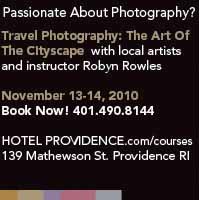
Hotel Providence: Travel Photography & Creative Writing Courses

Have you always wanted to become a travel writer? If the answer to that question is yes, one component of the journey you may want to focus on is travel photography. Being able to take your own pictures to accompany an article not only makes you a more valuable writer in the eyes of an editor, but it can net you extra income as well.

Today we have with us Tricia Carter, the workshop facilitator for the Hotel Providence’s newest course offering–Travel Photography. She’s going to elaborate a bit on the workshop and another upcoming event at the hotel.

Can you tell Freelance-Zone readers a bit about your travel photography course and what type of person it is designed for? 

This is a photography course designed for complete beginners through intermediates who would like to refresh their previous photographic knowledge. The workshop will provide a good technical foundation along with the fundamentals of composition to dramatically improve your images. You will learn to see what makes some images memorable, while others simply are not. With this new mystery of your camera Robyn will teach you how to apply your new photographic techniques creatively to capture those perfect travel photographs.

Who is the person that will be teaching the session and what is their background in travel photography? 

Robyn Rowles, owner of Robynrowlesphotography.com and Artist in You art studio, has traveled all over the world as a professional studio and freelance photographer.  Robyn owned and exhibited in various distinguished galleries internationally. Recently she turned her attention to North America and is in the process of developing a photography book chronically the rural Southern United States travels capturing the strength, beauty and simplicity of its many diverse cultures.
THPCourses_photo200x200

What are some of the things that people will learn during the course?

Alongside your like-minded peers, in a nurturing and supportive environment, you will discover your personal aesthetic and apply your new eye and skills to capture a moment, a sense of place, and a true cultural portrait. You will learn how angles, lighting, and other techniques can unearth the beauty in uncommon places.

Can you tell readers what the cost is for this course and what is included for that price?

$389.00 Single Occupancy

The cost for the $389.00 for single occupancy and $544.00 for double occupancy. These rates include:

  • Overnight accommodations in our Superior Rooms
  • 2 days of expert instruction by Robyn Rowles
  • Lunch and Dinner on Saturday
  • Breakfast on Sunday
  • Overnight Valet Parking
    * optional keepsake book of your photographs for an additional $75.00

Our local rate is $180.00. This excludes overnight room and breakfast.

You also have a Creative Writing course coming up—can you tell readers a bit about that as well?

Our first creative writing course, As The Plot Thickens….Developing Your Novel, was so well-received we thought that it was only natural to try it again! Our next workshop will be centered on writing children’s literature. We are grateful to have Brown University instructor and author, Joanna Howard involved again, so the caliber of the workshop will be excellent.

Reddit Digg Facebook Technorati Google StumbleUpon Netscape Yahoo Ask Fark ThisNext

A Sure-Fire Confidence Builder

Yes, you *can* cure presentation anxiety

Yes, you *can* cure presentation anxiety

By Jake Poinier

As a parent, your job is never done in correcting your kids’ use of the English language. I was reminded numerous times this morning as my high-school age son began a story with “George and me…” followed by my middle-school daughter injecting “like” into every other sentence. What I try to convey to them is that, while these are the types of things that help you not seem like a dork among peers, it’s not the way to impress teachers and (eventually) bosses.

With that thought, Joe’s post this week about being fearless triggered a memory for me on how we present ourselves as freelancers. As an entrepreneur who works with intellectual property, you are selling your skills — but you’re also selling yourself. And I can point to one single experience that was a sure-fire confidence builder far beyond all of the sales and marketing seminars I’ve ever attended.

I’m talking about Toastmasters.

I was required to attend a local chapter as a newbie salesperson back in the late ’90s. At first it seemed hopelessly contrived. The meetings are very structured, with different roles (timer, Jokemaster, emcee, etc.) assigned to each of the participants, and a very rigid timeline of what has to happen when. But even though my membership long ago lapsed, the lessons have stuck with me:

  • You get honest feedback on your presentation content and style. Having a third-party perspective on your speech patterns and gestures is an eye-opening, “do-I-really-do-that?” experience. With a little guidance and weekly practice, it’s amazing how fast you make progress and cure presentation anxiety. Bonus: If you say “um” and “ah” a lot, you’ll be cured of the habit.
  • You learn how to give honest feedback. Even when someone bombs, your job is to identify what they did well and help build on it. Yes, this is helpful when “guiding” your freelance clients to avoid or change something awful.
  • You learn how to be concise. Whether you’re telling a brief anecdote or giving a 5-minute speech, there’s a light box that signals yellow, green or red to tell you how you’re doing on time. Talking too much can be a deal killer.

Bottom line, if you have any fear about public speaking, your local Toastmasters chapter will help eradicate it in a fun, friendly, supportive environment. More important, you’ll feel far more confident presenting yourself in general, whether it’s making cold calls, pitching a new client, leading a writing seminar, or accepting a Nobel Prize in Literature.

What’s been your biggest confidence builder as you’ve started and grown your freelance business — workshop, club, personal guru? Please share in the comments!

When he’s not hanging around Freelance-Zone, contributing blogger Jake Poinier runs Boomvang Creative Group and offers freelancing advice under the pseudonym Dr. Freelance.

Reddit Digg Facebook Technorati Google StumbleUpon Netscape Yahoo Ask Fark ThisNext

Freelance-Zone Spam-Free E-Mail List

Subscribe to FZ!


Powered by WP Email Capture

A Writer’s Digest Best 101 Websites for Writers Site

BERJAYA

Privacy Policy

Freelance-Zone.com uses a privacy policy similar to Google's. Read our privacy policy for more information.

Hire Us

Joe Wallace and Catherine L. Tully are currently available on a limited basis for lectures, talks, coaching and mentoring on the business and craft of freelance writing.

They also do consultant work on a per-project basis for websites, small businesses, and corporations on everything from website content to social media. Please send a detailed e-mail to editor (at) freelance-zone (dot) com and allow at least 24 hours for a reply.

BERJAYA