close
The Wayback Machine - https://web.archive.org/web/20101127030331/http://www.ediblegeography.com/

Speculative Riot

I am actually rather intimidated by the incredible line-up of Thrilling Wonder Stories, an eight-hour festival of all things speculative taking place at London’s Architectural Association this Friday.

BERJAYA

IMAGE: Thrilling Wonder Stories II at the Architectural Association (view larger here).

Although it is not specifically a food-oriented event, edible geographers will find many reasons to attend in person or watch online, including presentations by media artists Ant Farm, who investigated interspecies communication in their designs for a Dolphin Embassy; Winy Maas of urban think tank The Why Factory, whose oeuvre includes Foodprint Manhattan and City Pig; novelist Will Self, who regularly chronicles his dining adventures along the British high street for the New Statesman; and designers Dunne & Raby, whose explorations include Foragers, a world of DIY devices and synthetic biology that enables humans to extract nutritional value from a broader range of substances, tackling future food crises by expanding the definition of “food,” rather than by simply producing more of it.

BERJAYA

IMAGE: Design firm BERG London will be among the panelists at Thrilling Wonder Stories. In this image of a kangaroo steak with pickled onions, BERG’s Jack Schulze speculates on the challenges of cultural adaptation to industrially produced artificial protein, and proposes borrowing the embedded traditions within origami to lend lab-grown meat an aura of authenticity, care, and craft. (Image used courtesy BERG London).

They will be joined by filmmakers, concept artists, game designers, and more, in a series of panels about the uses of fiction in understanding the present and imagining the future. BLDGBLOG’s Geoff Manaugh, who co-curates the Thrilling Wonder Stories series with Liam Young, and I will also be part of a panel discussion, telling quarantine stories of various flavours, from astronomical and agricultural to geological and geopolitical.

The event is free and open to the public; it takes place from noon to 8:00pm on Friday, November 26, at the Architectural Association in London (map). If you can’t be there in person,  you can watch live online or follow the @wonderstories Twitter feed.

Posted in Uncategorized | Leave a comment

A Short, Non-Linear History Of The Commemorative Cocktail

BERJAYA

IMAGE: Bartender in Catholic Sokol Club, Ambridge, Pennslyvania; Library of Congress Prints & Photographs division, Washington, DC, via Rebecca Federman.

Commemorative cocktail names act as a sort of alcoholic telegraph, a filtered, patchy, and somewhat unreliable headline service calling out public figures, trends, or events, from Obama’s inauguration to the introduction of a new steam engine. Rebecca Federman, whose blog describes her favorite finds from New York Public Library’s vast archive of historic menus and cookbooks, was the perfect person to dig up obscure examples of the form for the food issue of the New City Reader, and I am very pleased to reproduce her article in full below.

However, you’ll have to pick up your own copy of the New City Reader at the New Museum (or download the pdf here) to get hold of the recipe for our own commemorative cocktail: The Last Newsman. At the urging of my co-editors, Will Prince and Krista Ninivaggi, mixologist Greg Seider combined scotch, bourbon, vermouth, two kinds of bitters, and a brandied cherry to create a cocktail that will keep Summit Bar drinkers up to speed with what the executive editors of the New City Reader delicately refer to as “epochal shifts presently occurring in the information industry.”

•••

A Short, Non-Linear History Of The Commemorative Cocktail by Rebecca Federman

While one would be hard-pressed to find a salad or casserole named after military weaponry, the French 75 — a tongue-tingling concoction of champagne, gin, lemon juice, and sugar — is an offering found on many a cocktail menu. It was, in fact, named in tribute to a 75-mm quick-firing gun used widely during World War I.

Commemorative cocktails are born out of an incredible assortment of historical events, from monumental achievements and epic heroes to fleeting trends and otherwise insignificant peculiarities. The poetic bartenders (or publicists) who imagined the mixed drinks described below were commemorating, in liquid form, a host of special events, people, places, and innovations. And, yes, even the occasional scandal.

The rather delightful result is that even the most news-averse barfly can keep up-to-date on current events, from union strikes to space travel, simply by sampling fresh additions to the cocktail menu.

BERJAYA

IMAGE: Portrait of Joe Helbock, Charlie’s Tavern, New York, N.Y., ca. Mar. 1947; Library of Congress Prints & Photographs division, Washington, DC, via Rebecca Federman.

The First Japanese Delegation

In David Wondrich’s Imbibe!, a fascinating portrait of the nineteenth-century bartender Jerry Thomas, Wondrich specifically calls out Thomas’ recipe for the Japanese Cocktail as “a fine example of yet another Cocktail-naming gambit, the commemorative Cocktail.” The story, as Wondrich tells it, began in 1860 when the first Japanese delegation to the United States ended their tour in New York. Of the many esteemed guests from Japan, one became more infamous than the others. Tommy, as he was commonly referred to in the American media, was an English-speaking member of the Japanese delegation whose fondness for both pretty women and booze formed the subject of several newspaper articles. Wondrich deduces that since Tommy and company were staying at the Metropolitan Hotel, just one block from the bar where Jerry Thomas was mixologist-in-residence, the bartender created a drink in their honor — or lack thereof.

JAPANESE COCKTAIL
(from Jerry Thomas’ Bar-tender’s Guide, as reprinted in David Wondrich’s Imbibe!)

- 1 Tablespoon of Orgeat syrup
- ½ teaspoon of Bogarts bitters
- 1 wine glass (2 ounces) of brandy
- 1 or 2 pieces of lemon peel

Fill a tumbler one-third with ice, and stir well with a spoon.

England’s Industrial Shutdown

After what the New York Times referred to as “many wearisome days of fruitless squabbling,” on May 3, 1926, roughly three million members of England’s largest labor union, the Trades Union Congress (TUC), went on strike in support of British coal miners whose pay was being decreased despite increased working hours. The strike’s members included workers in England’s transportation and building trades; iron, steel and metal workers; and workers in the paper and printing industries. A nation-wide shutdown was only narrowly averted by the efforts of volunteer workers. The TUC finally called off the strike on May 12, 1926.

STRIKE’S OVER COCKTAIL
(from the Savoy Cocktail Book)

According to the note attached to this recipe, Harry Craddock, the head bartender at the Savoy Hotel, created this cocktail on May 12, 1926, to commemorate the end of the General Strike in England.

- 1/4 Lemon or Lime Juice
- 1/4 Swedish Punch
- 1/2 Gin

Shake well, and strain into a cocktail glass.

Man On The Moon

On July 25, 1969, a small article ran in the New York Times announcing the “Moonshot,” a cocktail created by French champagne and cognac producers to commemorate the Apollo 11 flight. The publicist for the French producers—the Moonshot was unveiled not at a bar but at a press conference—pointed out that the drink is best served on the rocks, because, as he correctly noted, “the moon’s surface is rock.”

MOONSHOT
(from the New York Times, July 25, 1969)

- 3 ounces French Champagne
- 2 ounces cognac
- 3 ounces orange juice

Mix well, and serve over ice.

The Eliot Spitzer Scandal

While not a cocktail in the traditional sense, the “Client #9 Champagne Oyster Shooter” appeared on the menu of the Grand Central Oyster Bar on March 12, 2008, the same day that Eliot Spitzer announced his resignation as governor of New York. Spitzer was referred to as Client #9 in an FBI affidavit detailing the operations of the Emperor’s Club, a high-end prostitution service that Spitzer frequented. When his scandalous assignations were leaked to the media, the Oyster Bar was there to commemorate it. The price for the champagne oyster shooter was jokingly listed at $5,000 but actually only cost an easy-to-swallow $7.95.

[NOTE: This article is from the food issue of the New City Reader, and was written by Rebecca Federman, the librarian and electronic resources coordinator for the New York Public Library's culinary collections, and the author of her own well-worth-following blog, Cooked Books.]

Posted in Uncategorized | Leave a comment

Coffeehouse Commons

Another sneak peek at the contents of the food issue of the New City Reader — in case you can’t tell, I was really rather inspired by the brief, and almost obnoxiously proud of what Will, Krista, and I managed to put together with the help of our fantastic contributors and the New City Reader team! You can pick up your own copy for free at the New Museum in New York City.

This particular article, reproduced below, is told in the form of an app pitch. It was brought to life by illustrator Nikki Hiatt, with comments from game designer Kevin Slavin, and it was inspired by a conversation with Geoff Manaugh, as well as a previous coffeehouse-based collaboration with fellow foodophile Dan Lewis in honour of Benjamin Franklin’s 300th birthday.

If you want to build it, please get in touch!

•••

BERJAYA

In the eighteenth-century English-speaking world, coffee houses were “the chief organs through which the public opinion of the metropolis vented itself,” according to historian T. B. Macauley. In addition to supplying an exotic stimulant — caffeine — coffee houses formed the central nodes in urban information networks. They were among the first public* gathering spaces where news, ideas, and goods could be debated, produced, and exchanged.

Early newspapers such as Addison’s and Steele’s Spectator were born and circulated in coffee houses, while the New York Stock Exchange and Lloyd’s of London can trace their origins to the Tontine Coffee House and Edward Lloyd’s Coffee House, respectively. Countless civic-minded enterprises were launched in coffee houses of the period; some, such as Britain’s RSA, whose mission is to support innovation for the common good, still exist today.

For the past decade, with the advent of Wi-Fi, the explosion of blogs and online news forums, and traditional media’s increasing reliance on freelancers, independent coffee shops have again become places where ideas are generated, news is consumed, and comment is free.

BERJAYA

However, gesticulating men in wigs passing pamphlets hand-to-hand have been replaced by Mac-dependent hipsters with bad posture and permanently attached headphones. Today’s coffee shop exchanges take place online, invisible to the other occupants of the physical space in which they are produced. Meanwhile, several coffee shop owners have declared war on their freelancing clientele, complaining that they hog tables, make a single coffee last for hours and create an anti-social, library-like atmosphere.

BERJAYA

But what if there was an app that mapped each coffee shop’s virtual information ecosystem and transformed it into a visible whole?

BERJAYA

Using the “Coffeehouse Commons”™ web or mobile interface, journalists and bloggers can check in to submit links to their content, while readers and commenters also log in to provide URLs for their in-house activity. The app’s home page provides a constantly updated timeline of activity across all coffee shops, but by checking into a particular coffee shop, users can explore the range of information and ideas that were produced, discussed, and consumed within that space.

BERJAYA

How would coffeehouse conversation change if it was re-attached to the physical fabric of the city?

*Access to this “public” space was, of course, limited by race, gender, class, and even the typical one-penny admission fee.

[NOTE: All illustrations by Nikki Hiatt. Originally created for and published in the New City Reader food issue, available in print form at the New Museum, or online soon.]

Posted in Uncategorized | 1 Comment

A Cocktail Party In The Street: An Interview With Alan Stillman

BERJAYA

IMAGE: Alan Stillman in front of the first T.G.I. Friday’s location at 63rd Street & 1st Ave, on Manhattan’s Upper East Side.

In 1965, Alan Stillman was a young man living in Manhattan, who, in his own words, was “looking to meet girls.” The bar restaurant he founded, T.G.I. Friday’s, began life as a public cocktail party — the first neighbourhood joint to welcome both men and women alike, with the express motive to unite the two. Forty-five years later, Stillman’s singles’ bar in the Upper East Side has metamorphosed almost beyond recognition, spawning a landscape of casual dining franchises that redefined the American idea of the restaurant. Stillman himself went on to found iconic steakhouse, Smith & Wollensky, among several other restaurants.

Architect Krista Ninivaggi and I interviewed Stillman for the food issue of the New City Reader; below is an expanded version of the conversation we excerpted in print. In it, Stillman tell us how to create a cocktail party in public, what to do when you get a bad review in the New York Times, and what the restaurant, real estate, and movie businesses all have in common.

•••

New City Reader: What’s the story behind T.G.I. Friday’s?

Alan Stillman: I lived on 63rd Street between First and York. Easy access to the 59th Street bridge meant you could get out of New York quickly, so in that two or three block neighbour­hood, there was a pile of airline stewardesses — and for whatever reason, there was also a whole bunch of models. Basically, a lot of single people all lived between 60th and 65th and between York Avenue and 3rd Avenue. It seemed to me that the best way to meet girls was to open up a bar.

NCR: Where were those people hanging out before you opened your bar?

Stillman: At the time, it was all cocktail parties. What would happen is that on Wednesday and Thursday, you’d start collecting information—things like, “On Friday night at 8 o’clock at 415 East 63rd Street, there’s going to be great party run by three airline stewardesses.”  Then somebody else would say, “Well, I got a good one—it’s going to be run by one of the baseball players at his apartment.” You built up a cocktail list and you bounced from one place to the other. The cocktail parties were wild, by the way. But there was no public place for people between, say, twenty-three to thirty-seven years old, to meet.

BERJAYA

IMAGE: P. J. Clarke’s today, via.

NCR: What about other bars — places like P. J. Clarke’s?

Stillman: P. J. Clarke’s was there — it had been in existence forever — but it wasn’t a meeting place. It was a guys’ beer-drinking hangout. There were very few women there. That was pretty typical of the New York bar scene at the time.

The other thing is that my timing was exquisite, because I opened T.G.I. Friday’s the exact year the pill was invented. I happened to hit the sexual revolution on on the head, and the result was that, without really intending it, I became the founder of the first singles bar.

The reason that it happened is that I used to stop into this corner bar near where I lived — a dirty old First Avenue bar with a bullet hole in the window called “The Good Tavern” — and I used to talk to the bartender. I would say to him, “You know, you ought to change the décor in here or do something with it — it would be a great place for all these people round here to meet each other. Eventually he said, “Why don’t you do it?” Five thousand dollars later, I had bought the premises with a short lease, and I was off and running.

BERJAYA

IMAGE: The original T.G.I. Friday’s location today, via T.G.I. Friday’s Facebook page.

NCR: Explain how you went about recreating that cocktail party atmosphere in a public space.

Stillman: All I really did was throw sawdust on the floor and hang up fake Tiffany lamps. I painted the building blue and I put the waiters in red and white striped soccer shirts. If you think that I knew what I was doing, you are dead wrong. I had no training in the restaurant business, or interior design, or architecture — I just have a feel for how to use all those things to create an experience.

I wanted T.G.I. Friday’s to feel like a neighbourhood, corner bar, where you could get a good hamburger, good french fries, and feel comfortable. At the time, it was a sophisticated hamburger and french fry place — apparently, I invented the idea of serving burgers on a toasted English muffin — but the principle involved was to make people feel that they were going to someone’s apartment for a cocktail party.

The food eventually played a larger role than I imagined it would, because a lot of the girls didn’t have enough money to stretch from one paycheque to the other, so I became the purveyor of free hamburgers at the end of the month.

I don’t think there was anything else like it at the time. Before T.G.I. Friday’s, four single twenty-five year-old girls were not going out on Friday nights, in public and with each other, to have a good time. They went to people’s apartments for cocktail parties or they might go to a real restaurant for a date or for somebody’s birthday, but they weren’t going out with each other to a bar for a casual dinner and drinks because there was no such place for them to go.

It took off extraordinarily quickly. In the first six to nine months, T.G.I. Friday’s got written up in Time, Newsweek, and the Saturday Evening Post. Then Maxwell’s Plum opened up across the street, which was another singles bar. It was really quite a phenomenon.

I believe that the first line in the history of bars, restaurants, and discos may have been at T.G.I. Friday’s. Inside of three months, we had to hire a doorman. One night I was tending bar, and he walked up to me and said, “Listen, there’s a dozen people standing outside, and we have no tables and no room at the bar. What do you want me to do?” And I said, “I tell you what. Why don’t you just tell them to wait, and when someone comes out, you’ll let them in.” He said that he didn’t know whether they would wait or not, and I said I didn’t know what else to tell him, and so he went back.

Next thing you know, I came out from behind the bar to get something and I looked outside and there were forty people standing in line. The next week we ended up buying velvet ropes. There was nothing like that anywhere else. You would either have a reservation at a fancy restaurant or you would just go into a bar or diner — nobody would wait in line for food and drink.

BERJAYA

IMAGE: Alcoholic slushies at the T.G.I. Friday’s of today, via.

NCR: What else did you have to introduce or change in those early months?

Stillman: We had to change the way we ran the place completely. It was a long bar, with bar stools, and I don’t think anyone expected there to be people standing four deep behind the stools. Straightaway, we went from one bartender to three. The waiters couldn’t get through the aisles because of the crowds, so we had to adjust where the seating was. We had to change the menu to be able to get food out of the kitchen more quickly. It was a total readjustment, because no one expected to be doing the kind of business we were doing.

Inside of eighteen months, two more places opened up within a block. By the summer of 1965, the police had to come along, put up barriers, and close First Avenue between 63rd and 64th Street on Friday night from 8 p.m. until midnight, because there were so many kids going back and forth between these bars that the cars couldn’t get through.

We’d moved the cocktail party outside into the streets.

NCR: Did your strategy work? Did you meet good-looking girls?

Stillman: Have you seen the movie Cocktail? Tom Cruise played me! I was lucky enough to do it for three years — he only did it to make a movie. Even today, the advantage of being the guy behind the bar is huge. Why do girls want to date the bartender? To this day, I’m not sure that I get it.

BERJAYA

IMAGE: Tom Cruise in Cocktail, via.

NCR: You opened up twelve T.G.I. Friday’s in total. How did you make the transformation from bar owner to businessman?

Alan Stillman: First of all, I’ll bet you Friday’s spawned thirty to forty restaurants and bars. We hired young people with bartending and waiting experience, and they made a lot of money, and a lot of them went out and opened up their own places.

But the second actual T.G.I. Friday’s was in Memphis, Tennessee. I didn’t pick it — they picked me. The original bar was two years old, and it had national recognition at that point. Somebody came in and said, “I’m from Memphis, Tennessee, and I own a shopping area down there with room for one of these. Will you sell me a franchise?”

I have to admit that I didn’t know what the word franchise meant. So I said, “If you have the money, I’ll be the partner and I’ll show you how to do it, and we’ll split it 50/50.” We shook hands and a year and a half later, we opened up a T.G.I. Friday’s in Memphis. People started coming in there from Little Rock and Nashville, and more guys walked in wanting to partner with me, and so I did the same thing again. Before I knew it I had five or six T.G.I. Friday’s round the country. It wasn’t pre-planned at all.

Then a couple of guys came in from Texas, and said, “We want to do this in Texas, and we want to do it at five times the size, on three floors, with a big central bar.” They had a lot of money and a lot of business expertise, and soon enough we were in Houston and Dallas and on it went.

BERJAYA

IMAGE: Suburban T.G.I. Friday’s today, via.

NCR: Did changing the size of the restaurant change the atmosphere?

Stillman: The size didn’t change it as much as our expansion into the big southern suburban towns. Those cities have a very different way of interacting with the street in the first place, but the big shift was that during the day, we started to get families. We had very informal, casual food — you could get an omelette or a hamburger — so families were coming in with their kids. That was the big change. It took six or seven years, but T.G.I. Friday’s became a very different animal.

By 1971, the economy was very bad. At the time, we had a dozen Friday’s and we were trying to open up three more. By then, everyone was chasing us. There was Somebody Tuesday’s and Bennigan’s and this thing and that thing, and you needed big money to do it right and open three this year, and five next, and ten the year after that. I didn’t want to sell out, but I didn’t not want to either. While we were out trying to raise the money to expand, someone came to me and offered me enough money. With a million dollars at that time, you could retire and do nothing for the rest of your life. So I sold.

BERJAYA

IMAGE: Interior of T.G.I. Friday’s today, via.

NCR: And moved on to Smith & Wollensky?

Stillman: I took a break first. I got married, we travelled around Europe, and that’s where I learned about food and wine. My wife and I spent a lot of time in France, and we became somewhat sophisticated. We saw a lot of French brasseries that served only French wine and French cuisine. When we came back here, the only thing like it was American steakhouses — but they didn’t serve any American wine. I thought that if I opened up a steakhouse and I served Californian wines, maybe I’d have something special and unique, and that’s how Smith & Wollensky got started. It was the American version of the French restaurants I loved in France.

I opened up Smith & Wollensky in 1977, with a list of forty-seven wines — half from California and half from France and Italy because we were scared to death that people weren’t going to order the American bottles, because they didn’t know what the hell they were. When you went into the nine other steakhouses in New York City at the time, you were asked if you wanted red or white.

There was nothing that was in itself hugely original — the menu was more extensive, the décor, the wines — but add it all together and when we opened, we were different from the other steakhouses in town. I did extensive steakhouse research, so we knew exactly what they were doing and what we wanted to do differently.

None of which helped, of course. The first review we got was the worst review in the history of the world. It was by Mimi Sheraton for the New York Times. We almost went broke. So we took out three full-page ads in the Times. At the time, the two big deal steakhouses in New York were The Palm and Christ Cella, and our ad showed two big matchbooks and said, “At last, a match for The Palm and Christ Cella!” We took it out three days in row, and business took off. We hadn’t done any advertising before. We didn’t know how to go out and pitch stories. At the time, no one advertised restaurants, especially not with full pages in the New York Times.

BERJAYA

IMAGE: The original Smith & Wollensky in New York City, via.

NCR: What else was different about Smith & Wollensky, in terms of menu and decor?

Stillman: I have the original menu here, but for the life of me, I can’t remember what we added that wasn’t on other steakhouse menus at the time.

We were in a former steakhouse that had been completely burnt down. We painted the exterior green and white, and we made the inside more — how shall I say this? — “elegant” than a typical steakhouse was at the time. It had more comfort to it — but that wasn’t because we intended it to be woman-friendly. It was a steakhouse, and at the time, steakhouses were male-oriented. Our target customer was people who ate at The Palm and Christ Cella — men my age. It’s only been in the past few years that I’ve seen people opening up “nightclub” steakhouses that are intended to attract single women. Now, if you want to see where a twenty-seven-year-old wants to eat steak in the year 2008, you should visit the restaurant my son Michael opened, Quality Meats.

BERJAYA

IMAGE: Quality Meats, via.

A lot of people open up restaurants that fit their age level. It’s much easier for me to open up a restaurant that I understand and that my friends would go to, even today, than it is to open one up for thirty year-olds. I have no understanding of Michael’s new restaurant. I understand that it’s beautiful and the food is wonderful, but as to who it attracts and how — it’s completely foreign to me. It’s too loud and too dark for me and my friends.

I’ve been told that you find the same thing in books, movies, and theatre — that people create things that make sense for their age group.

NCR: Do you see any other analogies between creating a restaurant and directing a film or writing a book?

Stillman: It takes a similar level of creativity as being a movie director, other than you have be more of a businessman. When you walk into a restaurant, you’re looking for an afternoon or an evening of entertainment. The entertainment part of it — the atmosphere and the service and all the little touches — is as important as the food. You can serve the best food in the world, and if people didn’t like the atmosphere and the decor, they won’t come back.

You can’t get me to go to a restaurant that’s got terrible atmosphere and service—it doesn’t matter how good the food is. I won’t go. There’s an enormous amount of creativity in orchestrating a space and an experience so that it creates a particular feeling.

Look at this. [Points to wooden frame around the first Smith & Wollensky menu.] No one presented their menus in a frame at the time. There’s a tremendous amount of creativity in the restaurant business. The problem is that a tremendous number of people think that it requires nothing but creativity, but the business part doesn’t take care of itself.

BERJAYA

IMAGE: Alan Stillman in his office with the original Smith & Wollensky menu. Photo by Krista Ninivaggi.

NCR: How did the feel of Smith & Wollensky evolve over time? What have you done to update it?

Stillman: This is something that I do think I’m good at. The New York City Smith & Wollensky is thirty-three years old, and there are others around the rest of the country that are ten or twelve years old. It’s about changing the place little by little, so that Smith & Wollensky is now fifty percent different than it was when it opened — but you wouldn’t know it. If you don’t know how to update your restaurant while keeping it the same, it will close after six or seven years.

The menu has to expand because you add new things to keep ahead of the competition but you have to keep the customer favorites. Dishware and glassware needs to be updated. It’s the things around the edges of the experience — sides, desserts, wines — that you can change. We’ve gone from four desserts to fourteen, made by an in-house pastry-chef.

I am very hands-on about this stuff. I choose the silverware, I make decisions about the decor, and I try every single thing on the menu. That’s my favourite part. The rest of it is just running a business. The fact that you’re selling steaks instead of widgets doesn’t make much difference.

BERJAYA

IMAGE: Meat vault at Smith & Wollensky, via.

NCR: How did Smith & Wollensky grow? Did you plan to open more than one from the start?

Stillman: No, definitely not. I actually had partners at Smith & Wollensky that didn’t want to expand — they didn’t want to take the risk and they wanted to take money out of the business rather than put more in. That’s not a fault — it’s just a business decision that you make. Smith & Wollensky in New York City stayed on its own from 1977 to 1997. It took me twenty years to buy the right to expand from them.

NCR: Smith & Wollensky has remained in cities as it expands. Is that a conscious strategy?

Stillman: Smith & Wollensky is definitely an urban restaurant. These are big restaurants doing big dollars, and we have to be in big cities.

My second one was in South Beach, in Miami. We looked at Chicago, South Beach, Las Vegas, Philadelphia, Washington DC, and wherever the right property showed up first, we built.

BERJAYA

IMAGE: Smith & Wollensky in Miami, via.

NCR: When you go looking for a Smith & Wollensky site, do you have a checklist?

Stillman: Yes. The bigger you get, the better your list gets. By the time you’re the size of McDonald’s, you don’t have to bother looking. You run your checklist up against some data and you know exactly where you can put your restaurant and where you can’t. Then it’s just a matter of getting hold of the real estate.

The single most important thing on Smith & Wollensky’s checklist is the ability to have an exterior look that is different from everybody else. That’s the deal-breaker — and the hardest part to find. We can’t put it in any old big office building because the owners won’t let us do that. We want people to drive by, not read the name, and say, “That’s Smith & Wollensky.” We started out like that with our first building, on the corner of Forty-ninth Street and Third Avenue, so it became our brand.

The other thing is that we build big restaurants. We’ve got seven hundred seats in most of our places, so we need the square footage. That’s an economic decision, not an atmosphere one. Big box, big tickets — that’s our formula.

The restaurant business does come down to real estate, though. A restaurant owner is renting or sub-letting you a piece of real estate for the evening, and how long you sit there and how much you spend determines whether they’re going to be successful or not.

Once I was in the $75 ticket business, then I started looking around and getting other ideas. I like to fill holes — figure out what’s missing and supply it. I opened Park Avenue and The Post House and the Manhattan Ocean Club, which has since turned into Quality Meats.

NCR: What’s missing in the New York City restaurant-scape right now?

Stillman: There’s very little missing in New York at the moment. It’s the food capital of the world, in my opinion. There is still room for originality — for example, my son, Michael, opened up the only Polynesian restaurant in town. There are not many holes like that to be filled, but there are other kinds of holes — the kind that you can fill with décor, atmosphere, prices, and imagination. And there are geographical holes — for example, I personally think that in Midtown, there is room for a high-end Indian restaurant.

Of course, you don’t have to open up something that fills a hole. There are a lot of people doing perfectly good business opening up more same-old steakhouses. That’s just not where the fun is for me.

NCR: Are there any current food trends that you find particularly intriguing?

Stillman: I don’t quite get the celebrity chef thing. What are these guys doing cooking meals on television? And why do they have multiple restaurants? Star chefs used to have a restaurant, and when you went there, he cooked for you. To me, if you’re not in the kitchen cooking, then I’m not eating your food.

I’m not condemning Wolfgang Puck and the others, but this celebrity chef trend has changed the feeling of what cooking is at a certain level.

Now Steve Wynn, with his hotels in Las Vegas, put his foot down and made star chefs sign multi-year contracts that they would be there five nights a week. Mr. Wynn has got 1500 rooms and a gambling empire on top of the restaurants, so he can afford to go to Paul Bartolotta and pay him a million dollars a year to be there five nights a week. And the result is probably the best Italian seafood restaurant in the whole world.

NCR: Do you prefer eating out at restaurants or eating at home?

Stillman: By choice, I would eat out six nights a week. It’s better and easier — and even if you were wealthy enough to have a personal chef who did all the work for you, it seems to me as though it would get boring after a while. I want to go out and see what’s going on in the city, and try different cuisines, and different cooking styles. The only reason I’d want to stay home once in a while is that maybe I want to watch a movie or read a book over dinner.

I eat in one of my own restaurants once a week. The rest is split: two-thirds, places I know and love; and one-third, new places I want to try.  In my head, I’m not going for business reasons, but my wife will tell you that when I’m out, whether I know the place or not, if she allowed me I’d pull out a pen and paper and start taking notes. She’s probably right. I’m a great stealer. I see things and bring them back to the business all the time.

[NOTE: I owe an enormous thanks to Alan Stillman for sharing his time and reminiscences so generously, and to Krista Ninivaggi, who coordinated and co-conducted the interview.]

Posted in Interviews | 5 Comments

The Food Issue

I’m rather excited to announce that the Food section of the New City Reader is hot off the presses!

BERJAYA

IMAGE: Front page of the Food issue of the New City Reader.

The New City Reader is a pop-up “newspaper of public space,” published as a sixteen-page broadsheet each Saturday this autumn. It was launched by Joseph Grima and Kazys Varnelis as part of the New Museum‘s current exhibition, The Last Newspaper, which looks at the ways artists “disassemble and re-contextualize elements of the newspaper in an effort to take charge of, and remake, the transmission of information that defines our daily lives.”

BERJAYA

IMAGE: News, 1969/2008, by Hans Haacke, in which a real-time feed of news agency reports is printed in the gallery. It is on display as part of The Last Newspaper at the New Museum, alongside a restaging of William Pope.L’s work, Eating the Wall Street Journal (2000), in which a “team of collaborators occasionally wander throughout the museum eating the financial daily.”

Each week’s issue takes its cue from a specific section in a traditional Saturday paper, and is put together by a fresh team of guest-editors with the help of a small in-house design and editorial staff.

The first issue introduced the project with a giant infographic explaining how the New York Times continued to be produced during the chaos of the city’s 1977 blackout. Subsequent issues have included the editorial pages, and the Culture, Sports, and Leisure sections, with topics ranging from Kuwait’s diwaniyyah network of distributed debate to the grass- and air-rights negotiations that take place between Ultimate Frisbee and pick-up football players in Brooklyn’s Prospect Park.

In the weeks to come, you can look forward to Business, Music, Legal, and Weather sections, among others, all guest-edited by some of Edible Geography’s favourite writers and designers.

BERJAYA

IMAGE: A page from the Food issue of the New City Reader, in which drawings by Will Prince and Krista Ninivaggi show the health codes and economic logic that shape our dining environments.

Flatteringly, I was invited to co-edit the Food section with architects Will Prince and Krista Ninivaggi of PARK. Although that meant that none of us slept for about a week, the collaboration was a lot of fun, and we were lucky to persuade an extremely talented group of people to write and draw for the issue, including Evan Allen, Leigha Dennis, Rebecca Federman, Nikki Hiatt, Irene Hwang, Klaus the cartoonist, Geoff Manaugh, Sarah Rich, and Greg Seider.

BERJAYA

IMAGE: A page from the Food issue of the New City Reader, showing illustrations by Nikki Hiatt (to be featured in a future post) and a cartoon by Klaus.

BERJAYA

IMAGE: A page from the Food issue of the New City Reader, featuring an introduction to the allusive geography of Coney Island, Michigan, by Irene Hwang and a cartoon by Klaus.

Our editorial brief was to filter the typical content of the food and drink section through the lens of public space, the newspaper, and alternative urban networks of communication. The result includes an atlas of imaginary fried chicken cartographies, an introduction to underground bushmeat networks and illegal grilled cheese, and interviews with a range of foodscape imagineers, from legendary critic Jonathan Gold to public health innovator Naa Oyo Kwate.

For now, you can pick up a free print copy at the New Museum in New York, check out the issue as a low-res PDF here, hold your breath until it is posted online here, and/or follow along this week as I post excerpts and outtakes.

BERJAYA

IMAGE: A special insert in the New City Reader: a selection of all-purpose grocery discount flyer templates provided by the editors for taxonomical purposes only.

Huge thanks are due to the New City Reader team, particularly Brigette Borders, John Cantwell, Neil Donnelly, Daniel Payne, Alan Rapp, and Chris Rypkema, our stellar contributors, and our generous informants and interviewees (including Candy Chang, Jonathan Gold, Marion Emmanuelle, Matthew Kemshaw, Nance Klehm, Naa Oyo A. Kwate, Ronnie, Jon Rubin and Dawn Weleski of Conflict Kitchen, Jeff Sisson, Alan Stillman, and Christina Zeigler).

Posted in Uncategorized | Leave a comment

Art Meat City

BERJAYA

Just a quick note to say that Foodprint Denver, the third event in the Foodprint Project series that Sarah Rich and I co-curate, takes place today! We’ll be at the Denver Museum of Contemporary Art from 4:00 to 6:00 p.m., conducting a back-to-back series of live, quickfire Q&As about the relationship between meat and design at a variety of different scales.

Colorado State University meat scientist Keith Belk will join us first, to discuss the biological architecture of cattle. His research includes the development of the Carcass Optimizer™, an online tool that draws on detailed cow muscle maps to “help packers and processors breakdown their carcasses into the most profitable combination of cuts,” as well as the invention of the Smart Machine Vision Beef Cam, which uses the same technology Levi Strauss uses to measure the color of stonewashed jeans, in order to accurately gauge the tenderness of lean meat.

He’ll be followed by Pete Marczyk, a local chef, and the founder and owner of Marczyck Fine Foods, the gourmet grocery store whose in-house butcher, Jimmy Cross, spent yesterday breaking down the bison that forms the centerpiece of the museum’s post-event Beast Roast. We’ll be asking Pete about the differences between bison and beef butchery, as well as regional variations in meat cuts and his prediction for the next bacon-style trend.

BERJAYA

IMAGE: Foodprint Denver is part of the Denver MCA’s three-day Art Meets Beast program.

Unfortunately Temple Grandin, who was scheduled to join us next to talk about her work to design livestock facilities that improve cattle’s emotional health, has been forced to cancel. Instead, we’ll move straight on to a discussion of the spaces in which we consume meat with The Fort restaurant’s Holly Arnold Kinney.

Moving onto a more abstract spatial level, we’ll ask UC Boulder professor Elizabeth Dunn to introduce us to the global geography of the cattle industry, as well to the “zones of wildness” produced by federal food safety regulation.

And, last but not least, rancher, author, and former Agriculture Commissioner for Colorado Peter Decker will speak to the relationship between ranching and the landscape, from Western appropriation of the native Ute prairie to contemporary ecological concerns.

The afternoon promises to be a brief but thoroughly thought-provoking introduction to the way meat both shapes and has been shaped by the city and its agricultural hinterland. Tickets are $15 (or $10 for MCA members), and for those of you who can’t make it, the MCA will be recording the event, so we’ll post the video to the Foodprint Project archive as soon as possible afterward.

BERJAYA

IMAGE: The Foodprint Denver logo, designed, as always, by the fabulous Nikki Hiatt.

Many thanks to our fantastic line-up of speakers, as well as to the Denver Museum of Contemporary Art and its inspired curatorial team,  Adam Lerner and Sarah Kate Baie, for inviting Sarah and I to bring Foodprint Project to Denver. I can’t wait — hope to see you there!

Posted in Foodprint Project, Uncategorized | Leave a comment

Cross-Species Dining: An Interview with Natalie Jeremijenko and Mihir Desai

BERJAYA

IMAGE: All photos of the Cross(x)Species Adventure Club dinner by Emilie Baltz.

Natalie Jeremijenko is an artist and designer whose background includes studies in biochemistry, physics, neuroscience, and precision engineering. She directs the xDesign Environmental Health Clinic at NYU, where she is also assistant professor in Art. Together with molecular gastronomist Mihir Desai, she organises occasional Cross(x)Species Adventure Club dinners, featuring drinks and dishes that challenge guests to expand their idea of the food web, in order to imagine edible interventions that go beyond sustainability to actually augment ecological health.

Their most recent Cross(x)Species dinner was held on August 21st, at the Neuberger Museum of Art in Purchase, New York. Although I wasn’t able to attend, I was thrilled to be able to talk through the menu with both Desai and Jeremijenko during a series of fascinating and lengthy phone calls. Our edited conversation, below, provides a tour through the evening’s culinary adventures, from edible cocktails to nano water buffalo ice-cream, diverting frequently to consider, for example, horse-racing as a business model for urban agriculture, and the morality of eating snails.

•••

Edible Geography: Your most recent Cross(x)Species Adventure Club dinner had an oil spill theme — can you talk a little about why and how you explored that through the menu?

Natalie Jeremijenko: With the enormous spill in the gulf, oil is in everyone’s imagination at the moment. It’s actually a useful way to look at the relationship between multi-scalar processes — digestion inside our bodies and digestive processes that happen in ecology. Oil, of course, is really only digested by bacteria, even inside us. That’s a great way to start the exploration of this idea that there are ten times as many non-human cells in our bodies as there are human cells: we’re more non-human than human. We are an ecology to other organisms. That’s where we began.
BERJAYA

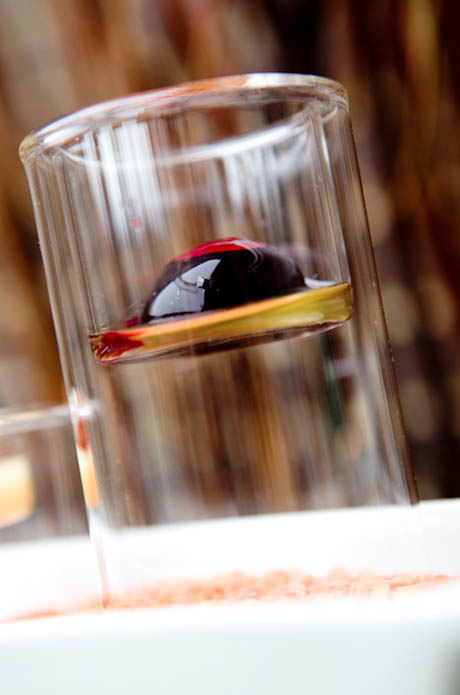
Mihir Desai: We had a major oil for each course, as a flavour. And, almost by default, virtually all the courses involved an emulsion of some sort, drawing on the properties of oil dispersal in liquid. For example, the cauliflower velouté in the fourth course was an emulsion using a fluid gel.

I think next time we’ll do even more. I’d like to do a confit — that’s basically anything just cooked in a bath of oil at a low heat for a long time — and perhaps also fry some things. A confit of goose would be really interesting. Natalie’s been eager to serve goose. They’re actually massacring them out in Prospect Park right now. Unfortunately, they’re not in season at the moment. You can only get really old birds, so we’re going to hold off for a bit.
BERJAYA

Edible Geography: Talk me through the evening, course by course.

Natalie Jeremijenko: We started off by doing some workshops. What happens in the workshop part is that Mihir and I swap off, introducing molecular gastronomy to people and then talking about why molecular gastronomy is interesting to use as a medium for the Cross(x)Species Adventure Club purposes.

Mihir Desai: This was actually a particular interesting dinner for me, because this was the first one where I got to hear a lot of what Natalie says. Usually, I’m going in and out and I miss most of it.
BERJAYA

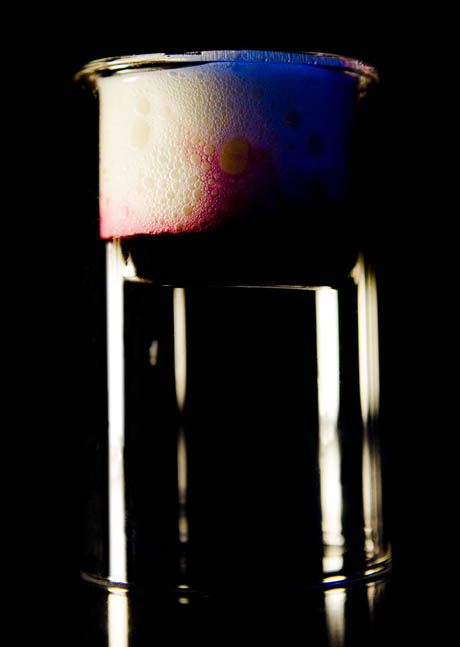
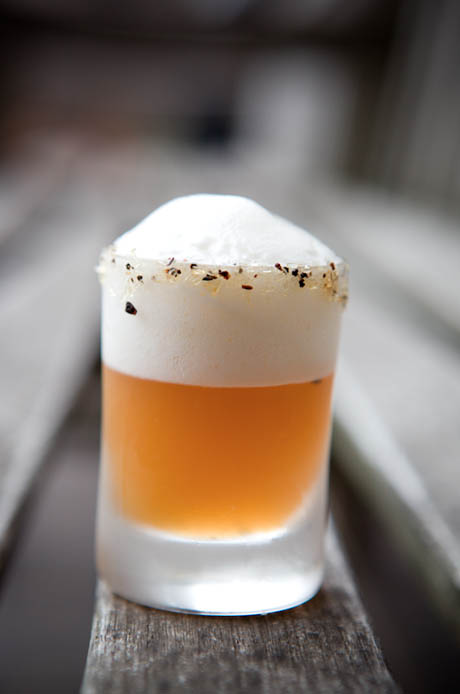
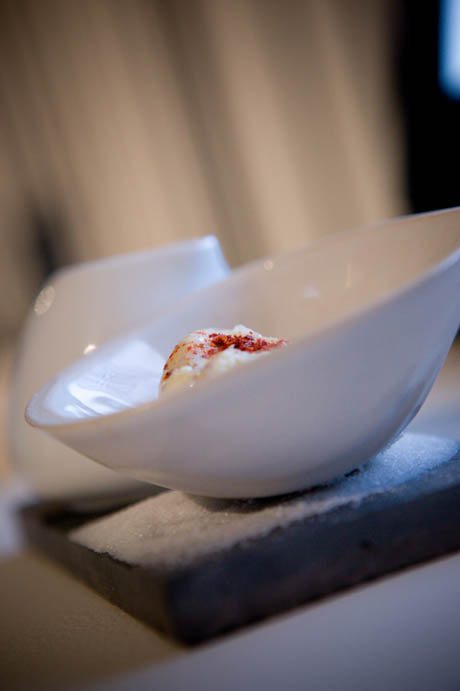
Natalie Jeremijenko: The dinner began with three edible cocktails and one wetland experiment, which was the marshmallow wet kisses. Actually, we put too much alcohol in those, so they didn’t really work! The wet kisses are made of methyl cellulose to emulate the marshmallow, which is a wetland plant.

In terms of oil, one of the big issues in the gulf is that there are many people calling to protect the wetlands from the spill. That’s a very understandable position to take, but I take a completely opposite one, because the only technology we know of that can effectively digest large amounts of petrochemical waste is wetlands. So we don’t need to protect the wetlands — instead, we need to expose the wetlands and also build many more wetlands, and reconstruct the ones we’ve destroyed, in order to deal with this spill.

Obviously, this really takes issue with the legacy idea that we have of conservation and preservation and environmentalism — that idea of preserving what’s left of “pristine” natural systems, without recognising that they’re not outside of our socio-ecological system. In other words, there’s no such thing as a pristine system.

It’s a big challenge to introduce this new form of environmentalism, which is one that’s reconstructive and generative as opposed to conservative and preservationist.
BERJAYA

Wetlands and wetland digestive processes are a theme that keeps coming up throughout the menu. In California, over ninety-five percent of the wetlands are filled and degraded and in the U.S. in general, that figure is about sixty percent — and there’s ongoing wetland loss. Much of it is filled for agricultural reasons, but there’s an increasing amount of urban pressure, too. And, of course, airports are almost without exception built on cheap, flat land proximal to city centers, which is more often than not swamps and bogs — or what we now call wetlands.

In the wet kisses, by using marshmallow and rice — rice, by the way, is the most important caloric source of food for humans in the world — we point to the fact that wetlands are by no means non-agricultural spaces. In fact, they produce more biomass per square metre than the terrestrial ecosystem equivalent.
BERJAYA

The wet kisses are an edible cocktail. They’re purple, using crème de violette, to evoke the purple-enhancing capacity of the lividium soil bacteria and the violacein that it produces. Lividium is a soil bacteria that is associated with wetlands, but it’s also associated with the microbial skin community of the frogs and salamanders that have survived the chytrid fungus, which is one of the major culprits in the biggest species extinction crisis the earth has seen since the dinosaurs — the extinction of amphibians.

When it’s on the microbial skin community of frogs and salamander, the lividium soil bacteria produces this purple violacein, which is actually a substance that’s under intense medical research for a whole lot of other reasons. So when you eat it as a marshmallow, your lips are innoculated with the lividium and the violacein, which equips you to kiss a frog and innoculate it with the protective agent against the chytrid fungus.

Mihir Desai: I should mention that, for now, the violacein is not actually present in the wet kisses. It is available as food grade chemical — it’s used industrially as a purple dye — but I’m still trying to find a source that will get it to me in small-enough quantities.

Natalie Jeremijenko: And, as I said, we did put too much alcohol in, so the methyl cellulose didn’t really whip up very well, but I think failed experiments when you’re doing a workshop are just as good as successful ones. Mihir makes everything look easy, usually, so it’s actually good when occasionally things don’t exactly work out.

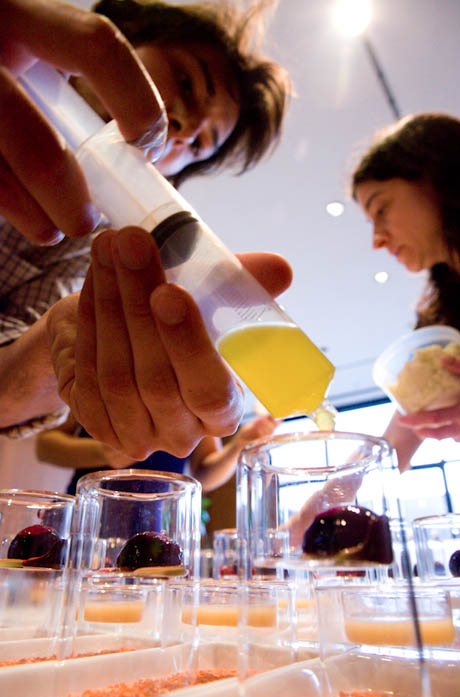
The other edible cocktails we did involved inverse spherification, which is a classic introduction to molecular gastronomy. I call them terrestrial bubbles.
BERJAYA

Mihir Desai: The spheres show off a technique of making an egg yolk, basically, out of any liquid by using sodium alginate, which is a seaweed-derived gelatin product. We had a workshop for two hours before the dinner, and during that people made these spheres for themselves. It’s not too complicated. The reason Natalie calls them bubbles is that they are sort of the inverse of an air bubble underwater — the kind you make when you go underwater and you breathe out. These are the opposite: they’re bubbles of liquid in the air. It’s a nice introduction to start thinking about terrestrial versus aquatic environments and where we fit in.

Natalie Jeremijenko: They also create a membrane effect that weeps — we did a beet version, so you could really see the weeping. Then by soaking it with an alcohol, we can also have a membrane exchange going on. And they’re so much fun to put in your mouth and pop!

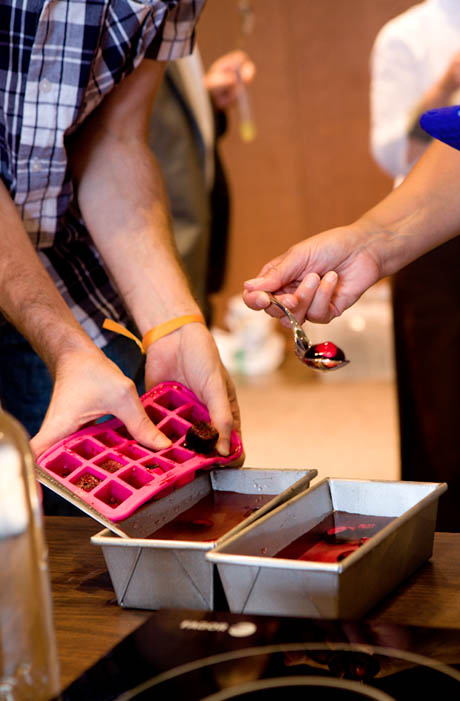
We also had the edible lures, of course. We’ve taken commercial fishing lure moulds and filled them with gin and tonic, with a bit of rosemary in it. I don’t know how much the fish like gin and tonic, but people do, and tonic fluoresces wonderfully well.
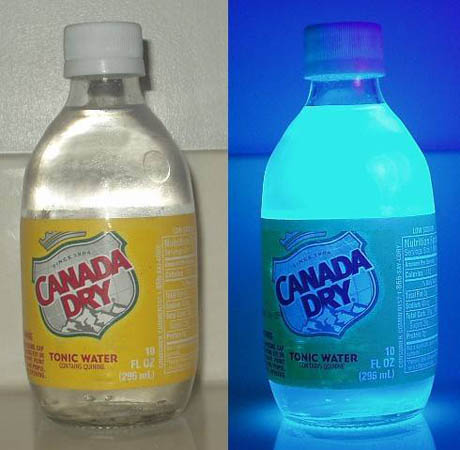
BERJAYA

We use gellan as the base for the lures, which makes them edible for fish, so you can share it with them. It also has a chelating agent in it — the chitinase. That’s an extract from chitin, the second most plentiful form of material in the world after cellulose. Oysters, lobsters, and other invertebrates use it as their structural base. As a molecule, it’s very inert and very stable, and it will grab a lot of material. When either people or fish ingest it, it binds to the bio-accumulated heavy metals and PCBs. There’s no other way to get them out — you can’t slice mercury out of a fish, or prepare it in a way that removes the PCBs. Fish are the greatest source of mercury in our diet — between eighty and ninety percent of the mercury in our bodies is from fish.

By feeding fish the lure with the chitenase in it, it binds to the bio-accumulated mercury and PCBs, and passes out as a harmless salt. It’s much less reactive and much heavier, so it settles into the silt and is effectively removed from bio-availability.
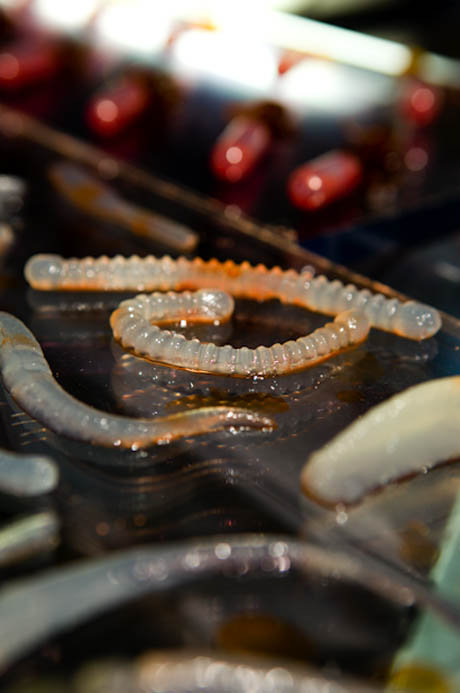
BERJAYA

We are using this as a kind of emblematic example of the feedback cycle: you transform the food of the fish, and then we eat the fish. Our approach is rather like targeted drug delivery, rather than treating the whole system as they’re doing up the Hudson by dredging all the sludge and shipping it off to Texas or to Pennsylvania or to the nearest Third World country where it continues to be toxic sludge. Instead, we’re using the bio-amplification that happens through the food web. The place where the toxins are most accumulated is in the bodies of fish, so by delivering the chelating agent to that point, we’re doing a very focused intervention. We’re addressing their health and we’re augmenting their nutritional value and resources, which we depleted in the first place with an urban design of hard edges and no shorelines — the cumulative urban impact on the aquatic ecosystem.

The lures are really the iconic example of the Cross(x)-Species project. It changes the interaction. If a busload of people started feeding these lures to fish, regularly, you would create sites where fish are there, and people learn that fish are there, and fish learn that people are there and when people are there, food is likely to appear, and you start this feedback cycle through which you can actually have an aggregated and significant positive environmental effect.
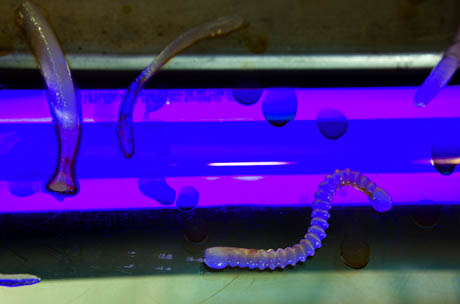
BERJAYA

The chitenase acts biologically in our bodies in the same way it acts in the fishes’ bodies, so there’s also that fundamental lesson that we’re biologically not that dissimilar. And then it has an indirect effect on our health, because by improving their health and augmenting their nutritional resources, we’re improving our own.

Edible Geography: It’s a perfect demonstration of the fact that if you expand your understanding of the food web, you can choose a more effective point to intervene.

Natalie Jeremijenko: Exactly. People in natural systems are always seen as a negative, but in an urban context where you’ve got a tremendous number of people, I think that the design challenge is to figure out how to use that resource. If you don’t give those people a nutritionally appropriate chelating lure to feed the fish, then they’re only going to throw cigarette butts or Doritos or chewing gum or something in the water.

It’s a particularly urban design challenge, to transform our relationship with the ecosystem to become a form of cultivation rather than extraction or damage.

We live in an incredibly rich ecosystem in the New York/New Jersey estuary system, and if we redesigned the nutrient flows — if we redirected fish waste from landfill, for example, and cycled it back into the estuary system, and supplemented the nutritional resources that are available, and designed those nutritional resources so that they actually are generative, we could really foster a dense, healthy, urban population of fish.

I like to think of New York as the New York of fish, aquatic organisms, and birds before it was the New York of people. It had the same kind of incredible carrying capacity and ability to sustain huge populations.
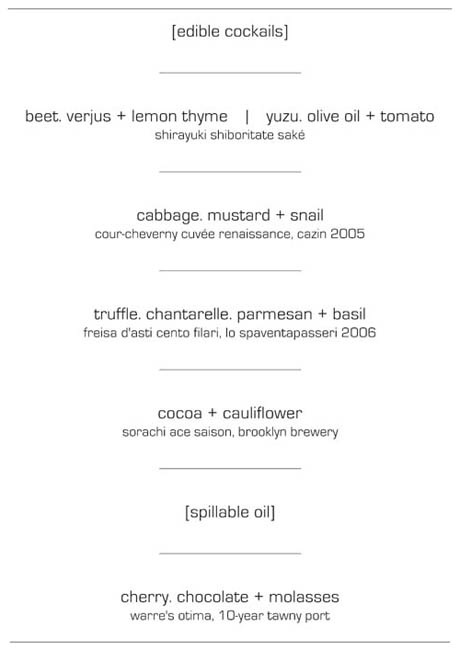
BERJAYA
BERJAYA

Mihir Desai: The cocktails and the first course were also a really nice introduction to the techniques that make molecular gastronomy interesting — spherification, liquid nitrogen, turning fats into powder, gellan, and so on.

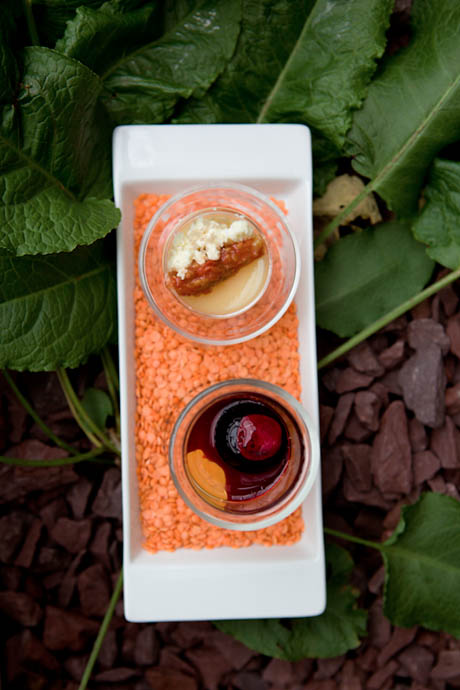
For the first course, we set the yuzu juice with gellan gum. Gellan is fantastic — it’s a synthetic product and you can get it in different strengths, so, unlike agar, it can set all the way from a soft, sort of chewy gel to a hard, brittle one.

In this dish we had a yuzu gelée with a tomato marmalade on top, and olive oil in powdered form.

Natalie Jeremijenko: Which melted in your mouth.

Mihir Desai: To make the oil into a powder, we used maltodextrin, which is a modified food starch. Unlike most starches that you’re probably familiar with, which soak up water, this one soaks up fat. By using maltodextrin, you can pretty much powder any fat, even though fats are notoriously difficult to powder. The other way around making a fat into a powder, if you don’t already have it in liquid form, is to freeze the material using liquid nitrogen, and then just smash it. So we also did that with some olives that we served for this course.

Natalie Jeremijenko: That was interesting, because the first part of the breakdown of oil is a mechanical as well as biological process. Throughout the dinner, the dishes explored the different possible states of oils, the ways oil and water combine, and how you can grab and break down oil. As Mihir explained, maltodextrin grabs the oil mechanically and makes it available to a number of other processes.

Maltodextrin is extracted from tapioca. Processing cassava or manioc — again, another extremely important food that huge populations depend upon — to extract the tapioca starch is very interesting, particularly in terms of the precision with which the cyanide is removed by what we might think of as very primitive methods, such as pounding and drying. In the lab, we would typically require liquid chromatography to achieve this level of precision, but Africans and South-East Asians traditionally do it entirely by taste. And talking about this allows us to make the point that taste is actually a very precise tool with which to guide our eating. It’s a very important tool of investigation.

The yuzu has some of the protease, bromalain, that pineapple is famous for. Bromalein can hydrolise protein, which is why you can tenderise meat with pineapple and you can’t put pineapple in Jello. So that functioned as a second stage to break down plant and bacterial proteins.

We served the first course with a sake. If alcohol is some sort of measure of biological conversion processes, sake is the most alcoholic of all the drinks, because it has three different biological processes, including the yeast, the fermentation, and the bacterial transformation.
BERJAYA

Edible Geography: Describe the second course.

Mihir Desai: The second course was really about Natalie’s idea of urban meat — urban-appropriate, alternative protein sources that are usually considered disgusting but could easily not be so. In this case, we had snails, which oddly enough, she won’t eat.

Natalie Jeremijenko: The centrepiece was a snail rollercoaster, and underneath the table we had embedded some video of snails, which had been sped up to human-recognisable speed. Snails provide a number of interesting analytic points. For a start, there’s the relationship with Slow Food, the symbol of which is a snail. But what brought me to snails is the fascination with what is viable in terms of urban agriculture.

It was also sort of a test. It was the first time we’ve served meat at a Cross(x)Species Dinner. I knew we had a lot of vegetarians there, including myself — I’m a vegan, largely. So the question was, if you could produce a meat in which the organism lived a long full life and its cultivation actually improved environmental health and augmented the local biodiversity, contributing positively to the local ecosystem, would that basically be a vegan meat? In moral philosophy, in the history of the twentieth century, you have the utilitarian approach and then you have this other interesting strand, in which a simple rule just doesn’t cut it for figuring out what’s right. The particularities really matter.

From a systems analysis point of view, I would posit that snail is the most viable urban meat. It has a long gastronomic history, of course — which I’m actually trying not to engage with. I think that traditional recipes for snails are horrible, and the whole process of disgorging them is really awful. Perhaps the most poetic aspect of the entire Cross(x)Species Dinner was that instead of flushing them with cornmeal, which is the traditional way of preparing snails — to flush out their digestive system — we fed them for the last few days of their lives on parsley. They were self-flavouring, if you will. You could taste their last meal, which is quite an interesting thing.

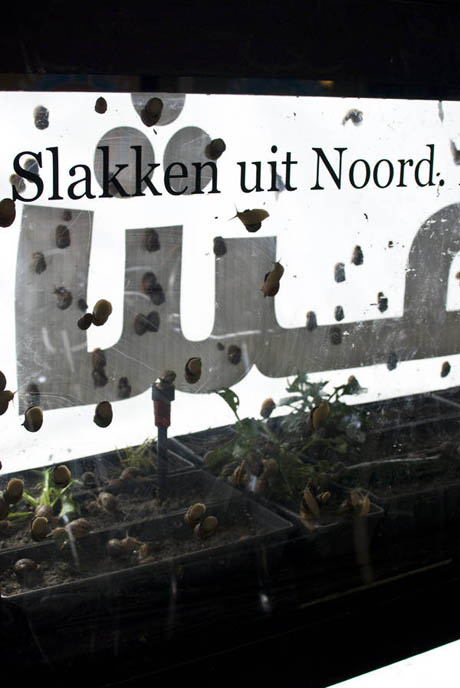
In any case, the idea behind using snails as an urban meat is because they don’t need horizontal grazing. They’re vertical animals; they’re upwardly mobile. Snails can navigate the vertical surfaces that make up our urban context.
BERJAYA

IMAGE: Wietske Maas’ “Snail Farm” via Mediamatic.

Unfortunately, urban agriculture is plagued by the most ridiculous ideas. The idea of vertical farm skyscrapers, where we take the most expensive genre of structures we’ve ever created as a species, and imagine that we can build them to grow carrots and tomatoes… it just doesn’t even begin to be feasible. I get so cranky because it misses the point completely — which is that, opportunistically, we do have a lot of vertical space,  so how do we inexpensively and effectively integrate vegetation and food production into that existing infrastructure?

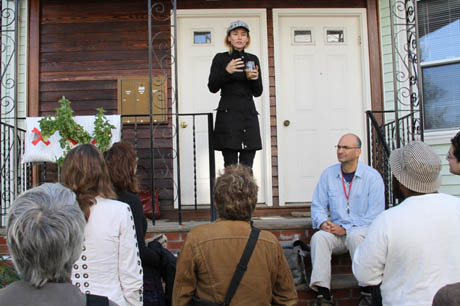
At the xDesign Environmental Health Clinic, we’ve been doing a clinical trial of these AgBags that we’ve developed. Essentially, they are a Tyvek bag that hangs either side of a windowsill or railing, which has soil moisture retention and allows you to grow a number of different crops. We’ve been experimenting with potato / tomato plants and a couple of other things — nasturtiums are one of the things we’re trying, but there’s a bit of controversy about whether or not the snails really like the nasturtiums. They look beautiful in salads, though.
BERJAYA

IMAGE: Jeremijenko demonstrates an AgBag in Boston, via.

I’m trying to do a whole section of edible flowers, actually. I really like exposing the sexual organs of plants and eating them and understanding them. Nasturtiums also provide for a lot of insects and pollinators — they make a very evident display. We have some growing at NYU Housing on the fourteenth floor, and it’s amazing the insects you get up there.

But importantly, what the AgBags also do is create urban grazing. One of the interesting things I’ve learned is that most of the food in the world is still produced by small farmers, who grow grain as their primary crop, but then graze animals within that plot too. The farmers intentionally share between one to five percent of their crop with the animals. These methods of intensification are used all over the world, in the majority of global food production — in Indonesia, in Africa, and so on. The grain is shared between the humans and the animals, and then the animals are the insurance for crop failure.

BERJAYA

IMAGE: Michelle Obama digging a vegetable garden, via.

This whole problem of most urban agriculture, which can be summed up in that iconic image of the First Lady holding her seventeenth-century pitchfork in a vegetable garden, is that the Luddite rejection of any possible innovations or intensification just does not bode well for viable urban food production systems. I love community gardens, but they’re always under threat, they’re always oversubscribed — horizontal urban space is very contested, but vertical space is not.

The AgBag system is modular, so you can connect to your neighbours upstairs, downstairs, and sideways. It can sort of metastasize, and the more you have, the more effective the irrigation is — there’s a rain guide that goes between the two.

So they are a viable, cheap, parasitic, modular way to take advantage of existing uncontested space for food production — but you still have to find a way to intensify it. The snails are a viable way to incorporate intensification and meat production with vertical grazing. In other words, with an AgBag, you’re both growing plant-derived food and providing the optimal habitat for snails, because of the moisture retention and the design, but also because you share some of the crop with them.
BERJAYA

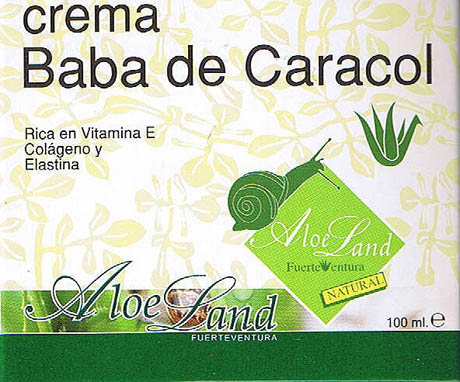
IMAGE: Spanish snail-slime cream, via.

The other interesting thing about snails is that you can milk them. There are actually a number of very expensive snail-slime face creams on the market. They take snails and agitate them and then they use the slime as the major component of these collagen-building, anti-oxidant-rich creams. That’s a very high-end product that you can get from the snail, with minimal effort — but that’s still not enough. We wanted to find a way of actually making urban agriculture pay for itself.

So what we’ve done with the clinical trial that we’ve launched is a package that has the AgBag in it, the snails, the plants, and these Brinno cameras, so that you get a timelapse of the snails. It translates their daily activity into a minute of footage, which just becomes fascinating, because they’re such extraordinary creatures with an incredible sensuality. You see love triangle dramas, you see them wrestling each other — you see a whole soap opera of entertainment going on.

That’s another layer of added value, but then to really monetise it we also superglue RFID tags on the snails that we issue to people. We’ve put an RFID reader at the bottom of the fourteenth and seventeenth floor sites that we are currently testing. We release the snails at the bottom and they make their way up to the top, and we take wagers on which snails are going to win. It’s sort of like horse-racing, where the bet-making is the thing that drives the industry.

Edible Geography: Of course — the gambling industry is much more lucrative than farming!

Natalie Jeremijenko: Yes, exactly. So we’ve created this very fun thing — we get daily and weekly updates on the great snail races, and we announce the winners, and so on. And then, of course, that poses a really interesting systems problem, which is if you have this performance information on the snails, do you eat the slow ones or do you eat the fast ones? Are we setting up a system where we have the synthetic evolution of faster snails?

It’s like the Olympic Village effect you see with cane toads. It’s really remarkably evident in the moving front of invasive cane toads in Queensland, where I come from. There are the cane toads that are happy where there are, and then there are the ones that are pushed out and are finding new territory, at the front. Of course, the ones that are moving and hopping are interbreeding, so the moving front is now something like three times faster than the cane toads that are not territorially advancing. They’ve got longer legs and larger muscles — it’s like the Olympic Village interbreeding to create these hyper-performing, extraordinarily fast, super cane toads.

I think I’m alone in this debate on the side of wanting to breed the fast snails.
BERJAYA

Edible Geography: Surely the fast ones would have more lean muscle mass to eat?

Natalie Jeremijenko: Well, yes — and we could market the Manhattan snail variety, sped up for life in the fast lane!

It is also just really interesting to me that snails challenge our time frame — they challenge our ability to perceive and recognise complex adaptive systems.

In any case, this particular experiment in snail agriculture is both an experiment in intensification and diversification and an attempt at improving environmental health. It starts to articulate what these new urban food systems could look like — but it rests very critically on branding these new and novel foods as delicious and desirable. Frankly, when I start talking to people about snail meat, most people say “ugh” — it’s not really something that most people associate with deliciousness. For lots of people, it’s associated with bad cafés in Paris on package tours, and lots of oil and butter and so on, rather than with these extraordinarily pleasurable creatures that lead epic, dramatic lives that you can review in a minute each day.

Edible Geography: And yet Mihir said you didn’t eat the snails…

Natalie Jeremijenko: Ah. Yes. This was a test of the concept of a vegan meat, as I said. And actually, everyone did eat the snails, except for me. I’m just so attached to them at this point.

In any case, the snails are a really big experiment for us, and so that was one of the things we were showcasing alongside the oil spill and wetlands theme.
BERJAYA

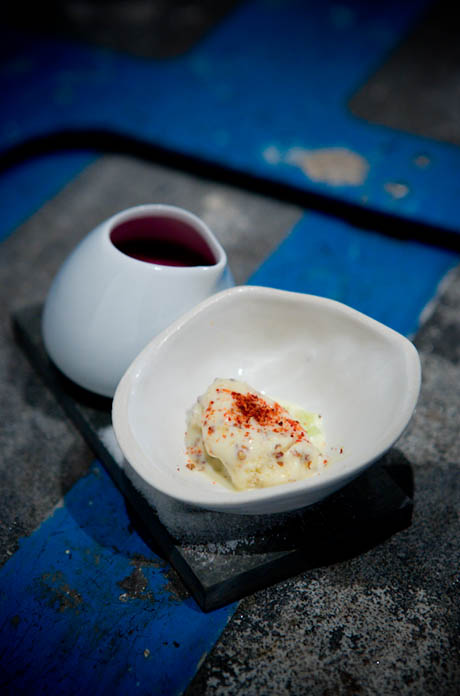
Mihir Desai: Flavour-wise, this snail course was a take on the classic sausage and sauerkraut food pairing. The mustard was a Dijon ice cream, which was made with nitrogen, the sauerkraut was a cabbage gazpacho, and the snails were served in a fricassée with Brussels sprouts and brown mushrooms. I really liked the plating of this one: we had it on slate, and the snails were on the right. Emilie Baltz made porcelain bowls out of gas masks, right after the first SARS thing, and they’re beautiful — she had something like 150 of them on the wall as an installation. But we’ve been using them as soup bowls. So we had the ice cream in the bowl and then a pitcher of the gazpacho for people to pour around it.

It was also a way for Natalie to talk about her air quality work, because of the gas masks. Ideally, I wanted to make that aspect more obvious by smoking the snails, but one of the plating service pieces didn’t make it up to the museum. We were going to serve the fricassée under a cloche that would have been pumped with a flavoured air, and people could have opened the cloche at the table.

With the snails, we served the Cour-Cheverny, which is a highly acidic wine from the Loire Valley. It’s really interesting because the grape that it’s made from, the Romorantin grape, nearly went extinct in the 1980s — there were no significant wines being made from it and all the vines were dying. Then, in the early nineties, a bunch of French vintners got together and decided to make this new appellation to save that grape. It’s 100% Romorantin grapes, it’s a phenomenal wine, and actually in the late nineties they even achieved AOC status.

Edible Geography: That example of a successful revival makes it a good match for the snails, which also need to be rebranded.

Mihir Desai: Exactly. And it’s highly acidic, so it goes well with the sour of the cabbage too.

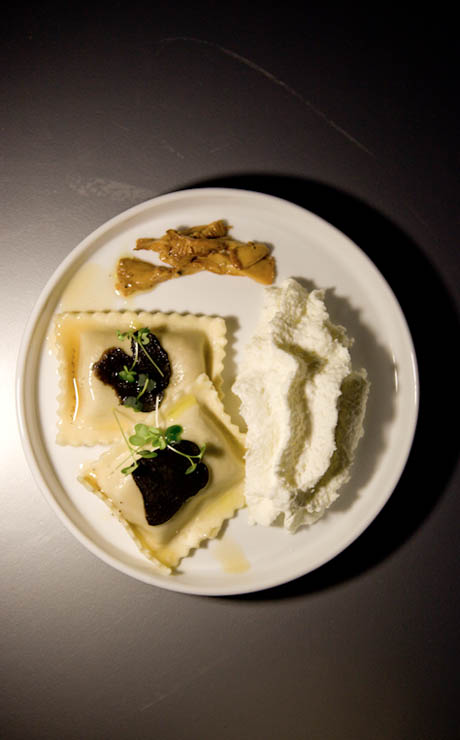
The next course had an earthy theme. This was probably the most popular course in terms of flavour. There was a ravioli of gorgonzola and walnut, and atop that we put black truffle slices. The shallots were on the side with a parmesan foam and a basil sauce.
BERJAYA

Natalie Jeremijenko: There are a lot of people doing interesting work on myco-remediation — for example, Phil Ross. I’m also interested in foraging versus cultivation — foraging is extractive, and I’m interested in changing foraging practices into cultivation practices. That’s the research direction we’re going in with truffles, to try to get to the point where you’re cultivating the larger ecosystem as opposed to trying to monoculture the particular fruiting body of the truffle. But that’s a longer story and much less developed than some of our other projects.

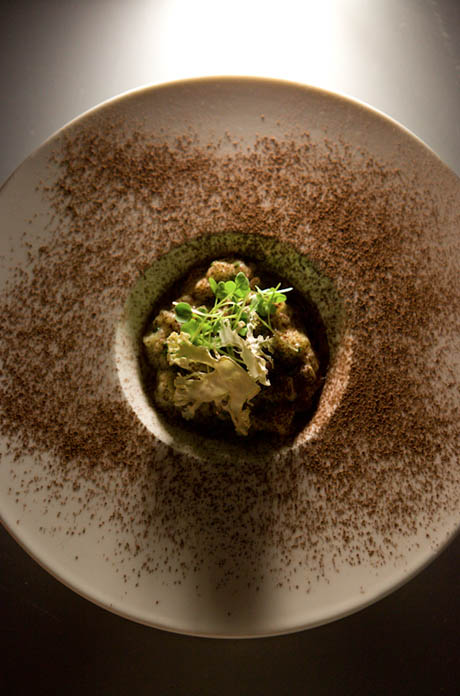
Mihir Desai: The cocoa and cauliflower course was based on a Heston Blumenthal pairing. A few years ago, Blumenthal went round his kitchen and tried different ingredients, just to see if he could find new pairings. One of the ones that worked best was white chocolate and caviar, which is in fact an amazing pairing. He also sent away something on the order of six or seven hundred food products to a local chemistry lab, and they ran all these chemical tests to find out what the olfactory compounds were. White chocolate and caviar, it turns out, actually have very similar profiles. Now there’s this database with ten thousand different profiles, but a university owns it and access to it is something like eight or nine thousand dollars. Nonetheless, a few profiles have leaked out and there are some smaller lists that are available, and one of the more unusual pairings is cocoa and cauliflower.

In this case, the cauliflower was in a bunch of different forms. It was in a velouté of cauliflower, and a cauliflower risotto, which we made with cauliflower stock and cauliflower cream with dehydrated cauliflower on top. There were also slices of the cauliflower stock, and atop we sprinkled cocoa dust.
BERJAYA

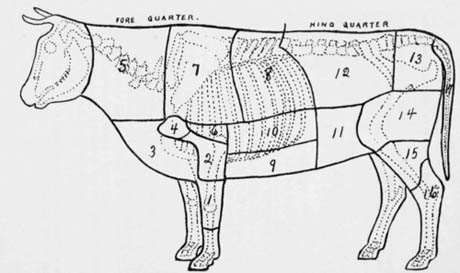
One of the things that we wanted to do at this dinner, but weren’t able to because our circulator is still on order, was serve offcuts. The one that I know most well is an under shoulder cut. Traditionally, butchers just threw it out because it’s too hard to separate and then market it, and anyway, no one knew how to cook it. But at Dickson’s Farmstand, in Chelsea Market in New York, there’s a very young, brash butcher who’s very much into these alternative things and he started selling it.

We worked on it for a couple of months to try to cook it well, and it turns out that if you circulate it at a really low temperature, it’s actually as tender, if not more tender, than filet. It’s super juicy — it’s very hard to make it unjuicy — and it’s ridiculously cheap. At one of my dinners we served it with filet side-by-side, and people could not tell the difference. This is a cut that the beef industry in the last year has decided to re-market as a wonder meat, but for decades it’s just been discarded.

There are ways to get around not having a circulator, but they’re not going to be as exact. One of the wonders of a circulator is that you can cook meat at very precise temperatures to get to certain textures that you could never get to before. For instance, salmon has this cooked state that actually tastes as if it’s raw, even though it’s completely cooked through. That’s something you could only achieve with a very exacting circulator.
BERJAYA

IMAGE: Diagram of beef showing principal cuts, via.

Edible Geography: How does the industry recommend that people prepare this under shoulder cut?

Mihir Desai: By grilling, which leaves it a little tough. I think generally they recommend overcooking it and then shredding it, kind of like a fajita. But it’s a really good piece of meat, so I don’t know why you’d want to do that.

We were running short of time, so we also didn’t do the make-your-own oil spill, unfortunately. It was intended a palate cleanser to be served before dessert. We had a strict curfew with the gallery.

It was going to be a lemon gelatin with a black oil that was made from currants that was to be served on the side. Then there was also a little iceberg that was made from vacuumed coconut milk — you put the coconut milk in a siphon, then you vacuum it to make it rise and expand the bubbles that the siphon put in, and then you freeze it so it’s basically this bubbly mass of white, which we shaped into an iceberg.

Natalie Jeremijenko: But at the dinner we also launched our prescriptions for water buffalo ice-cream subscriptions.

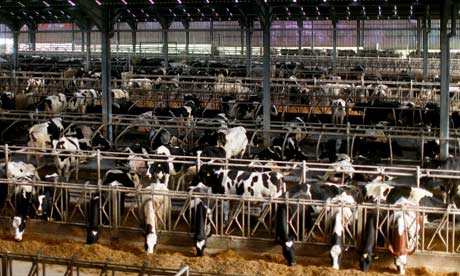
These came out of another piece in the exhibition: the “How Stuff Is Made And How It Can Change” encyclopedia. All of my students at NYU have to trace one product all the way through the manufacturing process, and then offer a viable innovation to improve any or all aspects of the production system. One of my students studied Ben and Jerry’s ice-cream, and looking at the dairy industry is just an extraordinary adventure. There are the same number of cows in the U.S. now as there were in the twenties, but each cow produces ten times more milk. It’s just an incredible measure of the force of industrialisation.

While the really large dairy producers are out in California, more than a quarter of the milk produced in this country comes from Vermont and its immediate neighbours. Within that landscape, Ben & Jerry’s is a progressive front for Unilever, who bought them a few years ago. Unilever is continuing a lot of the things that Ben & Jerry’s had originally done to use ice-cream as a medium for social ventures. But now it’s actually Unilever behind the brand, and looking at their operations — it’s shocking.
BERJAYA

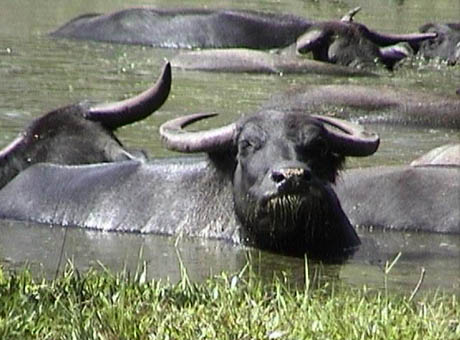
IMAGE: Water buffaloes, via Wikipedia.

In any case, the intervention we came up with was to suggest to Ben & Jerry’s that they develop and market a line of water buffalo ice-cream. On display in the exhibition is a letter from my student, saying “Here’s the recipe we’ve developed, and here’s the comparison between water buffalo milk and other milk — seal milk and elephant milk and human milk and cow milk and so on.”

It’s a very interesting comparison. Water buffalo milk is actually the milk of choice in buffalo ricotta. Apparently the Romans brought over water buffalo from India and knew that the luxury, creaminess, and high-protein, high-fat content of water buffalo milk makes for the best ricotta.

Our idea is that making a delicious water buffalo ice-cream line creates the demand to farm this animal, and, in turn, water buffalo have ecological demands, which include wetlands. They require wetland grazing. That’s actually part of why their milk is so rich — because wetlands produce so much more biomass by area. And, of course, wetlands are one of the ways that we can treat some of the range of horrible environmental complications that the dairy industry produces.
BERJAYA

IMAGE: Industrial dairy farm. Photo by Graeme Robertson for The Guardian, via.

In the first place, there are water usage issues: there are some estimates that it takes between seven and fourteen cups of water for every cup of milk produced in the dairy industry. Then there is run-off from the sprayed fields and the cesspools. The cheap, ubiquitously available, and effective way of dealing with that is to create constructed wetlands. Most people don’t realise that the processes used in water treatment facilities are simply simulated wetland technologies, deprived of much of their effectiveness and biodiversity.

In any case, wetlands are simply an extremely useful ecosystem for sequestering carbon dioxide, protecting the aquatic ecosystem, and recapturing nutrients before we lose them and create big algae blooms in marine ecosystems instead. Around California and Vermont — both big dairy states — and other places where there are shallow aquifers, the wetlands also infiltrate and recharge the aquifers. They do all these good things that we need them to do.

By creating a prescription for water buffalo ice-cream, we’re creating a demand to diversify the dairy industry and to create a system where an infrastructure of wetlands is actually constructed to provide water buffalo grazing for each of the dairy production facilities and to deal with the ecological waste that dairy farming produces. It produces more milk for the farmer and gives them another market, and then it also addresses the regulatory compliance issues associated with conventional dairy production. We’ve been asking Ben & Jerry’s to take this on as their next progressive thing, and to use this to influence Unilever.

Of course, this whole idea hinges on creating an extremely delicious ice-cream. We’ve actually used the liquid nitrogen method to create nano-crystals, so we call it nano water buffalo ice-cream, to get that extra smoothness that, I think, amplifies the creaminess of the water buffalo milk.

Edible Geography: Have Ben & Jerry’s responded with any interest?

Natalie Jeremijenko: This is something we’ve done a lot of work on, actually. I’ve been meeting with Unilever in the UK, and also Fonterra, who have asked for another report from us on it, which I’m working on right now. So they’re interested. We’ve had a student up in Vermont all summer — she’s actually from the area, and she’s been fantastic. We’ve actually met with many of the dairy farmers from the collective that supplies Ben & Jerry’s. Trying to convince them to take on another type of milk is, naturally, quite difficult. The farmers are very funny — we’ve had these beautiful conversations where they start by saying “What the …? What on earth are you talking about?”

From talking to them, where we’re at now is the idea that we buy the buffalo and actually get urban support for people to own the buffalo that the farmers will house, so that the farmers can toy with the idea of working with these animals without taking on all the risk.

Edible Geography: It’s sort of like a CSA system for water buffaloes.

Natalie Jeremijenko: Exactly. But it starts off by demonstrating that there is interest and by creating the demand with this prescription subscription, where we’re asking people to sign up to receive a different flavour every month. We have a small-scale source of water buffalo ice-cream to start with, just to get the ball rolling.

It’s precisely because Unilever uses the Ben & Jerry’s brand to hide an extraordinary amount of very unprogressive practices that there’s an Achilles heel that we can use to get in and influence a huge corporation. To have Fonterra, the biggest dairy producers in the world, asking for a report on water buffalo is pretty exciting.

The charge of the Cross(x)Species Adventure Club is to explore new food and food systems that will improve environmental health and augment biodiversity. With the snails, the water buffalo ice-cream, and the bio-augmentation with the lividium bacteria — these are the kinds of projects where we’re really getting some leverage.

Edible Geography: What role do the techniques of molecular gastronomy play in achieving the goals of the Cross(x)Species Dinners? What’s the connection?

Natalie Jeremijenko: In molecular gastronomy, you really focus on the cooking and food processes, and those are often very similar, in micro form, to ecological processes. With oil, the emulsification variations at different oil/water balances is very interesting, and this is where the entire palette of texture — the foams and gels and ice-creams and fluid gels — of molecular gastronomy — is so important.

Mihir Desai: Texture is one of the primary reasons to do most of this stuff. Some of the food combinations are new, but the vast majority are old and have been done so often that one way to make them new again is to change the textures of things and make them unexpected. I really like doing dishes that are just the textures of a single ingredient, so you get it in six or seven different forms. Each different chemical or process enhances a certain aspect of the ingredient and you get a better appreciation of the thing as a whole.

Coupled with that is an idea of the purity of the product. For instance, if you want to make a puree, instead of doing it the old-school way where you stew whatever thing it is in either cream or stock for a long time, which dilutes the flavour, there are a lot of purer ways to get that flavour out. For example, a really easy way to make a puree of any vegetable at home is to juice it, and then put the juice in a blender with xanthan gum. Xanthan has been around forever — it’s basically sap from a tree — and it will thicken any liquid into a puree. You can thicken it as much as you want, even up to the point where it’s more solid than Jello. We did that for the cauliflower, so that all you have is cauliflower — there’s no fat to mask the flavour or stock to dilute it. There are many other techniques like that, that allow you to extract pure flavour.

BERJAYA

Natalie Jeremijenko: I also think there’s something to the idea that the complexity of the tastes that people are experiencing makes them open to hearing about these complex systems and processes that they would otherwise not be motivated to hear.

The take-home message about why we want to augment biodiversity and improve environmental health is quite simply that biodiversity tastes really good. As a paradigm, it has an emotionally vivid value that you can’t quantify. All of the environmental groups really struggle with quantifying the value of biodiversity. It’s very hard to measure the value of biodiversity when it comes up against how many jobs a strip-mining operation will create or how much power and economic stimulation another hydro-dam project will create.

That’s what I think is most successful about the Cross(x)Species Adventure Club dinners as a medium, is that people really understand the importance of biodiversity when the intensity, and the complexity, and the sheer thrill of the food that they’re eating makes it so available in ways that you can never quite articulate otherwise.

Mihir Desai: I’ve been working with Natalie on these Cross(x)Species dinners for a little under a year. One of the reasons her work appeals to me so much, and these dinners appeal to me so much, is that for both of us, the food is not the end point. Food is simply a starting point — in this case, for an amazing conversation about environmental health and systems.

Posted in Interviews, Uncategorized | 1 Comment

Foodprinting: Denver & L.A.

BERJAYA

IMAGE: Cilantro harvested in Watts, photo part of a set taken by D C Anstett.

A couple of quick Foodprint Project announcements: first of all, if you’re in Los Angeles this Thursday, October 28, I’ll be participating in an evening of conversation entitled “Why is L.A. a Hungry City?” at the American Institute of Architects’ Los Angeles chapter. I’ll be joined by cooking consultant and activist Shelley Marks and architect Michael Pinto, who will be talking about their work integrating urban agriculture into the city.

BERJAYA

IMAGE: Fallen Fruit maps Los Angeles in terms of its fruit resources.

I’m really looking forward to hearing more about Marks’ work with her group, the Urban Farming Advocates, to redesign Los Angeles as a productive landscape using zoning revisions and legislative repeal — especially the awesomely named Food and Flowers Freedom Act of 2010.

Pinto, meanwhile, founded Project Food LA to understand the infrastructural causes of food deserts. He will, I hope, discuss his speculative proposals for Mudtown Farms community garden in Watts to demonstrate how architects can use food as the basis from which to design a built environment that promotes healthy lifestyles, provides jobs, and creates community.

BERJAYA

IMAGE: From the Good Food For All Agenda, a report of the Los Angeles Food Policy Task Force.

I will be adding a short presentation to the mix, introducing the Foodprint Project as an investigation into the ways two complex systems — a city and its food — overlap and shape each other.

Most often that interaction happens in unrecognised and even unplanned ways, but, on closer examination, these intersections frequently form the most effective places for designers, businesses, urban planners, and activists to intervene. Foodprint Project conversations, both in terms of the themes and the multi-disciplinary participants, are all about uncovering the design implications and potential within that overlap.

In addition to reporting back on the Foodprint Project’s findings thus far, I’ll be asking for input as Sarah Rich and I start to shape a conversation that is important for LA, and I’d really love to hear your thoughts. Admission is free (RSVP to Will Wright if you think you can make it), and the event runs from 7:00 – 9:00 p.m. at the AIA Los Angeles, which is in the Wiltern building (the address is 3780 Wilshire Blvd., Suite 800, Los Angeles, CA 90010; parking is validated, and there’s a map here).

BERJAYA

IMAGE: Foodprint Denver’s logo was designed by the super-talented and awesome Nikki Hiatt.

Secondly, I’m thrilled to announce Foodprint Denver: Art Meat City, a conversation about the ways that meat shapes and is shaped by Denver’s urban environment and agricultural surroundings, from muscle architecture to prairie ecology, via slaughterhouse design and steakhouse culture.

BERJAYA

IMAGE: Angus beef, according to the Beef Checkoff program.

Sarah and I were delighted to be invited to organise this meat-centric version of Foodprint in Denver as part of ART MEETS BEAST, a three-day nose-to-tail whole bison roast accompanied by music, lectures, and performances at the Denver Museum of Contemporary Art. It will take place from 4:00 – 6:00 p.m. on Thursday, November 11, and there are many more details on our (awesome) speakers and updated conversation format to come — but if you’re in or near Denver, be sure to save the date!

Posted in Uncategorized | Leave a comment

Cake Criminals

BERJAYA

IMAGE: Cake, reformatted by Danklhampel, image via Strange Harvest.

In the first decade of the twentieth century, Austrian architect Adolf Loos boldly proclaimed, “The evolution of culture marches with the elimination of ornament from useful objects.” Frills and ruffles, cornices and entablature, even iced gingerbread — all these decorations could, in his view, be blamed for keeping human civilisation trapped in a wasteful cycle of obsolescence.

Ornamented objects last less time in aesthetic terms than they do physically, Loos explained in his 1908 polemic, “Ornament and Crime,” and thus represent “a crime against the national economy,” not to mention “wasted manpower” and “ruined materials.” Fashionable evening dresses, decorative cabinetry, and carrots, if subjected to fancy recipes involving honey and nuts — for Loos, they were all regressive distractions, unworthy of a culture that also contained Beethoven and Wagner. The inventions of the truly “modern man” are, according to Loos’ lofty final words on the subject, “concentrated on other things.”

What, then, of those crafts whose sole purpose is ornamental? Food, hair, and skin are undoubtedly functional, but cake decorators, hairstylists, and tattoo artists are, by Loosian definition, design criminals. Architect Sam Jacob asked a new generation of Austrian designers to engage with these degenerative arts; their playful yet thought-provoking projects are on display at Vienna’s MAK museum until November 14.

BERJAYA

IMAGE: Pastillage, a decorative sugar technique more commonly found on wedding cakes, was used by Practice and Theory to create the wall text for the Design Criminals exhibition, image via Strange Harvest.

Type designers Practice and Theory reinvented pastillage, scaling up traditional sugar sculpture techniques to create the wall text and graphic communications for the entire exhibition. The tactile white ephemerality of their iced lettering actually appears far better suited to its function than the vinyl cut-outs usually applied to and removed from museum walls for each new show.

BERJAYA

IMAGE: Not related at all, but this poster by Practice and Theory, designed to celebrate the word “‘caliginosity,’ meaning ‘dimness,’ ‘darkness,’ one last time before it got deleted from the dictionary,” is too wonderful not to include in this post.

Mischer’Traxler, whose gorgeous Reversed Volumes appeared on Edible Geography earlier this year, created a cake-decorating machine that allows each visitor to choose the amount of ornament they wish to apply to their cake. The machine is part of their “Till You Stop” series, an ingenious new method of manufacture that blends automated processes with customer input to create unique products on a mechanical line.

It also, write the designers, “forces people to think about the amount of decoration they actually like.”

BERJAYA

IMAGE: Mischer’Traxler’s “Till You Stop” cake-decorating machine. Image via Dezeen.

BERJAYA

IMAGE: Sketch by Mischler’Traxler for their cake-decorating machine, image via Dezeen.

Will the exhibition visitors ultimately achieve enlightenment, and eschew pink icing and silver baubles altogether? On the evidence so far, it seems not — but by comparing differently decorated cakes side-by-side, Misher’Traxler’s installation does demonstrate the arbitrary nature of ornament and style.

BERJAYA

IMAGE: Maria P. with her choice of criminal ornament, image via Strange Harvest.

BERJAYA

IMAGE: Does using less icing on her cake make this woman less of a criminal? Image via Dezeen.

BERJAYA

IMAGE: Mischer’Traxler-induced cake-decoration variation, image via Dezeen.

Finally, Loos himself might be proud of Danklhampel’s contribution to the show. Their baking tin removes the need for icing altogether, reformatting cake into an eye-catching collage that also happens to encode a “participatory social action plan.”

In a lovely example of form following function, different-sized portions of different cake mixtures are thus arranged to both create their own surface ornament and invite us to re-imagine how we serve, share, and eat this staple food of celebratory ritual.

BERJAYA

IMAGE: Danklhampel’s cake tin redesign, image via Strange Harvest.

For more Loosian design crimes, including tattoos and braids, visit MAK Vienna before November 14, and/or read curator Sam Jacob’s post on the subject on his excellent blog, Strange Harvest.

Posted in Uncategorized | 2 Comments

Landgrab!

Over at the Glass House Conversations website, BLDGBLOG’s Geoff Manaugh has posed an interesting question, inviting speculation on the opportunities and pitfalls that might emerge as twenty-first century cities flex their geopolitical muscles in an increasingly urban world. The responses thus far are fascinating, with casual yet mind-blowing references to the unifying powers of sewage systems and the ways in which capital markets redefine perceptions of both time and geography.

BERJAYA

IMAGE: Nanshan district central square, Shenzhen, before Landgrab City’s installation. All photos and images courtesy Joseph Grima, unless otherwise attributed.

BERJAYA

IMAGE: Landgrab City installed as part of the 2009 Shenzhen-Hong Kong Architecture and Urbanism Biennale.

Reflecting on this question has also prompted me to post about another wonderful project from the 2009 Shenzhen-Hong Kong Architecture and Urbanism Biennale: Landgrab City by Joseph Grima and Jeffrey Johnson with José Esparza.

Their installation consisted of a “decent-sized field” of roughly 750 sq. metres, Grima explained, placed in the middle of a large and relatively featureless concrete plaza in one of Shenzhen’s busiest shopping areas. Within the field, small plots contained potatoes, cabbages, and banana trees, all carefully planted and tended by one Mr. Yang, “who runs a landscaping firm” in the city.

BERJAYA

IMAGE: Mr. Yang, who was responsible for almost all aspects of planting and growing the crops in Landgrab City.

But, despite its bucolic appearance, Grima is quick to point out that “this project doesn’t belong in the category of ‘urban farming’ proposals.” Instead, “it’s simply an attempt to portray, in the most comprehensible and unequivocal manner we could think of, the extent of the city’s true spatial footprint, a concept that is generally pretty alien to its inhabitants.”

In other words, in Landgrab City, Grima, Johnson, and Esparza have created an accurate scale model of how much farmland it actually takes to feed the city of Shenzhen, rather than a 3D billboard for the benefits of urban agriculture along the lines of San Francisco City Hall’s Victory Garden. (In fact, seeing the sheer quantity of agricultural land required to fulfil the city’s dietary needs might somewhat dampen the spirits of those urban farmers who cherish idealistic visions of self-sufficiency.)

In one corner of the field, a 30 metre² satellite photo of Shenzhen represents the city’s estimated geographic footprint in 2027, based on population growth predictions. The date was chosen because 2027 is the year China is expected to overtake the US as the world’s leading economy.

BERJAYA

IMAGE: On top of Shenzhen, in Landgrab City. According to Grima, the installation “seemed to be particularly popular among parents with small children — you’d often see young mothers and fathers pointing to the different plants. Since Shenzhen underwent explosive growth in recent decades, many of the city’s inhabitants were probably born or grew up in the countryside, and are probably quite familiar with these plants. Their children, however, are born in the city and have likely never seen a tomato plant or a potato growing in the ground — so the installation has become a kind of involuntary botanical gardens destination within the neighbourhood. Another unexpected and amusing phenomenon illustrates the Chinese relationship with green space within the city. Anything that is green seems to be perceived as a latrine of sorts, and on several occasions we saw parents encouraging small children to relieve themselves on the plants. They probably thought they were contributing to the cause through fertilization.”

BERJAYA

IMAGE: An aerial view of Landgrab City.

But although it is spectacularly large, this photo only occupies four percent of the field. The other ninety-six percent is divided into carefully calculated plots filled with different types of crops and pasturage. The exact size of each plot is based on how much land it will take to grow the volume of each type of food consumed by the people of Shenzhen in 2027.

For example, 129 m² or about eighteen percent of the total installation is devoted to growing fruit, including apples, mandarin oranges, bananas, and grapes. Another 105 m², or 14.5%, represents the livestock pasturage required to put beef, butter, lamb, and goat onto plates throughout the future city.

BERJAYA

IMAGE: Diagram of plot subdivisions from the Landgrab City proposal.

BERJAYA

IMAGE: Mandarin oranges growing in Landgrab City.

What this means, then, is for every square metre of “actual” city, the Shenzhen of 2027 will require twenty-four square metres of farmland. Just to give a sense of the scale this implies: to feed a single Chinese city that is 2,050 km² (Shenzhen’s current geographic area, according to Wikipedia), according to these calculations, you would have to devote every single square metre of an area of land the size of, say, The Netherlands and Cyprus combined, entirely to agricultural production.

The process of generating these numbers was one of the most interesting aspects of the project:

José [Esparza] created an incredible spreadsheet into which data for any city can be inserted and the extent of the city’s footprint (divided by crop type) is instantly crunched. All sorts of variables are taken into account, and most of these are available on the FAO’s website and other UN sources: not just quantities of food consumed, but also fertility coefficients (how much land is needed in a given climate to grow a tonne of a certain crop), and consumption patterns in the city as opposed to the countryside.

BERJAYA

IMAGE: Pasture in Landgrab City.

Of course, as Grima is quick to point out, the figures generated by this agricultural footprint calculator are extrapolations based on predictions, and thus are “probably only accurate to within +/-15%.” The larger point of the exercise, though — re-imagining the geographic footprint of the city to include its agricultural hinterland — is not only valid but also incredibly interesting, particularly when considered within the context of two twenty-first-century geopolitical trends.

One of these, as implied at the start of this post, is that during first decade of this century, humanity passed a tipping point, becoming a majority urban species for the first time in our history. According to United Nations estimates, just over half of the world’s population lives in a city right now, a proportion that is expected to increase to two-thirds by 2050.

Such a shift in scale naturally creates new challenges and opportunities, prompting an evolution in our understanding of what cities can do, how they should be defined, and, in turn, how they relate not only to each other but to national governments, transnational corporations, and the countryside around them.

BERJAYA

IMAGE: Landgrab City, showing crop subdivisions.

The other geopolitical trend, as referenced in the title of Grima’s installation, is the global landgrab phenomenon: the flurry of transactions in which nations and corporations have purchased large chunks of arable land overseas during the last couple of years.

Although landgrabbing itself is nothing new — think of the Roman Empire, Columbus and the New World, or the Great Powers’ scramble for Africa — its recent popularity as a legitimate financial investment has resulted in a stream of newsprint, scholarly analysis, and reports on the subject.

The logic of stealing land is at least familiar, but what does it mean for a country or — more bizarre yet — a hedge fund to buy and own hundreds or thousands of hectares of another nation state’s territory?

BERJAYA

IMAGE: Model of Landgrab City, illustrating the overseas sources of Shenzhen’s food supply.

For example, one of the most widely reported (although ultimately unsuccessful) landgrab examples was Daewoo’s attempt to purchase a ninety-nine-year lease to grow corn and other crops on 1.3 million hectares of farmland in Madagascar — half the country’s total arable land. The 2008 deal was initially seen as quite a coup for the South Korean company, with spokesman Hong Jong-wan boasting to the Financial Times that “food can be a weapon in this world,” and explaining that Daewoo could “either export the harvests to other countries or ship them back to Korea in case of a food crisis.”

Meanwhile, the U.N.’s World Food Programme actually runs school-feeding schemes for children in Madagascar, where a seventy-percent poverty rate creates hunger and nutritional deficits. The resulting popular protests eventually forced the Malagasy president from office, and his successor cancelled the deal.

But a curious and telling detail, as reported by Joseph Grima, is that “had the the deal gone ahead, Daewoo would have paid no importation tax to bring the rice grown in Madagascar back into South Korea, meaning that it is effectively considered “internal production.”

South Korea was not simply outsourcing its food production (which it already does, importing at least fifty percent of its food supply); instead, it was redefining its national territory to include the agricultural prostheses on which its people depend.

BERJAYA

IMAGE: Graph showing key commodity prices correlated with media reports on the landgrab phenomenon, from a World Bank report on the subject issued last month.

Most aspects of the landgrab phenomenon are fascinating, from the sheer scale of the deals (the World Bank, which issued its own report on the subject just last month, reckons that “45 million hectares’ worth of large scale farmland deals were announced” before the end of 2009), their varied motivations (from water-starved Gulf states looking to secure their food future in a post-oil world to Wall Street investors — including Warren Buffet — hedging against inflation), and the equally diverse responses they have provoked, with some commenters welcoming the investment as a new Green Revolution, and other labeling them as neocolonialist exploitation in development’s clothing.

But perhaps the most interesting possibility embedded within these land acquisitions is a wholescale renegotiation of the relationship between the urban and rural — between metropolitan regions and their agricultural hinterlands.

BERJAYA

IMAGE: Starchy roots growing in Landgrab City.

Cities have always been just “the tip of an alimentary iceberg,” as Joseph Grima puts it, dependent originally on their immediate surroundings, and more recently, on a dynamic and largely invisible global network of interchangeable industrial farms, refrigerated warehouses, and cargo containers. Seen in this light, China’s purchase of arable acreage in Mozambique and the Sudan are a phase change — they solidify and stabilise a relationship that previously only existed as a transitory manifestation of capital’s ebb and flow.

Suddenly, Shenzhen’s ties to the farmland that supports it are more tangible than they have been in centuries — even though that land is hundreds of thousands of miles away.

BERJAYA

IMAGE: Maize was the largest crop by area planted in Landgrab City.

The brilliance behind Landgrab City is to combine these parallel renegotiations — the shifting definition of the city and the evolving relationship between urbanised nations and their agricultural supply chain — and frame their convergence as a possibility.

“What if a city were to be no longer considered a geographically discrete entity, distinct from the landscapes of agricultural production it relies upon?” asks Grima. “What if spatial disbelief were to be suspended and a new definition of the city were to emerge as a consequence of the permanent bonds that are being forged: the city redefined as a discontinuous international – or even intercontinental – archipelago of urban and rural territories?”

BERJAYA

IMAGE: Visiting Landgrab City.

Perhaps, suggests Grima, the landgrab phenomenon, by defining the geographical limits and economic importance of farmland, could actually provide the first step in forging a new relationship in which an increasingly urban world recognises its dependence on a vast agricultural hinterland and thus its own interest in protecting that land’s productivity and environmental health.

In the same way that today’s global cities, large enough to have meaningful influence but politically and culturally discrete enough to define a strong identity, are attempting to set terms on the geopolitical stage, could the transactional frame of land acquisition provide rural areas with the territorial unity, political visibility, and economic leverage they need to establish their own interests?

Clearly, we are currently a long way away from achieving this holistic vision. Grima is clear-eyed, describing the majority of the landgrab transactions thus far “as a unmistakably hierarchical system of exploitation.” Nonetheless, this is exactly the moment — when the default notion of a city and its supply networks are already in flux — to propose a more sustainable alternative.

BERJAYA

IMAGE: Visiting Landgrab City.

In this context, Landgrab City is both more than a reminder of an invisible agricultural footprint and less than geopolitical manifesto. On its own, it does not attempt to propose how such a rural-urban partnership might work, politically, economically, or socially — but it does offer an inspiring call to anyone interested in cities and food to seize the moment and propose a better framework within which to negotiate that partnership.

[NOTE: If you'd like to add your thoughts on this issue to the Glass House Conversation (as well as in the comments here!), you only have a few hours left to do so: the Glass House comments close at 8:00 p.m. EST tonight, although they will continue to be available to read after that.]

Posted in Uncategorized | 4 Comments