close
The Wayback Machine - https://web.archive.org/web/20101007070600/http://mountainrunner.us/reports/think_tank/

Recently in Think Tank Category

Recommended reading from the smart people at Arizona's State University's Consortium for Strategic Communication comes "Out of Their Heads and Into Their Conversation: Countering Extremist Ideology" (PDF, 214kb).

Ideology is often ignored or deemed irrelevant to strategic communication because it is an old, possibly leftist, idea that is associated with academic social critique. It is treated as something that lives in the heads of individuals, driving them to radical action. From this point of view the concept is not really practical because by the time someone has adopted an ideology, it is too late.

We advocate a different view of ideology, as a system of ideas about how things are or ought to be that circulates in social discourse. This is a more practical view because it treats ideology not as an idea stuck in someone's head, but as something that is subject to influence through strategic communication. To be effective in these efforts we must understand culture and narrative, and have a clear grasp of what ideology does.

Read the whole thing here.

A report worth reviewing from a June 2009 conference in England. Some interesting (good and bad) highlights:

RAND's Chris Paul just published must read report on strategic communication and public diplomacy, Whither Strategic Communication? A Survey of Current Proposals and Recommendations. There is a lot to cite in this report, but I'll just copy from the summary:

U.S. strategic communication and public diplomacy have been the targets of scathing criticism and proposals for overhaul since shortly after September 11, 2001. Proposals and recommendations abound, but many reform efforts have stumbled or have been plagued by false starts. Further contributing to this problem are the differences in terminology and approaches between the U.S. Department of State and U.S. Department of Defense, the two agencies with primary responsibility in this area. With the need for reform persisting and interest in this area continuing to grow, RAND elected to conduct a survey of existing reform and improvement proposals. The subsequent literature review and interviews with subject-matter experts exposed four core themes in these recommendations: a call for "leadership," demand for increased resources for strategic communication and public diplomacy, a call for a clear definition of an overall strategy, and the need for better coordination and organizational changes (or additions). The survey also includes a detailed discussion of several frequently appearing recommendations, including revised legislation, leveraging the private sector, the adoption of enterprise-level or whole-of-government solutions, better use of research, a greater focus on measurement, increased use of technology, training and education improvements, a quadrennial review of strategic communication and public diplomacy, and a review of international broadcasting.

By the way, as good as Steve's quick and dirty summary of reports on public diplomacy and strategic communication is, this does displace it as the best overview. However, Steve's is still required reading.

I contributed to and and am cited in this report.

A side note: I learned of its public availability through Twitter, specifically from China-based David Wolf through http://tweetree.com/PekingReview. Chris didn't know it was up either.

This report is required reading for anyone involved in public diplomacy and strategic communication.

Chris Paul is the author of the book Information Operations--Doctrine and Practice: A Reference Handbook and co-author of the RAND report Enlisting Madison Avenue: The Marketing Approach to Earning Popular Support in Theaters of Operation, as well as a swimmer, cyclist, and friend (with open invite to borrow the one of my bikes when he's in town... God knows I'm not riding them).

See also:

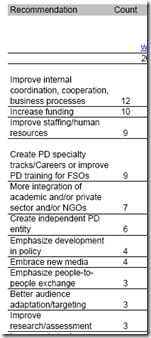
image GAO, CRS, academics, and anyone else interested in Public Diplomacy and Strategic Communication must look at Steve Corman's quick and dirty and most coherent summary ever of eighteen major public diplomacy reports from the most recent White Oak report back to a 2004 Brookings Report.

The raw numbers don't tell the complete the story, but that half or more of the reports shared four recommendations is significant.

Somebody, perhaps one of Steve's student's, should take this a step further: look at the reports' definition of public diplomacy and weigh the recommendations accordingly. Is Public Diplomacy an active component in the struggle of minds and wills using "fast" and "slow" communications or a passive informational tool primarily based on the "slow" communications of exchanges? 

Either way, Steve's analysis is unique and the top values are certainly common and yet elusive? Why? Because we had, until last year, no real understanding of the value of people to people engagement after we came out of thirty years of state on state diplomacy followed by the End of History. Congress is eager to help change the system and the Defense Department is eager to help, but will the system, now "owned" by President Obama and Secretary of State Clinton, be changed?

Engage

Who's Reading

Locations of visitors to this page
Map is refreshed daily, reset monthly, and does not capture all visitors.
Influence and Propaganda Conference