


The Economics of Ecology
Submitted by midtowng on Fri, 09/17/2010 - 22:16 The summer of 2002 was a drought year in the Klamath Basin.
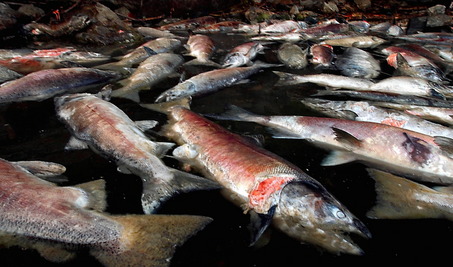
An estimated 70,000 salmon died that year after the Bush administration "ignored its own federal biologists and divert more water from the Klamath River for farm irrigation". According to documents, the decision was made because the farmers generally voted Republican. The Bush Administration then went on to order that water continue to be diverted for another eight years.
Only 24,000 fall chinook spawned naturally in the Klamath in 2004, followed by 27,000 last year.
The analysis from the U.S. Fish and Wildlife Service identified low water flows as a prime culprit in a major salmon kill on the Klamath River in 2002.
Because it takes several years for salmon to reach peak reproducing age, the effects of this huge fish-kill only started in 2005 when the National Marine Fisheries Service abbreviated the commercial salmon season. It cut the income of west coast fishermen "by 50 percent".
California and Oregon indian tribes, that have depended on salmon fishing for thousands of years, also had their fishing quotas cut back by as much as half.
It's easy to look at this example as an exception based on petty politics, but that would require you to overlook five centuries of political and economic policy.
- midtowng's blog
- 5 comments
- Read more
- 2 points
Major Site Administration News
Submitted by Robert Oak on Fri, 09/17/2010 - 00:11Folks, we are on a new server! Please leave a comment or email via the main contact form of any problems, page loads, access to your accounts.
Feedback on the new server as well as the site is greatly appreciated! We should now have the resources to make a lot of changes to the site itself.
If you can't get through at all, the gmail is oak.robert.
Below is the reason for the move. We're on a VPS with Wired Tree for all geek readers.
- 16 comments
- Read more
- 0 points
HUH? or Help for Underwater Homeowners in the U.S.
Submitted by On Porpoise on Thu, 09/16/2010 - 21:58We desperately need constructive vs. destructive solutions. Imagine the economic stimulus effect of 15 million hardworking, voting, home owning, American households with reduced debt service and tangibly increased expendable income over the next 5 years…
Tapping on the Walls of The Echo Chamber or “HUH?”
By On Porpoise
“The walls of the echo chamber can sometimes keep out fresh voices and new ways of thinking…”
— Barak Obama 11-26-08
Imagine this:
* Oval Office September 2010. Rahm Emanuel seated with President Obama.
* Emanuel: “Pardon me Mr. President – What the hell is that?”
* Obama: Pauses – listens intently – a “tap, tap, tap” is audible in the distance.
* Emanuel: “Dammit! They’re tapping on the walls of our echo chamber!”
In his NY Times column of September 5, 2010, Pulitzer Prize winning Princeton economist Paul Krugman yearns for the Obama administration to rediscover the virtues of “intellectual clarity and political will” – as prerequisites for proposing essential stimulus measures to reinvigorate the struggling U.S. economy.
- 2 comments
- Read more
- 2 points
Triumph of the Money Party!!! Warren's role downgraded, reports to Geithner
Submitted by Michael Collins on Thu, 09/16/2010 - 00:23
The White House snatched back one of the few bones it's thrown to the people outraged at the looting of the United States Treasury by failed financial concerns - the big banks and Wall Street. The promised appointment Elizabeth Warren as head of the new agency to protect consumers from the financial services industry has been seriously downgraded. Instead of running the Consumer Finance Protection Agency, Warren's role has been diminished to that of special assistant to the president and adviser to Treasury Secretary Tim Geithner.
"President Obama, sidestepping a possibly heated confirmation battle, will appoint Harvard law professor Elizabeth Warren as a special advisor to the Treasury Department to launch the government's powerful new Consumer Financial Protection Bureau, according to two Democratic officials familiar with the decision." LA Times, Sept 15
- Michael Collins's blog
- 22 comments
- Read more
- 4 points
"There Is No Economic Justification for Deficit Reduction" Galbraith to Deficit Commission
Submitted by Michael Collins on Fri, 09/10/2010 - 11:08 Posted by Michael Collins
Your proceedings are clouded by illegitimacy.
The conclusion to be drawn is that Social Security should in any event be off the agenda of your Commission, as it is a transfer program and not a program of public spending in the economic sense. In particular it does not use capital resources and will not drive up interest rates. This is true whether the "Social Security System" is in internal balance or not.
--James K. Galbraith
- Michael Collins's blog
- 14 comments
- Read more
- 3 points
Have we got your attention now, Wall Street!
Submitted by midtowng on Wed, 09/08/2010 - 17:25 Wall Street's troubles are compounding. It appears that small investors have waken up to the fact that the game is rigged. They are fleeing from casino capitalism in droves.
In a speech Tuesday, Mary Schapiro, chairman of the Securities and Exchange Commission, said the SEC was informed by retail brokers that the Main Street investors they cater to "have pulled back" from the stock market since the flash crash.
To buttress her point, Schapiro noted that stock funds have suffered net outflows every week since the flash crash.
When I wrote this well-received essay a week ago, the net outflows were beginning to gain attention from the media. In the past week, things have gotten much worse for Wall Street.
Because the lack of new "dumb money" flowing into Wall Street, as many as 80,000 banksters will lose their jobs.
Since Washington refuses to enact serious reforms of Wall Street, and the regulators refuse to do their jobs, it has come down to mom and pop investors to starve Wall Street into submission.
- midtowng's blog
- 3 comments
- Read more
- 4 points
Europe debt crisis: half-life of a bailout now only four months
Submitted by midtowng on Tue, 09/07/2010 - 15:26Europe is in trouble again.
Back in May the European Central Bank created a massive $1 Trillion bailout package for the countries on the fringe of Europe that were struggling with rising interest rates on their debts.
Despite the enormous bailout package, interest rates for the PIIGS countries just hit new records today.
Irish and Portuguese government bonds fell, pushing the yields on 10-year securities to records versus benchmark German bunds, on concern European banks are vulnerable to losses on their holdings of so-called peripheral euro-region debt.

- midtowng's blog
- 4 comments
- Read more
- 2 points
Too Corrupt To Fail [Updated]
Submitted by midtowng on Fri, 09/03/2010 - 21:50After nine years of work, $330 Billion in treasure, and nearly 1,300 American fatalities, bankers might ultimately do in Afghanistan what the Taliban could never accomplish.
Even as it battles a resurgent and spreading Taliban, the beleaguered government of Afghan President Hamid Karzai is facing a more immediate threat: a run on the country’s largest banks.
This week, droves of depositors rushed offices of Afghanistan’s Kabul Bank, pulling out their money amid concerns that bank has lost millions of dollars. BBC News broadcast images of Hummers and SUV’s racing to the bank, a troubling sign of growing mistrust for Mr. Karzai’s already heavily criticized government.
Something in the neighborhood of $200 to $300 million in deposits have been withdrawn in just a couple days, about half of all the bank's assets. If the stampede continues for just a few more days the bank will fail.
So why is this important? Because the Kabul Bank is what the government uses to pay its teachers, police, and soldiers.

- midtowng's blog
- 7 comments
- Read more
- 2 points


Recent Comments
1 hour 32 min ago
9 hours 7 min ago
9 hours 10 min ago
11 hours 16 min ago
12 hours 25 min ago
12 hours 54 min ago
16 hours 37 min ago
17 hours 5 min ago
18 hours 19 min ago
19 hours 40 min ago
20 hours 12 min ago
20 hours 53 min ago
1 day 2 hours ago
1 day 16 hours ago
1 day 17 hours ago
1 day 18 hours ago
2 days 7 hours ago
2 days 7 hours ago
2 days 8 hours ago
2 days 15 hours ago