close
The Wayback Machine - https://web.archive.org/web/20100625030035/http://www.nakedcapitalism.com:80/category/dubious-statistics

Archive for the ‘Dubious statistics’ Category

Double Dip Recession Talk Bustin’ Out All Over

I’ve been quite mystified at all of this “double dip” recession talk, even though I suppose it beats the “V shaped recovery” talk. Both presuppose that we had a recovery underway, the real sort, not the type that is mainly the artifact of inventory restocking, halting and sometimes covert stimulus, (like hiring unprecedented numbers of Census workers, cash for clunkers and home purchase tax credits to induce consumers to accelerate investments) and a weaker dollar than has since gone in the reverse direction.

While employment is a lagging indicator, you need to have a realistic prospect of meaningful hiring to talk of recovery. Small business was pretty much the only engine of job growth in the last expansion. Small businesses are now credit starved and suffering, and their prospects seem unlikely to turn in a meaningful fashion anytime soon.

And these concerns were operative before the sucking sound of deflation coming out of Europe had become a major part of the mix.

Some sightings of the new caution include Marketwatch:

The unexpected decline in May’s retail sales has many economists questioning the strength and durability of the nascent recovery…it was pretty much across the board — even if you exclude autos.

On the surface, this seems at odds with consumers’ attitudes. The latest survey of consumer sentiment shows a better-than-expected gain.

However, by historical comparisons, consumer moods are still fairly dour. And at any rate, these consumer surveys are not a good predictor of how much people actually spend….consumers are increasingly reluctant to open their wallets…They tend to frequent big-box stores and other discount outlets — and only when these merchants run big sales.

This hunkering down extends to consumers in all income brackets.

Another cheery report comes from BNP Paribas (hat tip reader Scott):

“I see quite a lot of market participants who talk about economic figures and corporate figures still being strong, which are, to a large extent, rational arguments,” he [Philippe Gijsels, the head of research at BNP Paribas] said.

“The only problem with these figures is that they give a rear view mirror perspective. They give us a valuable inside about the past, but fail to answer the question how much the economies in the US and even more so in Europe will slow down in the second half of the year and going into 2011,” Gijsels said.

What of those who say valuations are cheap? He has less sympathy for this argument.

“If we compare the price earnings valuations with the recent past, markets look attractive. However, when we look at stock market history, we see that valuations follow a regime switching pattern. A P/E of 15 can be the average for 15 years and it can drop to an average 8 for the next 15 years,” he said.

“Unfortunately you never know in what regime you are investing. And if people start to use bond yield/earnings yield arguments as an argument to buy this market, I invite them to look at this indicator in Japan over the last 20 years.”

David Rosenberg of Gluskin Sheff, who despite his generally dour outlook did get bullish for a short while, is back to being downbeat:

The smoothed ECRI leading economic index fell in the opening week in June for the fifth week in a row and now down in nine of the past ten. The index, went from +0.3% to -3.5%, the weakest it has been in a year. After predicting the V-shaped recovery we got briefly in the inventory-led GDP data when the index soared off the bottom in late 2008, at -3.5%, we can safely say that this barometer is now signalling an 80% chance of a double-dip recession. It is one thing to slip to or fractionally below the zero line, but a -3.5% reading has only sent off two head-fakes in the past, while accurately foreshadowing seven recessions — with a three month lag. Keep your eye on the -10 threshold, for at that level, the economy has gone into recession … only 100% of the time (42 years of data)

It would be nice for this to be over, but the history of severe financial crisis is that that recovery is longer in the making than in a normal recession, and tends to be weak in the absence of cleaning up bank balance sheets. Yet the aggressive “green shoots” boosterism and other forms of cheerleading by the officialdom plus optimistic interpretations of data were persuasive for a while.

More on this topic (What's this?)
More Scenes from a V-Shaped Recovery
Scenes from a V-Shaped Recovery
Read more on V-shaped recession, Cash for clunkers at Wikinvest

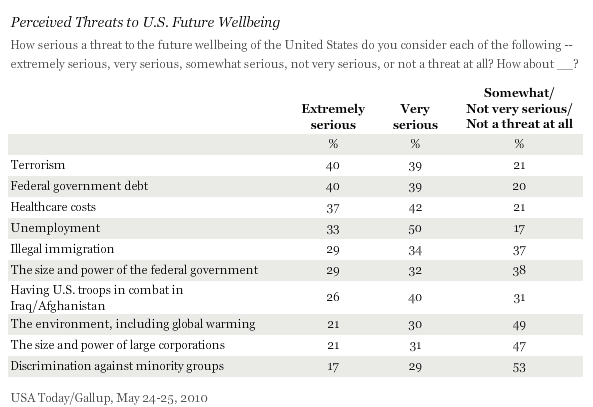
Pete Peterson Has Won: Americans Rate Federal Debt as Top Threat

A fresh Gallup poll reports that Americans are most worried about….federal debts (hat tip Marshall Auerback via the Atlantic):

Picture 53

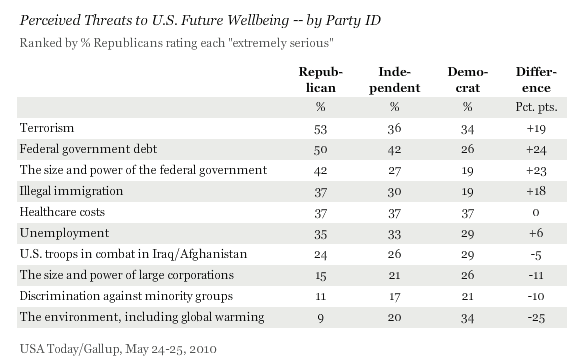
Gallup also provided a tally of how members of each party view the issue:

Picture 54

It would appear the ground has been laid rather effectively for (among other things) an assault on Social Security and Medicare. As we have pointed out before, Social Security is not under any immediate stress, and it would take only some minor tweaks to alleviate the (well off in the future) strains. And contrary to popular perception, the reason Medicare spending will get out of hand is due to projected medical cost escalation, not demographics. In other words, the “crisis” in Medicare is a symptom of our broken health care system, and not an entitlements problem per se. But in addition to the continued ability of Big Pharma and the health insurance industry’s ability to make a bad situation worse, as witness our healthcare “reform,” consumers have also been deeply conditioned to see more treatment as better. From both a cost and side effects perspective, this is simply not often the case. As reader Francois T stated apropos a New York Times article that caused consternation among people who know the terrain:

My oh my! One could write a volume or two about that. I’ll limit myself to the obvious, at the expense of the details.

Their [Abelson and Harris] article and the saga surrounding its writing:

http://www.healthbeatblog.com/2010/06/the-new-york-times-attacks-the-dartmouth-research-part-1.html

http://www.healthbeatblog.com/2010/06/yet-another-source-distressed-by-how-the-nyts-presented-its-data-in-a-story-about-the-dartmouth-rese.html

is a prime example of, when it comes to health care, Americans in general harbor very deeply rooted preconceived notions that pretty much preclude any meaningful and long-lasting reform.

The one operating in the minds of Abelson and Harris is the most toxic: More is always better. They cannot possibly bring themselves to admit, despite the overwhelming evidence of 30 years (!!) of solid, peer-reviewed research demonstrating there are ways to provide better health care outcomes while doing less, but in a SMARTER way. The evidence is crystal clear, but so are the prejudices. Since this is politics, prejudices win, hands down. Being journalists for the NYT, Abelson and Harris seem incapable of going beyond the vulgus populus.

It is important to note here that the attacks on the Dartmouth research were almost inexistent during the period post Clinton failure to reform health care…until Obama started his own attempt. A cursory Lexis-Nexis search is quite convincing in this respect. Those who stand to lose income or power during a health care reform will first and foremost attack it. Mind you, they have the tremendous advantage of playing on those preconceived notions I alluded to above.

So ingrained are these, that even senators and congresspersons who know the Dartmouth very well (yes, there are some that do) will never, ever tout the evidence publicly. Press them a bit about why they don’t, and one shall witness oratory escape maneuvers that would put Houdini to shame. It is just not (yet) “politically feasible”, as they say.

Apart from the Dartmouth research, there is another irrefutable piece of evidence that, when it comes to health care, smart beats more: The VA system.

http://www.washingtonmonthly.com/features/2005/0501.longman.html

Now, before everyone jump at my throat with the Walter Reed scandal, I would recommend reading Best Care Anywhere, by Philip Longman (updated edition 2010)

As per Maggie Mahar:

In the 2010 edition of Best Care Anywhere Longman also recounts how the Bush administration attempted to dismantle the open-source VistA software culture that Kizer had built, “doing its best to recreate the dysfunctional VA of the 1970s.” Meanwhile, as more vets turned to the VA for care (in part because the care was so much better than it had been in earlier years), the Bush administration failed to provide enough funding, leading to long lines and not a few complaints.

Fortunately for the veterans, the situation has dramatically improved since the change in Administration. (There is still a lot of work to be done, but the trend is toward improvement)

The bottom line is this: Since 1994, the turnaround of the VA system demonstrate it is possible to provide good outcomes with high patient satisfaction (except in psychiatric services, but this is another long and complex story) by following what the evidence provides, instead of being guided by which reimbursement schemes is the flavor du jour.

Similarly, the fear about rising deficits is misplaced right now. As George Soros pointed out in a speech today in Vienna, the action of righting an economy when it faces serious financial stresses is a lot like straightening out a car that has gone into a skid: you need to turn the wheels into the skid, which looks like taking it further off the track where you want it to go, until it regains traction and you can then steer it back to its proper path. In this case, we need an expansion of public debt to offset the needed contraction in private sector debt, and then to (Soros did point out that this was a tricky operation). Otherwise, a resumption of the crisis is in the cards.

There is considerable evidence that the deficit fears in general, and the attack on entitlements in particular, has been marketed actively. Our colleague Tom Ferguson explains below:

“Green Consumerism” Largely a Myth

An important little post by Amanda Reed at WorldChanging reveals how conventional measures of carbon emissions give consumers a free pass and ignore the greenhouse gas production resulting from global sourcing of consumer goods.

John Barnett of the Stockholm Environment Institute gave a presentation based on his work in the UK and 40 local governments in Europe. He focused on the fact that tallies of carbon output focus on producers, which has the convenient effect of omitting the impact of shipping finished goods to end buyers:

25-30% of emissions come from products and services that are produced in one country then traded to another…

As it stands now, most emissions data focuses on the production side of our consumer society. For example, the factory that makes your gadget in China contributes to China’s emissions count. When that same gadget is shipped to a UK consumer it does not count towards the UK’s emissions count. Barrett showed that the result of this approach has led to what he called “carbon leakage.” He said that as countries become more and more service based, with demand for products and services met by imports rather than production, the overall amount of carbon leakage goes up. “The volume of emissions that are not counted goes up.” This lack of accounting for growing imports of consumer goods shows up directly in the UK’s emissions records…the Kyoto numbers show an overall emissions reduction in the UK, but consumer emissions have actually gone up in the same time period!

Yves here. When this carbon leakage is factored back in, “green consumerism” looks to be an oxymoron:

“Green products” have less impact in reducing emissions than most people think. The growth of green consumption has not reduced emissions.

Gains in emissions reductions from technological advances have been wiped out by increases in consumption as people demand higher levels of affluence.

The UK’s 50-70% of gains from home energy conservation are lost when they’re redirected for other resource consumption, by people buying other goods and services with the money saved.

Yves again. I admittedly have a coldwater Yankee bias, but I continue to be amazed how consumers fail to be attuned to the fact that the job of a producer is to figure out how to empty their pockets. Why has the public so meekly accepted planned obsolescence? All sort of products, from cars to consumer durables to consumer electronics used to have much longer average lives in service. More frequent trade ins/ups seem to have been foisted upon consumers by playing on status-seeking and a desire for novelty. Yes, some new gadgets really do offer better and different functionality, but consider how many things you discard that are perfectly usable (of course, your truly is a real outlier here, since I particularly resent how computer manufacturers and software designers engage in feature bloat to compress product life cycles and take perverse pride in fighting it. I loved my NeXT computer and used it 10 1/2 years; this post is being written on a 8 year old laptop that had more memory and a bigger hard drive added later in its life. And do not get me started on the topic of fashion….).

Barnett addressed related issues:

Barrett said that some economists are exploring one possible solution: a move toward a future of “steady state economics,” in which a high quality of life exists with no economic growth, since economic growth has (so far) driven growth in material consumption.

Others argue that if we want to have economic growth without rising emissions, we need to do a much better job of decoupling quality of life and well-being from energy and resource use. A growing movement of people are looking at land use, transportation, energy and food systems, finding ways of providing a better quality of life in more urban and post-consumer patterns, and re-thinking how we define and deliver affluence at a systemic level away from the consumption of stuff…. The message, in the meantime, is clear: we can’t shop our way into the future.

Yves again. Tell people not to consume? Horrors. Aside from the fact that it would take a generational shift in values, or a Great Depression II to undo America’s addiction to retail therapy, another ugly complicating factor is that emerging economies, particularly China and India, are out to provide larger proportions of their population with middle class lifestyles. That is generally believed to entail owning more stuff.

Since confronting mass consumerism frontally seems unlikely to make much headway, one can only hope that outlier ideas like freeganism which essentially arb the system, wind up having more impact on values and behavior. Before you dismiss this idea as nuts, remember that organic food was seen as equally oddball in the 1960s. From the New York Times (hat tip reader John L):

Freegans maintain that by salvaging waste, they diminish their need for money, which allows them to live a more thoughtful, responsible and deliberate existence. But if they succeed in their overriding goal, and society ends up becoming less wasteful, the freegan lifestyle will no longer be possible.

That would constitute a considerable victory, if you ask me.

More on this topic (What's this?)
BEWARE THE BIG RED LEADING INDICATOR
THE SLOWDOWN IN CHINA CONTINUES
Read more on Investing in China at Wikinvest

CBO Issues Fed-Flattering Propaganda

I’ve seen some eye-poppin’, credulity-stretchin’ accounts in my time. The report “The Budgetary Impact and Subsidy Costs of the Federal Reserve’s Actions During the Financial Crisis,” just released by the Congressional Budget Office, ranks with the most extreme. It claims that the budgetary cost (which corresponds roughly to expected losses) of the Fed rescue facilities launched during the financial crisis is approximately $21 billion. Moreover, its peculiar formulation (”fair value subsidies”) conveys the misleading impression that this was the extent of the central bank’s support to the financial services industry.

In a (weak) defense to the CBO, my understanding (and readers are welcome to correct me) is that the office is tasked to execute analyses as they are framed. In other words, if the CBO is asked to opine on a particular matter, it has to deal with only the questions posed to it. It is not permitted to tweak the inquiry or broaden the focus to provide more insight.

The closest thing to a statement of scope and objectives comes in the Preface and it is remarkably thin. The most important remark:

The report also presents estimates of the risk-adjusted (or fair-value) subsidies that the Federal Reserve provided to financial institutions through its emergency programs.

Yves here. The report thus purports to answer the criticism made most forcefully by former central banker Willem Buiter before he became Citigroup’s chief economist: not only were the Fed’s numerous bailout vehicles a clear violation of Constitutionally-stipulated budget processes, but they expose taxpayers to the risk of eventual costs, since if the Fed takes big enough losses, the Treasury will have to recapitalize the monetary authority (the Fed can simply “print” its way out of a certain level of losses, but if that activity were to stoke inflation, the Fed would need instead to seek funds from the Treasury).

However, note the framing of the report. It conflates the discussion of budgetary costs and financial services industry subsidies, when explicit costs to taxpayers are only the tip of the iceberg of the bennies that banks received from Fed. While the other forms of support are arguably outside the CBO’s purview, the failure to state those omissions means that defenders of the Fed and the banksters can use this report to obscure the true extent of welfare for financiers.

A partial list of the subsidies the report chose to ignore:

1. Far and away the biggest, near zero short-term interest rates. As we pointed out recently, this is the biggest source of real cash earnings at financial firms these days, since banks can earn easy, risk-free profits simply by borrowing from the Fed and parking the proceeds in longer-dated Treasuries (even though the biggest financial firms are also reporting embarrassing trading profits, those are due in part to low interest rates, both their impact on funding costs and by boosting asset values). These low interest rates are a large tax on savers. Not only do they make investing in comparatively safe and liquid investments unattractive, but they compress risk spreads by enticing investors to go into riskier assets to chase yield, which props up prices of investments generally.

2. Gross underpricing of the rescue facilities. Bagehot’s rule for a distressed financial firm is to lend freely against good collateral at a penalty rate. But the Fed instead lent against virtually any and all collateral and at attractive, often artificially low rates.

The CBO’s “fair market” value seeks to argue that the facilities were priced correctly using an NPV analysis, but that’s bogus. First, as we will see in due course, a mere eyeballing of the results strains credulity. But second, the idea of the Bagehot rule is both to provide for good incentives (you don’t want to make it attractive to use emergency facilities) and to allow for an ample margin for error. A characteristic of panics is they follow bubbles, and what looked to be a decent valuation for collateral might prove to be more than a tad exaggerated. For instance, AAA CDOs were acceptable collateral at the Fed pre-crisis, and if memory serves me correctly, the haircut was 30%. That seemed hugely generous, but the record shows that real-estate related CDOs would have needed a haircut of 80% to 100%.

Although my favorite example comes from the TARP, which is also discussed in the CBO report, it illustrates the general principle. This discussion comes from former derivatives trader Roger Ehrenberg:

The US taxpayer has been systematically looted out of hundreds of billions of dollars… Whether anyone will admit it or not, without the AIG (read: Wall Street and European bank) bail-out and the FDIC issuance guarantees, neither Goldman nor any other bulge bracket firm lacking stable base of core deposits would be alive and breathing today…

It stood with the rest of Wall Street as a firm with longer-dated, less liquid assets funded with extremely short-dated liabilities….In exchange for giving the firm life (TARP, FDIC guarantees, synthetic bail-out via AIG, etc.), the US Treasury (and the US taxpayer by extension) got some warrants on $10 billion of TARP capital injected into the firm. While JP Morgan Chase CEO Jamie Dimon prefers to poke a stick in the eye of the Treasury, seeking to negotiate down the payment to buy back the TARP warrants, Lloyd Blankfein smartly paid the full $1.1 billion requested. He looked like a hero for doing so, a true US patriot repaying the US Government in full for its lifeline, thanking the US taxpayer in the process. $1.1 billion… $1.1 billion…Hmm…something doesn’t seem right. You know why it doesn’t seem right? BECAUSE THE US TREASURY MIS-PRICED THE FREAKING OPTION.

There is not a Wall Street derivatives trader on the planet that would have done the US Government deal on an arms-length basis. Nothing remotely close. Goldman’s equity could have done a digital, dis-continuous move towards zero if it couldn’t finance its balance sheet overnight. Remember Bear Stearns? Lehman Brothers? These things happened. Goldman, though clearly a stronger institution, was facing a crisis of confidence that pervaded the market. Lenders weren’t discriminating back in November 2008. If you didn’t have term credit, you certainly weren’t getting any new lines or getting any rolls, either. So what is the cost of an option to insure a $1 trillion balance sheet and hundreds of billions in off-balance sheet liabilities teetering on the brink? Let’s just say that it is a tad north of $1.1 billion in premium. And the $10 billion TARP figure? It’s a joke. Take into account the AIG payments, the FDIC guarantees and the value of the markets knowing that the US Government won’t let you go down under any circumstances. $1.1 billion in option premium? How about 20x that, perhaps more. But no, this is not the way it went down….

Yves here. So let’s do a little comparison. Ehrenberg argues that the subsidy embodied in the underpriced TARP warrants for Goldman alone (the strongest firm of the bunch) was $21 billion, if not more. The CBO would have us believe that the subsidies provided to all financial players across ALL Fed facilities was a mere $21 billion. Tell me how credible that sounds.

3. The Fed has allowed Wall Street to skim more from its rescue operations, like its over $1 trillion purchase of mortgage backed securities. From the Financial Times in 2009:

Wall Street banks are reaping outsized profits by trading with the Federal Reserve, raising questions about whether the central bank is driving hard enough bargains in its dealings with private sector counterparties, officials and industry executives say…

However, the Fed is not a typical market player. In the interests of transparency, it often announces its intention to buy particular securities in advance. A former Fed official said this strategy enables banks to sell these securities to the Fed at an inflated price.

The resulting profits represent a relatively hidden form of support for banks, and Wall Street has geared up to take advantage. Barclays, for example, e-mails clients with news on the Fed’s balance sheet, detailing the share of the market in particular securities held by the Fed.

“You can make big money trading with the government,” said an executive at one leading investment management firm. “The government is a huge buyer and seller and Wall Street has all the pricing power.”

A former official of the US Treasury and the Fed said the situation had reached the point that “everyone games them. Their transparency hurts them. Everyone picks their pocket.”…another official familiar with the matter said the central bank “has heard that dealers load up on securities to sell to the Fed. There is concern, but policy goals override other considerations.”

Yves here. Let me translate. “Policy goals” means the extra margin the Street nicked from the Fed was a feature, not a bug.

Now to the report itself. It is unabashedly Fed and financial services industry friendly. Start from the top: “The financial system plays a vital role in the U.S.
economy.” You can tell this is a preamble to “the Fed had to rescue the banks” which it predictably recites later:

In CBO’s judgment, if the Federal Reserve had not strategically provided credit and enhanced liquidity, the financial crisis probably would have been deeper and more protracted and the damages to the rest of the economy more severe.

Yves here. This anodyne statement is intellectually dishonest. The report discusses ONLY the Fed’s rescue programs. Thus, the CBO posits bi-modal choice (acting v. not acting) when the officialdom had a huge menu of possible actions. This “the Fed had to Do Something, ergo its programs were warranted” misses the massive moral hazard of what was put in place: the continuation of super-low interest rates and the Greenspan/Bernanke puts, the failure to remove the managements and boards of seriously troubled organizations.

Then we get to the piece de resistance (click to enlarge):
Picture 33
Yves here. Regular readers of this blog know we have done extensive analysis on Maiden Lane III, one of the rescue facilities for AIG’s toxic exposures (see here and here for a few of the examples). The idea that it will show no losses is utter hokum. Similarly, the Fed’s massive purchase of MBS are also likely to result in red ink. The central bank entered into them explicitly to tighten risk spreads at a time when Treasury yields were at low levels, thanks both to heightened appetite for safe assets and active efforts by the Fed to lower interest rates.

The old saw among traders is that it is easy to move markets, but hard to do so profitably. Whether the Fed seeks to sell these MBS later to mop up liquidity, or holds them to maturity, it is very likely to show losses relative to its purchase price.

So how, exactly, does the CBO come up with such a miraculous result? Go look at how they built the model. It’s sufficiently vague and technical-sounding to deter most readers:

To estimate such subsidies, the Congressional Budget Office (CBO) developed a stochastic simulation model for each major program. In general, under that approach, CBO projected probability distributions of future cash flows associated with each program and then discounted the cash flows to their present value using rates that reflected the risk associated with the particular
flows.1 The probability distribution of a program’s cash flows depended on several factors: the program’s rules and structure; the probability distributions of interest rates, default rates, and recovery rates on defaults; and how the demand for a program was affected by those variables.

Yves here. First, this is a hold-to-maturity approach. Second, there is no indication as to how they derived their default and recovery rates. We’ve seen from the famed stress tests that the officialdom has a weakness for estimates that are too optimistic. An article today from the Dow Jones Equity Analyst (hat tip reader Scott, no online source) describes hedge fund Fortress Group predicting “the great liquidation”:

If you think the opportunity for distressed debt investors has come and gone, think again, says Peter Briger Jr., principal and head of distressed debt operations at Fortress Investment Group LLC (FIG).

“In the next five years we’re going to see more financial asset liquidation out of the shadow banking system and the regulated banking system than we’ve
seen over the past 100 years,” Briger said during a keynote address at the 2010
SuperReturn U.S. conference in Boston.

Briger predicted that financial institutions will offload between $5 trillion and $10 trillion in assets in the coming years. He pointed to some $1.6 trillion in asset dispositions that have already been announced by 13 financial institutions, including AIG, Fortis Bank, Royal Bank of Scotland and Lehman Brothers.

Briger said believes that it will take years for those assets to unwind, in part because of the complexity associated with financial assets in today’s market, as well as their sheer volume.

Yves here. How does this “great liquidation” impact the CBO’s valuation? All this paper hitting the market over the next few years will suppress recovery rates, big time.

The report is silent on how it arrived at its assumptions, particularly its loss and recovery estimates. But it is hard to take an analysis that has egregious errors like this in it seriously:

At the end of 2009, the amount of reserves that banks held with the Federal Reserve was the central bank’s largest liability. Such reserves have grown from about $6 billion at the end of July 2007 to more than $1,022 billion at the end of 2009; those reserves greatly exceed the amount that banks are required to hold.3 In effect, the Federal Reserve financed its activities during the crisis primarily by creating bank reserves rather than by issuing more currency or
increasing its other liabilities.4

I was disturbed by the last sentence, and a financial analyst who has expertise in central bank operations concurred:

It’s complete nonsense. All that happened was that the Fed took the shadow banking system on its balance sheet. The Fed doesn’t “finance” any of its activities per se.

Scott Fullwiler, who has considerable knowledge of Fed operations, agreed and added:

The quote suggesting reserve balances were $6 billion in July 2007 was quite wrong, but typical. That was the size of required reserve balances. But required clearing balances were about the same size, so that brings the total to double that, then you have to add another $2 billion for excess balances. So, it was about $14-16 billion total. People who don’t understand the Fed’s operations don’t know that they have to add a few things into the Fed’s balance sheet quote of reserve balances. This can be seen in charts 2 and 3 here

This paper unwittingly suggests that any Audit the Fed initiatives that have the CBO as an important actor will be ineffective, perhaps even counterproductive. If the CBO is as easily led by the nose as this report indicates, it’s likely to be another garbage in, garbage out exercise in modeling that serves to tart up Fed propaganda. The government official who called this exercise to my attention labeled it a “disgrace”, and I agree fully with his assessment.

German Households Owe More Than Greece’s Do

Be careful about your cultural stereotypes! From Bloomberg, via Marshall and Andrew:

Picture 46

Update: Hah! I missed a post from Mark Thoma that also shows that Greeks work more hours than Germans, a LOT more.

Were the Ratings Agencies Duped Rather than Dumb?

The line of thinking that underlies an investigation by New York attorney general Andrew Cuomo is a challenge to conventional wisdom about the financial crisis. The prevailing view is that since credit ratings were one of the single biggest points of failure in the crisis, the ratings agencies were one of the biggest, if not the biggest, perp.

Now this crisis had many parents, with the cast of characters including Alan Greenspan, Bob Rubin, Phil Gramm, Gaussian copula models, negative basis trades, captured regulators, undercapitalized banks and dealers, and of course, ratings agencies.

And the ratings agencies DO deserve a lot of blame. They played a compromised role in the structured credit market, via assisting in the design of deals they ultimately rated. In addition, the traditional ratings system which is hard wired into a lot of investment processes does not translate very well into structured credit deals. As Joe Mason and Josh Rosner demonstrated in a 2006 paper, structured credit transactions inherently are exposed to the risk of more dramatic downgrades than a corporate bond. So an AAA rating for those deals was NEVER as solid as an AAA on a corporate or municipal bond, even before considering the impact of a housing bubble, lousy origination standards, and design of some deals to favor the interest of the short side.

But the rating agencies have managed to argue a First Amendment exemption, which so far has made them judgment-proof (although a recent decision challenged that view in a structured credit case). So Cuomo could be argued to be unfairly targeting the banks due to his inability to pursue the ratings agencies.

But the Cuomo investigation is honing in on a crucial issue: did the banks misrepresent the assets in the deals rated? That has the potential to be a Big Deal, since it could result in bad ratings and the resulting losses being attributed to bad information from banks, who could be sued, and conveniently also are deep pockets.

The issue of misrepresentation is a common thread in many current and potential lawsuits. It is at the heart of the SEC’s case against Goldman. It also forms the basis for Fannie and Freddie action against the four biggest mortgage originators in the US: Bank of America, Citigroup, JP Morgan, and Wells Fargo. These banks had represented contractually that the mortgages underlying the bonds they sold to the agencies met certain standards, when they didn’t. The losses to these banks resulting from these false claims is $5 billion for 2009 and higher numbers are expected in 2010.

A New York Times story on Cuomo’s probe covers a lot of ground that will be familiar to readers of the blog: that low and behold, the banks tried to game the ratings! Since banksters try to game everything, this is hardly news:

At Goldman, there was even a phrase for the way bankers put together mortgage securities. The practice was known as “ratings arbitrage,” according to former workers. The idea was to find ways to put the very worst bonds into a deal for a given rating. The cheaper the bonds, the greater the profit to the bank.

While this behavior is to be expected, and the rating agencies should have been on guard, this sort of thing is another matter:

A central concern of investors in these securities was the diversification of the deals’ loans. If a C.D.O. was based on mostly similar bonds — like those holding mortgages from one region — investors would view it as riskier than an instrument made up of more diversified assets. Mr. Cuomo’s office plans to investigate whether the bankers accurately portrayed the diversification of the mortgage loans to the rating agencies.

Yves here. On the one hand, correlation was a crucial input into structuring these deals, and one big reason so many supposedly AAA bonds failed was the underlying assets were highly correlated. A story earlier this week in Bloomberg on a Merrill CDO provides support to the Cuomo thesis:

Neo CDO Ltd. was a complex construction. More than 40 percent of its holdings were slices of collateralized debt obligations sold by Merrill, according to Moody’s Investors Service and data compiled by Bloomberg. Many of those were CDOs made up of other CDOs backed by bonds linked to home loans. About one-sixth of Neo was invested in junk-rated debt.

Yves here.This deal was managed by Harding, widely seen as captive to Merrill. While the assets Harding selected presumably adhered to the restrictions set forth in the offering memo (limits on the % by rating, on regional and servicer concentrations, etc). it seems astonishing that a deal would be 40% CDO squared, 1/6 junk, and still have a AAA tranche that was 75%+ of total par value (which I would imagine it did). Normal mezz CDOs (ones made mainly of BBB subprime bond tranches) usually had only 10% maximum from other CDOs; so-called high grade CDOs, which were made from “better” cuts of subprime (A, AA, and junior AAA) did permit more CDO squared, but even then, the usual limit was 30%. And to have so much from the same issuer was also unusual.

Moreover, banks themselves often did these deals off their correlation desks. That further raises the possibility that the banks were arbing the correlation risk against their investors (in other words, they could be narrowly truthful in insisting, as Goldman and Magnetar do, that they weren’t designing the deals to fail; they were designing the deals to have highly correlated exposures. But that would mean if they got in trouble, they WOULD fail, as oppose to merely be somewhat impaired).

On the other hand, we argued in ECONNED that the use of correlation models on mortgage bonds was misguided:

ABS CDOs were the financial equivalent of turning pigs’ ears into silk purses, and in the end, they worked about as well. How could anyone at the time have convinced himself that these junior exposures to low credit quality instruments could produce AAA-rated paper? The problem is that procedures that made some sense on first generation securitizations were dangerously misleading here. It’s easy to blame rising real estate prices and ratings agencies, but the real roots lie again in flawed economic models.

Recall the discussion of correlation risk from chapter 3. The theory, developed by Harry Markowitz and William Sharpe, was that investors could create an optimal portfolio that suited their appetite for risk. But to do that, they needed to find investments whose prices moved differently, and they needed to have precise information about how these prices would move in relationship to each other (“covary”) in the future. In other words, this was a clever idea that would seem to have little practical application, except that a whole industry of faux science was constructed on this flawed foundation.

The way this approach was applied to structuring collateralized debt obligations was particularly dubious. The ratings agencies, the monoline insurers, and many investors looked at the risk of default using correlation models. But correlation is a concept in financial economics used to estimate overall portfolio risk based on price movements of the instruments in that portfolio in relationship to each other. If the price of one holding increases 5% in a day, another could change in a whole range of ways: up even more, up but not as much, no change, or down a lot or a little.

But if one loan defaults, the next will either default or not default. Only simple binary outcomes are possible. Thus using Markowitz/Sharpe-type models to analyze defaults was fundamentally wrongheaded.

Yves here. The interesting bit is from a legal standpoint, the logical response for the investment banks would be to say the credit agency models were bunk, the way that correlation models that were developed in the corporate loan market were repurposed to the asset backed securities market was problematic. But the difficulty here is the banks were hawking correlation products and correlation trading strategies; they were even deeper into these approaches than the rating agencies. So Cuomo may indeed be able to land a very solid blow if his inquiry does establish that the investment banks misrepresented

Campaign to Cut Entitlements Picking Up in U.S.

The first part of this two part series proved to be very popular among blog readers, given the level of comments, so I thought I’d feature the second part, which was posted by Real News Networks on Monday. Enjoy!

US Retirement Benefits to be Cut?

Tom Ferguson, professor of political science professor at the University of Massachusetts, Boston, is in fine form here. Enjoy!

Guest Post: Will Policy Exits Just Be Revolving Doors?

By Richard Alford, a former economist at the New York Fed. Since then, he has worked in the financial industry as a trading floor economist and strategist on both the sell side and the buy side.

Both fiscal and monetary policymakers have said that they will begin to unwind the stimulative policy stances when the economy shows signs of embarking on a self-sustaining return to full employment and trend growth. However, the yield curve remains steep as the markets fear higher real interest rates emanating from growing fiscal deficits and higher inflation stemming from the low level of interest rates and the growth of the Fed balance sheet. A quick review of recent US economic history suggests that that policy exits will be revolving doors.

The arguments in the post are generally consistent with mainstream economic views regarding fiscal and monetary policies. There is of course disagreement about the size of the fiscal multiplier and hence disagreement about the scale of the contractionary impact implied by a move to fiscal balance or discipline. There is more of a consensus among mainstream economists on the appropriate approach to designing and implementing monetary policy. There are also a number of alternative schools of thought regarding monetary policy and its impact on the economy. However, adopting one of the non-standard approaches to evaluate monetary policy would only establish what is already obvious: mainstream and non-mainstream economists disagree. As a consequence, monetary policy stance will be explored in the framework of the mainstream formulation.

Since the mid-1990s, the US economy has been almost continuously reliant on fiscal and monetary stimulus to maintain satisfactory rates of growth and full employment.

Simple measures of the fiscal deficit or surplus are not appropriate measures of the stimulus or drag provided by fiscal policy. Drops in revenues and increases in outlays occur automatically during a cyclical downturn and then reverse themselves during a cyclical upturn. Despite some limitations, cyclically adjusted budget measures separate out cyclical factors and are useful to determine, in a rough way whether the budget is providing a positive or negative influence on the growth of real income in the short run.

Based on CBO calculations, the cyclically adjusted Federal budget deficit (red line in the chart) was only in surplus for only 6 of the 76 quarters between the start of 1990 and the end of 2008. The cyclically adjusted budget was in deficit and providing stimulus in 70 quarters even though the economy was in recession for only 7 of the quarters between Q11990 and Q42008. The CBO has since reported that the unadjusted budget deficit for fiscal 2009 was 9.9% of GDP and the forecast (based on the President’s budget) for fiscal 2010 will be 10.3% of GDP. (Note: during the two periods in which the cyclically adjusted budget deficit was less than 3% coincided with asset price bubbles, which stimulated economic activity and capital gains based tax receipts.)

alfordedficit

Given the jobless recovery of 2001 -2007, one must conclude that a move to fiscal discipline, other things unchanged, would contribute to rates of unemployment that have recently been deemed unacceptable. Consequently, any move to fiscal discipline is likely to be short-lived.

Many economists have argued that the Fed was “too loose for too long”, or overly stimulative post-2001. The Fed argues otherwise, pointing its adherence to the Taylor rule. However, there have been very public disagreements between advocates of different specifications of the Taylor rule. These disagreements have largely focused on the most appropriate measure of inflation. For example, John Taylor has argued the Fed policy was too easy from 2002-2005 based on a Taylor rule that employed current CPI instead of the forecasts of future PCE deflators.

More importantly, conventional Taylor rule analysis does not distinguish between domestic and imported inflation or between deviations of output from potential caused by a) declines in domestic animal spirits and b) increases in the world’s willingness to export to the US at unchanged or lower prices.

Consequently, given globalization and the inability of the Dollar to adjust to maintain external balance, the Taylor rule-based policy has been continuously stimulative since at least the mid-1990s.
The Taylor rule can be jury-rigged so as to reflect the US monetary policy stance that would have reflected only domestic factor-driven deviations from target levels of inflation and output.
Assume:

1. the traditional Taylor rule parameters ( 1.5x(the inflation gap) and 0.5x(the output gap),

2. Kohn’s estimate that imported deflation pulled measured US inflation (PCE deflator) down between 50 and 100 basis points per year for the period 1996-2006,

3. the excess of final purchases by US-based economic agents over potential US output, which grew from about 2% of GDP in 1996 to about 6% in 2006 (which implies “demand” averaged 2% (of GDP) higher than conventionally measured).

The amended Taylor rule suggests that the Fed funds target should have averaged more than 200bps higher (other things equal –although a difference of that size in the Fed fund target would have implied that virtually everything else would have changed.)

US monetary policy has been decidedly and consistently stimulative. Alternative statement of the conclusion: stimulative US monetary policy offset both the disinflationary effects of imported deflation on “measured” US inflation and the drag on net aggregate demand emanating from the net trade sector. It did so not by promoting adjustments to globalization, but by contributing the growth of unsustainable asset price bubbles which in turn supported bubbles in consumption and residential and commercial real estate investment. The anti-cyclical aggregate demand based policies pursued since the mid-1990s have not address the underlying structural problems.

The US economy is growing. Given the policy-based stimulus it would a shock if it wasn’t. The real question is: will it keep growing if the promised policy exits are realized.

Going forward, it is unlikely that exports will increase fast enough to compensate for any near-term exiting of the current very stimulative policy stances. The labor market, the trade deficit, the return of positive private savings, the excess supply of both housing and commercial real estate, the political pressures, and the crippled financial system and recent history suggest that any policy exit will short-lived.

Jamie Dimon Complains About Demonization of MegaBanks

One has to wonder whether anyone in a position of influence really believes what he is selling. At best, Jamie Dimon’s defense of too big to fail banks like his own JP Morgan is a vivid illustration of Upton Sinclair’s saying, “It is difficult to get a man to understand something, when his salary depends upon his not understanding it.” But Dimon’s patently self-serving argument is more likely part of a broader industry push to try to win over the public it just looted.

The Financial Times took note of his salvo, which comes in his letter to shareholders:

In the current political environment, size in the business community has been demonized, but the fact is that some businesses require size in order to make necessary investments, take extraordinary risks and provide vital support globally. America’s largest companies operate around the world and employ millions
of people. This includes companies that can make huge investments – as much as $10
billion to $20 billion a year – and compete in as many as 50 to 100 countries to assure America’s long-term success. Combined, big and small businesses spend $1.5 trillion per year on capital expenditures and $300 billion on research and development. It is estimated that more than 70% of the capital expenditures are made by large companies.

The productivity of our workers and the huge economies of scale of our corporations (generated from years of investing and innovating) are what ultimately drive our economy and income growth. Employees at large companies share in that productivity: Compensation and benefits for employees at large companies are substantially higher than at small firms.

It is estimated that large enterprises and large foreign multinationals active in the United
States have accounted for the majority of U.S. productivity growth since 1995.
Companies such as Ford, Boeing, Pfizer, Caterpillar, Apple, Microsoft and Google are exemplars of initiative and innovation worldwide. Cutting-edge companies like Hewlett-Packard underpin vibrant networks of small and midsize suppliers and vendors. Academic research shows that these investments abroad actually create more jobs in the United States.

Large companies such as the ones mentioned above need banking partners with large
enough balance sheets to finance transactions around the world. And it’s not just multinational corporations that rely on such scale: States and municipalities also depend on the capital that a firm like JPMorgan Chase can provide.

Yves here. It goes on in this vein for a few more paragraphs, but you get the drift of the gist. The idea is 1. Big companies are key to productivity growth, ergo growth and 2. Those big companies need banks with really big balance sheets.

Let’s debunk them in order.

The choice of productivity growth is peculiar, since the US statistics have been found to be wanting (as in they used a now-disputed measure, namely, checks cashed, for financial services industry productivity growth, which appears to have greatly overstated productivity increases in the service sector). And a big chunk of the rest of the growth in productivity did come from a large company….Wal-Mart. Wal-Mart’s success in this vein cannot be extended to large companies generally (and a lot of readers no doubt will take issue with Wal-Mart serving as an example of the sort of corporate conduct that big businesses should emulate).

We then get into the next layer: is what is good for the very biggest companies necessarily good for America? That is another tacit assumption in this argument. Given that large corporations have been shedding jobs, and in the last upturn, were net savers (as in were not borrowing to invest in their business, but were rather paying down debt rather than invest in growth) that argument seems like quite a stretch. While some large companies individually are exceptions, as a group, big companies were not creating jobs, nor were they investing in growth. And numerous studies have found that large companies are not innovative (yes, there are always exceptions, but smaller enterprises have consistently been found to be the hotbed of new ideas and processes; why do you think BigCos have to resort to devices like snunkworks to elicit similar behavior?)

So…do these really big companies actually need megabanks? I find this a stretch too. In all the years I have worked in the banking industry, I never heard anyone at McKinsey in the 1980s or 1990s recommend greater size as a way to win more business with major corps (and I’ve done a fair amount of interviewing of corporate treasurers and CFOs over the years myself).

Now there is one exception here. There is a service big corps value highly. It’s a global payment system….offered by Citigroup:

As an example of what the unit allows multinationals to do, an Asian subsidiary of a European company can deposit funds with Citigroup locally and the money will instantly show up on the ledger of the parent a continent away. The system makes it easier for corporate treasurers to manage their finances, and many corporate and government clients outsource a wide range of other finance work to GTS….

Executives told officials with the Treasury Department and the Fed that GTS’s technology and presence in more than 100 countries made it too dangerous for the U.S. to let Citigroup collapse.

Yves here. But Dimon wasn’t arguing about payment systems, he was arguing about financing. It’s already worth noting that some of the companies on his Admirable Big Companies list, like Microsoft and Google, generate lots of cash flow and have comparatively modest investment needs, and hence are not capital markets junkies.

Moreover, in the stone ages of finance (the 1980s) we had companies that straddled the globe too. And guess what? They did just fine having their capital markets needs largely satisfied by investment banks, which were mainly private partnerships, getting loans and payment services from US commercial banks, and using foreign banks if they needed to issue Eurobonds or procure other local market funding services. Even now, large multinationals are not dependent on a single bank. They often seem subject to fads as to how to work with banks (I’ve seen over my career vogues for more banking relationships, as in more horses for courses, replaced by a change in conventional wisdom of favoring fewer banks, and then a reversion. I suspect these changes in fashion keep CFOs busy and therefore looking like they are earning their keep).

So why do big banks need such big balance sheets? Bank industry expert Chris Whalen has described JP Morgan as as $1.3 trillion bank appended to a $76 trillion derivatives clearing operation. And he also begs to differ with Dimon’s “fortress balance sheet” claim, contending that JPM would have gone down even faster in the crisis than some of the other major banks by virtue of its derivatives exposures. You need a really big balance sheet if you are active in the OTC derivatives markets, particularly credit default swaps.

Oh, and as witness what happened in the crisis, big banks (who are given backdoor subsidies, like Maiden Lane I) are a much easier way for the authorities to dispose of dodgy players. By contrast, a bad bank vehicle like the Resolution Trust Corporation has to get funding from Congress and is therefore under considerable scrutiny. No reason to let the public see what is going on if that can be avoided, right?

Update 4/1, 6:00 PM: I neglected to mention a wee factoid that casts considerable doubt on Dimon’s “fortress balance sheet” claim. Year end 2009 total equity was $165 billion. Per Mike Konczal’s conservative analysis, JPM’s losses on second mortgages are between $58 and $87 billion, if not higher.

 
BERJAYA