



by Faiz Shakir, Amanda Terkel, Benjamin Armbruster, Zaid Jilani, Alex Seitz-Wald, Tanya Somanader, and George Zornick
Pakistan Underwater
EDITOR'S NOTE: The Progress Report will be taking our annual two-week August recess starting next week. We will return to your inbox on Monday, August 30. While our newsletter will be taking a break, our blog won't be. So check out ThinkProgress.org for news and updates throughout the day. See you soon, and thanks as always for reading!
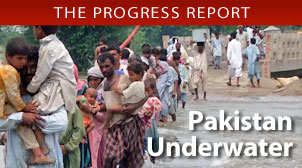
In Pakistan, Muslims began celebrating the holy month of Ramadan yesterday with "misery and fears of an uncertain future," as massive monsoonal flooding continues to ravage the country, leaving one-fifth of Pakistan underwater. After weeks of flooding, about 14 million people have already been affected by the floods -- including six million children -- and estimates of the dead have ranged from 1,200 to 1,600. Already, this "exceed[s] the number of people affected by the Indian Ocean Tsunami, the 2005 Kashmir Earthquake, and the Haiti earthquake combined." Meanwhile, there are fears of second round of flooding, as the Pakistani government issued new flood warnings yesterday that could last into the weekend for several cities in the Punjab and Sindh Provinces. But one of those cities already "looked like a ghost town after more than 80 percent of its population left because of flooding fears." Flooding began on July 22 in the province of Baluchistan when heavy rains caused the Indis river -- which runs the length of Pakistan -- to overflow its flood barriers, pouring from one province to the next. While millions are stranded without food or clean water, the U.N. is also worried about disease outbreaks -- there have already been "36,000 suspected cases of potentially fatal acute watery diarrhea." In the long run, the flooding could have a devastating impact on Pakistan's economy, leaving much of the country's crops and infrastructure destroyed in its wake.
U.S. RESPONSE: The Pakistani government "has conceded that it does not have the resources to tackle the crisis. But officials say they have been disappointed by the relatively small amount of international assistance that has been offered." The U.N. "says that less than $45 million in international aid has been committed, with an additional $91 million pledged." Meanwhile, nearly $300 million had been pledged or committed within the first ten days after the 2005 earthquake in the Pakistani region of Kashmir, and ten days after the Haitian earthquake in January, the amount "surpassed $1.6 billion." Despite this global failing, the Obama administration's response has actually been very proactive. The U.S. "has provided the most assistance thus far," as Washington has already provided $76 million in relief aid. Much of this aid goes to U.N. organizations and other NGOs on the ground, and the U.S has also been directly involved in relief operations by sending helicopters to the area. As of Thursday, U.S. helicopters had "evacuated 3,089 people and delivered 322,340 pounds of relief supplies," and many more are on the way. Defense Secretary Robert Gates announced yesterday that he was tripling the number of helicopters dedicated to Pakistan from six to 19. The military has also positioned naval vessels off Pakistan's coast to aid with logistics, while the State Department has provided much-needed rescue equipment, in addition to humanitarian supplies, including 440,928 halal meals. "The American assistance has been considerable, it has been prompt, and it has been effective," said Tanvir Ahmad Khan, a former Pakistani foreign secretary and now chairman of the Islamabad-based Institute of Strategic Studies.
HEARTS AND MINDS: While the Pakistani military has been credited with effective disaster response, the civilian government's efforts have been widely viewed as lacking, leaving a vacuum that needs to be filled. Much of the Western media coverage of the floods has focused on a supposed struggle between Islamic charities -- some with ties to militants, such as Lashkar-e-Taiba, which is accused of the deadly Mumbai terror attacks -- and international donors, led by the U.S., over who will fill this vacuum and gain the public's good will. A number of "hardline" groups with ties to banned right-wing political parties have indeed announced major aid operations. The Pakistani Taliban itself has pledged major aid, but only if the Pakistani government refuses American help. But U.S. Special Representative for Afghanistan and Pakistan Richard Holbrooke "dismissed reports that hardline Islamic charities were filling the vacuum and gaining support in areas the Pakistani government hasn't been able to reach." "The people I've talked to question the accuracy of those reports," he said. "I don't think we should even worry about those right now. We should just worry about relief and getting assistance to the people." Indeed, regardless of the role of the Islamic charities and the militants, the U.S. has a moral obligation and a strategic interest to aid Pakistan during this trying time. A Pew Research Center survey last month found that nearly six in ten Pakistanis think of the U.S. as an "enemy," while just 11 percent view it as a partner. The floods have "presented U.S. policymakers with an unusual chance to generate goodwill." So far, Washington's response the floods has actually been about on par with its response to the 2005 earthquake in Kashmir, which killed 79,000 in the Northern Pakistani district. But while the death toll in the flooding has been low, the scale is far bigger than the 2005 quake, as it affects nearly the entire country and has devastated everything in its wake. "The magnitude of this crisis is unprecedented" in Pakistan, said the World Health Organization's Dr. Irshad Shaikh. Hoolbrooke and Gates have both acknowledged this, and thus the relief effort will need to be scaled up as soon as possible.
GLOBAL WARMING: The flooding in Pakistan comes during a time when smoke from unprecedented wildfires outside of Moscow have "choked the city," major landslides in China have killed at least 1,000, and a "sweltering" heat wave descended on the Middle East. Meanwhile, a 100-square-mile chunk of ice calved off from a glacier in Greenland -- "the most massive ice island to break away in the Arctic in a half-century of observation." Some scientists are now stating the obvious: these disasters are fueled by global warming. "It's not just a portent of things to come, scientists say, but a sign of troubling climate change already under way," the AP reports. The "weather-related cataclysms of July and August fit patterns predicted by climate scientists." Indeed, the U.N. Intergovernmental Panel on Climate Change (IPCC) "has long predicted that rising global temperatures would produce more frequent and intense heat waves, and more intense rainfalls." The 2007 IPCC report said rains "have grown heavier for 40 years over north Pakistan and predicted greater flooding this century in south Asia's monsoon region." In Russia, it's been "the hottest summer ever recorded," fitting with the 2007 report, which predicted "a doubling of disastrous droughts in Russia this century." China is witnessing its "worst floods in decades," something the 2007 IPCC report also warned of. As Center for American Progress Fellow Matthew Yglesias points out, it would be better to address climate change -- a root cause of this extreme weather -- than to have to address its symptoms. "I don't see any substantial political dissent" about helping Pakistan's flood victims, Yglesias writes. Yet, "you see massive political dissent from the idea that the United States has strong moral and pragmatic reasons to reduce the greenhouse gas emissions that make these kind of deadly outlier events more likely and more frequent."
|
|

|
|




Along with gay people, womb-bearers get rights, too.
Soldiers try trading tech support for Afghan intel.
On being in agreement with Rep. Jack Kingston (R-GA).
Extended learning time in schools.
Why the "Professional Left" continues to hold Obama accountable.
Time's Afghanistan reporter failed to disclose a conflict of interest.
Smoggy Senators protest EPA plan to save thousands of children's lives.
Limited liability hedonism.

"The most important thing I would do, the most important of all, is what I have done all the years I've been in the Congress. I'd reach across the aisle to the Democrats, and I'd say, 'Let's go work together.'"
-- Sen. John McCain (R-AZ), 7/27/08
VERSUS
Q: I would like to ask Sen. McCain if he will make a promise on the air now that if we reelect him, he will not reach across the aisle, especially with Lindsey Graham, for comprehensive immigration reform. Will you not do that for the time you're in office?
McCAIN: Yes, ma'am.
-- McCain, 8/12/10


 Topic Cloud


