close
The Wayback Machine - https://web.archive.org/web/20100325062308/http://www.woodka.com:80/

Yes, We Did — and Yes, We Will

March 22nd, 2010

I’m glad to finally see the health care bill pass. While it isn’t exactly what the progressive community wants, it’s certainly a big step forward, and will provide health care for millions of people as well as make health care better for the rest of us. So it’s a big win.

And there were a lot of doubts about getting this far. I’ve learned one thing about Obama — he will make every effort to keep his word and do what he says he will do. He has great integrity, and that is certainly what I saw in him when I started working with the political community to get him elected. I’m glad for the work I did over those years, sad for the friends I alienated in doing so, but their lives will be better, too. Even if they don’t appreciate that. But I’m glad for the friends I’ve made, and how deeply those friendships run. I’m glad to have the life I have now, with true, deep friendships and relationships, and I would not have those things if I did not follow my heart and do what I know is the right thing to do.

These days, I’m starting to get kudos for the work I do in pet therapy. The thing is, I don’t do any of the things I do for the ego gratification, for the good feeling of people praising me for what I do. I do what I do because it’s simply the right thing for me to be doing. It’s the Buddhist idea of “right work” — once you know it’s right, you simply do it. There is no ego involved.

I think for many of us who worked so hard on the campaign, on the years of political activism, we don’t feel much except great relief that it is finally showing results and the job is getting done. We know we still have years of struggle ahead to continue making the changes this country needs. Some may feel pride, some are experiencing great joy today, but for those who really understand and believe in change, we know the real work is still ahead, and this is just the first big step. A huge step, and it marks the beginnings of a new age in America, yes — but there is still so much to do.

Yes, we did.
Yes, we will…..

“Every once in a while a moment comes where you have a chance to vindicate all those best hopes that you had about yourself, about this country, where you have a chance to make good on those promises that you made … And this is the time to make true on that promise. We are not bound to win, but we are bound to be true. We are not bound to succeed, but we are bound to let whatever light we have shine.” — Barack Obama

Ostara (repost from 2005)

March 21st, 2010

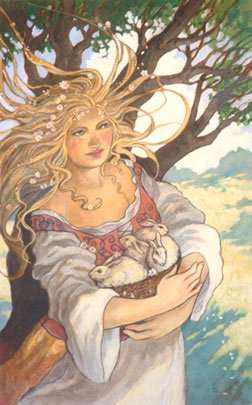
Ostara.jpg

Why have holidays? Today, they are simply a tradition, but once, they meant survival. The holidays were kept so people would know what to do and how to survive, and celebrate doing so. If you just made it through a hard winter, congratulations. Go find some eggs in the forest and perhaps a few rabbits to kill, and let’s eat. But how do you remember it’s time to find eggs and rabbits? You have a holiday about eggs and rabbits, and make up a nice story to go with it that you will remember.

And so we get into the complicated pagan traditions of celebrating the Equinox, mixed with the complicated tradition of hunting for eggs and rabbits, mixed with the Christian church coming in and appropriating pagan holiday festivals and adapting them to the Christian religious celebration calendar, and you end up with Easter.

In the Roman Catholic Church, there are two holidays which get mixed up with the Vernal Equinox. The first, occurring on the fixed calendar day of March 25th in the old liturgical calendar, is called the Feast of the Annunciation of the Blessed Virgin Mary (or B.V.M., as she was typically abbreviated in Catholic Missals). ‘Annunciation’ means an announcement. This is the day that the angel Gabriel announced to Mary that she was ‘in the family way’. Naturally, this had to be announced since Mary, being still a virgin, would have no other means of knowing it. (Quit scoffing, O ye of little faith!) Why did the Church pick the Vernal Equinox for the commemoration of this event? Because it was necessary to have Mary conceive the child Jesus a full nine months before his birth at the Winter Solstice (i.e., Christmas, celebrated on the fixed calendar date of December 25). Mary’s pregnancy would take the natural nine months to complete, even if the conception was a bit unorthodox.

As mentioned before, the older Pagan equivalent of this scene focuses on the joyous process of natural conception, when the young virgin Goddess (in this case, ‘virgin’ in the original sense of meaning ‘unmarried’) mates with the young solar God, who has just displaced his rival. This is probably not their first mating, however. In the mythical sense, the couple may have been lovers since Candlemas, when the young God reached puberty. But the young Goddess was recently a mother (at the Winter Solstice) and is probably still nursing her new child. Therefore, conception is naturally delayed for six weeks or so and, despite earlier matings with the God, She does not conceive until (surprise!) the Vernal Equinox. This may also be their Hand-fasting, a sacred marriage between God and Goddess called a Hierogamy, the ultimate Great Rite.

The other Christian holiday which gets mixed up in this is Easter. Easter, too, celebrates the victory of a god of light (Jesus) over darkness (death), so it makes sense to place it at this season. Ironically, the name ‘Easter’ was taken from the name of a Teutonic lunar Goddess, Eostre (from whence we also get the name of the female hormone, estrogen). Her chief symbols were the bunny (both for fertility and because her worshipers saw a hare in the full moon) and the egg (symbolic of the cosmic egg of creation), images which Christians have been hard pressed to explain. Her holiday, the Eostara, was held on the Vernal Equinox Full Moon. Of course, the Church doesn’t celebrate full moons, even if they do calculate by them, so they planted their Easter on the following Sunday. Thus, Easter is always the first Sunday, after the first Full Moon, after the Vernal Equinox. If you’ve ever wondered why Easter moved all around the calendar, now you know. (By the way, the Catholic Church was so adamant about not incorporating lunar Goddess symbolism that they added a further calculation: if Easter Sunday were to fall on the Full Moon itself, then Easter was postponed to the following Sunday instead.)

Incidentally, this raises another point: recently, some Pagan traditions began referring to the Vernal Equinox as Eostara. Historically, this is incorrect. Eostara is a lunar holiday, honoring a lunar Goddess, at the Vernal Full Moon. Hence, the name ‘Eostara’ is best reserved to the nearest Esbat, rather than the Sabbat itself. How this happened is difficult to say. However, it is notable that some of the same groups misappropriated the term ‘Lady Day’ for Beltane, which left no good folk name for the Equinox. Thus, Eostara was misappropriated for it, completing a chain-reaction of displacement. Needless to say, the old and accepted folk name for the Vernal Equinox is ‘Lady Day’. Christians sometimes insist that the title is in honor of Mary and her Annunciation, but Pagans will smile knowingly. — Mike Nichols

Whew! Sure gets complicated when you take on other people’s traditions! And all that just so we would have some idea when to gather eggs and find bunnies, and learn when to plant crops once we started agriculture, and now it’s a big Christian holiday. Wow.

And of course, it’s all about rebirth, since spring brings everything back to life as the sun rises higher in the sky and th eweather warms up again. So where does that whole resurrection myth come from? Again from Mike Nichols:

Another mythological motif which must surely arrest our attention at this time of year is that of the descent of the God or Goddess into the Underworld. Perhaps we see this most clearly in the Christian tradition. Beginning with his death on the cross on Good Friday, it is said that Jesus ‘descended into hell’ for the three days that his body lay entombed. But on the third day (that is, Easter Sunday), his body and soul rejoined, he arose from the dead and ascended into heaven. By a strange ‘coincidence’, most ancient Pagan religions speak of the Goddess descending into the Underworld, also for a period of three days.

Why three days? If we remember that we are here dealing with the lunar aspect of the Goddess, the reason should be obvious. As the text of one Book of Shadows gives it, ‘…as the moon waxes and wanes, and walks three nights in darkness, so the Goddess once spent three nights in the Kingdom of Death.’ In our modern world, alienated as it is from nature, we tend to mark the time of the New Moon (when no moon is visible) as a single date on a calendar. We tend to forget that the moon is also hidden from our view on the day before and the day after our calendar date. But this did not go unnoticed by our ancestors, who always speak of the Goddess’s sojourn into the land of Death as lasting for three days. Is it any wonder then, that we celebrate the next Full Moon (the Eostara) as the return of the Goddess from chthonic regions?

Naturally, this is the season to celebrate the victory of life over death, as any nature-lover will affirm. And the Christian religion was not misguided by celebrating Christ’s victory over death at this same season. Nor is Christ the only solar hero to journey into the underworld. King Arthur, for example, does the same thing when he sets sail in his magical ship, Prydwen, to bring back precious gifts (i.e. the gifts of life) from the Land of the Dead, as we are told in the ‘Mabinogi’. Welsh triads allude to Gwydion and Amaethon doing much the same thing. In fact, this theme is so universal that mythologists refer to it by a common phrase, ‘the harrowing of hell’.

However, one might conjecture that the descent into hell, or the land of the dead, was originally accomplished, not by a solar male deity, but by a lunar female deity. It is Nature Herself who, in Spring, returns from the Underworld with her gift of abundant life. Solar heroes may have laid claim to this theme much later. The very fact that we are dealing with a three-day period of absence should tell us we are dealing with a lunar, not solar, theme.

Well, whatever one celebrates, It’s spring, and that means new life, warmer weather, and gardening! Yeah!

The Lover of Myth

March 19th, 2010

“Therefore, even the lover of myth is in a sense a philosopher; for myth is composed of wonders.” — Aristotle

“That is the substance, this the shadow; that the reality, this the dream.”
– E.S. Phelps

“We can do magic in these times
Be what we want to be
We’ll all be rock ‘n’ roll stars
Immortal on TV ”

– Joe Jackson

“Myth is an attempt to narrate a whole human experience, of which the purpose is too deep, going too deep in the blood and soul, for mental explanation or description.” — D.H. Lawrence

“Old myths, old gods, old heroes have never died. They are only sleeping at the bottom of our mind, waiting for our call. We have need for them. They represent the wisdom of our race.” — Stanley Kunitz

“If you dream the proper dreams, and share the myths with people, they will want to grow up to be like you.” — Ray Bradbury

“Today the function of the artist is to bring imagination to science and science to imagination, where they meet, in the myth.” — Cyril Connolly

“The role of the artist I now understood as that of revealing through the world-surfaces the implicit forms of the soul, and the great agent to assist the artist was the myth.” — Joseph Campbell

“Because philosophy arises from awe, a philosopher is bound in his way to be a lover of myths and poetic fables. Poets and philosophers are alike in being big with wonder.”
– St. Thomas Aquinas

“At the moment I am looking into astrology, which seems indispensable for a proper understanding of mythology. There are strange and wondrous things in these lands of darkness. Please, don’t worry about my wanderings in these infinitudes. I shall return laden with rich booty for our knowledge of the human psyche.” — Carl Gustav Jung

Shrutam Deva Maya Sarvam

March 18th, 2010
shiva-parvati-side0r

Make a practice of meditating on the joy you feel when you think of someone you love. This is your personal gateway to ananda. Each person you love or have loved is a doorway to the divine. When you think of them, it is as if you are thinking a mantra, a name of God. When you unite with them, even by cherishing their memory in your heart, you are practicing a kind of bhakti, love yoga.

Dogs are masters of this dharana. When a dog sees someone they love, they don’t hold back. They levitate with bliss, it rises in them and they leap. Lately, part of my practice has been to meditate on the uninhibited joy dogs express. Teachers are everywhere in our environment, and in the connections we have with all other living beings. Who are your teachers?

Silence

March 15th, 2010

My Silence

My silence bridges the gulf between my life’s success
and my life’s failure.
My silence does not magnify my defects.
Nor does it connive at them.
My silence transforms my defects into strength indomitable.

My silence is a climbing flame that warms my world of despair.
My silence is my inner light.
No problem of mine can defy solution.
My silence is a selfless distributor of joy to ever-widening horizons.

In my silence I become a man of sterling character,
a prolific writer, a voracious reader, a divine lover,
a profound inspirer and a triumphant liberator.

In my deep silence I never become a victim to ignorance,
the greatest calamity that can befall any human being.
In my growing silence I am convinced that even as a man on this earth
I shall be able to reach heights, transcendental, divine.

Excerpt from “Songs of the Soul” by Sri Chinmoy

Silence II

Silence is not a lack of words.
Silence is not a lack of music.
Silence is not a lack of curses.
Silence is not a lack of screams.
Silence is not a lack of colors
or voices or bodies or whistling wind.
Silence is not a lack of anything.

Silence is resting, nestling
in every leaf of every tree,
in every root and branch.
Silence is the flower sprouting
upon the branch.

Silence is seeing and singing praises.
Silence is the roar of ocean waves.
Silence is the sandpiper dancing
on the shore.
Silence is the vastness of a whale.
Silence is a blade of grass.

Silence is the healer dreaming
the plant, the drummer drumming
the dream. It is the lover’s
exhausted fall into sleep.
It is the call of morning birds.

Silence is the star kissing a flower.

Silence is a word, a hope, a candle
lighting the window of home.

Silence is everything –the renewing sleep
of Earth, the purifying dream of Water,
the purifying rage of Fire, the soaring
and spiraling flight of Air. It is all
things dissolved into no-thing–Silence
is with you always…..the Presence
of I AM

- Elaine Maria Upton

“Why do you stay in prison
when the door is so wide open?

Move outside the tangle of fear-thinking.
Live in silence.”

– Jalal ad-Din Rumi

“Silences make the real conversations between friends. Not the saying but the never needing to say is what counts.” — Margaret Lee Runbeck

“In the attitude of silence the soul finds the path in a clearer light, and what is elusive and deceptive resolves itself into crystal clearness. Our life is a long and arduous quest after Truth.” — Mahatma Gandhi

When words become unclear, I shall focus with photographs. When images become inadequate, I shall be content with silence.” –- Ansel Adams

You are the One which is aware
of the awareness of objects and ideas.
You are the One that is even more silent than awareness.
You are the Life which precedes the concept of life.
Your nature is silence and it is not attainable,
It always Is.

‘This – Prose and Poetry of Dancing Emptiness’
– Sri H. W. L. Poonja (Papaji)

Vacation from my vacation

March 12th, 2010

Came home from the wine country and San Francisco with wine, chocolates, a sore foot and knee from a trip on an unlighted stair, and an upper respiratory infection. So, sorry I’m not posting much but the Cipro is kicking my butt and I’m sleeping it off. More later…

Off to San Francisco

March 5th, 2010

Weekend in the wine country and then in San Francisco for the Game Developer’s Conference — probably won’t be posting til I get back to San Diego.

“A good traveler has no fixed plans, and is not intent on arriving” — Lao Tsu

Morning Inspirations

March 4th, 2010

“If your spiritual aspirations produce socially beneficial qualities in you such as love, joy, peace, patience, kindness, generosity, faithfulness, gentleness, and self-control, then they can be considered something more that a mere psychological defense. In contrast, if you are overcome by qualities such as impatience, distractibility, impulsiveness, demandingness, conflict, discord, and scorn for others, then you are growing weeds, not fruit.”
- Raymond Richmond (via Mike Garafalo)

I think I’ve been a bit distractible and impatient lately.Time to get back to patience and self-control for a while…..

“If you make room for the energy you wish to bring into your life, there is a much better chance of receiving it. Make a space at your table, both literally and metaphorically. Expect the fulfillment of your heart’s desire, and let your home reflect it.” — Beth Owl’s Daughter

I like this thought — that I ought to make room in my life for what I would like to show up in it. Not so much law of attraction, but just to clear the space for what I want in my life. Plus I enjoy physically clearing space when I’m trying to create new things. We just took out our front lawn in anticipation of putting in a more drought-tolerant, native landscape. So here we are actually clearing the space for something new to come into our lives.

“The symbolism we encounter in art and in our dreams serves to bridge the individual to the universal., the microcosm of our inner life to the macrocosm of existence… Symbolism adds to the beauty and the mystery of art and life. It captures the essence of our experiences. ” — Fred White, The Daily Writer

This gets to something that I encounter a lot — how to explain the things I am thinking to other people in a way that is universally understandable. So much of our individual experience is only relevant to our own lives, or the lives of those close to us, to the touchstones we have created for ourselves. To make those experiences understandable to others, we need a language or symbology we can use to translate it for other people.

Sometimes the imagery of religion or spirituality is confused with some mundane reality, and people get frustrated that they don’t have those exotic experiences that others describe. But many times, the reality is that the metaphorical language or symbols actually describe a rather common experience that anyone might feel, and people think they are missing it only because they didn’t get that particular symbol, like missing a joke because you don’t understand it.

The trick is to elevate this experience to an artistic level, rather than just the mundane level. It may not reach as many people as describing it in mundane terms, but it becomes a more enriching and transcending experience because of the symbology. We want to understand the everyday, but we also want to be inspired by the extraordinary. When you truly see the extraordinary in the everyday, your entire life is elevated to that new spiritual level. What great artists try to do is to inspire that experience in others, so that they too can “get” that the everyday is actually the spiritual experience. Georgia O’Keefe didn’t paint flowers, she painted her experience when looking at flowers.

Decide to Network

March 2nd, 2010

Decide to Network
Use every letter you write
Every conversation you have
Every meeting you attend
To express your fundamental beliefs and dreams
Affirm to others the vision of the world you want
Network through thought
Network through action
Network through love
Network through the spirit
You are the center of a network
You are the center of the world
You are a free, immensely powerful source
Of life and goodness
Affirm it
Spread it
Radiate it
Think day and night about it
And you will see a miracle happen:
The greatness of your own life.
In a world of big powers, media, and monopolies
But of six billion individuals
Network is the new freedom
The new democracy
A new form of happiness.

–Robert Muller, Under Secretary General of the United Nations

http://en.wikipedia.org/wiki/Robert_Muller

via Kathryn

The Millions: In Our Parents’ Bookshelves

March 1st, 2010

With the Kindle you don’t know what the person next to you is reading, or how far along in it they are, or whether their copy of the book is dog-eared or brand new (because it’s neither).

One of the most prominent losses in this regard stands to be the loss of bookshelves. A chief virtue of digital books is said to be their economical size—they take up no space at all!—but even a megabyte seems bulky compared to what can be conveyed in the few cubic feet of a bookshelf. What other vessel is able to hold with such precision, intricacy, and economy, all the facets of your life: that you bake bread, vacationed in China, fetishize Melville, aspire to read Shakespeare, have coped with loss, and still tote around a copy of The Missing Piece as a totem of your childhood. And what by contrast can a Kindle tell you about yourself or say to those who visit your house? All it offers is blithe reassurance that there is progress in the world, and that you are a part of it.

Of the bookshelves I’ve inspected in my life, two stand out as particularly consequential. The first was my mother’s, which was built into the wall of the bedroom where she grew up. When I would visit my grandparents in the summer I would spend hours inspecting that bookshelf. The books were yellowed and jammed tightly together, as though my mother had known it was time to leave home once she no longer had any room left on her shelves. In the 1960s novels, the Victorian classics, and the freshman year sociology textbooks fossilized on the bookshelf, I got the clearest glimpse I ever had of my mother as a person who existed before me and apart from me, and whose inner life was as bottomless as I knew my own to be.

And then there was my wife, whose bookshelves I first inspected in a humid DC summer, while her parents were away at work. The shelves were stuffed full of novels—Little House on the Prairie, The Andromeda Strain, One Hundred Years of Solitude—that described an arc of discovery I had followed too. At the time we met, her books still quivered from recent use and still radiated traces of the adolescent wonder they’d prompted. In the years since, on visits home for the holidays and to celebrate engagements and births, I’ve watched her bookshelves dim and settle. Lately they’ve begun to resemble a type of monument I recognize from my mother’s room. They sit there waiting for the day when our son will be old enough to spend his own afternoons puzzling out a picture of his mother in the books she left behind.

It remains to be seen how many more generations will have the adventure of getting to know their parents in just this way. One for sure, and maybe two, but not much beyond that I wouldn’t think. To the extent that bookshelves persist, it will be in self-conscious form, as display cases filled with only the books we valued enough to acquire and preserve in hard copy. The more interesting story, however, the open-ended, undirected progression of a life defined by books will surely be lost to a digital world in which there is no such thing as time at all.

via The Millions: In Our Parents’ Bookshelves.

I love books, and love to walk in other people’s homes and see packed bookshelves — it lets me know we have much in common. Why do we need huge TVs and no books? The comfort of a real book is something I never want to lose, and the mass of them on my shelves makes me feel I am at home.

Source (updated from Feb 2005)

February 27th, 2010

source.jpg

(I blogged this three years ago, but Rambling Taoist is posting on this book today, so thought I would repost this here).

Wellspring of energy
Rises in the body’s core
Tap it and be sustained.
Channel it, and it will speak.

The source of all power is within yourself. Although external circumstances may occasionally hamper you, true movement comes solely from within yourself. The source is latent in everyone, but anyone can learn to tap it. When this happens, power rises like a shimmering well through the center of your body.

Physically, it will sustain and nourish you. But it can do many other things as well. It can give you gifts ranging from unusual knowledge to simple tranquility. It all depends on how you choose to direct your energies.

We cannot say that a person will become enlightened solely by virtue of having tapped this source of power; energy is neutral. It requires experience, wisdom, and education to direct it. You may gain power from your meditations, but it is possible for two people with the same valid attainment to use it in two different ways, even to the extremes of good and evil. Finding the source of spiritual power is a great joy; deciding how to direct it is the greatest of responsibilities.

Deng Ming-Dao, 365 Tao

I wrote this in 2005:

I don’t really have a lot to say about spiritual power today. It is a wonderful feeling when you feel it, and when that energy is flowing within you things seem to become effortless. I can’t keep mine flowing consistently but then i don’t tend to spend a lot of time in meditation. My energy source is definitely lying coiled and resting today. Perhaps I’ll push myself along to yoga later and get the juices flowing again… yawn. First maybe a dip in the spa and a long hot shower to get moving…

Five years later, a lot has changed for me. I would say that I flow very well from within my source, my life is fairly effortless these days. But I am beginning to feel the power rising; I do not yet know where and how it will be channeled. I’ve been sustained for a long time now and haven’t felt the need to do much, other than my political efforts, which I’m told have been very powerful at inspiring others, and my pet therapy work, which I hear the same about. I don’t actively try to inspire or create action these days; I mostly move with the Tao and allow myself to be a channel for whatever creative force wants to flow through me. This is hard to explain to people sometimes, but I don’t actually try to force my own will so much as I go along with whatever seems to need to be done at the moment. It is rare that I will tell people no if they ask something of me.

So I don’t always know exactly where I am headed, or even what the day will bring. I prefer not to bring my expectations to the day anymore, but rahter to let myself move along with whatever the day may bring. I’m not always able to do this, of course, and do get out of sorts, but I don’t expect everything to just flow to me either. It’s not about the law of attraction, it’s about the law of following for me. I don’t so much attract what I want — I turn it around to want what is attracted to me. It’s a different attitude, but it leads to a great deal of happiness and fulfillment.

Get it done already!

February 25th, 2010

I’ve been watching the healthcare summit this morning, and observing how calmly Obama handles the Republicans. I sure couldn’t do it. I yell at them just listening to them, they are so inane. Same talking points over and over, and it is obvious they don’t really care about anyone. The Sunlight Foundation has been doing a wonderful live coverage with blogging and showing the campaign contributions of each speaker from opensecrets.org, and it’s very revealing. The most adamant speakers against healthcare reform have huge contributions from the healthcare industry. I suppose that’s to be expected, but seeing it live as they are talking is so refreshing. I wish our mainstream media could be this open and honest.

With this kind of coverage available on the Internet, is it any wonder mainstream media is fading? We want to be able to interact with our world, both to share what we know and to learn new things. We want to be able to directly tell our legislators what we think, and not being able to do that real time is so frustrating. Twitter users were twittering CNN to stop talking over the speakers. This is what we want — to get our messages out to the media, to the big corporations and to our government. It comes out from the right wing in stupid ways, but the anger they express is just as real on the left — we all want to be listened to and responded to. I think the healthcare summit, and the kind of coverage and interaction I’m seeing today (also chatting with people on twitter and facebook about this) is the real future of our public interactions. I hope that healthcare reform passes soon, and I know it is not enough — but what I’m seeing today is very encouraging — not just on the political side, but also on the side of those working in the Internet media to really reform how we interact with our government and corporate agencies.

Pointing the Way

February 21st, 2010

2010-02-01

Do not confuse the pointing finger with the moon….

Insurmountable opportunities

February 21st, 2010

“We are confronted with insurmountable opportunities.” — Walt Kelly, “Pogo”

“There is no failure except in no longer trying. There is no defeat except from within, no really insurmountable barrier save our own inherent weakness of purpose.” — Kin Hubbard

“Imaginary obstacles are insurmountable. Real ones aren’t. But you can’t tell the difference when you have no real information. Fear can create even more imaginary obstacles than ignorance can. That’s why the smallest step away from speculation and into reality can be an amazing relief. ” — Barbara Sher

I’ve been confronted with many insurmountable opportunities lately to find new information and do new things, visit new facilities for pet therapy work, explore new people, etc. It’s been a distracting year so far but a fun one. I’m really hoping to get back to a more regular blogging schedule though.

Flaws

February 18th, 2010

“You are flawed, you are stuck in old patterns, you become carried away with yourself. Indeed you are quite impossible in many ways. And still, you are beautiful beyond measure.”
– John Welwood via Whiskey River

“The greatest work of all is to show up each day willing to not be “there” yet. So long as we believe we should be better than we are, we will be blind to our own light and resentful of the light of others. Our greatest error is to interpret failure to be present as evidence that we are irredeemably flawed. There is no way back to ourselves and to each other that does not begin with compassionate awareness that we’ve once again lost our way.” – Molly Gordon

An ancient gnarled tree:
Too fibrous for a logger’s saw,
Too twisted to fit a carpenter’s square,
Outlasts the whole forest.

Loggers delight in straight grained, strong, fragrant wood. If the timber is too difficult to cut, too twisted to be made straight, too foul-odored for cabinets, and too spongy for firewood, it is left alone. Useful trees are cut down. Useless ones survive.

The same is true of people. The strong are conscripted. The beautiful are exploited. Those who are too plain to be noticed are the ones who survive. They are left alone and safe.

But what if we ourselves are among such plain persons? Though others may neglect us, we should not thing of ourselves as being without value. We must not accept the judgment of others as the measure of our own self worth. Instead, we should live our lives in simplicity.

Surely, we will have flaws, but we must take stock in them according to our own judgment and then use them as a measure of self-improvement. Since we need not expend energy in putting on airs or maintaining a position, we are actually free to cultivate the best parts of our personalities. Thus, to be considered useless in not a reason for despair, but an opportunity. It is the chance to live without interference and to express one’s own individuality.

Deng Ming-Dao, 365 Tao

Sabi by itself means “the bloom of time.” It connotes natural progression-tarnish, hoariness, rust-the extinguished gloss of that which once sparkled. It’s the understanding that beauty is fleeting. The word’s meaning has changed over time, from its ancient definition, “to be desolate,” to the more neutral “to grow old.” By the thirteenth century, sabi’s meaning had evolved into taking pleasure in things that were old and faded. A proverb emerged: “Time is kind to things, but unkind to man.”

Sabi things carry the burden of their years with dignity and grace: the chilly mottled surface of an oxidized silver bowl, the yielding gray of weathered wood, the elegant withering of a bereft autumn bough. An old car left in a field to rust, as it transforms from an eyesore into a part of the landscape, could be considered America’s contribution to the evolution of sabi. An abandoned barn, as it collapses in on itself, holds this mystique.

There’s an aching poetry in things that carry this patina, and it transcends the Japanese. We Americans are ineffably drawn to old European towns with their crooked cobblestone streets and chipping plaster, to places battle scarred with history much deeper than our own. We seek sabi in antiques and even try to manufacture it in distressed furnishings. True sabi cannot be acquired, however. It is a gift of time.

The Wabi-Sabi House: The Japanese Art of Imperfect Beauty

Can you celebrate your flaws, enjoy the sabi in your nature? Can you paint your cracks with gold, and learn that the flaws in your nature are what make you whole?


And we’re back…

February 16th, 2010

Server crash today — sorry if you were looking for me! Haven’t been writing much lately anyway, it seems.

True Vows, and True Love

February 13th, 2010

All the True Vows (via Hecate)
by David Whyte

All the true vows
are secret vows
the ones we speak out loud
are the ones we break.

There is only one life
you can call your own
and a thousand others
you can call by any name you want.

Hold to the truth you make
every day with your own body,
don’t turn your face away.

Hold to your own truth
at the center of the image
you were born with.

Those who do not understand
their destiny will never understand
the friends they have made
nor the work they have chosen

nor the one life that waits
beyond all the others.

By the lake in the wood
in the shadows
you can
whisper that truth
to the quiet reflection
you see in the water.

Whatever you hear from
the water, remember,

it wants you to carry
the sound of its truth on your lips.

Remember,
in this place
no one can hear you

and out of the silence
you can make a promise
it will kill you to break,

that way you’ll find
what is real and what is not.

I know what I am saying.
Time almost forsook me
and I looked again.

Seeing my reflection
I broke a promise
and spoke
for the first time
after all these years

in my own voice,

before it was too late
to turn my face again.

“Dreams are illustrations… from the book your soul is writing about you.” -– Marsha Norman

“The truth is, we are meant to be bountiful and live. The universe will always support affirmative action. Our truest dream for ourselves is always the Goddess’ will for us.” — Julia Cameron

You are just perfect the way you are, and you already have everything you want — you just have to say yes to it and open the door.

When you stop fighting against the flow, the flow stops fighting you, too.

Love is not giving in to all someone’s whims — love is bringing out the best in someone, teaching them to love what is difficult for them. Love what is difficult to love in yourself, and in others, and it will help you to bring out the best in yourself and in others, as well.

Luminous

February 13th, 2010

You are you. But somewhere deep down you want to become a Buddha or a Jesus and then you go around in a circle that will be unending. Just see the point of it — you are you. And the whole, or existence, wants you to be you.

That’s why existence has created you, otherwise it would have created a different model. It wanted you to be here at this moment. It did not want Jesus to be here in place of you. And existence knows better. The whole always knows better than the part.

So just accept yourself, If you can accept yourself, you have learned the greatest secret of life, and then everything comes on its own. Just be yourself.

There is no need to pull yourself up; there is no need to be a different height from what you are already. There is no need to have another face. Simply be as you are, and in deep acceptance of it, and a flowering will happen and you will go on becoming more and more yourself.

Once you drop the idea of becoming somebody, there is no tension. Suddenly all tension disappears. You are here, luminous in this moment. And there is nothing else to do but to celebrate and enjoy. — Everyday Osho

“To get the right word in the right place is a rare achievement. To condense the diffused light of a page of thought into the luminous flash of a single sentence, is worthy to rank as a prize composition just by itself.” — Mark Twain

“A book should be luminous not voluminous.” — Christian Nevell Bovee

“The dancer’s body is simply the luminous manifestation of the soul.” — Isadora Duncan

“Life is a luminous halo, a semi-transparent envelope surrounding us from the beginning” — Virginia Woolf

“It may be that you are not yourself luminous, but you are a conductor of light. Some people without possessing genius have a remarkable power of stimulating it.” — Arthur Conan Doyle

“Words become luminous when the poet’s finger has passed over them its phosphorescence.” — Joseph Joubert

“There is then creative reading as well as creative writing. When the mind is braced by labor and invention, the page of whatever book we read becomes luminous with manifold allusion.” –Ralph Waldo Emerson

“In some photographs the essence of light and space dominate; in others, the substance of rock and wood, and the luminous insistence of growing things…” — Ansel Adams

“Thou dost not know thy own destiny and dost not know that it gets its worth from thee — otherwise the luminous ruby is only a piece of stone.” — Muhammad Iqbal

“Painting is by nature a luminous language.” — Robert Delaunay

“Strange to say, the luminous world is the invisible world; the luminous world is that which we do not see. Our eyes of flesh see only night.” — Victor Hugo

“Our dreams are luminous, a cast fire upon the world.
Morning arrives and that’s it.
Sunlight darkens the earth.”
— Charles Wright

“Luminous is this mind, brightly shining, but it is colored by the attachments that visit it. This unlearned people do not really understand, and so do not cultivate the mind. Luminous is this mind, brightly shining, and it is free of the attachments that visit it. This the noble follower of the way really understands; so for them there is cultivation of the mind.” — Anguttara Nikaya

Fueki Ryuko

February 9th, 2010

Fueki Ryuko — ‘Constancy and change.’ The enduring patterns in the ever changing stream of nature. Sometimes understood to be the eternal truths that poets try to communicate.

permanence and change“,
synthesis between tradition and innovation
Fueki Ryuko 不易流行(ふえきりゅうこう)

fuga no makoto is a result or product of the dynamism of two colliding forces: fueki ryuko, which is another important teaching of Basho.
Fueki simply means “no change” and refers to values of a permanent and enduring nature.

Ryuko, on the other hand, means “changing fashions of the time” and refers to newness, innovation, originality or unconventional values that would break with old ways in a revolutionary manner.

For instance, Beethoven created new and innovative music, ushering in a new age and setting a new trend. However, he did not do so without first having been steeped in classical music of an old tradition. Thus he had fueki ryuko and left legacy of permanent value.
None of us is Beethoven, but all of us can become a little Beethoven! Fueki ryuko is an abbreviation of senzai-fueki ichiji-ryuko (eternal no-change and temporary fashion).

When fueki and ryuko collide and interact in a dynamic explosion of creative haiku writing, the result could be like a newly born baby taking after both parents but different from both. And there is a single ultimate value that lies beyond fueki ryuko, and that is nothing but fuga no makoto.

– Susumu Takiguchi

“”Fueki ryuko”… is one of the essential principles of what I call Basho’s dialectic poetics. It should be given much greater significance than was originally perceived. This is because it now applies to almost all aspects of modern Japan where the balance between fueki, or permanent values, and ryuko, or changes, is shaky. A similar situation is also seen elsewhere in the world.

The two words can be interpreted in more ways than one. Fueki, for instance, can represent unchanging tradition while ryuko can represent changing fashion. Since the two are contradictory there should be a kind of creative tension generated between them. This tension should keep haiku fresh, creative and interesting. If people cling to tradition and neglect newness (or atarashimi) inherent in fashion, then haiku could become stale, imitative and boring. If, on the other hand, people indulge in newness without tradition, haiku could become gimmicky, incomprehensible and nonsensical. Needless to say, fueki should be genuine fueki, and ryuko should be genuine ryuko. And here starts one of the most important arguments, “What makes fueki and ryuko genuine?”" — Susumu Takiguchi

When a haijin (a writer of haiku) writes a haiku about something wabi sabi she will often attempt to capture both its transient beauty and the abiding qualities within the beauty, what haiku masters in years past called, Fueki Ryuko. Such haiku stimulate feelings of favorable melancholy. The most successful haiku of this type produce a clarity of perception in which the reader sees the subject of the haiku for what it is. There is a release of any desire to repair or arrest the effects of time, experience, or age. Everything is just right the way it is, defects and all. — Richard R. Powell

More on fueki ryuko here.

Saying goodbye to an old friend

February 9th, 2010

Our friend Gertrude at the Casa is gone, after 107 years. We’ll miss doing our pet therapy visits with her. But after leaving her empty room and wiping away the tears, in the very next room, we found a new Gertrude to visit. Somehow, it made Darwin and me feel better.

This article was written about Getrude last year.

107 Candles for Gertrude.

BERJAYA

I reckon Gertrude Drais has lived through at least 20 presidential elections, and worn shirt waist dresses to chemises, bell bottoms to saggies. She shared her native Chicago with Al Capone and his pals, speakeasies, Prohibition – and its repeal. World Wars I and II, the Korean conflict, Viet Nam War, Desert Storm, and the current wars have kept her glued to the radio, then TV.

Mrs. Drais had seen a lot of history by the time of her May 14th – 107th –birthday blowout at the Casa de las Campanas.

One of Casa’s first residents, Gertrude and her childhood girlfriend signed up for apartments in 1984, moving in upon completion in 1988.

Gertrude still loves to travel, but now she restricts it to circumnavigating the wing where she lives, surrounded by her many souvenirs. For decades, she traveled all over the world. She can show her Trip Diary to prove it. It began in 1953 with a trip by train to Montana. Other times it was by car, or airplane. In meticulous penmanship, she journaled where she went and how, with whom, how much it cost, and highlights of the adventure. A favorite was to China.

Her parents immigrated to the US from Sweden in the late 1800’s. Gertrude and her brother were born in the windy city. She can recite some of the bible verses she learned in the Swedish Evangelical Church. Her philosophies are simple, “Remember what you’ve learned.” And, “We all worship the same God, whatever we call Him.”

Gertrude married in 1927, giving up her job as a secretary for the Nickel plate Railroad. Tragically, her only child died in early infancy. Gertrude and her husband traveled, and took up golf and bridge, the latter of which she still plays. Widowed in 1963, Gertrude followed close friends to northern California in 1967, when she remarried. The newlyweds traveled extensively until her second husband died while on a trip to Hawaii, just two years later.

Gertrude continued to travel alone and with small groups, including a trip to her family homeland – Sweden, in 1972. She met all her cousins who were surprised to hear her fluent Swedish. When a childhood friend moved to Seven Oaks in Rancho Bernardo, she decided to follow. So did about a dozen other of their school chums. When her girlfriend told her about Casa de las Campanas being built, the two went over and picked out their homes from the plans. “Life is good at Casa,” Gertrude says.