
Archive for the ‘Uncategorized’ Category
Zig-zags and hidden messages

The upcoming Balfron Project (via Blueprint), ‘a large-scale photographic event to be staged at the Grade II listed building Balfron Tower. Shot on film with a large format still camera, the event will result in a mural sized photograph presenting both this icon of 1960s New Brutalism and its connection to the lives of the people who inhabit it today. Residents are invited to participate by choosing how they wish to represent themselves within the larger picture.’ A project by Simon Terrill who specialises in cataloguing, assembling and erasing crowds.
//
Alphabetical Autocompletes, a fun contemporary parlour game at Varsity Bookmarking. Through which we get the lovely Jacket Mechanical, concerned with book cover art in all its forms. Related, Why art books won’t become e-books any time soon. As long as we continue to fetishise feel, texture, grain and patina… / on Iwan Baan, the architectural photograph who pretty much dictates the contemporary aesthetic. Baan’s website / Depressive Robots, at entshwindet und vergeht, which also points us towards Found Objects (a ‘hauntological dumping ground’) / Matthew’s Drawings, a tumblelog.
//
The post-Christmas haze is going to be extra special for those who order this little trinket: Edible Gingerbread Playhouse by Dylan’s Candy Bar. We wonder how many of these attention-grabbing, high-ticket items are actually sold through the Neiman Marcus Christmas Book. See also the Cupcake Car.
//
We’re looking forward to this: Care of Wooden Floors, a forthcoming novel by Will Wiles / Art Deco in the UK, a weblog / Sociological Images, the visual presentation of politics / photography by James Pomerantz (via Lenscratch), especially the Agua Sagrada series, shot in a Mexican cenote, ‘a water-filled sinkhole’.
//
Media, museum, at Butterpaper, which looks at the controversy surrounding the design of the Garden of Australian Dreams at the National Museum of Australia, by Ashton Raggatt McDougall. Described as ‘teeth-grating kitsch’ by the local media, the building is a rare splice of deconstructivist intent with po-mo borrowing – there’s a section that’s a breathtaking steal from Libeskind’s Jewish Museum in Berlin (see below). But it also courted controversy over alleged messages in the morse code relief patterns on the walls. Brings to mind Liam Gillick’s canopy for the Home Office building, which incorporates a message known only to Gillick. See also Secret Society: Cracking the codes of Conceptual art. And perhaps the ‘Mystery on Fifth Avenue‘, a splicing of Martha Stewart and Umberto Eco.

Visiting imaginary places

Our apartment, by Topsy Design, another contemporary exponent of ‘living over the shop‘, or rather, ‘living within the shop.’ Whereas traders once used to shoehorn their living quarters above their working quarters, the evaporation of production and the growth in very specialist retail means that LOTS has evaporated. Instead, LWTS will become more and more commonplace thanks to the combination of curated personal spaces and increased pressure on urban housing.
//
London Underground button badges. Wait for the iron grip of LU’s enforcement officers to catch wind of this / this is slightly perverse, Collider’s reimagining of FallingWater for the Ministry of Sound’s Chillout Sessions XII (via Ian Claridge), a mash-up of modernism, the Mad Men aesthetic, tilt-shift photography and the ongoing model-making revival. Related, SCB links to this Architectural Models tumblr / art by Dexter Dalwood.
//
Many thanks to Architectural Review for the mention, and for pointing us towards The Day After You Die and Japanese Scientists, two image-heavy sites, doing what tumblrs and their ilk do best; present the visual highlights from what appears to be a life of constant hedonism and aesthetic perfection / designboom’s Venice Architecture Biennale coverage is amongst the most comprehensive there is. Given the cornucopia of quite literally instant online coverage, whereby the key events of each day are tweeted, streamed and blogged as they happen, one starts to question the wisdom of attending the Biennale at all.
//
Ugly Vegas Carpets Want You to Keep Playing: ‘casino carpet is known as an exercise in deliberate bad taste that somehow encourages people to gamble’ / Western Motel: Edward Hopper and Contemporary Art, an exhibition that ‘concentrates on Hopper’s influence on cinema’ / Imperials, a tumblr / classic hip hop covers in Lego / art by Paul Cummings (detail above).
The origins of the persuasion industry

/
The last of the Madison Avenue mavericks of Mad Men: ‘Meet Jerry Della Femina, the door-to-door salesman who became become so influential in US advertising he’s Peggy Olson, Don Draper and Bert Cooper rolled into one’. His 1970 book, From Those Wonderful Folks Who Gave You Pearl Harbor, is reissued in a retro-style jacket that is now de rigeur for any discussion or reference to this period (now thoroughly re-worked as the cradle of modern attitudes towards consumption and commodification).
/
We also like The Persuasion Industry, John Pearson and Graham Turner’s look at the ‘British Advertising and Public Industry in Action’, first published in 1965. In a sense, this is a book in thrall to the glories relayed over the Atlantic from Madison Avenue, chronicling the point at which sex and aspiration begin to creep into marketing in Britain. Pearson and Turner (who also wrote of The Car Makers, implying a broad swathe of knowledge covering both the manufacture as well as the emerging art of selling cars) begin the book with a look at Ford UK’s shift from small-scale agency to large one, with the names cited eventually to dissolve into the acronymical stew that characterises the modern agency.
/
The quotes are revealing, as is the advert illustrated above – ‘Four bedrooms… Three children… Two Fords!’. The company eventually settled on the London Press Exchange, one of the oldest agencies in the country. Their head of account, Bryan Oakes, had this to say about their approach, ‘In our ads, we always give people the important facts about the car, the basic consumer benefits. In addition we always give a hint of the people who might use the car – but we play it up a bit [italics ours]…. Here, for instance [in a Ford Anglia advertisement, maybe this or this], the kids obviously go to private school and the mother is efficient, a little bit cool but marvellous in bed. There’s gloss, gleam, the size, the bigness – this, we’re saying, is the life you’ll be living.’ Yet, as the book explains on page 39, Ford knew at the time that 50% of Anglia buyers were on relatively modest incomes.
/
LPE eventually became part of Leo Burnett, a company that keeps its corporate history behind a very slick flash interface. An agency founded on the core belief of creating ‘inherent drama’ and the signature provision of a bowl of green apples on the reception desk, the acquisition of LPE in 1969 gave it a global foothold, kick-starting the era of the truly international agency (perhaps also relevant, the Museum of Public Relations). It was a canny buy, for in the early 60s, LPE were masters of this new kind of aspirational marketing. A few pages later we get to their campaign for National Benzole, one of the myriad small oil companies eventually swallowed up by the giants (much like the ad agencies themselves), known for putting its name to some rather quaint maps. They weren’t a patch on the Shell Guides, but according to Ian Byrne’s excellent Petrol Maps site, there were some ‘superb’ guidebooks edited by Hugh Casson and illustrated by Paul Sharp.
/
We digress. LPE’s National Benzole campaign was centered around what Mr Oakes called ‘the Getaway People‘. This was 1963. ‘They were the people who did the good things… the jet set, clean-limbed beautiful girls, the gods and goddesses who did exotic things. We used expensive cars – E-Type Jaguars and Aston-Martins [sic] – and the promise was that, if you get this petrol, you’re aligning yourself with those wonderful people, midnight drives on the beach and so on. Of course, it’s tough luck – you don’t happen to have a Jag just yet, or a girl like that, but any day now…’. And so begins a game of unsubtle collusion between punter, promoter and manufacturer, with cars as engines of virility and promise. The industry never found a different way of selling cars, and hasn’t really needed to. The book also tackles Oxo, Guiness, politics and PR and is highly recommended.
//
Other things. Bad children’s books: ‘The Best Things to Drink Are under the Sink’ is probably the best but overall not a patch on the Washington Post invitational from a few years ago, the results of which have now blended into a thousand websites, with most begging out for real print treatment (‘The Protocols of the Grandpas of Zion’ and ‘Why Can’t Mr. Fork and Ms. Electrical Outlet Be Friends?’, for example).
//
Slow Painters, the antithesis of the painting a day crowd (via Slow Muse / Lego Architecture / Review, a local bookshop / many, many British car advertisements / Lovely Design, creative stuff / interactive graphics by Scott Snibbe / Found Shopping Lists / how to disguise a tethering application as an iPhone torch. Neat.
//
How quickly does the security apparatus of the past becomes the heritage of the present? It’ll be a while before the multi-headed hydra chronicled in Top Secret America creates the same fond fascination generated by the Cold War. How would a Subterranea Britannica of post-9/11 USA appear?

Cities in (Empty) Space
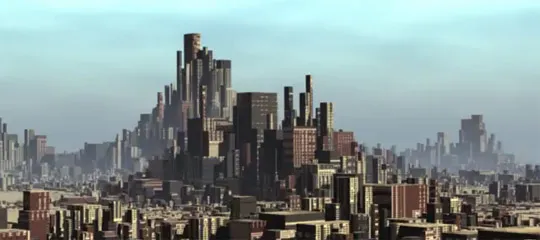
The Pop-Up City, ‘an online magazine by [placemaking agency] Golfstromen which explores new ideas, trends, strategies and methods for a dynamic and flexible interpretation of contemporary urban life.’ We have never come across a placemaking agency before. We like their link to the Suicidator City Generator. If you have and understand Blender (we don’t and don’t) ‘you can automatically create entire, three-dimensional modern cities in a matter of seconds by adjusting various parameters, such as city size and complexity, rather than creating each building, each street, and each texture manually… The master concepts in SCG are randomness and therefore uniqueness: each generated city, each building, and each street is random and unique, making your city look real. Besides, you can greatly alter the look of a city simply by changing the input parameters.’ There’s a short film of the results here.
//
The Seven-Cent Advance, books reviewed by their intended readers / visit the Sci-Fi Air Show, Oshkosh 2110 / Stuff your rucksack informs about charitable exchanges worldwide / Adam Curtis does some fascinating digging into the BBC Archives to look at the hidden histories of BP (via). Related, our page of Oil industry ephemera, a very incomplete collection. Perhaps BP could go back to publishing cheery little London guide books.
//
What would a museum of the Planet Earth look like? / farewell Chris Sievey / IDIOM, ‘an online publication of artistic and cultural practice’ / The New Enquiry, contemporary criticism / Robert Corr, a weblog / a selection of Vertical farming links: a movie, an urban proposal, an Off-Grid Vertical Farm for Downtown Seattle, a part vertical farm, part TV station, and some films: I, II and III.
//
When the coverage is better than the tennis, Salon on Xan Brooks’s epic live blog of a match that went to 59-59 in the final set before light stopped play / Somebody’s Oatmeal, visual weblog / work by Nick Shea / architectural paintings by Frank Webster / Vintage Crayons, Paints and Art Supplies, a flickr set (via Print Fetish) / sad to say, but it’s farewell Grafik.
Collections, big and small

The Sands Mechanical Museum, incorporating the Coin Op Game Museum and the Pocket Watch Museum, a personal ‘virtual museum’. It doesn’t have the scope of Cyberheritage, the quite awesome extensive UK site devoted to collating all forms of historical material. Also in a similar vein, Turnstile, a frankly vast (and very ‘things-y’) website devoted to picture sets, artworks and more.
//
Around Britain with a paunch, a food blog / Random Curiosity, a visual journal / Your City from the Air, an epic forum thread at SkyscraperCity / 6 degrees of Black Sabbath, find the musical links you didn’t know existed / zoom in on the Moon / zoom into the Moon a lot / Radical Cartography, making maps from data / the Games of my Life.
//
Live train map for the London Underground, not especially useful, but amazing nonetheless (via Haddock / the Geograph Project, which ‘aims to collect geographically representative photographs and information for every square kilometre of Great Britain and Ireland’ / the Sketch Book Project, via DO / Archinect points us towards this marvellous Abandoned Palace on Beekman Street at Scouting New York / we are not time travellers.
Catios and Chevys

A fine example of corporate BrandSpeak gone awry, ‘Saving Chevrolet Means Sending ‘Chevy’ to Dump: ‘…one way to present a consistent brand message, the [G.M.] memo suggested, is to stop saying “Chevy,” though the word is one of the world’s best-known, longest-lived product nicknames…. “We’d ask that whether you’re talking to a dealer, reviewing dealer advertising, or speaking with friends and family, that you communicate our brand as Chevrolet moving forward.”’
//
Save the Maginot Line, a photographic project by Alexandre Guirkinger. More about the Maginot Line, the fatally flawed line of defensive bunkers / Laura Barnard’s art and photographs, especially / 25,000 barrels falling out of the sky / Somewhere, a dog barked. But why? / Crystal Cubes, Tetris for the bling obsessed / Conjuring Arts, a magic site / Sarra, a tumblr / ‘Catios’ Bring Cats Outdoors.
The Hidden Posters of Notting Hill Gate

Photographs by Michel Gravel / 19 epic Lego guns that actually work / art by Jeanette Barnes / old pictures from a bottom drawer at NASA / German children’s books / paintings and drawings by Wesley Burt / London at Night / The Happy Ghost: ‘The rapper 50 Cent, who must be a very busy man, pays someone to ghostwrite his 140-character tweets for Twitter.’
//
AAA: Architecture Advertising Automobiles / the Caravan Club Archive / Topsy Design sells things like Scientific Posters / related, Indian posters / World Cup infographic. Fun, even if you don’t really like football / ‘the latest examples of Apple’s stupid editorial censorship‘, already re-thought / the hidden posters of Notting Hill Gate, hidden away since 1959.
The Architectural Uncanny

A set of photographs of Poundbury by Dennis Gilbert. There’s a studied blankness here, an almost subconscious attempt at sabotaging the contrived neo-classical picturesque that Poundbury supposedly represents. It’s unfortunate perhaps that the modern archetype the town most closely resembles are the sprawling commuter estates, their banality cherished by contemporary photographers and used ironically to symbolise the passing of an unattainable utopia. Gilbert’s camera seems to focus on the bits that aren’t quite right, the architecturally uncanny – small windows, blank walls, top heavy roofs, random facade arrangements. Perhaps in more careful hands, these self-conscious diversions would have a certain charm – that’s largely the reason for Portmeirion’s success.
/
Few places have never aspired to ape any aspects of this pervasive domestic nostalgia. Milton Keynes, for example, followed the American model: MK as LA. See also Gentrification and Its Discontents, ‘Manhattan never was what we think it was’, or how the image of the perfect city is informed largely by memory and wishful thinking. A quote, ‘[Sharon] Zukin declares that she “resent[s] everything Starbucks represents,” which really means that her urban ideal is the cool neighborhood at the moment before the first Starbucks moves in, an ever-more-fleeting moment.’ Previously at things.
//
Republican web woes: “A ‘teacher’ told my child in class that dolphins were mammals and not fish!” a third [policy submitter] complains. “And the same thing about whales! We need TRADITIONAL VALUES in all areas of education. If it swims in the water, it is a FISH. Period! End of Story.” / What have we today? Clippings from This England / are Orbit bashers indulging in a ‘nervous desire to second-guess posterity … a new phenomenon [that’s a] product of the modernist supremacy slipping into the past and the immense power of the “they laughed at Columbus” meme in a relativist age, or part of the same queasy cultural acceleration that means some artists and comedians now see outrage as a form of acclaim.’.
//
Dungeness: Sounds in the Darkness at Restless Energy: ‘This is no gentle lulling of crickets and frogs on the bayou, but rather a raging torrent of sinister gurgling screams, like the collective anger of a million inconsolable babies all reaching fever pitch at the same time.’ Via Spencer Murphy / Buy Vintage, old cars, mopeds and bicycles for sale. See also the Online Vintage Bicycle Museum / contemporary acoustic sessions at Songs for the Shed, including things favourites Owl in the Sun / Alvaro Siza at dinner / MyPaint, ‘open source painting’.
//
Work stops on Chinese ghost town. No names, but this urban shell is in Qingshuihe province in Mongolia, probably not too far from Ordos, which seems to be set for a similar fate. A couple of recent news reports: Gizmodo, WeirdAsiaNews.
//
The Gigapan camera / the art of Kim Gordon / Liverpool Museums blog / Place Setting, an art project / it’s almost counter-productive, but we feel duty bound to share Willfully Obscure with you, an mp3 blog pushing out ripped copies of some truly obscure gems / see also Space Rock Mountain / the complete works of Serge Gainsbourg.
//
Take Ivy, ‘originally published in Japan in 1965, setting off an explosion of American-influenced “Ivy Style” fashion among students in the trendy Ginza shopping district of Tokyo’ / create a rainy mood / how to make a time capsule in the digital age. Sad premise, interesting tips / Tenderproduct and Tenderpixel / ecar, an architectural tumblr.
//
On Tetris, ‘Most importantly, as a freelancer, my life has become a constant wait for the “I” block.’ That wait is often unbearable, but when it finally comes—via an editor’s e-mail or telephone call—there’s a flash of light and a scream of sound.’ At The Millions, a literary magazine. See also Berlin Block Tetris, via Caterpillar House. Once upon a time this would have passed as wry social comment, but now it’s just something rather neat and beautiful.
Visual platter

An illustrated foray into archives. Decorated books online / the Eckersley Archive / Books and photographs on Aeronautics / Manners, Custom and Dress During the Middle Ages and During the Renaissance Period, by Paul Lacroix / the ASIFA-Hollywood Animation Archive / more at the Archives Hub.
//
Another happy rediscovery, Full Table, Dr Chris Mullen’s epic ‘lyrical encyclopedia of visual propositions’, an absolute treasure trove. From this great magazine image by Stanley Kubrick, taken in Lisbon in August 1948, a page devoted to the Flying Wing, a set of visual codes, the visualisation of BANGS, A World of Pattern, by Gwen White, The Beautiful Island, an extraordinary architectural collage fantasy by Meg Rutherford from 1969, Arthur Radebaugh’s epic series of futuristic paintings for Bohn (triple-deck jetliners and vast road building machines) and a set of scrapbooks, ‘images at random you ought to see collected over thirty years’. The what’s new page alone would take hours to fully appreciate. The section on the Festival of Britain alone is awesome; see this article on the construction of the site.
//
A selection of other things. Lost Finale Round-Up, no spoilers, just expectations (but outdated by now) / the forthcoming Chrome Webs Store, apps for your PC / the Future Laboratory has a shop / 48 HR magazine hits the legal buffers / Dan Reetz might have other stuff on his plate at the moment, but we’re still intrigued by his You Are Not Dead project / Fat House, Fat Car, the automotive equivalent of McMansions / SELFS, the South East London Folklore Society.
//
Ghosts of the Future: Borrowing Architecture from the Zone of Alienation, a guest post at BLDG BLOG by Jim Rossignol of Rock Paper Shotgun on recreating the real world and the mythology that has been strewn around it. ‘If borrowing architecture from the zone proves anything, it’s that simulation should not exist in a vacuum.’ Our cultural memories are not only much stronger than we imagine, but they’re far hungrier too. The piece references this vast STALKER flickr set.
It’s also worth looking at Rossignol’s post on digital magazines, and how content and communities should be the first step in this brave new world of content, rather than simply catering for new technology, using software sledgehammer that bend and twist paper magazine formats into pads and screens. There’s a similar vibe in Peter Preston’s recent piece, which states that the new breed of portable screens are not old media substitutes and won’t function as such. Instead, they’re ‘multipurpose devices’.
//


Modern archaeology

A random assemblage of links, with forgotten modernity lurking just under the surface. View to Corrupt, ‘each time you view this page it writes a portion of your IP address to a random location in the image shown above. With each view the image becomes more corrupted (via A whole lotta nothing, which also posted this Trip to Dead Horse Bay (flickr set), ‘At the turn of the last century, it was a place where literally dead horses were brought for processing into products (rendering, using their hides, etc). Later in 1953, when an expressway was being built through Brooklyn, they bulldozed straight through apartments and homes, dumping the refuse on Barren Island where Dead Horse Bay is located.’
//
The Big Picture presents a definitive portfolio of Shanghai Expo 2010. Rumours abound that the Expo isn’t bringing in the numbers that were predicted. ExpoMuseum, the definitive online repository for World Expo info and imagery, doesn’t give much indication of what happens to Expo sites after the event moves on, but the legacy of Expo culture is surely fascinating. There can be few more obviously unsustainable things than an Expo, a highly labour-intensive construction site that leaves very little in the way of permanent buildings. In addition, there can be few more effective ways of confirming contemporary obsessions than a flickr set of ruined Expo buildings, in this case from Expo 92 in Seville. This was also the exhibition that gave us Nick Grimshaw’s reusable glass box, once slated for rebirth on the North Circular in a development now known as Century City (‘The tastefully designed interior, inspired by the style of Luxor and Caesars Palace in Las Vegas will enchant and amaze the visitors from all over the world.’)
//
Paintings by Mark Takamichi Miller / hybrid comic book imagery by Aaron Noble / illustration by Jason Hill / Feral Children, not a Daily Mail subsite, but a collected cultural history of wild youngsters / Private Circulation magazine / A Million Monkeys Typing, a weblog / this looks old; might it still work? Scream, ‘a software application to facilitate screaming.’ / Foucault’s pendulum is sent crashing to Earth / vote in The Maggies / My Love/Hate Affair With Typekit / In pictures: Hitler’s autobahn dream / The New York Review of Magazines.
 things magazine


